• Astronomy

The Orionids Meteor Shower

Published on 14 October 2025

Less well-known than the famous Perseids, the Orionids are the most interesting meteor shower of October. In 2025, viewing conditions are favorable thanks to the New Moon.

The Orionids Meteor Shower

The sky of October 2025 offers us some beautiful encounters between the Moon and the planets or even the Pleiades to which are added very modest meteor showers (see our article on the sky of October 2025 ). And if you are interested in what are improperly called “shooting stars”, try your luck with the Orionids , a meteor shower which benefits from good conditions for its peak, shortly before the end of the month .

Note: Unless otherwise stated, the times shown are in standard time for metropolitan France . The maps are calculated for Toulouse, but remain valid for the entire metropolitan area.

ORIONIDS AND ETA AQUARIDS

In everyday language, we often speak of a meteor shower . Although poetic, the expression remains incorrect since these fleeting luminous traces in the sky are in fact dust from asteroids or comets that burn up as they re-enter our planet’s atmosphere.

TWO SHOWERS FOR A COMET

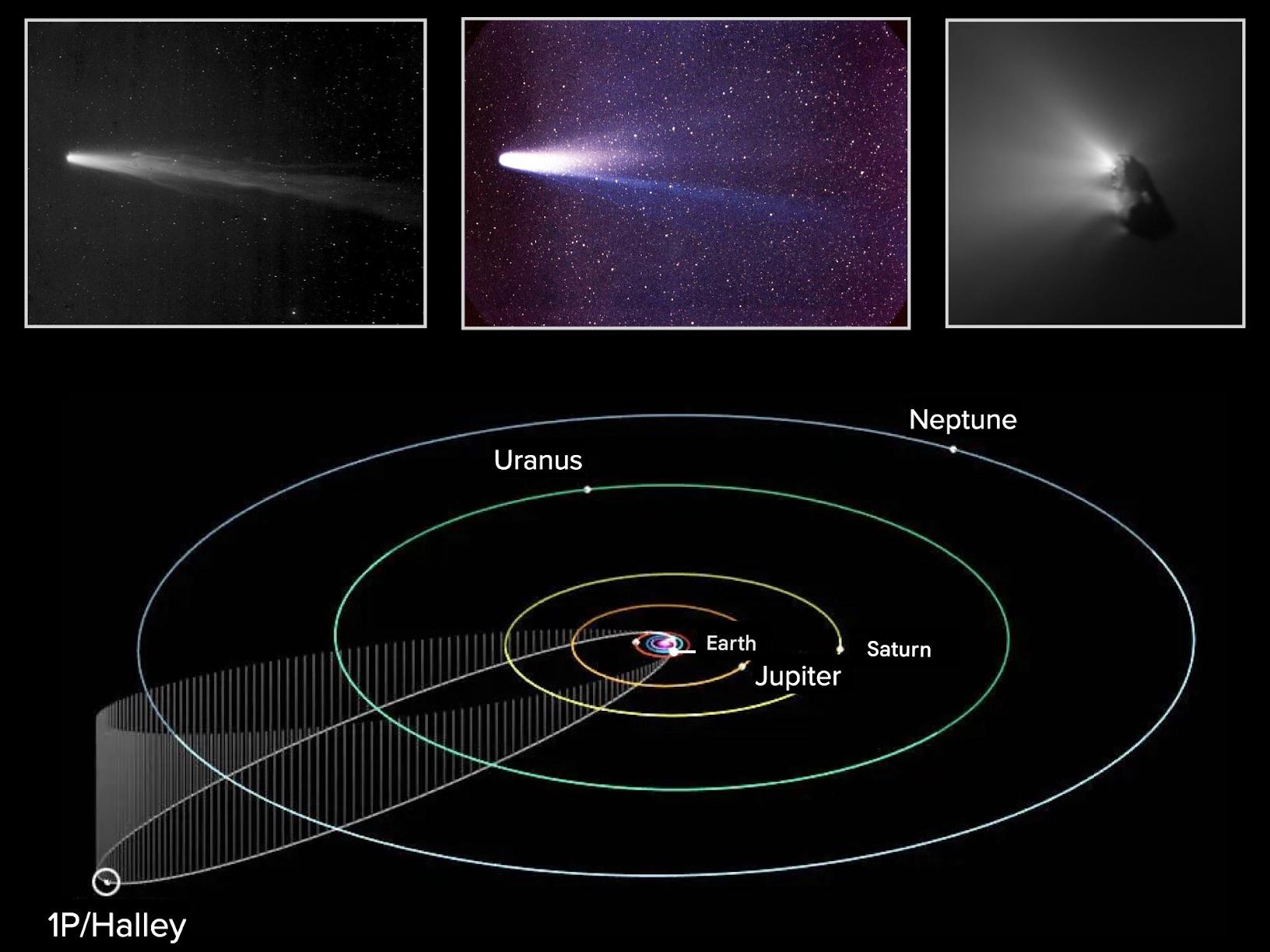
From time to time, the Earth encounters a cloud of dust on its path around the Sun, most frequently a comet. For example, the Perseids in August are from Comet Swift-Tuttle. The Orionids occur in October when the Earth encounters dust in its orbit left by the famous Halley’s Comet, which takes 76 years to complete its (very elliptical) orbit around our star. During the course of a year, our planet previously passes through dust sown by the same Halley’s Comet. The event takes place in May and results in the Eta Aquarids meteor shower .

Diagram of the orbital path of Halley’s Comet (position of celestial bodies in May 2019). There are very old traces of observations of this comet, but it is named after the British astronomer Edmond Halley (1656-1742), because he was the first to determine its orbit. Above, two photos of Halley’s Comet in 1910 (left) and 1986 (center) with ground-based telescopes, then its nucleus imaged by the European Giotto probe on March 14, 1986, from a distance of 2,000 km.
© Cité de l’espace after NASA (diagram), Harvard College Observatory (Halley in 1910), NASA/W. Liller (Halley in 1986), and ESA/MPS (Giotto probe).

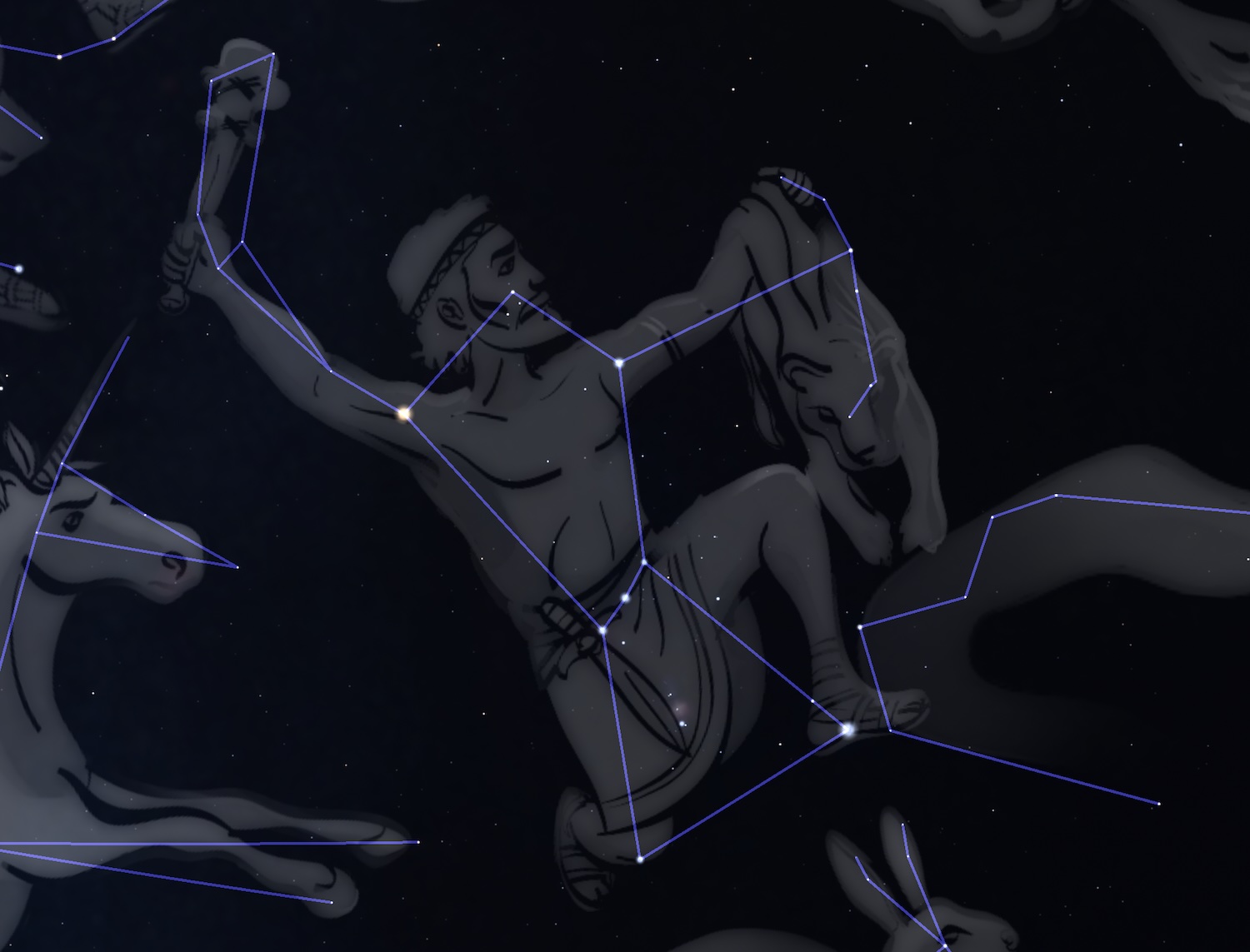
The constellation Orion represents a mythical hunter, but it is its bow tie shape that makes it easy to spot.
© Cité de l’espace/Stellarium

THE ORIONIDS OF OCTOBER 2025

The  Orionids  are so named because their radiant is located in Orion . The radiant is the point in the sky from which the meteors appear to come due to perspective. This can be compared to driving in a snow shower: even though the snowflakes are falling toward the ground, they appear to be shooting toward the windshield.


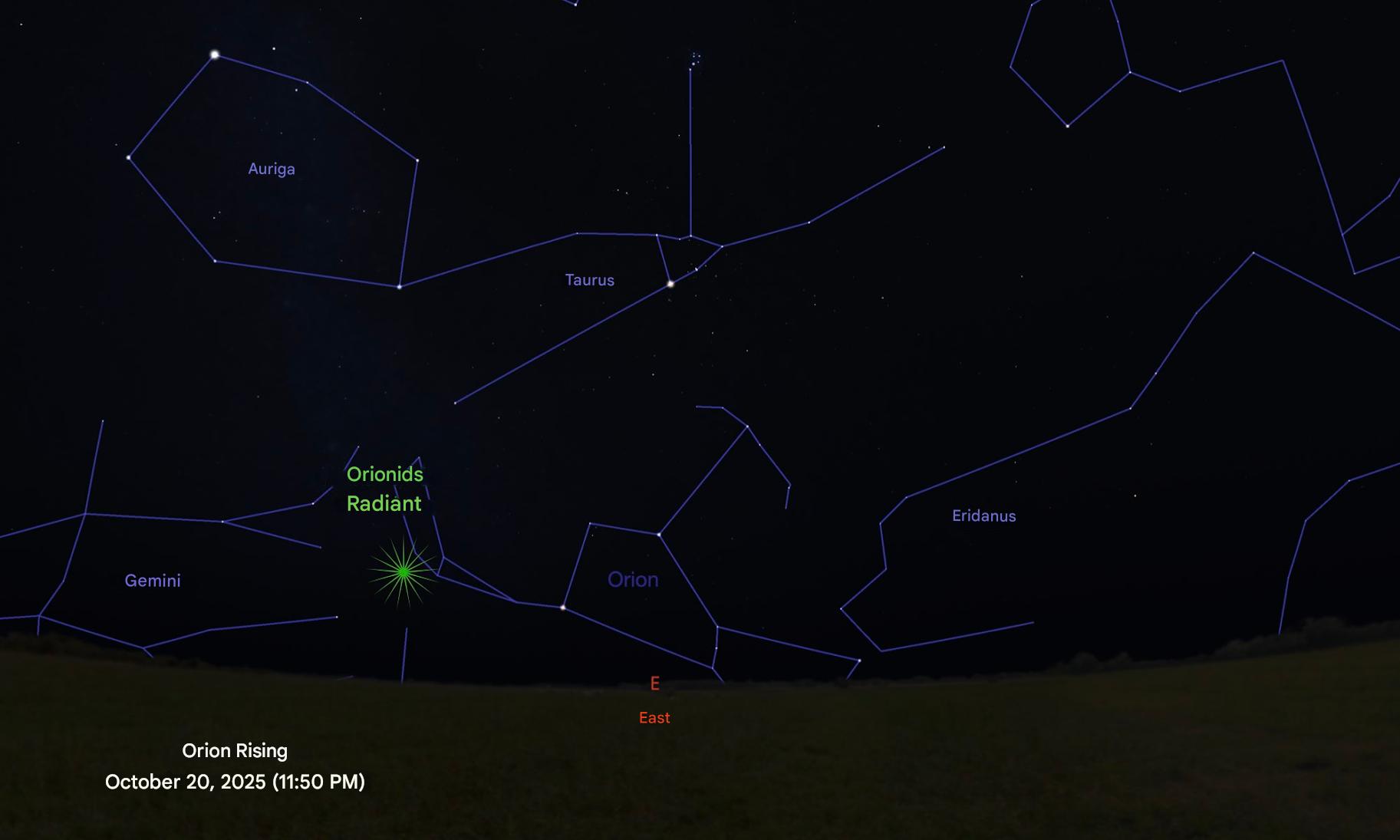
The constellation of Orion , which announces the winter skies (in October it rises in the East around midnight), represented a hunter for Ancient Greece , but we mainly recognize it because of its shape, which evokes a giant bow tie!

The Orionids are undoubtedly the most promising meteor shower of October . However, we should not expect a spectacle comparable to the more famous Perseids of August. To be clear, the Perseids display a zenith hourly rate of 100, which means an average of 100 “shooting stars” per hour. Be careful, this index is understood for a sky perfectly devoid of night pollution and if the radiant was ideally at the zenith. In practice, we see fewer (or much fewer) meteors! By comparison, the  zenith hourly rate of the Orionids is estimated between 20 and 30  (generally noted 20+), or one meteor every 3 minutes under a perfectly dark sky and if the radiant was at the zenith. You understand that you will not see as many.

In October, Orion rises in the East around midnight. Here, Orion emerges from the East at 11:50 p.m. on October 20 (for Toulouse).
© Cité de l’espace/Stellarium

THE NEW MOON WILL HELP US

However, in 2025, the classic Perseids were disappointing, as the peak occurred a few days after the Full Moon, which hampered observations with its brightness. On the other hand, our natural satellite will not be a spoilsport for the Orionids since their peak occurs this year at the time of the New Moon .
The Orionids have a reputation for producing fast and bright “shooting stars,” which sometimes leave a persistent trail for a few seconds.

The Orionids are considered active from October 2 to November 7, but as with all meteor showers, it is the period of peak activity that is the most interesting to observe.

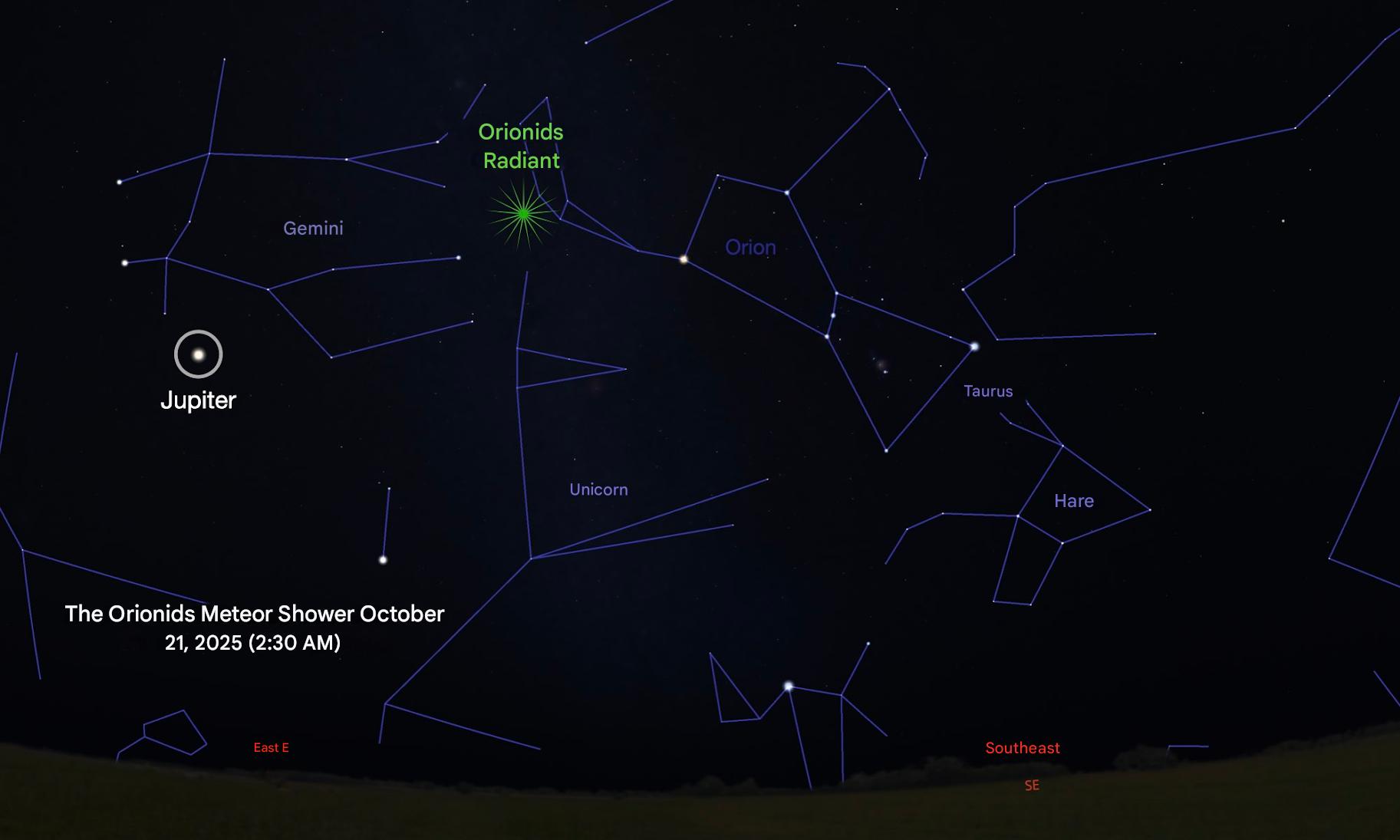
According to sources, the timing of this peak activity varies. The favorable period would thus begin on October 21 at 4:30 a.m. Our map is at 2:30 a.m., because it is prudent to start observing a little earlier.  Others are counting on a peak in the following night (that of the 21st to the 22nd), or even from the 22nd to the 23rd . The Moon will not interfere in all cases. We will therefore try our luck from the night of the 20th to the 21st, or even a little earlier depending on our motivation.

The Orionids radiant is located in the constellation Orion, which emerges from the eastern horizon around midnight in October. The map remains similar for the following nights of the 21st to the 22nd or the 22nd to the 23rd.
On the Gemini side, note the presence of Jupiter.

© Cité de l’espace/Stellarium

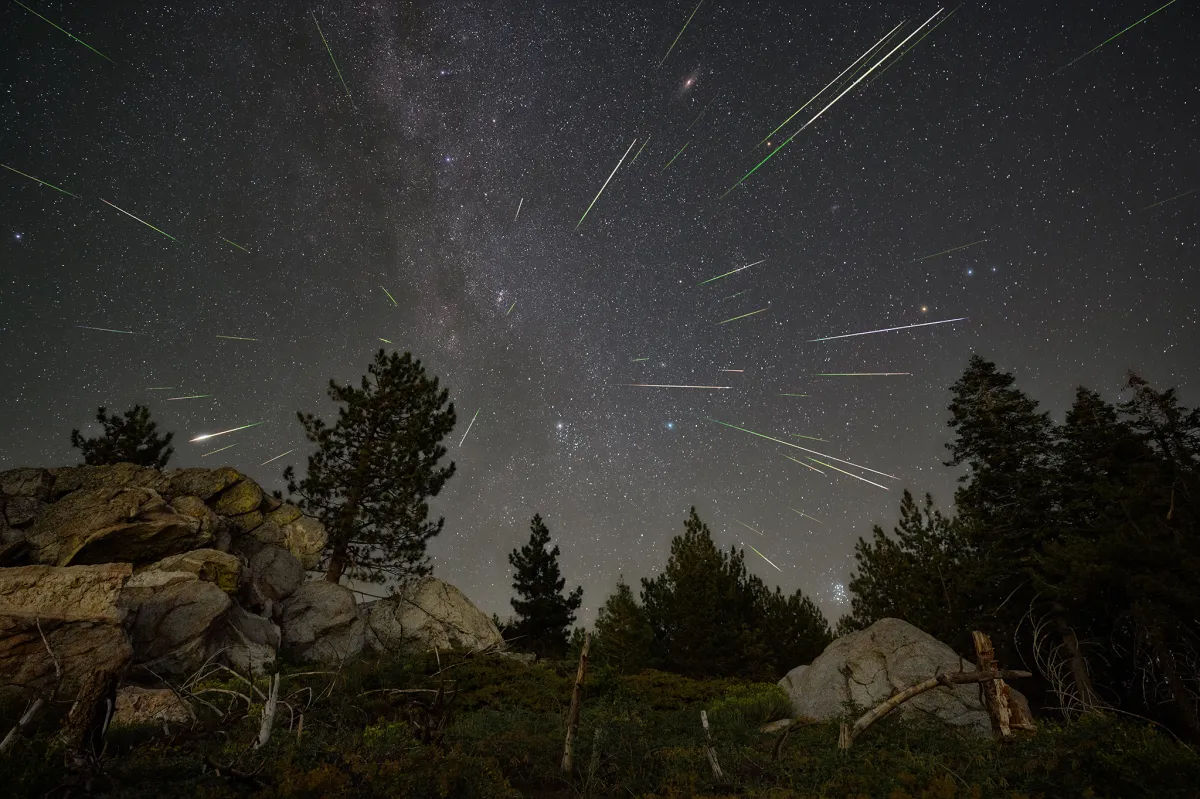
This long-exposure photo highlights the Perseid radiant. Obviously, you don’t see that many meteors at once: the several-hour photo pause here recorded several.
However, you don’t need to look only at the radiant to enjoy a meteor shower.
© NASA/Preston Dyches

SOME OBSERVATION TIPS

To try to capture the Orionids, like other meteor showers, don’t necessarily try to focus on the radiant (the point from which they seem to come by perspective effect), but take in the sky far from any light pollution. Indeed, you must first move away from urban centers whose lighting constitutes a source of light pollution . This pollution degrades the quality of the sky and we then miss some of the shooting stars.  Also be careful not to create light pollution yourself!  If you are outside on a terrace or balcony, for example, turn off all exterior lights, but also any interior lights which will be disturbing if the shutters are not closed. Avoid looking at your smartphone, because the light from its screen will dazzle you and your pupils will contract. Remember that it takes about 15 minutes for vision to adapt to night conditions (maximum pupil opening).

THE BEST INSTRUMENT?

YOUR EYES!

On the equipment side, your eyes are  the ideal instrument . No need for binoculars or telescopes, their field of view is too narrow.  The ideal is to gaze at the celestial vault… and wait! Yes, patience is an essential quality. A meteor shower can be disappointing if, for example, the peak does not occur at the expected time or if the number of meteors turns out to be lower than expected.
To avoid hurting your neck by turning towards the zenith, the best is to make yourself comfortable by lying on the ground (bring a blanket) or on a deck chair. Finally, in October, the nights can be cool, so dress accordingly.

Related articles