
• Earth

Earth’s magnetic field weakens over the South Atlantic

Published on 16 October 2025

European SWARM satellites confirm that the Earth's magnetic field is unevenly distributed and evolving. Over the past eleven years, it has strengthened in Siberia and weakened in the South Atlantic. Monitoring it helps protect our satellites.

Earth’s magnetic field weakens over the South Atlantic

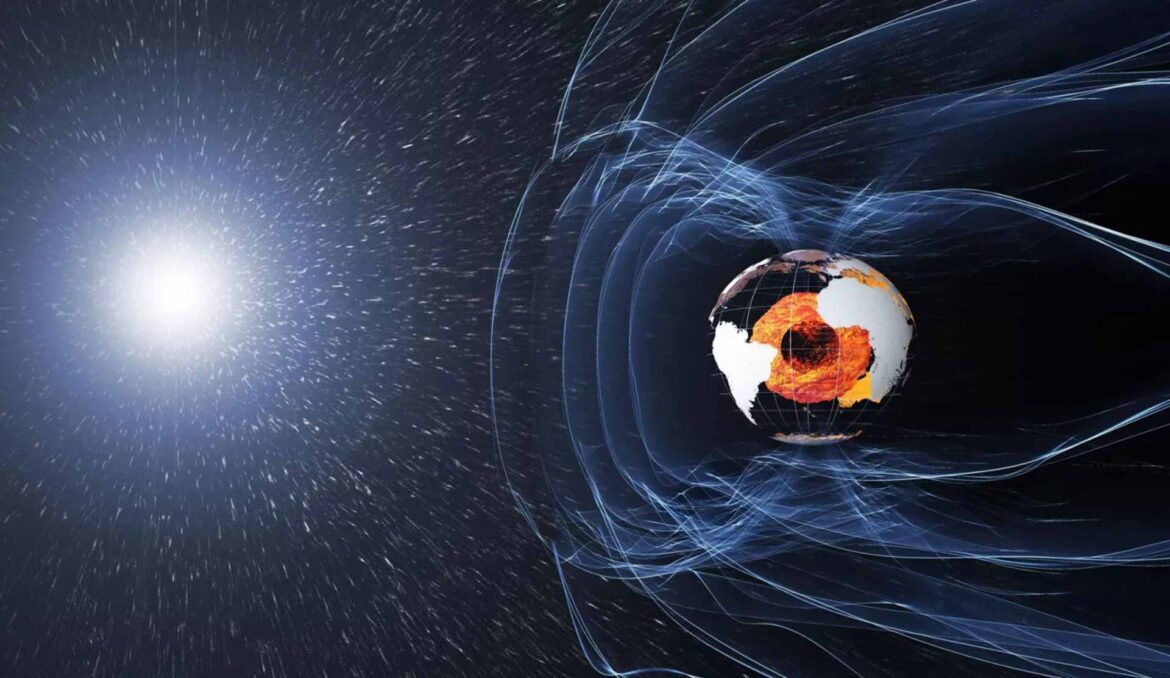
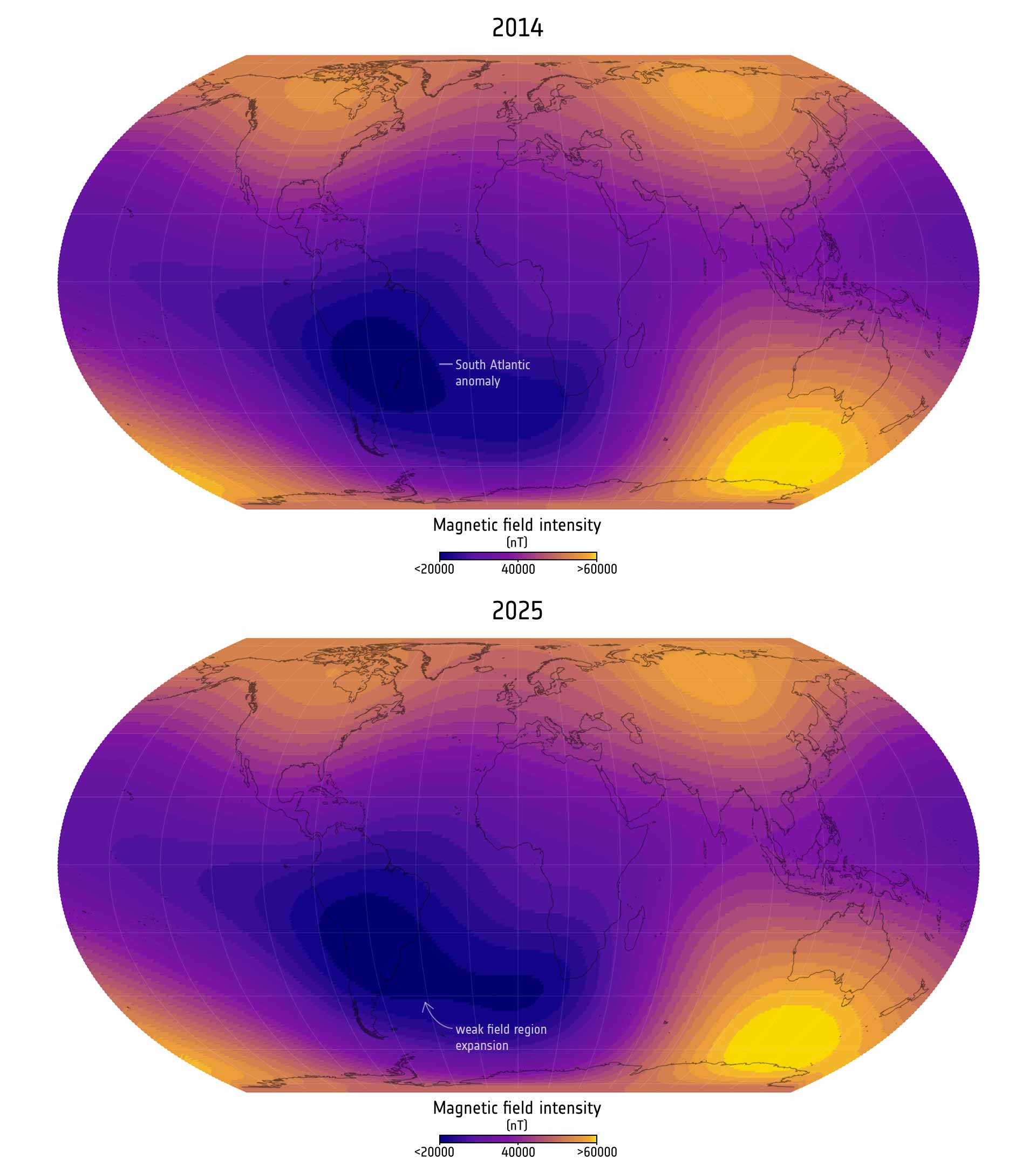
It protects us, it is essential to life, but it is unevenly distributed. The magnetic field acts as a shield and protects us from cosmic radiation and dangerous particles coming from the Sun. But we have known since the 19th century that it is not uniform . Thanks to the European SWARM mission, scientists have compiled eleven years of observational data. They confirm the expansion of a weak zone in the magnetic field called the South Atlantic Anomaly . We knew that this region is the one where our protection is the least effective. But what this study reveals is that this zone has expanded considerably since 2014. 

Evolution of the Earth’s magnetic field between 2014 and 2025 according to SWARM data.

© ESA

A more or less vulnerable shield

A zone of weakness over the South Atlantic

The magnetic field is primarily generated by the Earth’s core. A continuously moving ocean of molten liquid iron forms the outer core, located about 3,000 km below our feet. This movement creates electrical currents, which in turn generate our electromagnetic field. The South Atlantic Anomaly represents the point where this shield is thinnest. Data collected by the European Space Agency’s SWARM satellites show that this area expanded between 2014 and 2025. An expansion equivalent to half the size of continental Europe.

An expansion that is accelerating in places

But here, too, the situation is not uniform. A specific region of the Atlantic Ocean, located southwest of Africa, has seen an even more rapid weakening of the magnetic field since 2020. This behavior is linked to strange patterns observed at the boundary between the Earth ‘s liquid core and the rocky mantle. Normally, in the southern hemisphere, scientists expect to see magnetic field lines exiting the core. But beneath the South Atlantic Anomaly, we are seeing unexpected areas where the field, instead of exiting, enters the core .

Earth’s magnetism in perpetual motion

The field strengthens in Siberia as the North Pole moves

It is important to remember that the Earth’s magnetic field does not behave like a simple magnet. Studies of different sources of magnetism show that it is dynamic. As the South Atlantic Anomaly expands, changes are also observed in areas where the field is particularly strong. Since the Swarm constellation entered orbit in 2013, the three European satellites have observed that the magnetic field has strengthened over Siberia . This strong area has expanded by an area comparable to that of Greenland. At the same time, the strong field region over Canada has weakened and shrunk by an area almost equivalent to that of India. This imbalance is linked to complex processes taking place in the Earth ‘s turbulent core . It is also associated with the movement of the magnetic north pole (which must be distinguished from the geographic north pole) from Canada towards Siberia over several decades.

Evolution of the location of the Earth’s geomagnetic pole.

© ESA

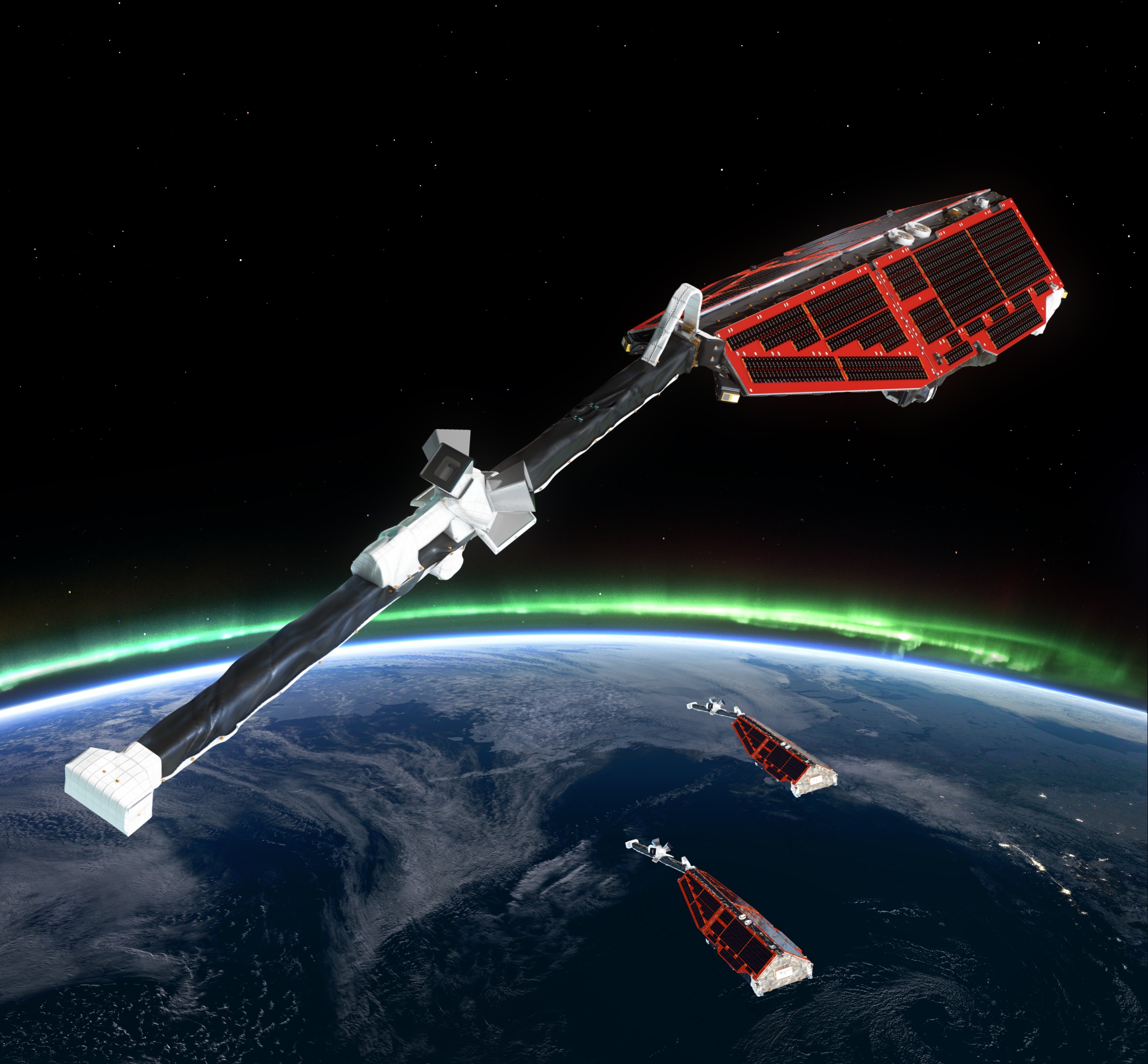
ESA’s SWARM satellites were launched into polar orbit in 2013. Alpha and Charlie orbit at an altitude of 460 km, while Bravo orbits at 530 km.

© ESA

Why should we monitor the evolution of magnetism?

Impacts on navigation and satellites.

The shifting of the North Pole has consequences for navigation. If the magnetic pole shifts, the compass direction is inevitably disrupted . But beyond that, satellites could also be affected. Satellites in low orbit and crossing regions of magnetic field vulnerability risk being exposed to higher doses of radiation. These energetic particles, normally deflected by the Earth’s magnetic shield, can then bombard electronic systems . This risk is even greater during this period when the Sun is particularly active . In concrete terms, this increased exposure to radiation can lead to malfunctions or damage to essential satellite equipment .

Related articles