• Moon

Artemis II: Final preparations for manned flight around the Moon

Published on 25 September 2025

Artemis II, the first manned lunar mission since the Apollo era, is scheduled to launch between February 5 and April 26. It is a crucial 10-day test for the Orion spacecraft, dubbed “Integrity,” and the SLS launch vehicle.

Artemis II: Final preparations for manned flight around the Moon

Artemis II is getting closer. On September 23 and 24, NASA held two press conferences to present the mission’s progress , scientific objectives , and to meet the crew . The first manned flight in NASA’s return-to-the-Moon program is a crucial test mission following the success of Artemis I. Scheduled to last just over ten days, this flight around the Moon is to certify the SLS launch vehicle and the Orion spacecraft , called Integrity, for this mission. Then Artemis III will return astronauts to the lunar surface. The mission will test many critical systems and the craft’s manual capabilities , while carrying the crew further than any human has traveled since the Apollo era.

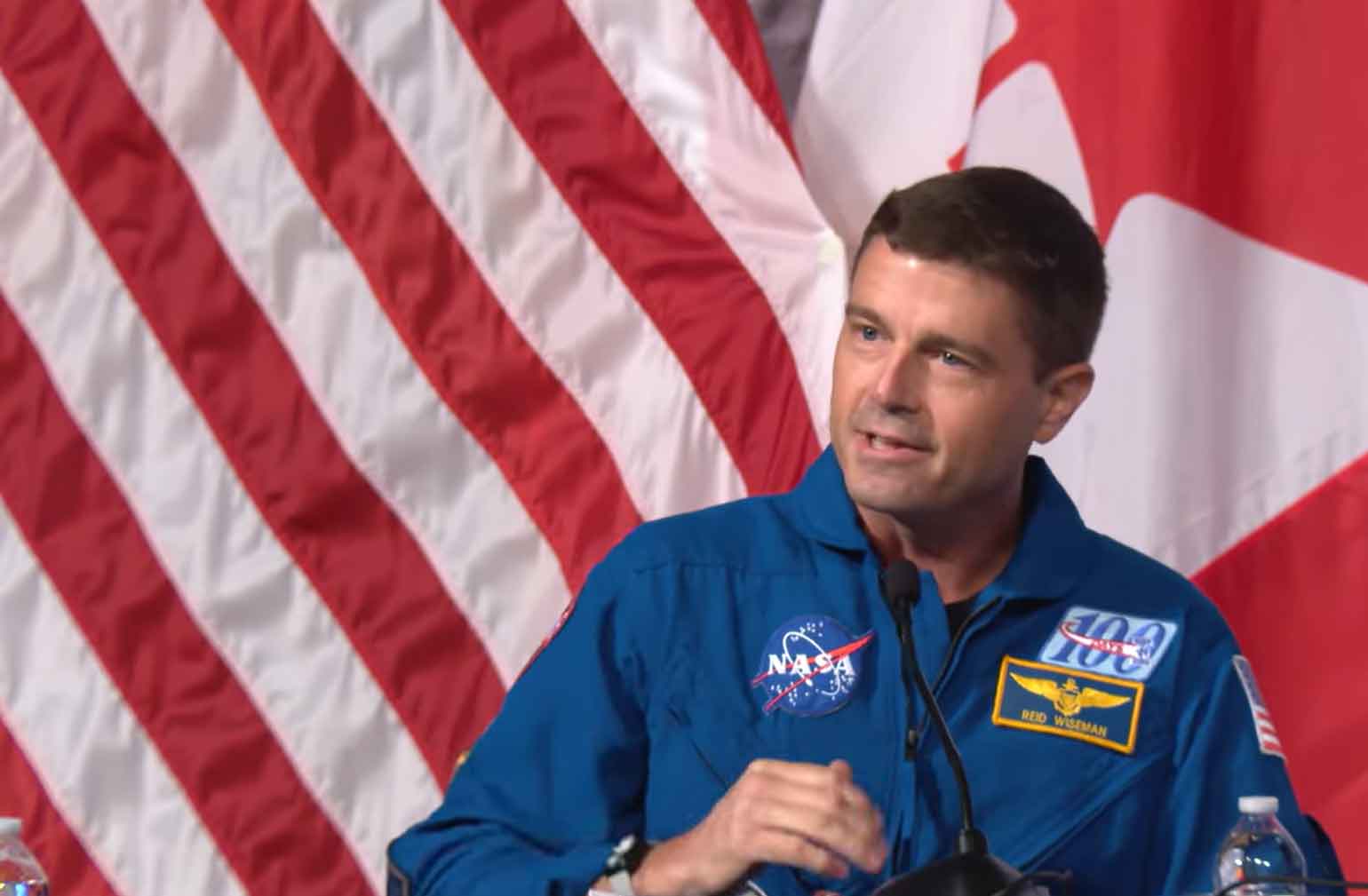
” We don’t need to talk. We know exactly what we’re all thinking, ” explained Mission Commander Reid Wiseman, emphasizing the crew’s cohesion.

© NASA

“We’re going to the Moon!”

From intensive preparation to the starting line

The Artemis II crew consists of Commander Reid Wiseman, Pilot Victor Glover, Mission Specialist Christina Koch, and Mission Specialist Jeremy Hansen of the Canadian Space Agency. After more than two and a half years of intensive work, Reid Wiseman summed up their overall feeling with these words: “Victor, Christina, Jeremy, we’re going to the Moon! It’s been an incredible two and a half year journey, and we’re starting to see the light at the end of the tunnel  .” This period has allowed for crucial cohesion among the crew members . ” We don’t need to talk. We know exactly what we’re all thinking, ” he summarized. This mutual trust is essential for managing the risks inherent in a test flight. Navigating a spacecraft the size of a minivan for more than ten days requires psychological adjustment. Christina Koch explained that they specifically train to work in the absence of privacy, including a short nap after a 37-hour day: ” We commit to success… but also to communicating to know when someone needs a little alone time .” This flight is different from those in low Earth orbit, such as to the ISS, in terms of risk management. She reiterated the definitive nature of the mission from the “point of no return .” ” Our TLI [Translunar Injection] maneuver, the maneuver that sends us to the Moon, is also our deorbit maneuver. What that means is that as soon as we do that maneuver, we are committed for the rest of the mission .”

You too, get your ticket around the Moon

NASA is offering to send your name on the Orion capsule alongside the Artemis II crew

Launch schedule

Integrity the Orion capsule of Artemis II

We were hoping for a more precise schedule from these two days of press conferences. At most, NASA officials defined a window that opens from February 5th until April 26th at the latest . But we have learned the name of the Orion capsule. It has been named Integrity . A name chosen by the crew and their replacements. This name was chosen taking into account the values ​​of the agencies involved in the mission, their own, and the mission’s objectives.

No rush

Artemis II is primarily a test mission to certify the capabilities of the SLS launch vehicle and the crewed Orion spacecraft . Launch vehicle assembly is advanced. Reid Wiseman confirmed that the SLS is ” virtually stacked and ready to go .” The Orion spacecraft’s core stage, boosters, and Launch Abort System (LAS) are being integrated or ready for mating . Reid Wiseman admitted that the crew is eagerly awaiting launch, but there is no pressure on dates. ” We’re going to launch when the vehicle is ready, when the team is ready . I won’t believe it until we’re off the launch pad .”

christina_koch_entrainement

On January 30, 2025, Kristina Koch exits the Orion capsule mockup for training.

© NASA

LuneXplorer: Experience what it’s like to be an astronaut on a mission to the Moon

At the Cité de l’Espace, the LuneXplorer experience allows you to experience and feel the acceleration of a takeoff and the deceleration of a moon landing.

The SLS launch sequence through to separation from the Orion capsule.

© NASA

The Artemis II Flight Plan

Launch Sequence

After liftoff from pad 39B at the Kennedy Space Center, Max Q (the moment when the launch vehicle is under the greatest pressure) is reached after 1’11”. After a little over 2 minutes of flight, the boosters and the SRB boosters separate. The Launch Abort System (LAS) separates. Then, after 8’15”, the upper stage (ICPS) separates and the central body begins its descent towards the Pacific Ocean. A major objective at the beginning of the mission (3 hours and 24 minutes after launch) will be the Proximity Operations Demonstration (Prox Ops Demo). The crew will use manual controls to approach and then move away from the last stage (ICPS) of the SLS launch vehicle. The Orion capsule will approach to a minimum distance of ten meters. This maneuver aims to validate Orion’s flight qualities for future docking missions with the lunar lander or the Gateway station .

The first day will be devoted to checking critical systems. Victor Glover, the mission pilot, emphasized the importance of these checks, particularly the life support systems: ” We’re going to check the critical systems. The water system. And the toilets. Very important. You need a toilet to go to the Moon .”

The Artemis II mission flight plan from takeoff to splashdown.

© NASA

The journey to the Moon

The Artemis II flight is designed as a free-return trajectory. This means that the combined gravity of Earth and the Moon will ensure that the spacecraft returns to Earth after flying by the Moon, reducing the need for trajectory corrections by propulsion. This type of trajectory was used on the Apollo 8 and Apollo 16 missions . At the perigee of its orbit around Earth, the Orion spacecraft will ignite its engines for the Trans-Lunar Injection, the so-called point of no return. They will reach the Moon in about 4 days and make their closest flyby at an altitude of 10,427 km. The flyby of the Moon, the furthest point from Earth, up to about 400,000 km is planned for the sixth day . Although this is primarily a test flight, the crew will conduct scientific observations. Christina Koch said they will spend three full hours observing the lunar surface during their closest approach. ” Human eyes are one of the best scientific instruments we have, ” she said. It is possible that the crew will observe up to 60% of the far side of the Moon, which was not illuminated during the Apollo missions. On return, just before reentry, the capsule will separate from the European Service Module. Splashdown is planned in the Pacific Ocean off the coast of California.

The Artemis II mission summarized in video.

© NASA

Related articles