




• Earth
  • Solar System

2m-wide asteroid brushes past Earth

Published on 08 October 2025

Asteroid 2025 TF, the size of a sofa, brushed past Earth at an altitude of 428 km on October 1. It was only discovered after this flyby. This event, which poses no risk to our planet, underscores the priority given to planetary defense against dangerous near-Earth objects.

2m-wide asteroid brushes past Earth

It came very, very close. But there was no need to be alarmed; there was little risk. On October 1, 2025 TF, an asteroid about 2 meters in size flew past Earth at an altitude similar to that of the International Space Station . This event highlights the importance of planetary defense and the need to continue improving detection tools for all near-Earth objects , including those that are harder to spot. Astronomers are particularly interested in asteroid populations in close orbit around the Sun, which could represent a potential threat.

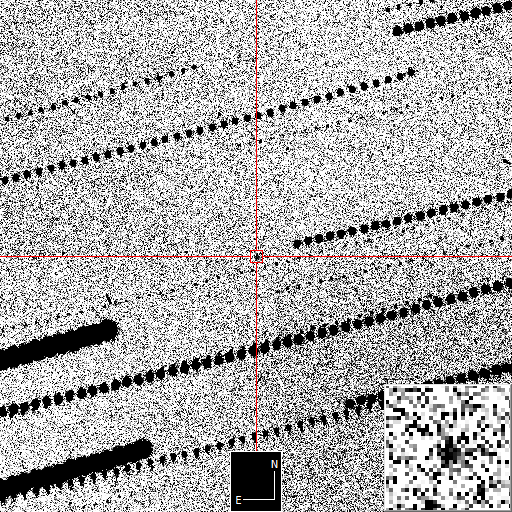
Asteroid 2025 TF as seen by the Las Cumbres Observatory in Australia.

© ESA / Las Cumbres Observatory

Asteroid 2025 TF, a surprise guest

A flyby at ISS altitude

Asteroid 2025 TF made its closest approach to Earth on October 1, 2025, at 00:47:26 UTC (2:47 a.m. Paris time). Its closest approach was precisely measured at 428 ± 7 km from the Earth’s surface. This distance is comparable to the altitude of the International Space Station , which typically orbits at an altitude of 370 to 460 km. The object was identified as small, with an estimated diameter of 1 to 3 meters, about the size of a sofa .

Late detection

Asteroid 2025 TF was spotted by the Catalina Sky Survey a few hours after its closest approach. Shortly after its discovery, astronomers from the European Space Agency’s Planetary Defense Office observed it using the telescope at the Las Cumbres Observatory in Siding Spring, Australia. An object of this size does not pose a significant hazard to Earth . If asteroid 2025 TF had struck Earth’s atmosphere, it would have produced a bolide , a very bright meteor . At best, it might have resulted in the discovery of small meteorite fragments on the ground.

The challenge of planetary defense

Spotting asteroids near the Sun


The 2025 TF passage, while harmless, highlights the ongoing work of monitoring programs . Telescope networks are generally optimized to detect larger, more threatening objects . So-called “potentially hazardous” asteroids are those larger than 140 meters in diameter that approach within 7.5 million kilometers of Earth. One category of objects that is particularly difficult to observe are asteroids that orbit closer to the Sun than Earth. From our planet, they appear in the sky only at dusk or are obscured by daylight. A group of astronomers recently drew attention to rocky bodies that share Venus’s orbit. Venus is 108 million kilometers from the Sun, while Earth is 150 million kilometers. Currently, 20 asteroids are known to be in “1:1 resonance” with Venus . This means they take the same amount of time as Venus to complete one orbit around the Sun. These Venus-coorbiting asteroids have elliptical orbits. Simulations indicate that the gravity of other planets can subtly alter their trajectories over time (about 12,000 years). It’s possible they could evolve into much more elliptical orbits, bringing them close enough to Earth to pose an impact risk.

2025 TF passed within 428 km of Earth over Antarctica.

© ESA account

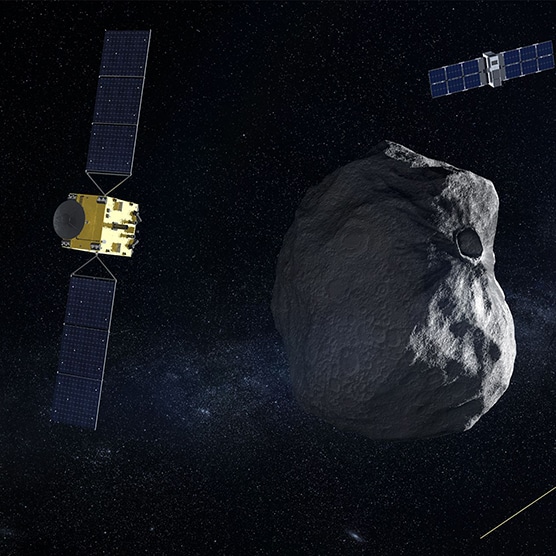
The HERA mission, which left in October 2024, is due to arrive near Dimorphos in December 2026.

© ESA

Future space missions

To better identify these objects that are difficult to see from Earth, NASA is developing a dedicated space mission: the Near-Earth Object Surveyor (NEO Surveyor) . This telescope will be placed at the L1 point, a stable gravitational point located about 1.5 million kilometers closer to the Sun than our planet. This position will allow it to observe asteroids by looking outward from the Solar System , away from the Sun’s light . The goal is to catalog many asteroids that are difficult to detect from Earth. NASA’s DART mission proved in November 2021 that it was possible to modify the orbit of an asteroid by dropping a space probe onto its surface. The European HERA probe is on its way to the asteroid Dimorphos hit by DART . The ESA mission is expected to arrive in December 2026 to analyze the consequences of the American mission and ensure that it would be reproducible against a near-Earth asteroid that would threaten Earth.

Related articles
