• Astronomy

The sky of October 2025

Published on 03 October 2025

The autumn sky of October 2025 will be an opportunity for the Moon to cross paths with Jupiter, Saturn, Venus, and the Pleiades. At the end of the month, we'll be on the lookout for the Orionid meteor shower.

The sky of October 2025

With the autumn equinox (for the northern hemisphere) having passed, night takes over from day. Amateur astronomers or those simply curious about the sky thus benefit from a dark sky that lasts longer .   On October 1st, the Sun sets at 7:35 p.m. (for Toulouse) while on the 20th it will pass behind the horizon at 7:03 p.m., 32 minutes earlier! The night will continue to gain time on the day until the solstice on December 21st .

Our maps and timetables are calculated for Toulouse in standard time for metropolitan France. The vast majority of these times remain valid for the entire metropolitan area.

Switch to Winter Time
Please note that during the night of Saturday, October 25th to Sunday, October 26th, France officially switches to winter time. At 3 a.m. on Sunday, it will be 2 a.m.
Note that this so-called winter time, sometimes criticized for the night coming too early, is actually closer to the path of the Sun!

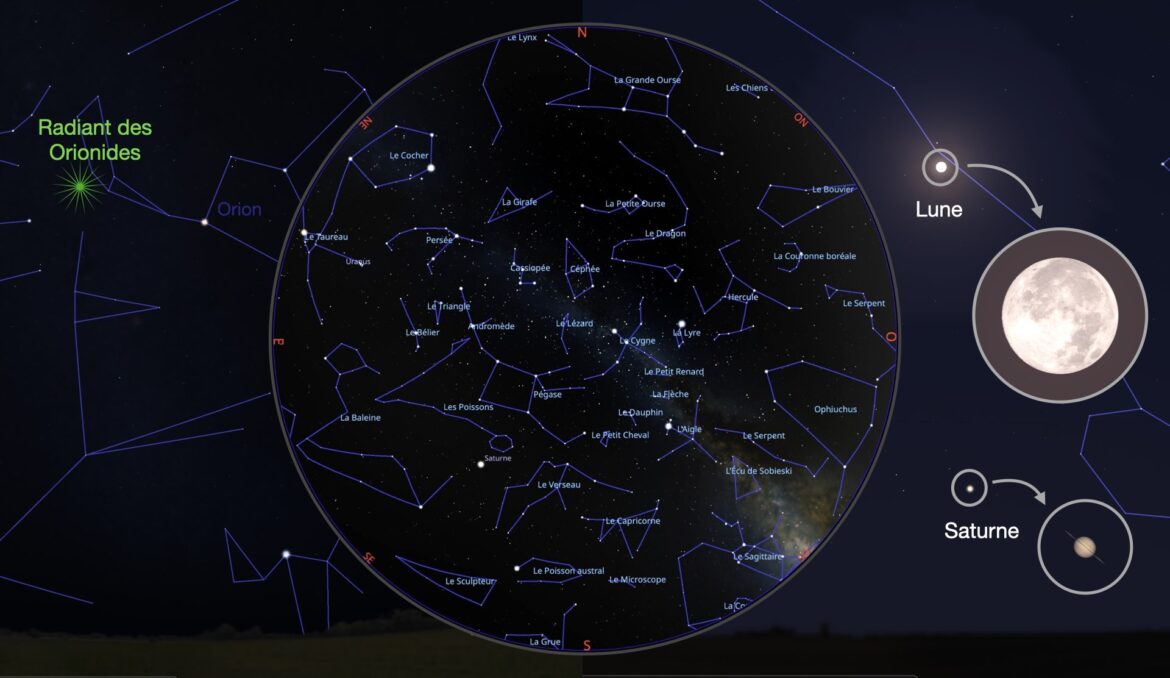
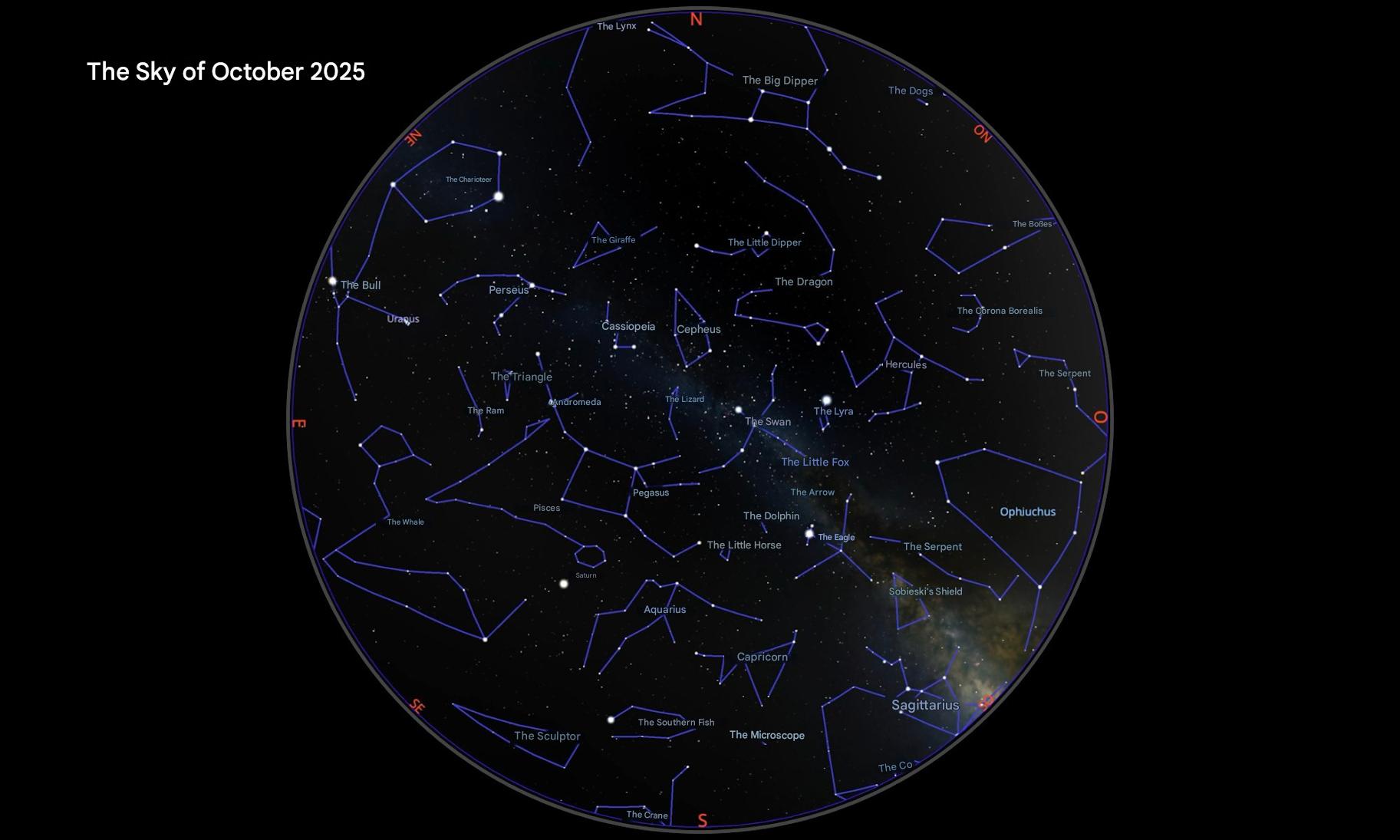
This map shows the sky for Toulouse on October 15 at 10:00 p.m. (legal time, therefore the time on your watch).
It is valid for the most part for the month of October across metropolitan France , except for the position of the Moon (which is already set for this date and time).
© Cité de l’espace/Stellarium

THE MOON AND SATURN

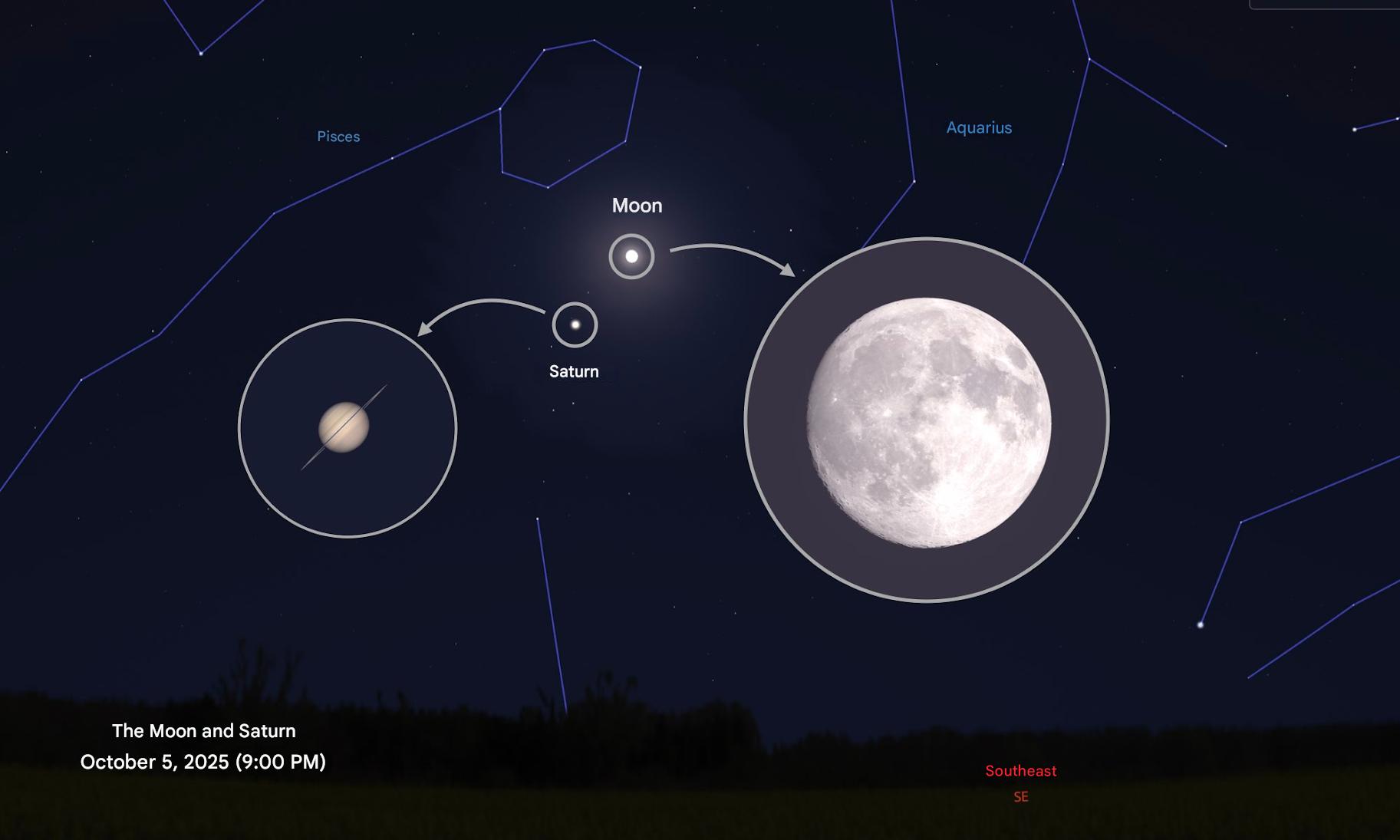
We begin October with a classic encounter between our natural satellite and the planets. On October 5, the Moon will allow us to easily spot Saturn.  Its characteristic yellowish glow of magnitude 1 will easily impose itself in this area of ​​the sky. At this time, Saturn’s rings are rather discreet, with the Earth being almost in their plane.

In Toulouse, the almost full Moon (97.5% illumination) rises at 6:39 p.m., followed by Saturn at 7:00 p.m. However, we recommend waiting for both stars to rise above the horizon to better enjoy the spectacle. At 9 p.m., Saturn will be at an altitude of 20° . During the night, the duo will climb even higher, peaking at just over 40° (just before 1 a.m.).

On October 5 at 9:00 p.m., a Moon-Saturn pair awaits you about twenty degrees above the horizon, a little to the left of the southeast.
© Cité de l’espace/Stellarium

THE SMALL METEOR SHOWERS OF OCTOBER

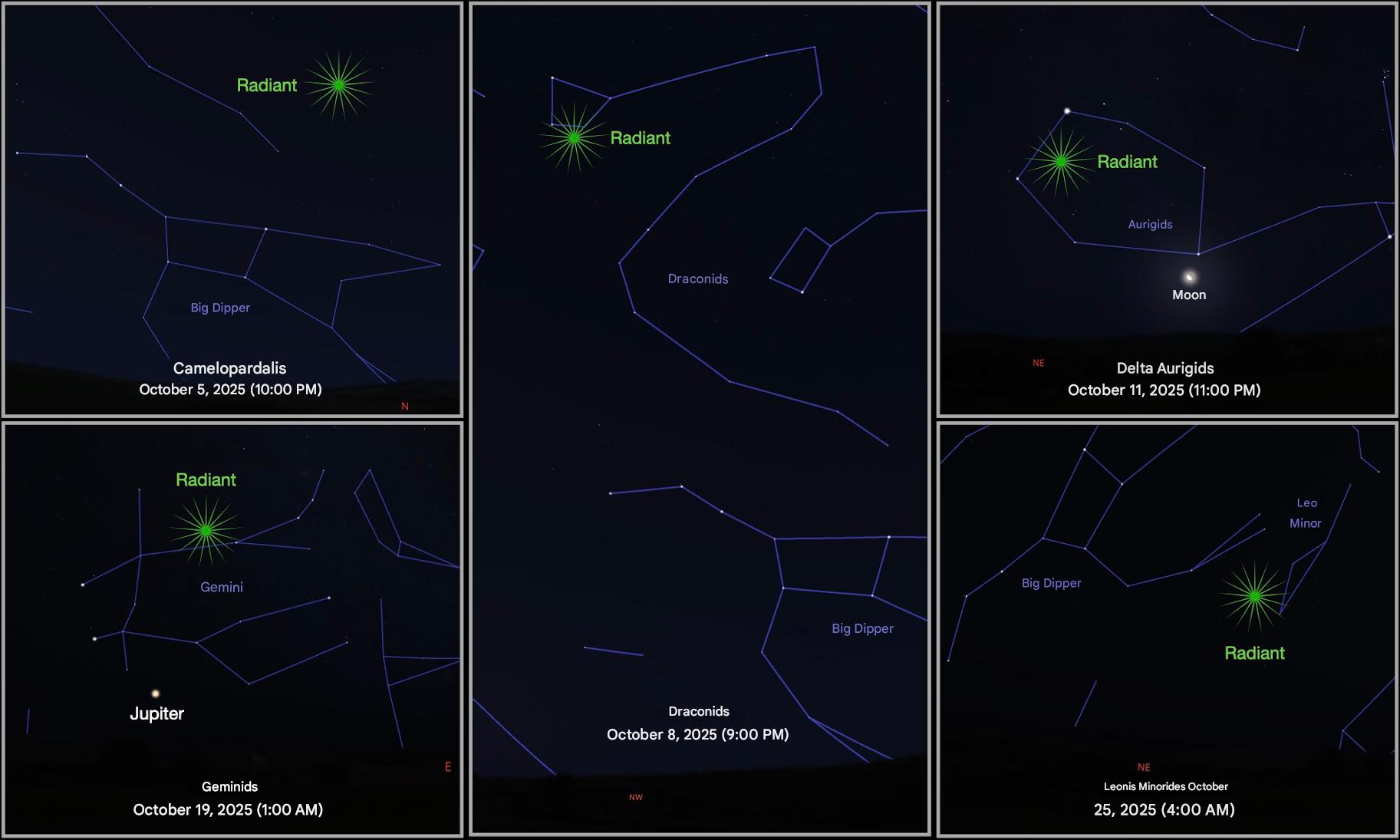
Here we group together five very modest meteor showers from October . Their Zenithal Hourly Rate (ZHR) ranges from 2 to 5, which means that under a sky perfectly free of night pollution and if the radiant were at the zenith (two very ideal conditions) we would observe from 2 to 5 “shooting stars” per hour . In practice, we see fewer.
Remember that these “shooting stars” are in fact dust particles that leave a fleeting bright trace as they burn up upon re-entering our atmosphere. These dust particles are most generally sown by a comet.

The October Camelopardalids peak is expected on October 5th with a radiant (the point from which the meteors appear to come by perspective effect) in the constellation of Giraffe. Conditions are very unfavorable , because, in addition to a modest extreme ZHR of 5, a nearly full Moon will hamper observations with its light.

The Draconids of October 8 (radiant in Dragon, high in the sky) offer little more in the way of meteors, although some years there are (unpredictable) surprises. Unfortunately, here too, the brightness of the nearly full Moon will blot out most of the visible meteors.

Even more discreet with a ZHR of 2, the Delta Aurigids of October 11 will be diminished by a three-quarter illuminated Moon, enough to largely thwart any desire for observation.

The October Geminids (or epsilon-Geminids, not to be confused with the December Geminids) remain in the very discreet category with 3 meteors per hour. On the other hand, the Moon will not interfere. The peak is expected on the night of October 18 to 19 .

Finally, the Leonis Minoris have a peak expected on October 25th around 4 a.m. , so we favor the night of the 24th to the 25th. A Moon at around 10% will not be a problem, but the ZHR of 2 is anemic.

October especially offers us a more interesting shower with the Orionids on October 21 (see below).

Position of the radiants of the five very modest meteor showers of October.
© Cité de l’espace/Stellarium

THE FIRST SUPERMOON OF THE YEAR

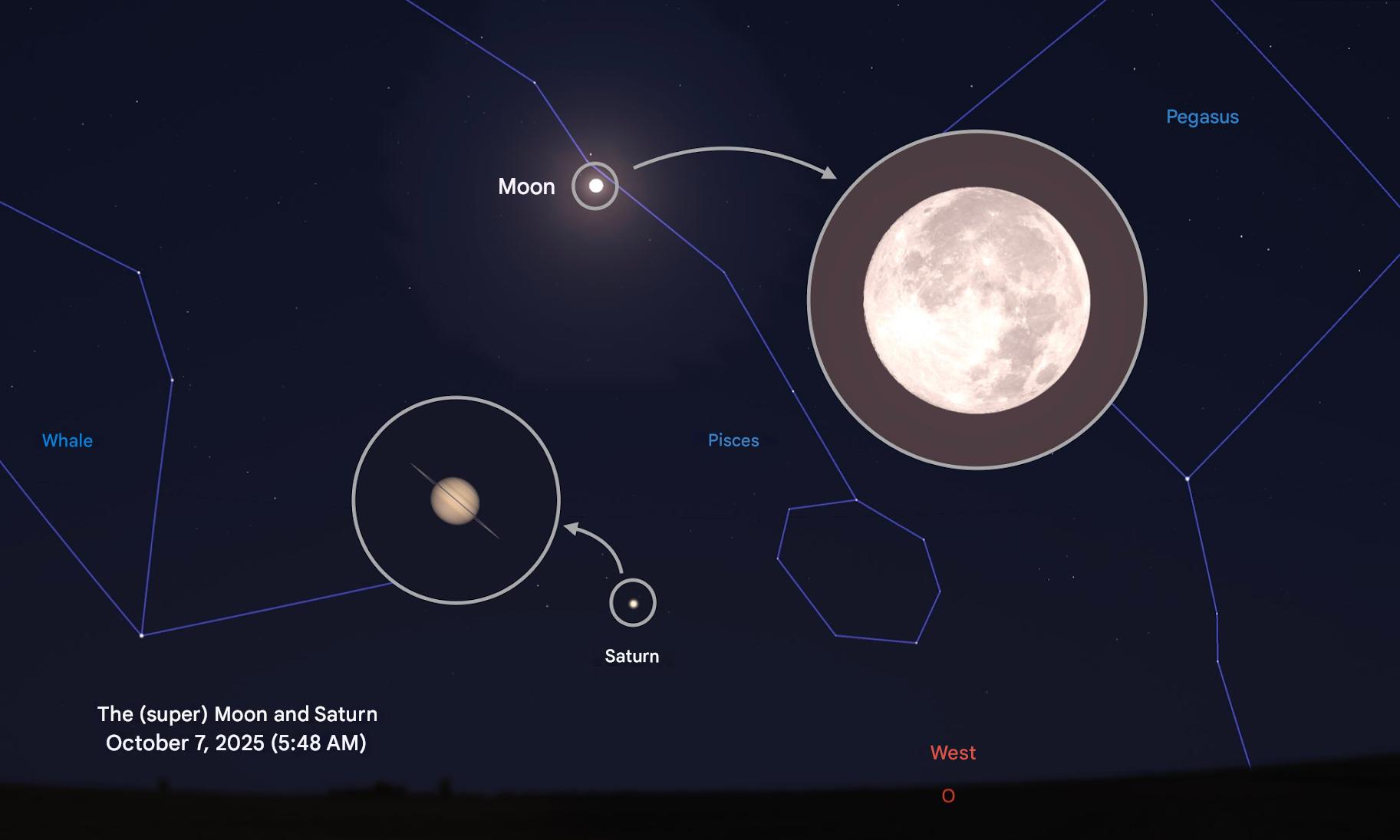
The highly publicized Super Moon is finally back in 2025! This October Full Moon, also known as the Harvest Moon in North America, occurs when our natural satellite is quite close to us in its orbit. As we have already explained, a Super Moon is nothing truly Super or exceptional . The late American scientist Fred Espenak established a scale based on the Earth-Moon distance ranging from 0 to 1 (0, the Moon is furthest away and 1, it is closest). A Full Moon is rated Super from 0.9 to 1. The one on October 7, which occurs at 5:48 a.m., is characterized by a score of 0.964 (the Moon will be 361,458 km from Earth).

Two more “Super Moons” are expected before the end of the year, on November 5 and December 4.

At the exact moment of the Full Moon, our celestial neighbor will be in the West at an altitude of 24°, with Saturn well below (at an altitude of only 7°).
© Cité de l’espace/Stellarium

THE MOON AND THE PLEIADES

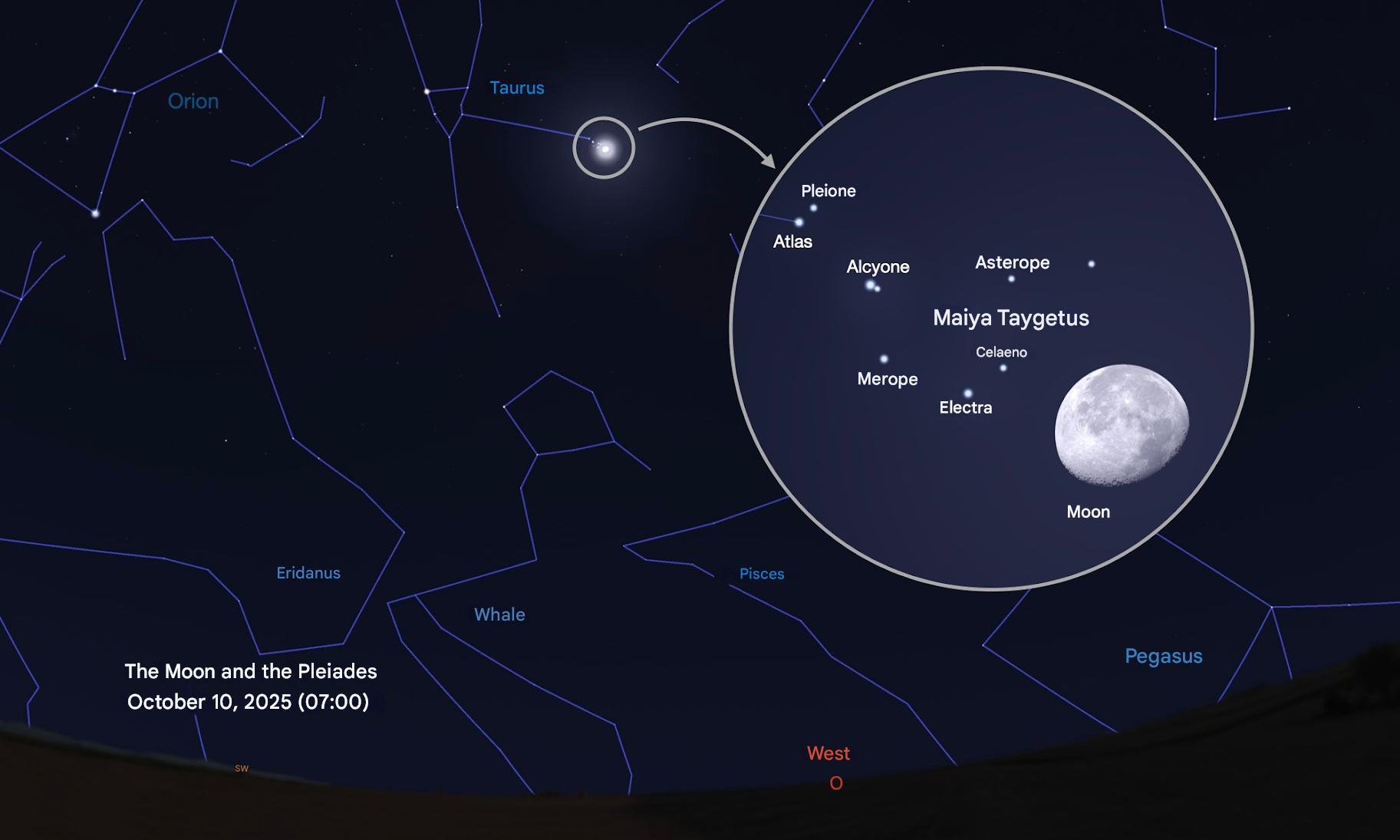
On October 10 at 7 a.m., the Moon brushes past the Pleiades . An event reminiscent of the one that took place on the night of September 13 to 14. Indeed, our celestial neighbor occasionally crosses paths with this group of stars that immortalizes in the constellation of Taurus the famous seven sisters of Greek mythology  : Alcyone, Asterope, Maia, Taygete, Celaeno, Merope, and Electra. Their father and mother seem to be watching them from nearby thanks to two stars named Atlas and Pleione. We now know that this is an open cluster of 3,000 young stars (only about ten are visible to the naked eye under good conditions) located about 440 light-years away from us. The delicate nebulae that surround them were considered remnants of their formation mechanism, but it is now thought that we are observing an interstellar cloud that they pass through while dispersing.

The Pleiades already offer a beautiful object to scrutinize with the naked eye , especially since it resembles a miniature Big or Little Dipper (the size in the sky is equivalent to 2 times the full Moon). Under a good night sky, we can easily see 5. Capturing the 7 or 9 main ones requires skies clear of any light pollution and/or the use of binoculars.

The Moon will meet again with the seven sisters of the Pleiades on the morning of October 10, 1 hour before sunrise.
© Cité de l’espace/Stellarium

THE MOON AND JUPITER

VENUS AS A BONUS

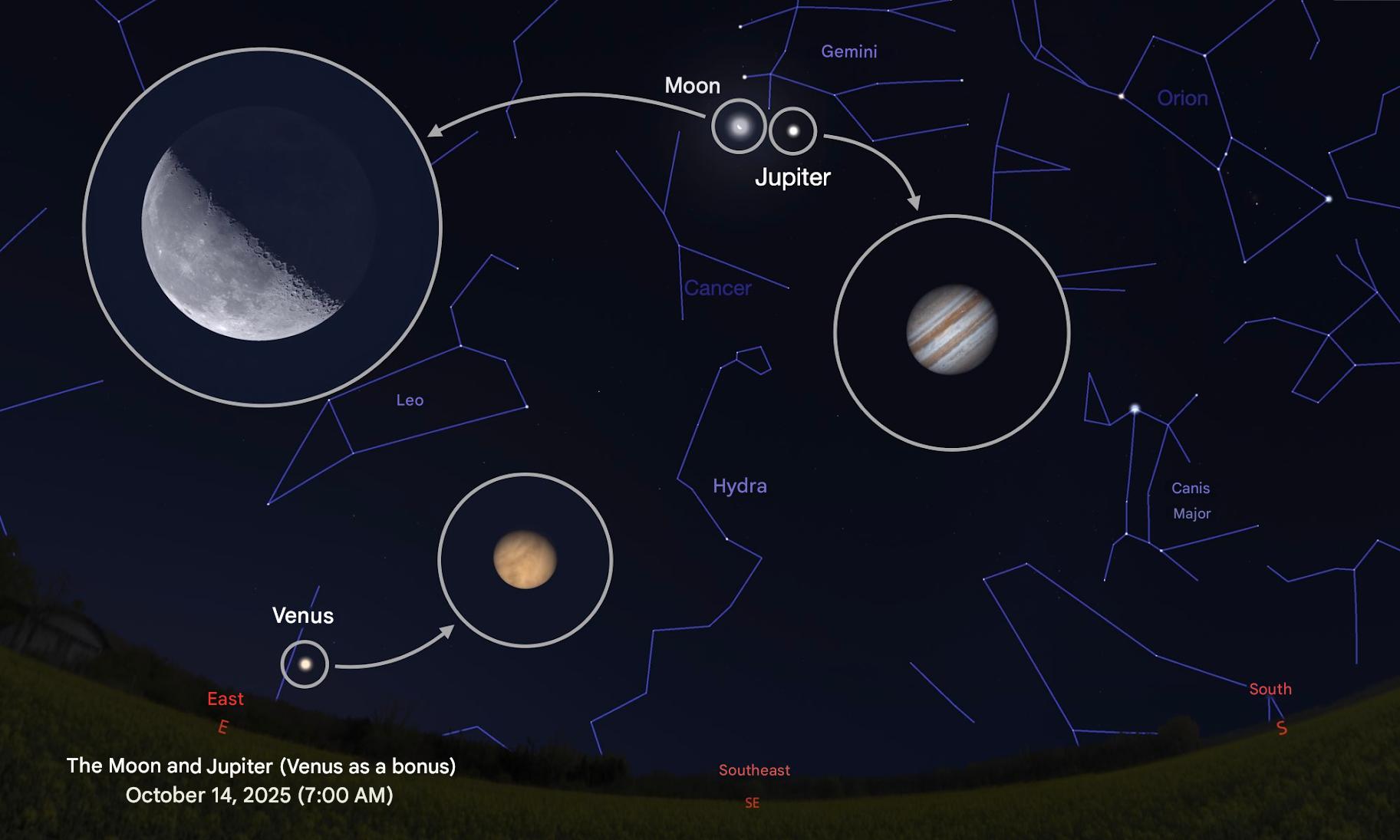
Four days later, October 14th offers us a classic duo, that formed by the Moon and Jupiter . Our natural satellite and the largest planet in the Solar System will have risen about twenty minutes after midnight. At 7am, the Moon-Jupiter couple will be enthroned at a little over 60° above the Southeast .
It will be an easy observation , 1 hour and 7 minutes before sunrise. The strong brightness of Jupiter will not be missed near a waning quarter of the Moon.
More difficult, however, will be the bonus with Venus at only 7° above the Eastern horizon . Of course, if we wait, Venus rises, but beware of the Sun which rises in the corner at 8:07am (for Toulouse). We remind you that looking at the Sun without protection can make you lose your sight.

On the morning of October 14, 1 hour before sunrise, a Moon-Jupiter pair will light up the upper sky.
© Cité de l’espace/Stellarium

THE MOON AND VENUS

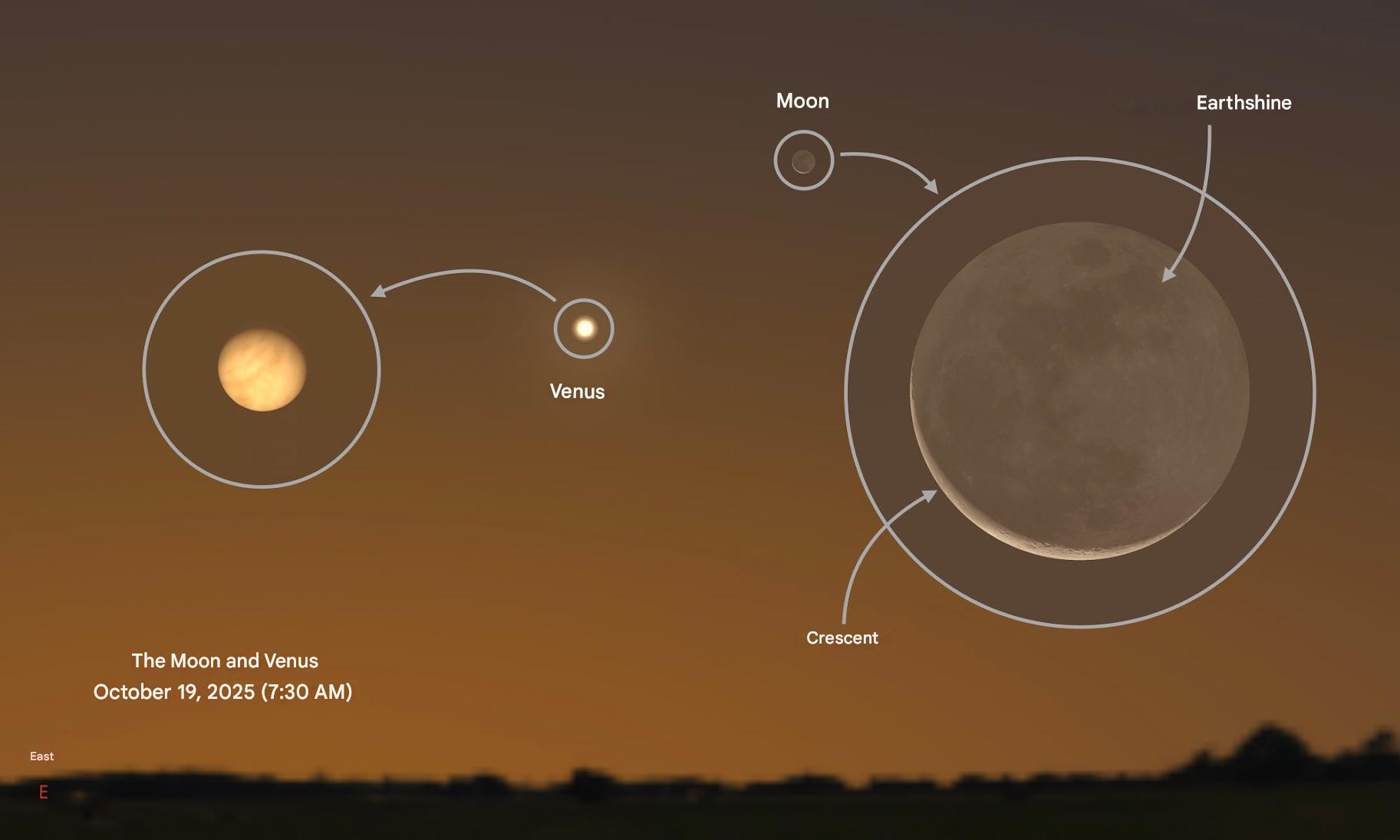
After visiting Jupiter, the Moon will this time approach Venus on the morning of October 19. This observation, which will not be easy, requires a completely clear eastern horizon . At 7:30 a.m., a thin crescent Moon (illumination at 4.5%) will be only 13° high. This thin crescent should highlight the earthshine, part of the Moon that is weakly illuminated by the light of the Sun reflected by the Earth.
A little lower to the left, the brightness of Venus (magnitude of -3) will impose itself… if nothing interferes, the planet being only 7° above the horizon. As the minutes pass, the Moon-Venus duo climbs gently, but beware of the Sun rising in this corner of the sky at 8:14 a.m. for Toulouse .
We repeat our warning: looking at the Sun without protection can make you lose your sight.

Low on the horizon, a thin crescent Moon will accompany Venus 45 minutes before sunrise on October 19.
© Cité de l’espace/Stellarium

THE ORIONIDS

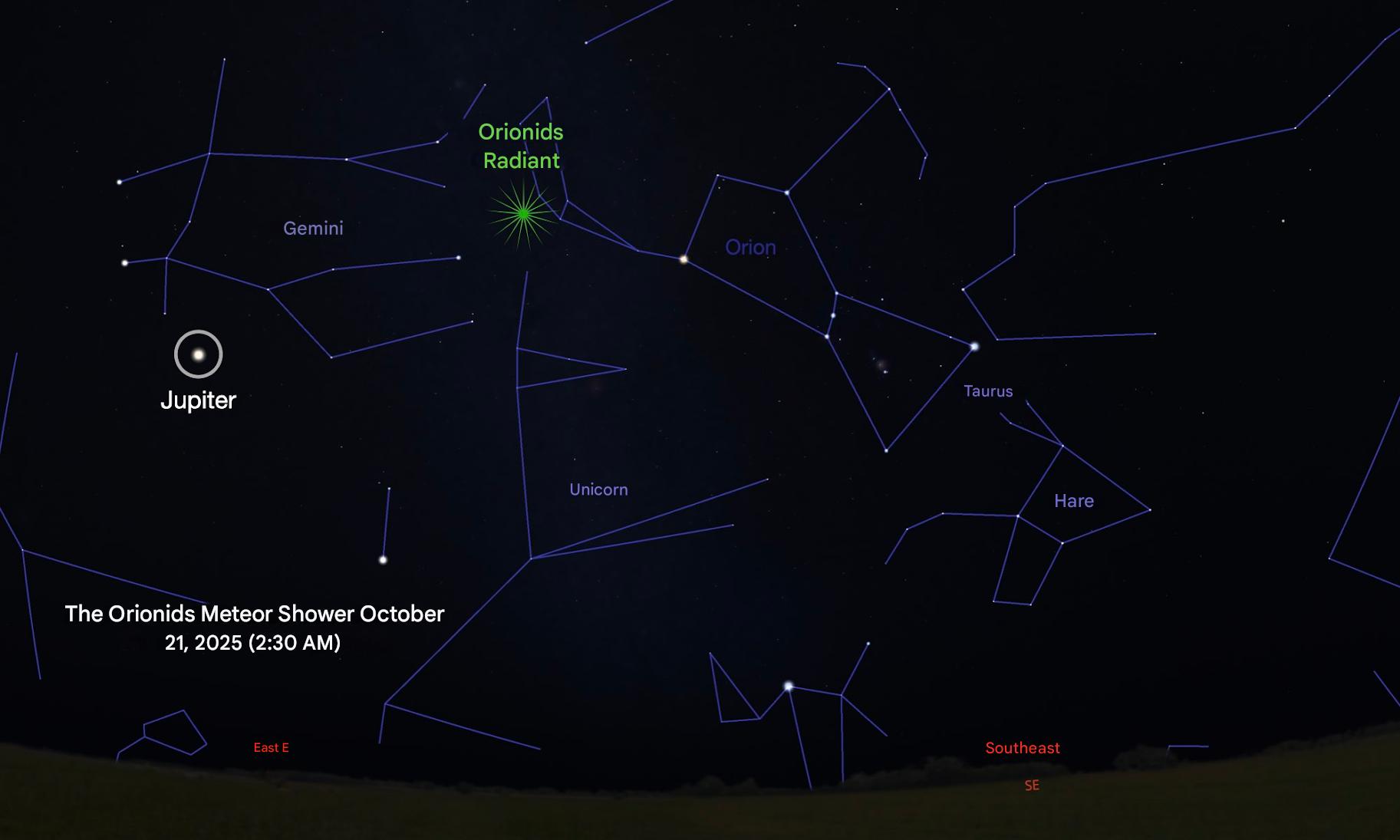
October’s star meteor shower is undoubtedly one to watch for in the constellation of Orion , the great hunter that heralds winter skies.
The Orionids (the radiant being in Orion) originate from the dust sown by the famous Halley’s Comet. The zenith hourly rate is estimated at between 20 and 30 (usually noted as 20+), or one meteor every 3 minutes under a perfectly dark sky and if the radiant were at the zenith. The Orionids have a reputation for producing fast and bright “shooting stars,” which sometimes leave a persistent trail for a few seconds .
Depending on the source, the timing of peak activity varies. The favorable period would thus begin on October 21 at 4:30 a.m. Our map is at 2:30 a.m., as it is prudent to start observing a little earlier. Others are counting on a peak in the following night (the 21st to the 22nd), or even the 22nd to the 23rd . The Moon will not be a problem in all cases.

To try to capture the Orionids, like other meteor showers, don’t necessarily try to focus on the radiant (the point from which they appear to come due to perspective), but take in the sky away from any light pollution (which includes your smartphone screen, which is glaring) and be patient.

The Orionids radiant is located in the constellation Orion, which emerges from the eastern horizon around midnight in October. The map remains similar for the following nights of the 21st to the 22nd or the 22nd to the 23rd.

© Cité de l’espace/Stellarium

Related articles