• Astronomy

The sky in October 2026

Published on 29 September 2026

During October this year, the Moon will be in close alignment with Mars, Jupiter, Saturn, and the star Regulus. Our celestial neighbor will interfere with the Orionid meteor shower.

The sky in October 2026

With the autumn equinox (for the Northern Hemisphere) having passed on September 23rd, night now begins to lengthen . Amateur astronomers and those simply curious about the sky can enjoy a longer, dark sky . On the first day of October, the Sun sets at 7:35 PM (in Toulouse), while on the 15th it will dip below the horizon at 7:11 PM, a full 24 minutes earlier!
On October 31st, the sun sets at 5:47 PM… This dramatic shift is due to the time change that took place during the night of the 24th to the 25th, see below. The night will continue to lengthen until the solstice on December 21st.

Finally, note that Saturn reaches opposition on October 4th , meaning it rises just as the Sun sets. Furthermore, the distance between Earth and Saturn is shorter, and the ringed giant will climb high in the night sky, making it ideal for observation with binoculars or telescopes. On October 24th, the Moon will help you spot Saturn’s characteristic yellowish glow.

Daylight Saving Time Begins:
Please note that on the night of Saturday, October 24th to Sunday, October 25th, 2026 , France officially switches to winter time. At 3:00 AM on Sunday, the time will become 2:00 AM.
It’s worth noting that this so-called winter time, sometimes criticized for bringing night too early, is actually closer to the sun’s path!

Reminder: unless otherwise stated, the times are those of the legal time in metropolitan France . The maps are calculated for Toulouse, but in most cases remain applicable to the entire metropolitan territory.

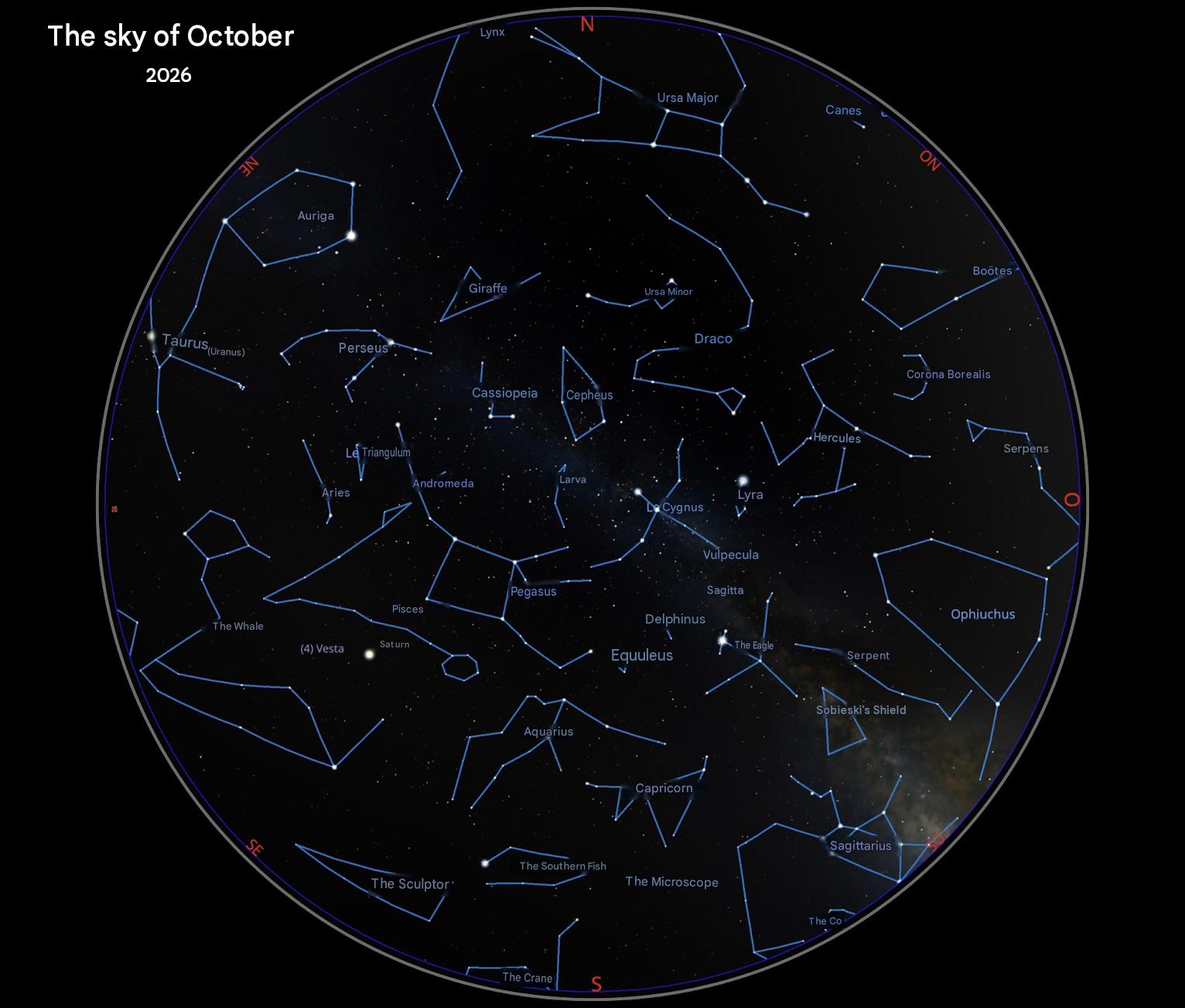
This map shows the sky for Toulouse on October 15th at 10:00 PM (local time, i.e., your watch time).
It is largely valid for the month of October across mainland France, except for the position of the Moon (which will have set at that time).
© Cité de l’espace/Stellarium

THE SMALL METEOR SHOWERS OF OCTOBER

FOR THE CURIOUS

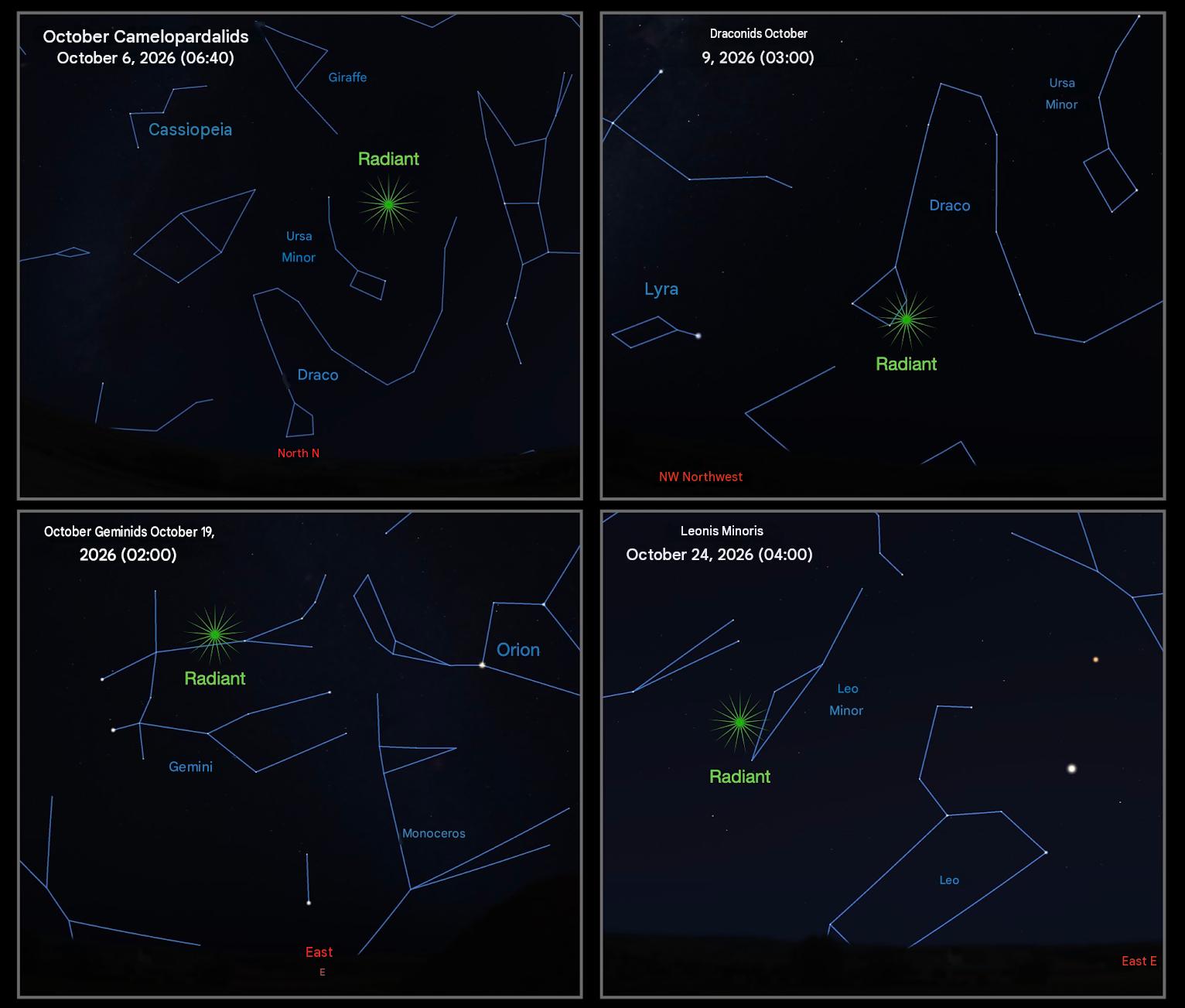
Here we’ve compiled a list of the few, very modest meteor showers that occurred in October. Their zenithal hourly rate (ZHR) ranges from 2 to 5, meaning that under a sky perfectly free of light pollution and if the radiant were at its zenith (two very ideal conditions), we would observe 2 to 5 “shooting stars” per hour. In reality, we see fewer.
It’s worth remembering that these “shooting stars” are actually dust particles that leave a fleeting, bright trail as they burn up during their entry into our atmosphere. These dust particles are most often released by a comet.

The peak of the October Camelopardalid meteor shower is expected around 6:40 a.m. on October 6th. The radiant (the point from which the meteors appear to originate due to perspective) is located in the constellation Camelopardalis. Conditions are expected to be average, as, in addition to a modest extreme ZHR of 5, a 19% crescent moon rising around 3:00 a.m. will interfere with observations.

The peak of the Draconid meteor shower, predicted for October 9th around 3:00 AM (radiating in Draco, high in the sky), will offer little additional meteor activity, although some years have seen (unpredictable) surprises. However, a 2% waning crescent moon rising late (around 6:40 AM) will not interfere with the display. 

The October Geminids (or epsilon-Geminids, not to be confused with the December Geminids) remain very faint, with only 3 meteors per hour. The peak is expected around the night of October 18th, but conditions are unfavorable with the Moon at 48% amplitude on the 18th.

Finally, the Leonis Minoris are expected to peak around October 24th at approximately 4 AM. Unfortunately, a nearly full moon will likely erase a weak ZHR of 2.

October offers us a more interesting rain with the Orionids on October 21 , even if hampered by the Moon (see below).

The radiants of four very modest meteor showers in October.
© Cité de l’espace/ Stellarium

OCTOBER 5TH IN THE MORNING: THE MOON AND MARS

A CRESCENT FOR THE RED PLANET

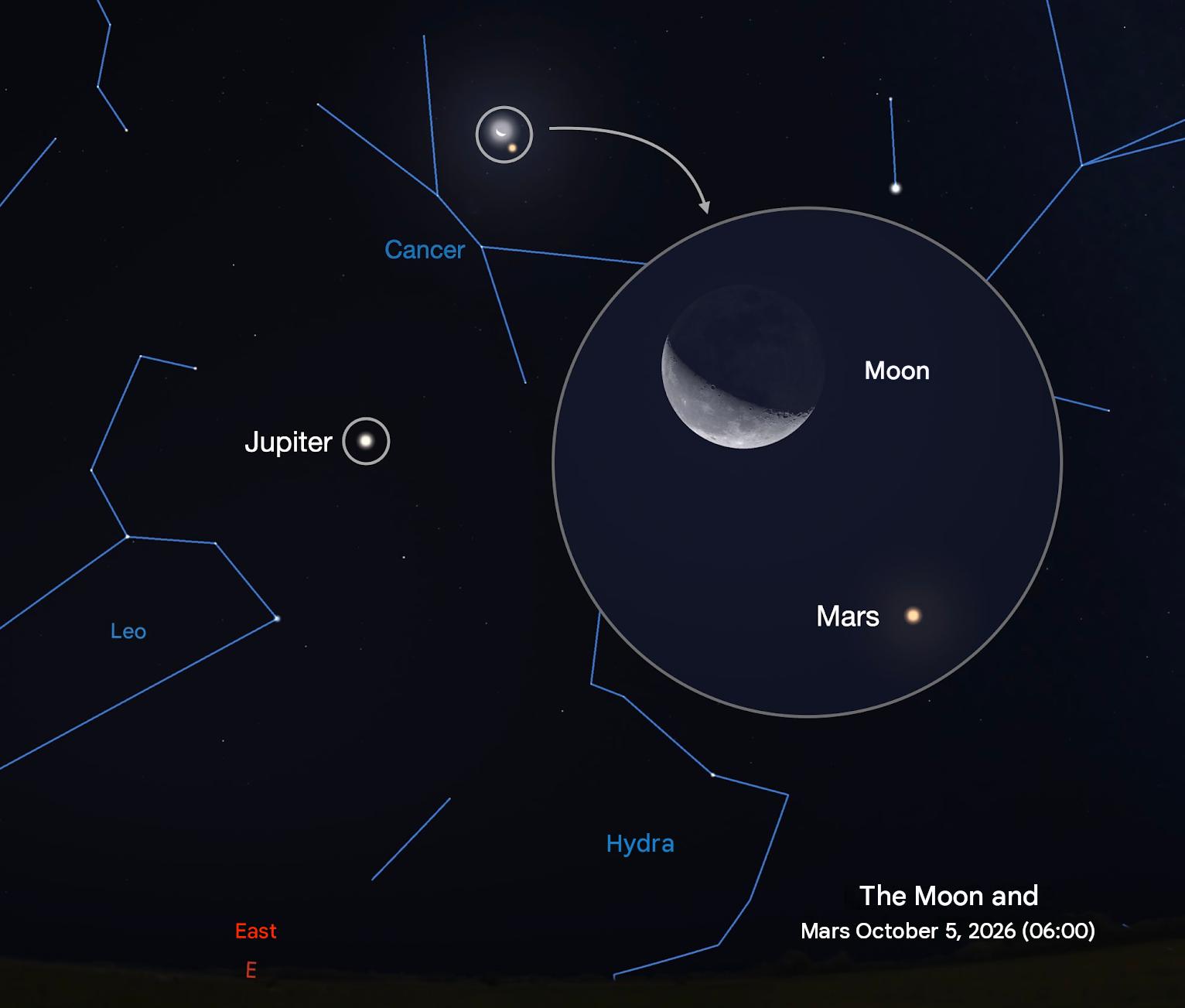
In October, the Sun rises later. So, at 6 a.m., the sky is still dark, offering a beautiful conjunction of Mars and a crescent Moon on the morning of October 5th .
This pair will be high in the sky, a little over 40° above the eastern horizon. Lower down, you’ll easily spot the bright glow of Jupiter.
Note that Mars and the crescent Moon will have risen earlier in the night (around 2 a.m.). As the hours pass, observing conditions improve, with the pair rising higher in the sky before sunrise (expected at 7:56 a.m. for Toulouse).

On the morning of October 5, Mars and a crescent Moon formed a striking pair, highlighted by the much lower brightness of Jupiter.
© Cité de l’espace/ Stellarium

OCTOBER 6TH IN THE MORNING: THE MOON AND JUPITER

TO CAPTURE THE MOON’S PATH ACROSS THE SKY

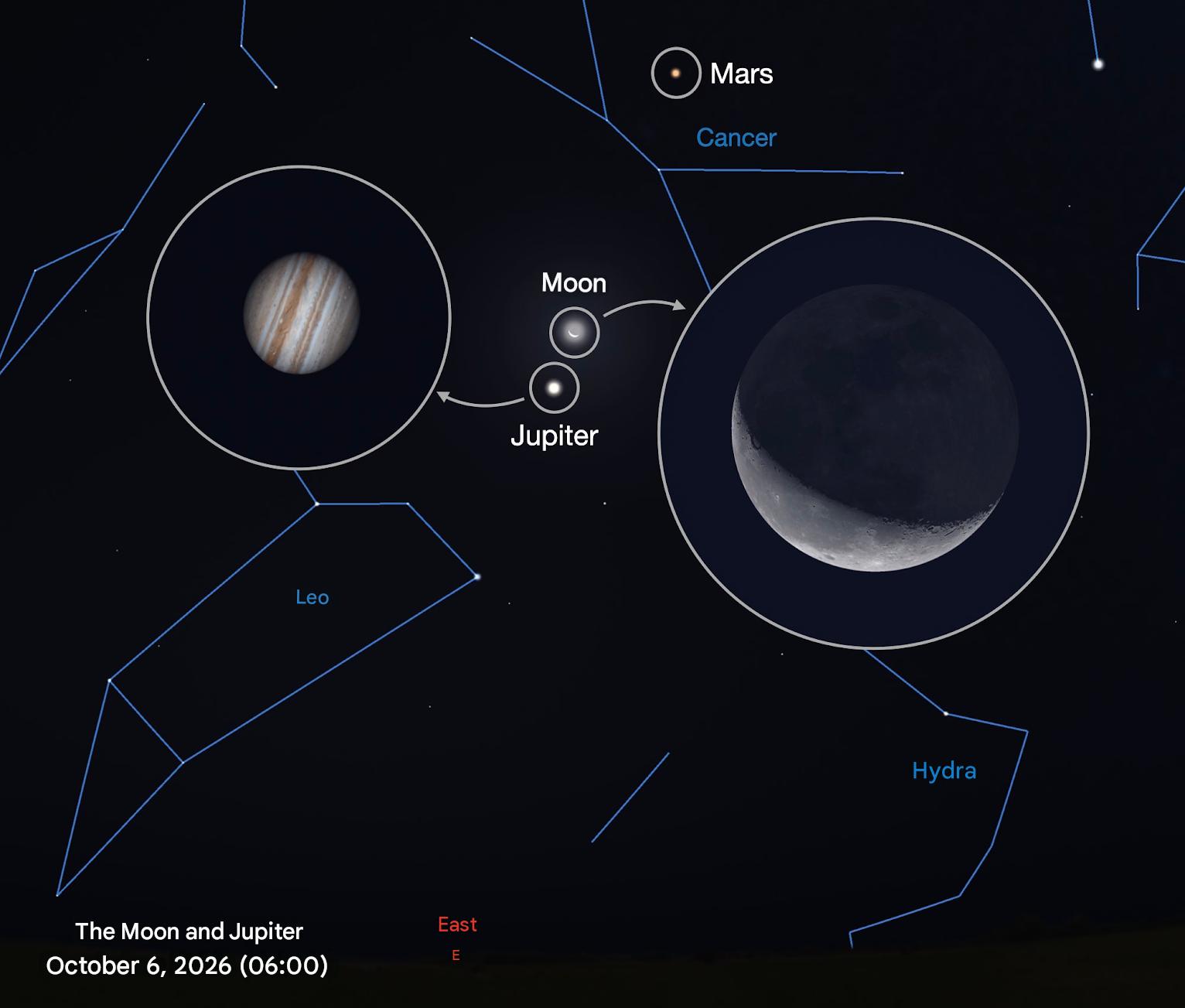
The following day allowed us to observe the Moon’s orbit in a rather spectacular way. While on October 5th the Moon crossed Mars, on October 6th at the same time (6:00 AM), the crescent of our natural satellite was now floating not far from Jupiter , the largest planet in the Solar System. The red planet (actually appearing orange) would be visible slightly above it.

Jupiter and the Moon will be just over 25° above the eastern horizon on October 6 at 6:00 a.m.
© Cité de l’espace/ Stellarium

OCTOBER 7TH IN THE MORNING: THE MOON AND REGULUS

REGULUS SHINES IN LEO

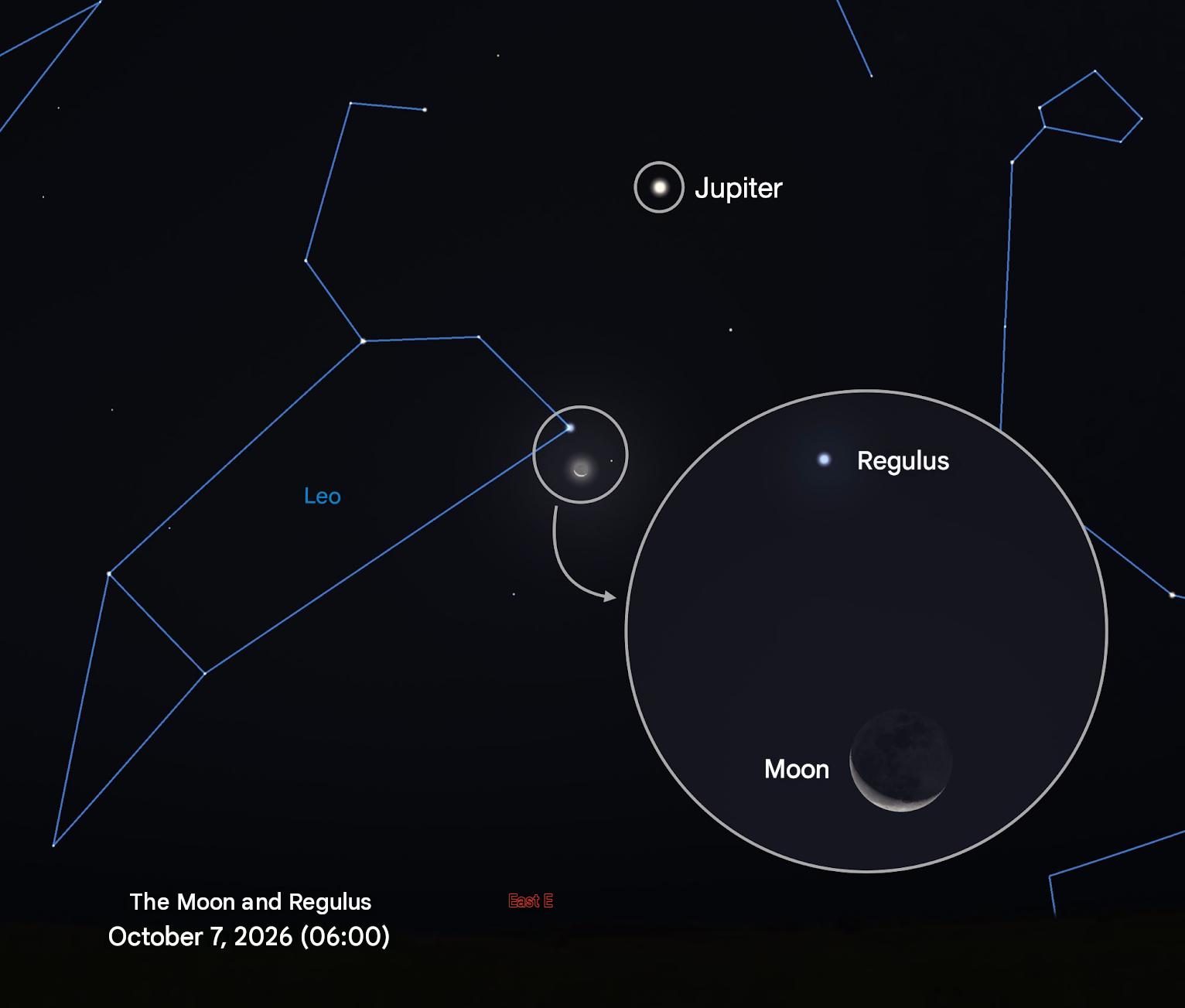
Our neighbor’s journey across the sky continues. Around 6 a.m. on October 7th, the Moon will pass close to Regulus , the brightest star (magnitude 1.4) in the constellation Leo. This status also gives it the name Alpha Leonis, according to the classification of stars in a constellation based on their brightness (alpha for the brightest, beta for the second brightest, and so on).

The duo formed by a crescent Moon and Regulus will be joined higher in the sky by bright Jupiter.
© Cité de l’espace/ Stellarium

OCTOBER 21: THE ORIONID METEOR SHOWER

A SHOW DISRUPTED BY THE MOON

Our full article on the 2026 Orionids

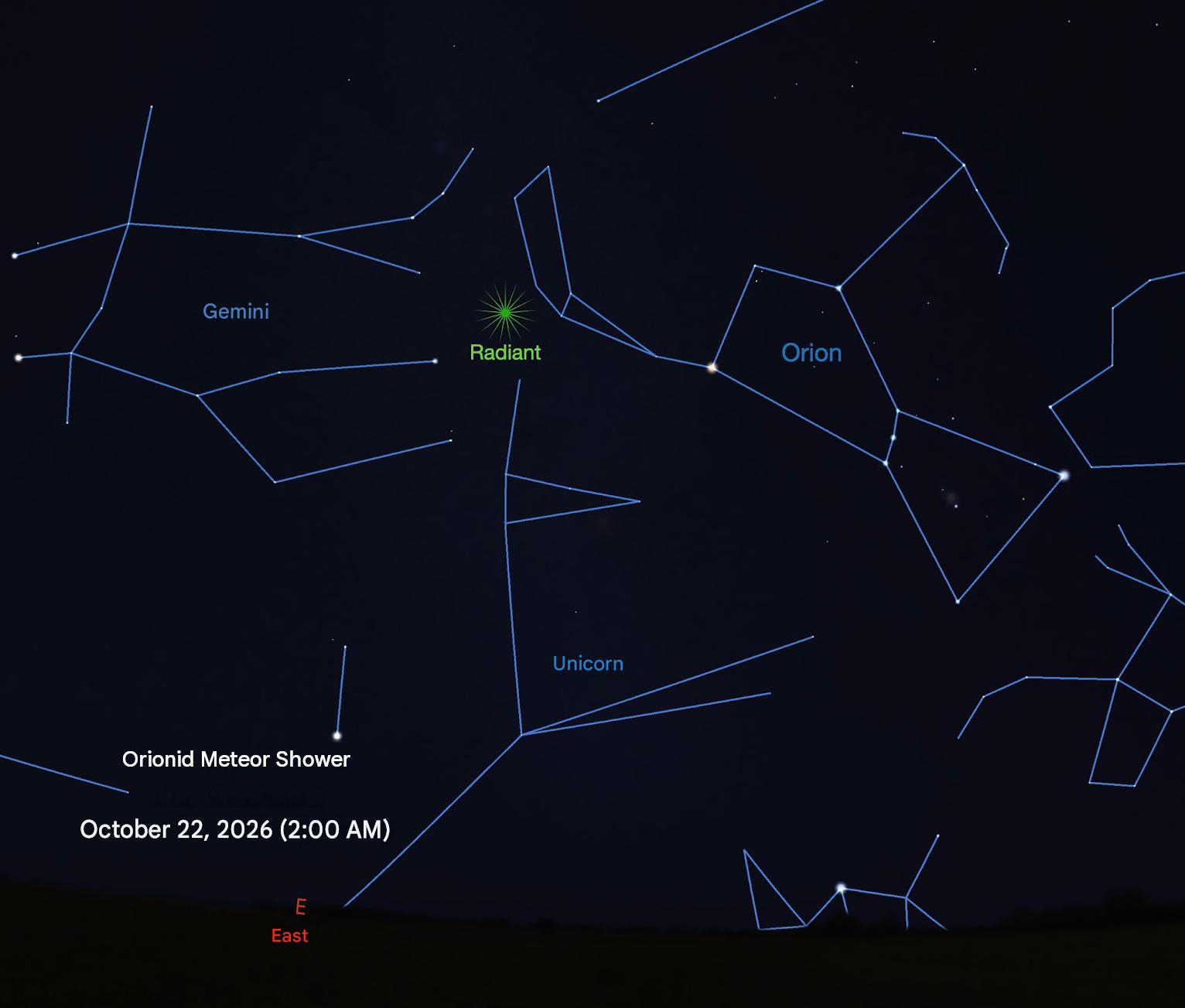
The star meteor shower of October normally occurs in the constellation of Orion , the great hunter heralding the winter skies. In 2026, the Moon will interfere .
The Orionids (with their radiant in Orion) originate from dust scattered by the famous Halley’s Comet. The zenithal hourly rate is estimated between 20 and 30 (usually noted as 20+), meaning one meteor every 3 minutes under a perfectly dark sky and if the radiant were at the zenith. The Orionids are known for producing fast and bright “shooting stars,” which sometimes leave a lingering trail for a few seconds.
Depending on the source, the peak of activity is generally considered to be on or around the night of October 21st. Our map is calculated for October 22nd at 2:00 AM, the night of the 21st to the 22nd.   Unfortunately, the Moon will be 79% illuminated, obscuring a large portion of the “shooting stars .” So don’t expect a significant display! The most dedicated observers will wait until the moon sets at 3:54 AM on October 22nd (Toulouse time).

To try and capture the Orionids, like other meteor showers, don’t necessarily try to focus on the radiant (the point from which they appear to come due to perspective), but rather take in the celestial vault far from any light pollution (which includes the glare from your smartphone screen) and be patient.

The radiant of the Orionids is located in the constellation of Orion, which emerges from the East around midnight around the peak of October 21 to reach about thirty degrees above the horizon around 2:00 a.m.

© Cité de l’espace/Stellarium

OCTOBER 24: THE MOON AND SATURN

OUR NATURAL SATELLITE IS SHOWING THE WAY FOR THE RINGED GIANT

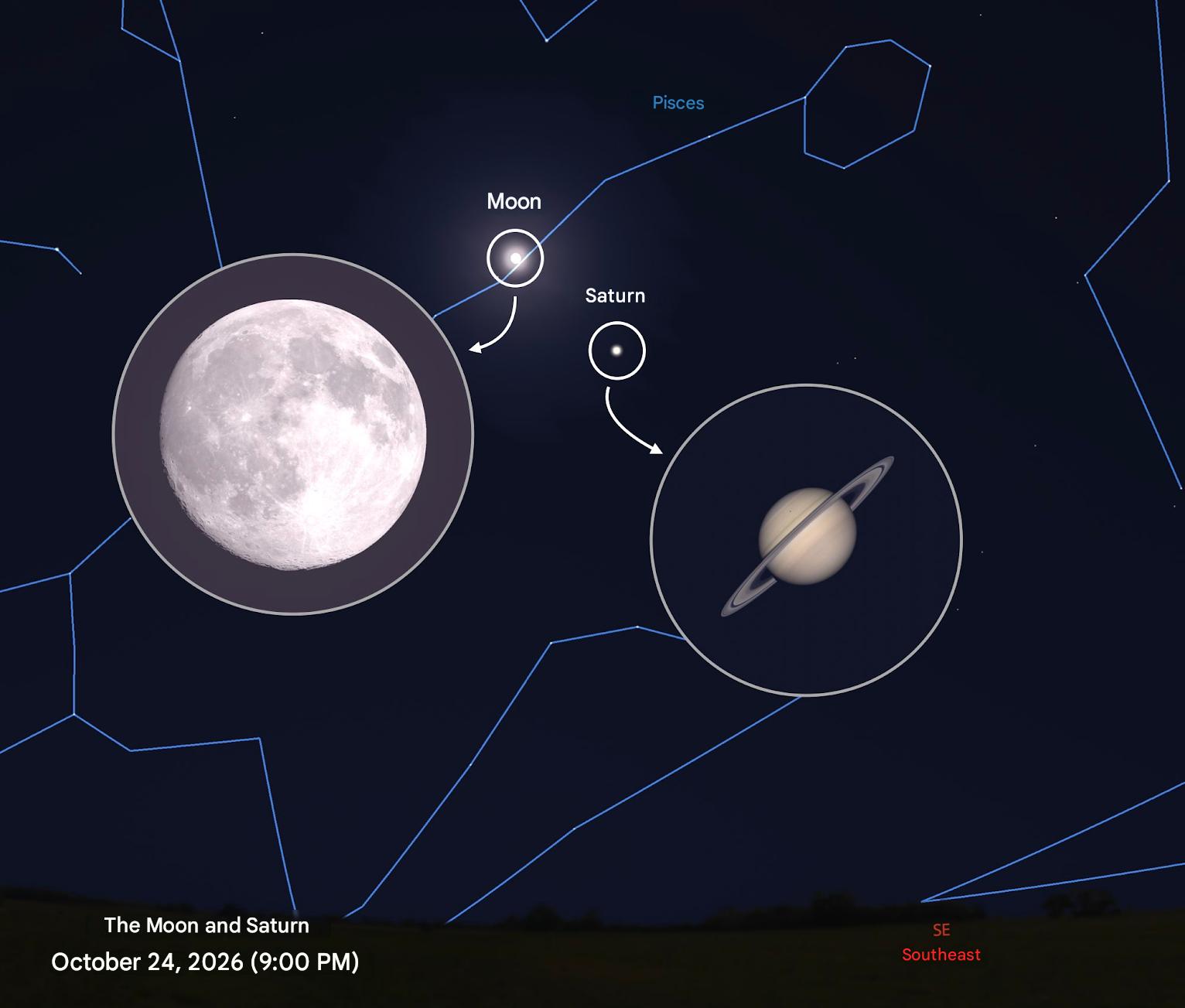
Two days before its full moon, the Moon will guide us on the evening of October 24th, making it easy to find the ringed giant . Just over two hours after sunset (6:57 PM in Toulouse), you’ll easily spot a 97.5% illuminated Moon 32° above the east-southeast horizon. To the lower left, about 6° away , note the characteristic yellowish glow of Saturn. As a guide, a 5° difference in the sky is generally roughly the length of your thumb held at arm’s length.

On October 24th, use the Moon to easily find Saturn.

© Cité de l’espace/Stellarium

NIGHT OF OCTOBER 27-28: THE MOON AND THE PLEIADES 

THE SEVEN SISTERS VISITED BY OUR HEAVENLY NEIGHBOR

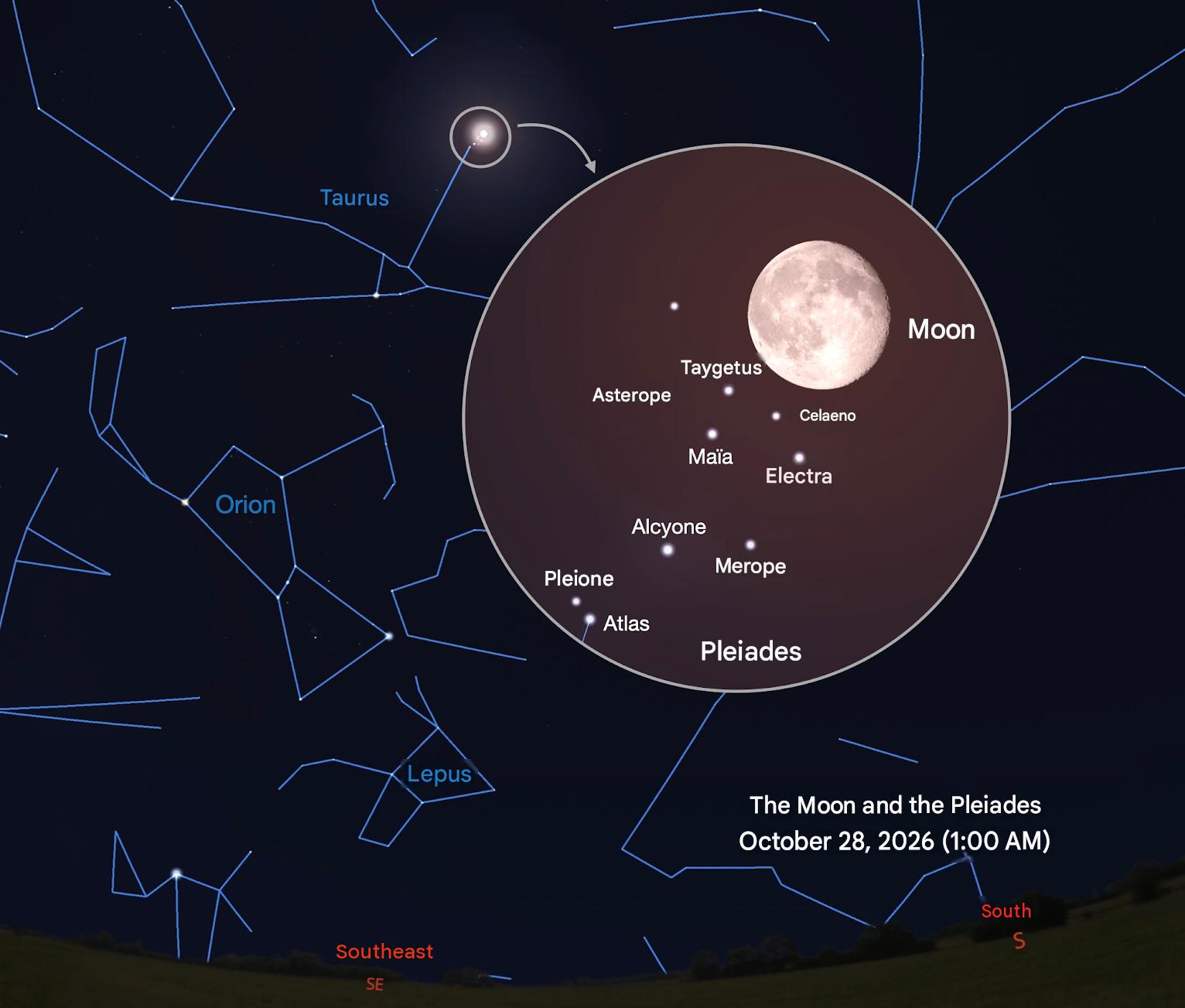
On the night of October 27-28, the Moon will offer us one of its visits to the Pleiades star cluster . Our natural satellite passes more or less regularly near this group of stars.
The Moon will be 65° above the southeastern horizon at 1:00 AM, grazing the Pleiades. In the constellation Taurus, these stars celebrate seven sisters from Greek mythology: Alcyone, Asterope, Maia, Taygete, Celaeno, Merope, and Electra. Their parents appear to watch over them from nearby, thanks to two stars named Atlas and Pleione. We now know that this is an open cluster of 3,000 young stars (only about ten are visible to the naked eye under good conditions) located approximately 440 light-years from Earth. Be aware that the Moon’s strong brightness (95% illuminated) will interfere with the view of the Pleiades .

On the night of October 27-28, the Moon will pass close to the Pleiades.

© Cité de l’espace/Stellarium

Related articles