• Astronomy

Everything you need to know about the 2026 Orionids

Published on 06 October 2026

The Orionids are the most interesting meteor shower of October. In 2026, even if conditions aren't ideal, there might still be some beautiful shooting stars to see.

Everything you need to know about the 2026 Orionids

October 2026 brings us a celestial vault marked by the opposition of Saturn on October 4 (beginning of a period favorable for its observation), rendezvous between the Moon and celestial objects (Jupiter, the Pleiades, or Saturn) as well as some very modest meteor showers (see the sky of October 2026).

Without a doubt, the star meteor shower of this autumn month takes place in the constellation of Orion , the Orionids.

Note: Unless otherwise stated, the times shown are in Metropolitan France time . The maps are calculated for Toulouse, but remain valid for the entire metropolitan territory.

A GIFT FROM HALLEY’S COMET

In everyday language, we often talk about a meteor shower . Although poetic, the expression remains incorrect since these fleeting luminous trails in the sky are actually dust from asteroids or comets that burn up upon entering our planet’s atmosphere.

ETA AQUARIDS AND ORIONIDS

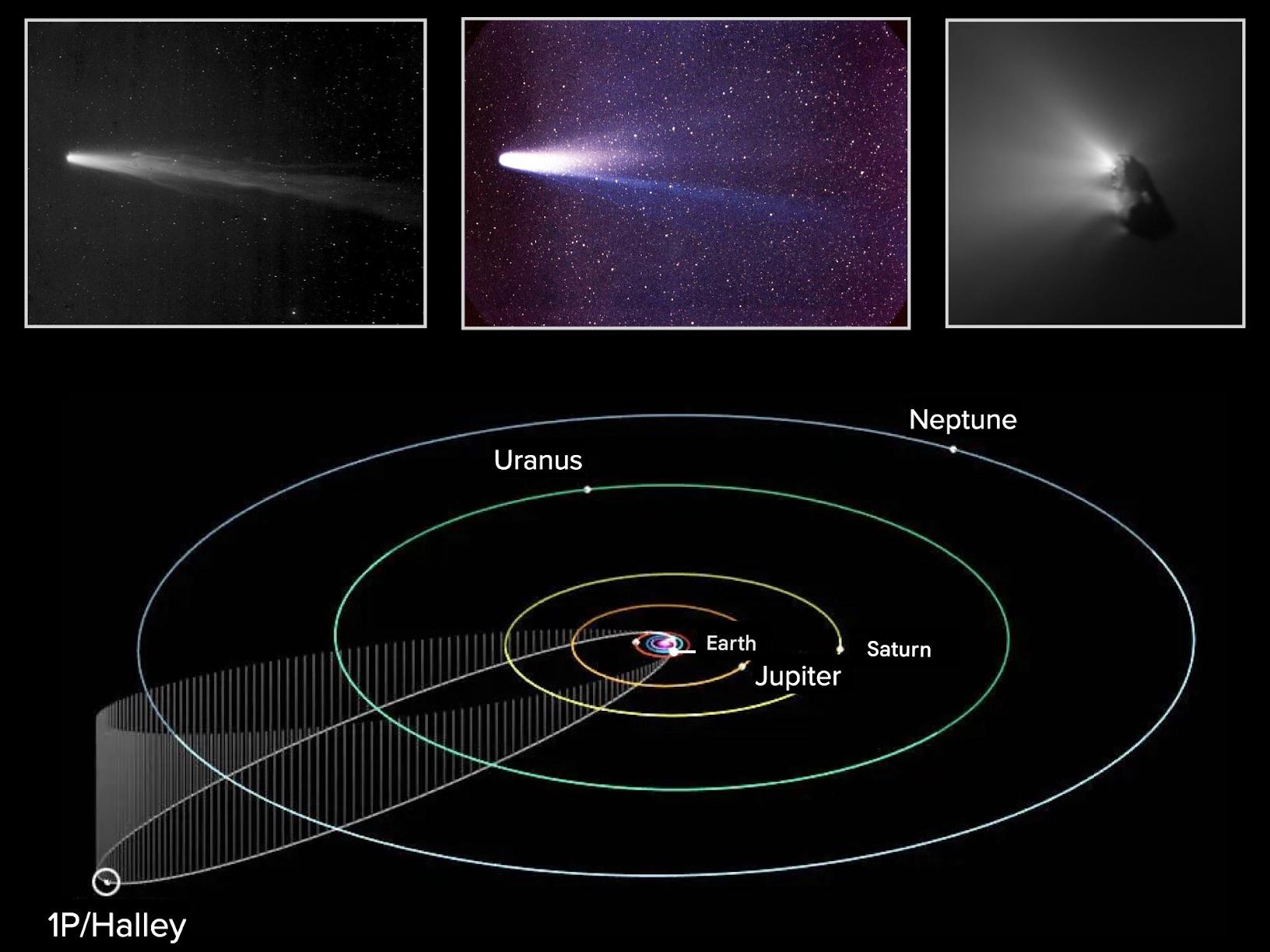
From time to time, Earth encounters a cloud of dust scattered by the Sun, most often by a comet. For example, the Perseids meteor shower in August is caused by Comet Swift-Tuttle. The Orionids occur in October when Earth’s orbit encounters dust left by the famous Halley’s Comet, which takes 76 years to complete its highly elliptical orbit around our star. During the course of a year, our planet passes through dust scattered by the same Halley’s Comet. This event takes place in May and produces the Eta Aquarids meteor shower.

Diagram of the orbital path of Halley’s Comet (position of celestial bodies in May 2019). Very early records of observations of this comet exist, but it bears the name of the British astronomer Edmond Halley (1656-1742), as he was the first to determine its orbit. Above, two photos of Halley’s Comet in 1910 (left) and 1986 (center) taken with ground-based telescopes, followed by an image of its nucleus taken by the European probe Giotto on March 14, 1986, from a distance of 2,000 km.
© Cité de l’espace, based on NASA (diagram), Harvard College Observatory (Halley in 1910), NASA/W. Liller (Halley in 1986), and ESA/MPS (Giotto probe).

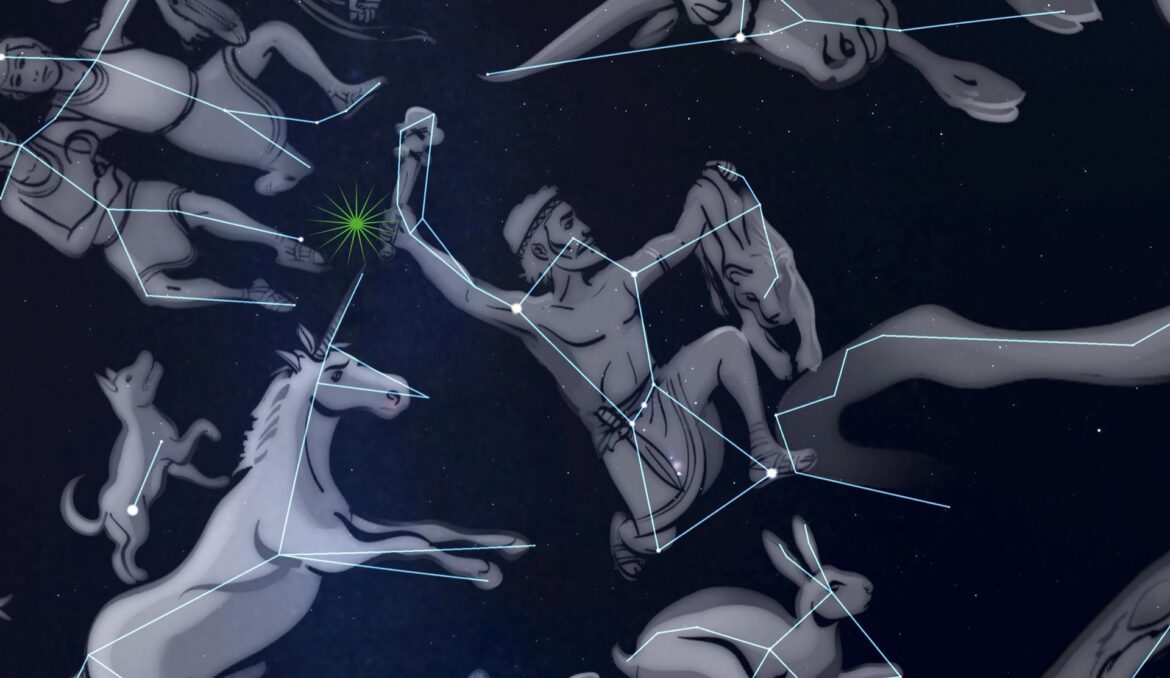
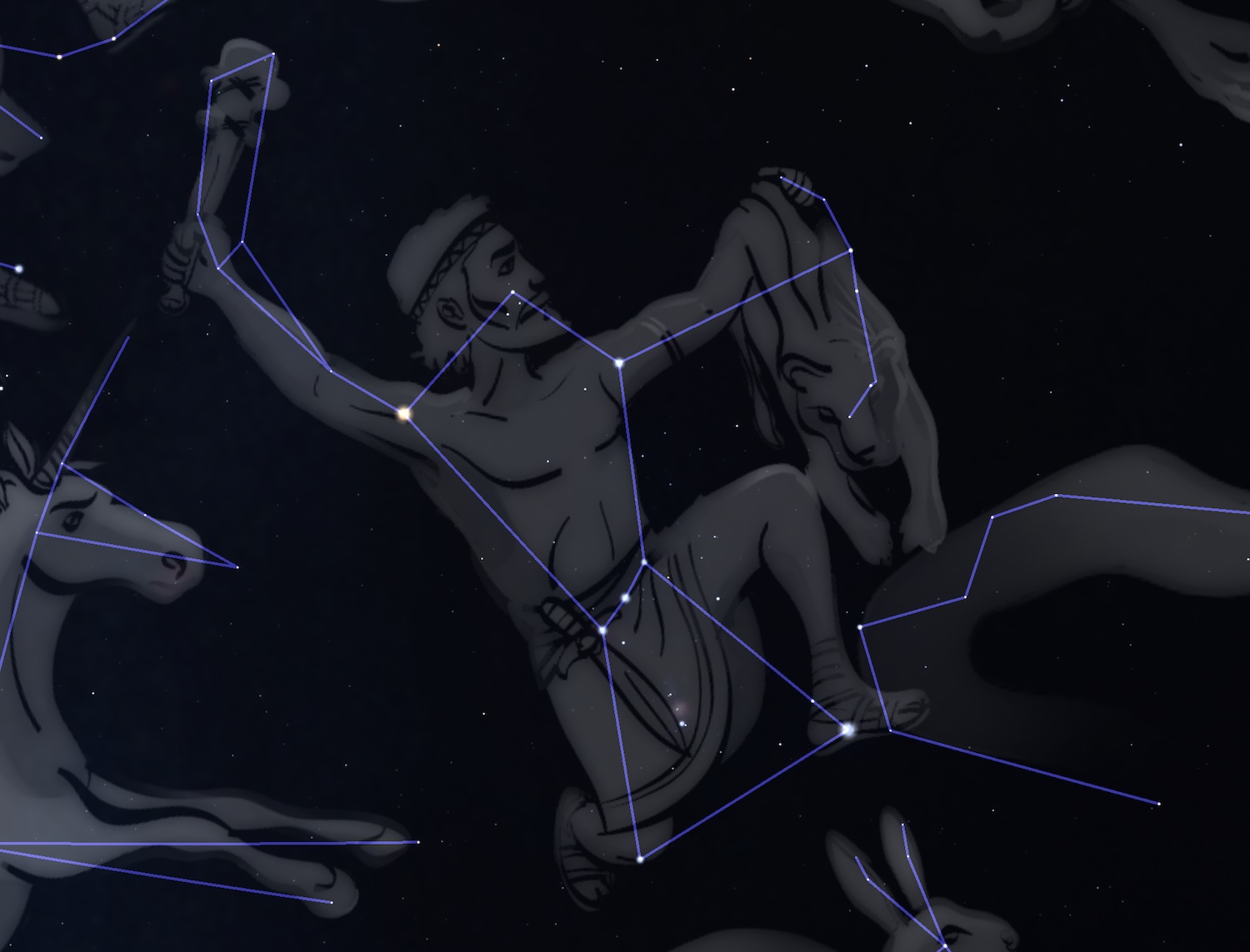
The constellation Orion represents a mythical hunter, but it’s its bowtie shape that makes it easy to spot.
© Cité de l’espace/Stellarium

THE GREAT HUNTER, HARBINGER OF WINTER

The Orionids are named for their radiant, which is located in Orion . The radiant is the point in the sky from which the meteors appear to originate due to perspective. This can be compared to what happens when you drive a car in a snowstorm: even though the snowflakes fall towards the ground, they appear to be flying towards the windshield.

The constellation Orion, which heralds the winter skies (in October it rises in the East around midnight), represented a hunter for Ancient Greece, but it is mainly recognized because of its shape which evokes a giant bow tie!

ORIONIDES 2026

A SHOW DISRUPTED BY THE MOON

The Orionids are considered active from October 2nd to November 7th . However, as with other meteor showers, it’s the peak of activity that primarily interests observers and skywatchers . For the Orionids, the peak is estimated to occur when the zenithal hourly rate is between 20 and 30 (usually noted as 20+), meaning one meteor every 3 minutes under a perfectly dark sky and if the radiant were at the zenith (two criteria rarely met). The Orionids also have a reputation for producing fast and bright “shooting stars,” which sometimes leave a trail that lasts for a few seconds.

Sources vary regarding the timing of peak activity. The most favorable period is estimated to be during the night of October 21-22, 2026, or thereabouts .

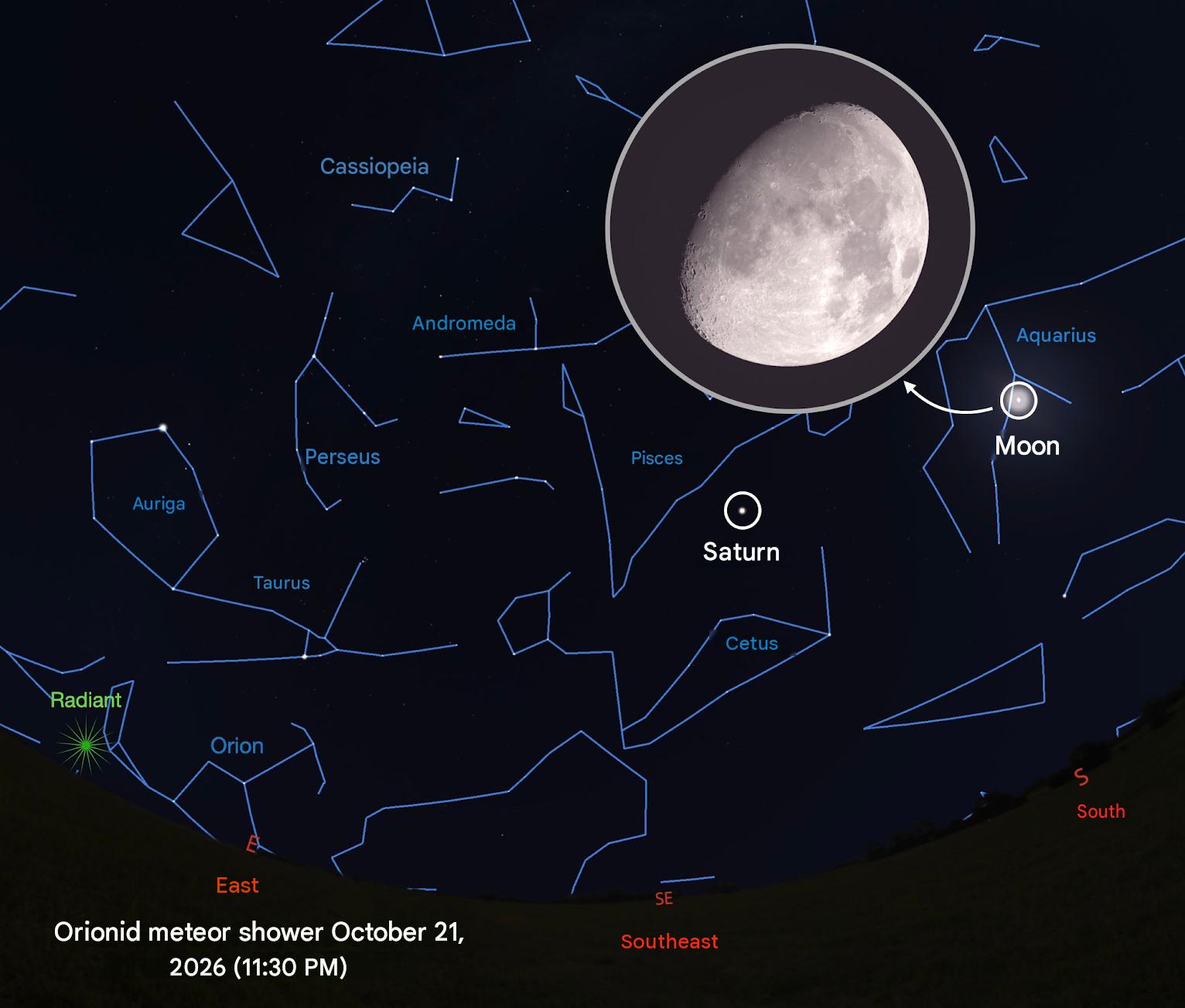
For the peak of the 2026 Orionid meteor shower (October 21-22), the 79% illuminated Moon will obscure some of the meteors for much of the night. The radiant rises around 11:30 p.m.
© Cité de l’espace/Stellarium

Unfortunately, the Moon will be 79% illuminated, obscuring many of the “shooting stars .” So don’t expect a remarkable show!

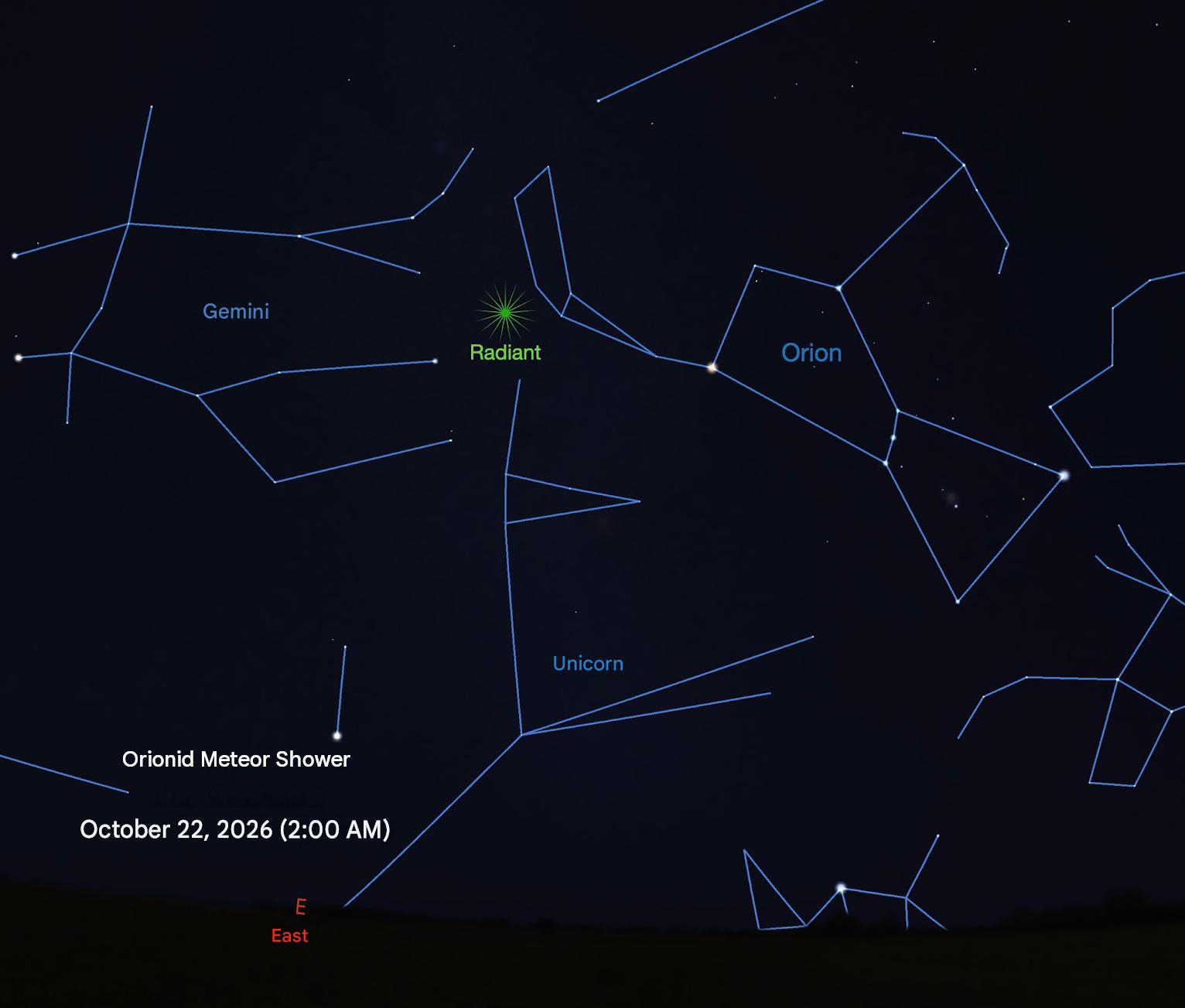
The map below is calculated for October 22 at 2:00 AM, i.e., the night of the 21st to the 22nd. The radiant will already be higher in the sky, but the Moon will still be present.

The radiant of the Orionids is located in the constellation of Orion, which emerges from the East a little before midnight around the peak of October 21 to reach about thirty degrees above the horizon around 2:00 a.m.

© Cité de l’espace/Stellarium

A TIME SLOT STARTING AT 4AM

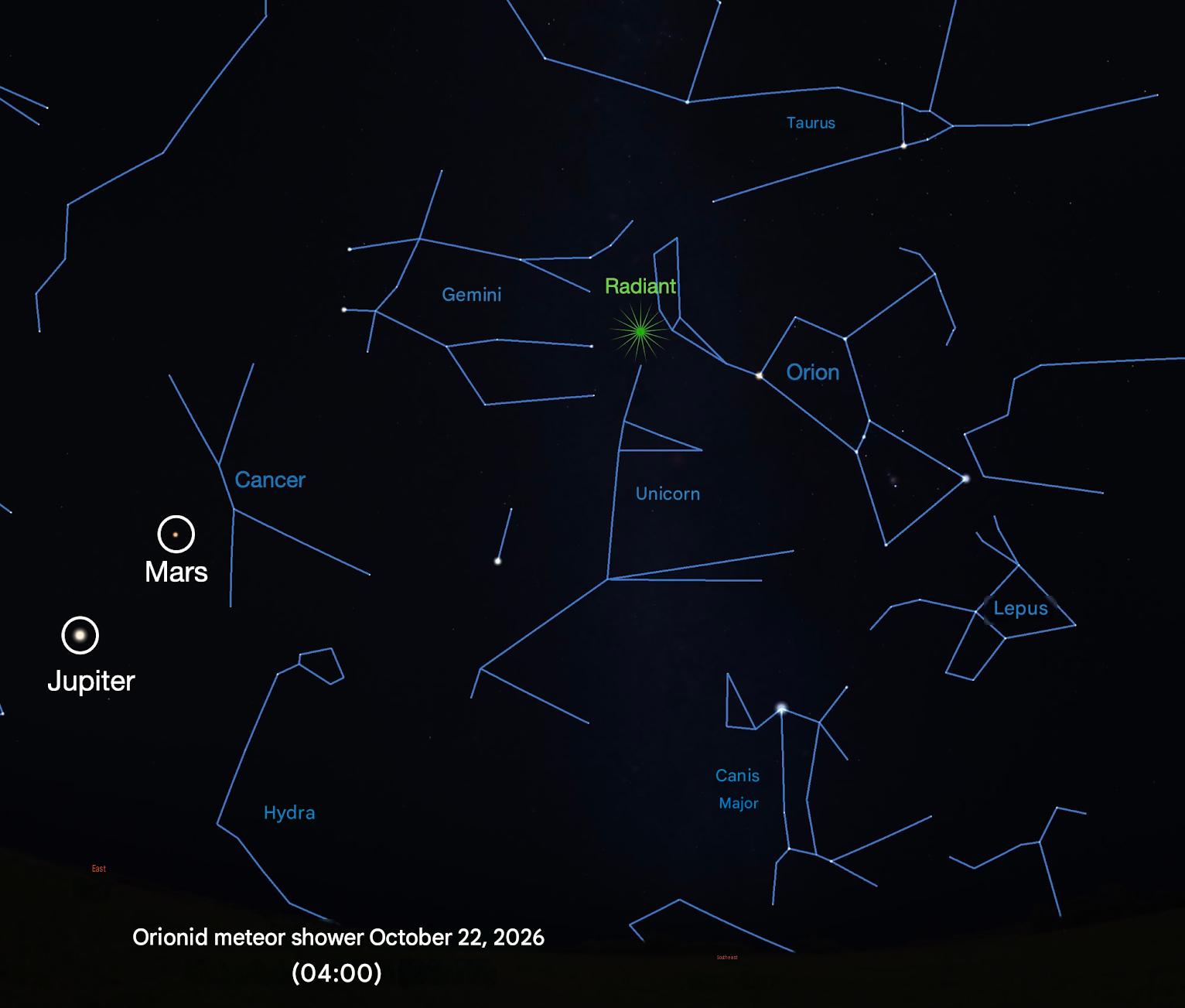
The most dedicated observers will wait until sunset at 3:54 a.m. on October 22nd in Toulouse (or wake up very early immediately afterward). Around 4:00 a.m., the night sky will still be dark, therefore favorable, and a few shooting stars may streak across the firmament . Keep in mind, however, that the 2026 Orionid meteor shower is not the most promising.

With the Moon setting at 3:54 a.m. on October 22 (Toulouse time), the sky will offer more favorable conditions for observing the Orionids meteor shower from 4:00 a.m. onwards. The radiant will also be high in the sky, about 50 degrees above the southeastern horizon. You will also notice the presence of Mars and Jupiter in the east.
© Cité de l’espace/Stellarium

SOME OBSERVATION TIPS

To try and spot the Orionids , as with other meteor showers, don’t necessarily focus on the radiant (the point from which they appear to originate due to perspective), but rather take in the celestial vault far from any light pollution . Indeed, it’s essential to get away from urban centers, whose lighting is a source of light pollution. This pollution degrades the quality of the sky, and you’ll miss some of the shooting stars.  Also, be careful not to create light pollution yourself!  If you’re outside on a terrace or balcony, for example, turn off all outdoor lights, as well as any indoor lights that will be a problem if the shutters aren’t closed. Avoid using your smartphone, as the screen’s light will dazzle you and cause your pupils to constrict. Remember that it takes about 15 minutes for your vision to adapt to nighttime conditions (maximum pupil dilation).
As explained above, in 2026, the Moon will cause “natural light pollution” and greatly hinder the viewing of meteors . However, after moonset (expected at 3:54 a.m. on the 22nd), conditions will improve with a darker and more favorable sky. With the Sun rising (for Toulouse) at 8:17 a.m., astronomical twilight will begin at 6:41 a.m. (Sun 18° below the horizon). This is when the night sky will begin to lighten. For the peak of the Orionids meteor shower, there is therefore a window of dark skies on October 22nd from 4:00 a.m. to 6:41 a.m.

THE BEST INSTRUMENT?
YOUR EYES!

As for equipment, your eyes are the ideal instrument . No need for binoculars or telescopes; their field of view is too narrow. The best approach is to gaze at the celestial vault… and wait! Yes, patience is an essential quality . A meteor shower can be disappointing if, for example, the peak doesn’t occur at the predicted time or if the number of meteors is lower than expected.
To avoid straining your neck while facing the zenith, it’s best to get comfortable by lying on the ground (bring a blanket) or in a deck chair. Finally, October nights can be chilly, so dress accordingly.

Related articles