




• Launch

SpaceX succeeds in catching the Starship upper stage

Published on 15 November 2026

During Starship's 15th test flight, SpaceX succeeded in catching the upper stage with the launch tower after 22.5 hours in orbit, a major breakthrough for NASA's Artemis lunar program despite losing the Super Heavy first stage in the Gulf of Mexico.

SpaceX succeeds in catching the Starship upper stage

SpaceX’s fifteenth Starship test flight concluded on November 14 with the successful catch of the upper stage by the launch tower at Starbase, Texas. After twenty-two and a half hours in Earth orbit, this success validates a key milestone for the future lunar lander of NASA’s Artemis program. Despite the forced splashdown of the Super Heavy first stage in the Gulf of Mexico, this mission demonstrates the feasibility of a controlled return of an orbital spacecraft.

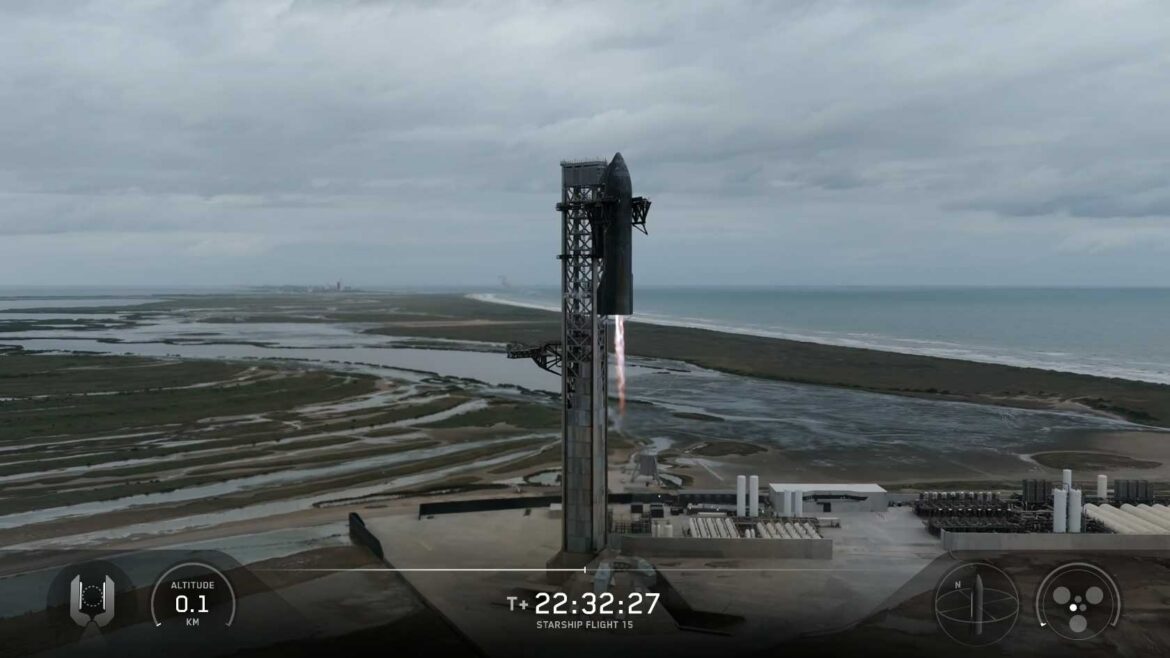
Watch Ship 42 return into the mechanical arms of the Mechazilla launch tower on November 14 at 10:20 p.m.

© SpaceX

How did Starship’s 15th test flight unfold?

A liftoff on November 13 followed by the catch of Ship after twenty-two and a half hours in orbit

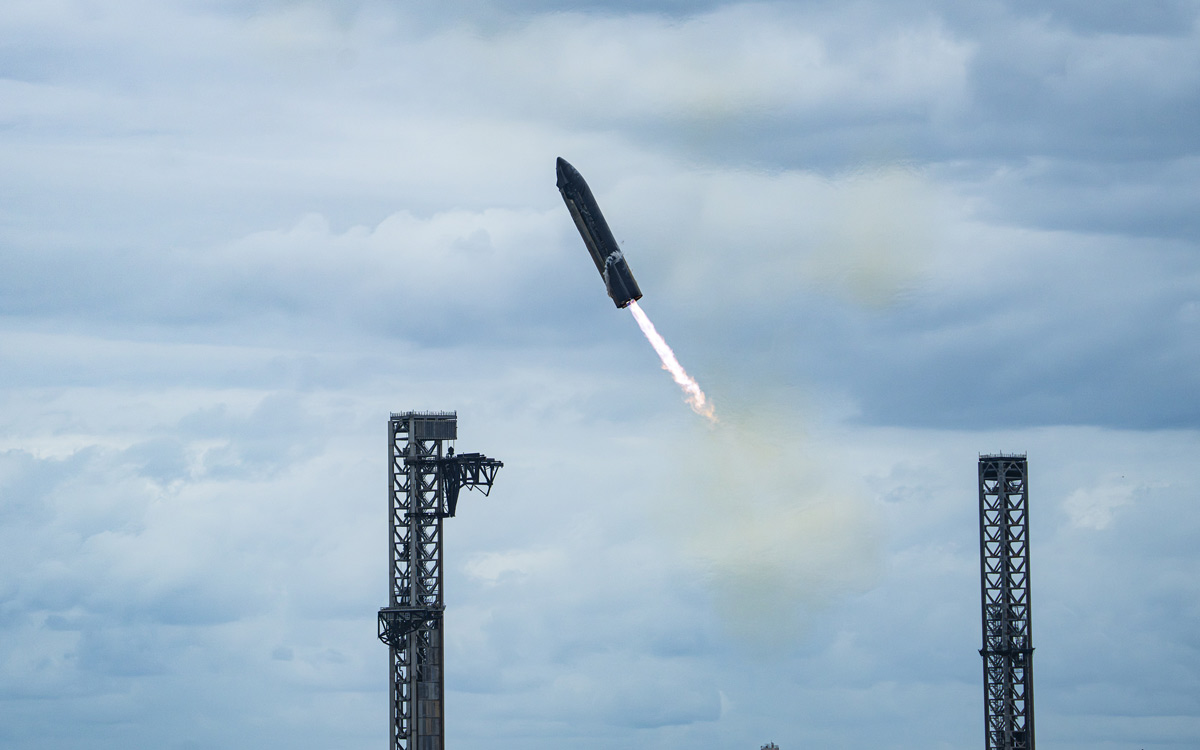
The launch vehicle lifted off on Friday, November 13 at 11:45 p.m. French time, from Starbase. Two and a half minutes later, hot-staging went as planned with the ignition of the second stage engines. Initially planned for the launch pad, the return of the Super Heavy booster was diverted toward the Gulf of Mexico at 6 min and 35 sec into the flight following a propellant level alert and engine underperformance. But no need to worry, tempered Elon Musk, founder and CEO of SpaceX, who specified on his social media platform X that these early ships and boosters are already surpassed by improved designs in production or on the test stand. “This loss of the booster does not change our timeline to achieve high-volume, fully reusable Starship flights,” he assured. For its part, the upper stage Ship 42 inserted into Earth orbit at an altitude of 275 kilometers 26 minutes after liftoff. During the flight, the spacecraft deployed 26 Starlink V3 telecommunications satellites over more than 40 minutes. Then, after 14 orbits around Earth spanning twenty-two and a half hours, the spacecraft performed its atmospheric reentry. On Saturday, November 14 at 10:20 p.m. French time, Starship came to rest in the mechanical arms of the Mechazilla launch tower.

How does the successful catch of Ship change the development of Starship and the Artemis program?

A key technical demonstration for full launcher reusability and preparing the lunar spacecraft

This first recovery of the orbital upper stage is an essential step for SpaceX, which aims for the complete reusability of its launch vehicles. “It was the missing link, it was the Grail of spaceflight, plunging through the fire to be caught in midair by steel. We caught a Starship, and now everything changes,” enthused live Dan Huot, SpaceX spokesperson and host during the official broadcast. “It is absolutely incredible to see, one of the most incredible and historic engineering feats of all time just happened before our eyes,” reacted Jessie Anderson, engineer and operations host at SpaceX, who was also watching the broadcast. The spacecraft was then inspected. Elon Musk went to the site and stated he had hugged Ship 42. “It could probably be relaunched after a few weeks of refurbishment. However, many small improvements are needed to achieve immediate reusability (like an airplane), which means zero expected refurbishment, apart from scheduled maintenance.” In any case, for NASA, which selected a modified version of Starship as the lunar lander (HLS) for the Artemis missions, this success validates the vehicle’s ability to perform a controlled return from orbit and return intact to the ground. Next year, the Artemis III mission is set to take place in Earth orbit. It will consist of two orbital rendezvous between the Orion capsule and Blue Origin’s Blue Moon, on the one hand, and then with Starship, on the other. The previous Starship test flight had been the first in which the spacecraft reached orbital velocity. It had ended with an early return. This time, SpaceX demonstrated Starship’s ability to perform an extended flight in orbit, which would allow the Artemis III mission to take place.

Ship 42 spent more than 22.5 hours in orbit. It deployed 26 Starlink V3 satellites.

© SpaceX

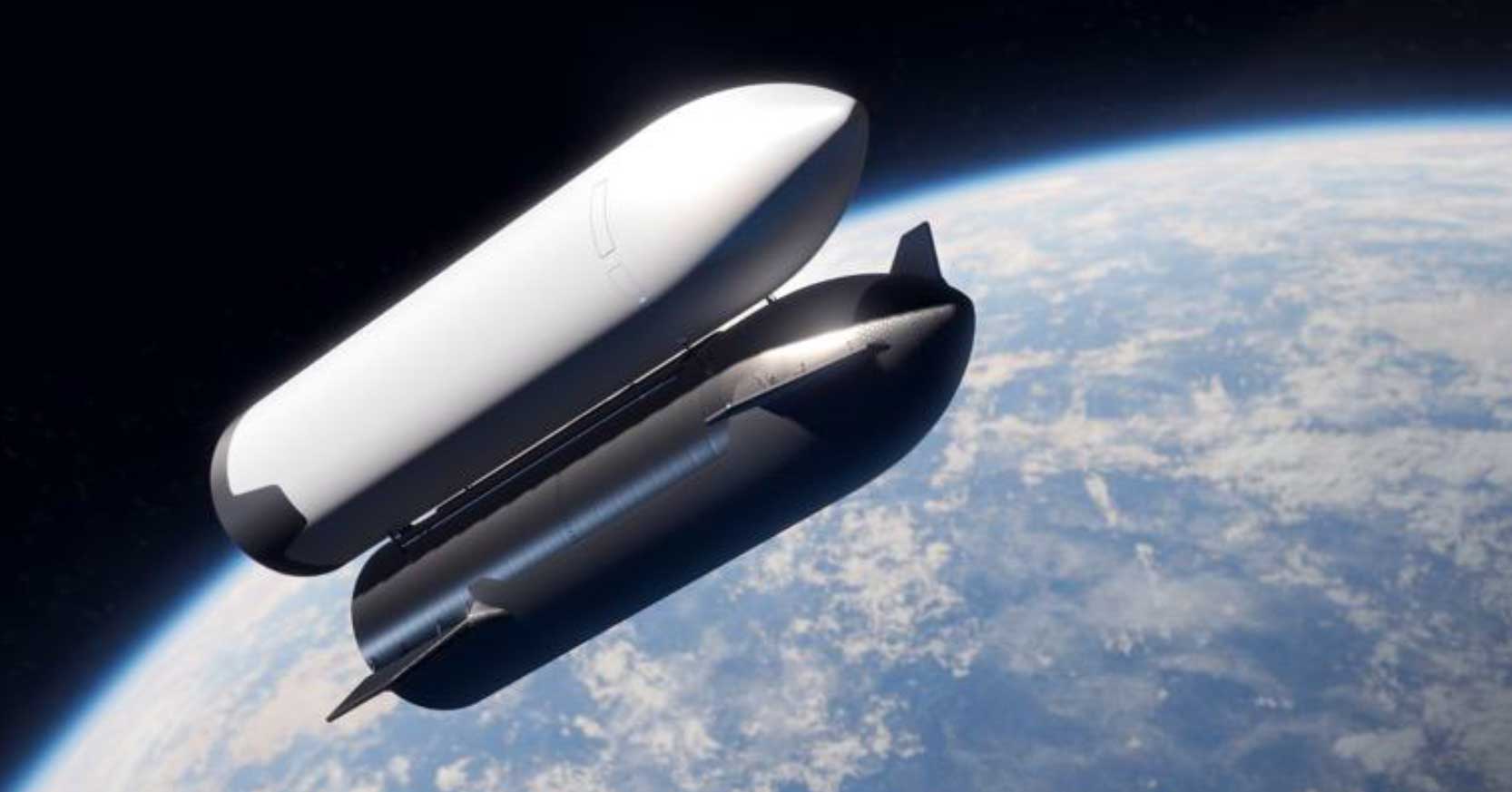
In-orbit refueling remains one of the main challenges for rolling out the Starship program before reaching the Moon.

© SpaceX

What are the crucial milestones remaining for upcoming test flights?

Achieving a simultaneous double catch and validating in-orbit propellant refueling

Although catching Ship is a success, the Starship program still has several technical milestones to pass before becoming fully operational. The first goal of upcoming tests will be to achieve the simultaneous catch of both stages (Super Heavy and Ship) during a single mission. Regarding accommodations for crewed flights, SpaceX is continuing ground assembly of the “Cabin 1” prototype, intended to validate the crew cabin and life support system required by NASA. The most complex engineering challenge remains demonstrating cryogenic propellant transfer in Earth orbit. To carry missions to the Moon, Starship will have to refuel at an orbital depot supplied by several tanker ships. While Elon Musk estimates that six to eight tanker launches will be enough, some experts on NASA’s Aerospace Safety Advisory Panel (ASAP) mention up to 22 flights required. But SpaceX has even bigger ambitions for its spacecraft, presented as the one that will make the human species multiplanetary, but which will serve above all to place Starlink satellites or, eventually, data centers into orbit. First, the company is already considering a V4 version, even larger and more powerful. “Starship V4 will be about 70 m long, representing an increase of about 40% in length and allowing more than 60% additional propellant to be loaded,” Elon Musk detailed in a post on X a few hours ago. “The engine count will increase to 9, with 3 additional Raptor-Vacuum engines added, and these will be higher-thrust V4 engines.” As for flight rate, the SpaceX boss had already mentioned more than 10,000 launches per year! Before Starship, NASA had developed the first reusable spacecraft, the American space shuttle that flew between 1981 and 2011. At the time, the agency aimed to fly each shuttle two weeks after its return, a goal never achieved. In practice, it took several months, with the shortest interval between two flights being 50 days for Atlantis in 1985.

Related articles
