
• Solar System

Japanese probe Hayabusa2 changes target after engine failure

Published on 18 November 2026

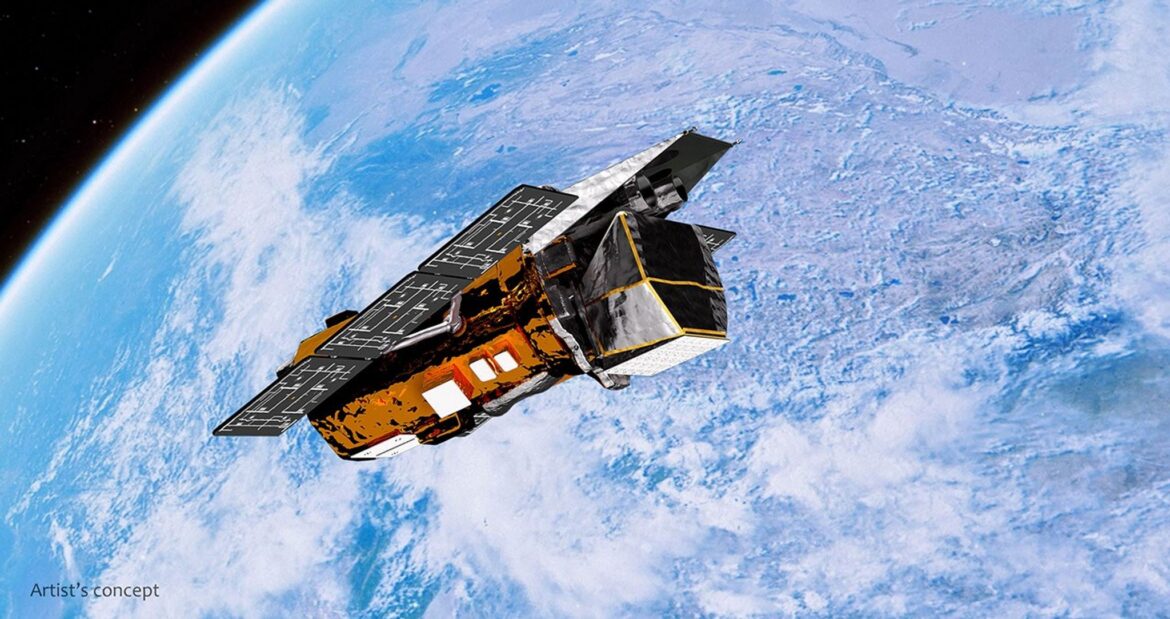
Due to a propulsion issue, the Japanese probe Hayabusa2 will not be able to land on its planned asteroid. Following its successful sample return in 2020, JAXA is adapting its mission and now targets a flyby of 2015 BM510 in April 2028.

Japanese probe Hayabusa2 changes target after engine failure

The Japan Aerospace Exploration Agency (JAXA) is shifting the objectives of its famous Hayabusa2 space probe. After its successful sample collection in 2019 and its flyby last July of asteroid Torifune, the probe was set to land on asteroid 1998 KY26. However, anomalies in its ion engines prevent the landing initially scheduled for July 2031. The Japanese agency has therefore chosen a new target: a close flyby of asteroid 2015 BM510 in April 2028.

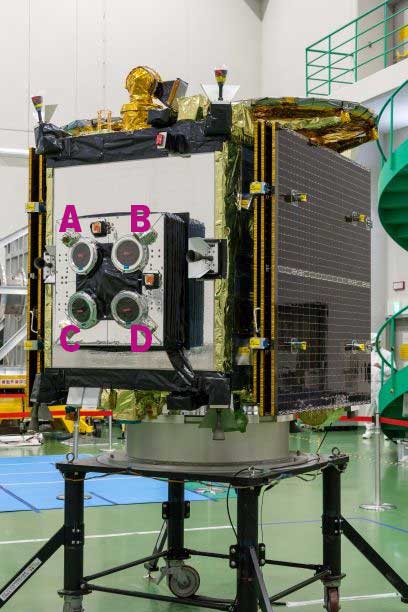
The four ion engines ABCD. The ion emitter part of engine D was coupled with the distributor part of engine B to keep propelling the probe.

© JAXA / Cité de l’espace

Why must the Hayabusa2 probe modify its trajectory?

Technical issues with ion propulsion require a course change.

After passing asteroid Torifune on July 5, 2026 at a distance of about 400 meters, the probe was supposed to adjust its orbit through continuous thrust and reach asteroid 1998 KY26. A landing on its surface was even planned for July 2031. However, the spacecraft’s ion propulsion system experienced abnormal electrical discharges that disrupted its operation. Notably, Hayabusa2 originally set off with 4 xenon-fueled ion engines. These are very fuel-efficient engines designed to accelerate the probe very gently, over years. Little by little, however, they shut down, and this summer engine D suffered an electrical failure. To avoid losing the probe, JAXA engineers combined the ion emitter part of engine D with the electron distributor part of engine B. This is called a “cross mode”. It works, though no one knows how long this high-tech workaround will hold up. The technical team therefore preferred to revise its flight plan in order to preserve the probe. “Unable to predict how far we can go with the cross-mode operation of the ion engines, we decided to adopt a reliably achievable plan by making the best use of Hayabusa2’s current state,” explained Yuya Mimasu, leader of the probe’s extended mission team at JAXA’s Institute of Space and Astronautical Science, during a press conference. “We have made the decision to carry out a new exploration via a flyby of asteroid 2015 BM510.”

An unprecedented flyby of asteroid 2015 BM510 planned for April 2028.

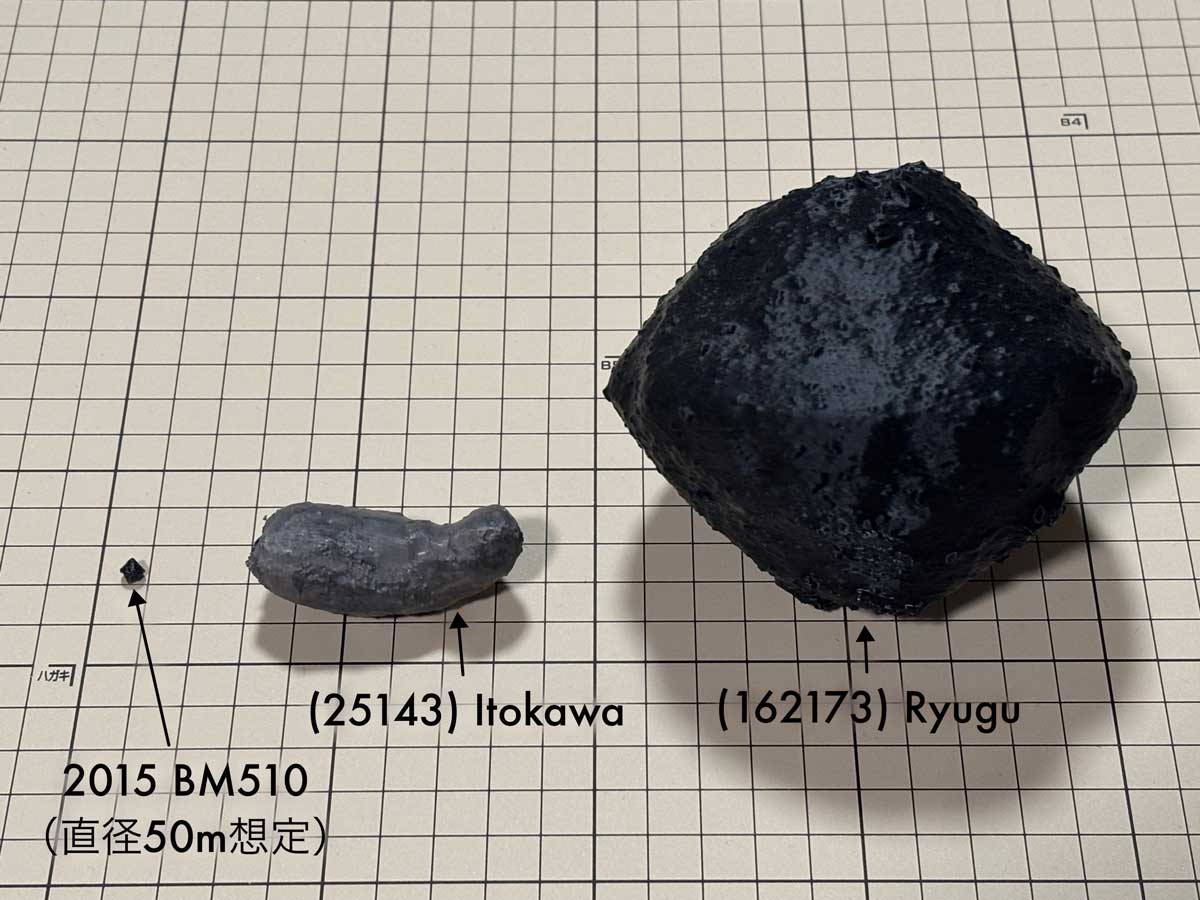
Both are near-Earth asteroids, but the probe’s new target is much larger. 2015 BM510 is estimated to be between 17 and 74 m (compared to 11 m for 1998 KY26), belongs to the very primitive class of D-type asteroids, and completes a rotation in just 49 minutes. Very dark, these objects contain materials with high chemical freshness. This flyby will represent the first close-up observation of an asteroid of this type. “If we manage to get within a few hundred meters, we will be able to obtain images of the asteroid at very high resolution,” says Makoto Yoshikawa, member of the Hayabusa2 extended mission team at JAXA.

From left to right: Makoto Yoshikawa, member of the Hayabusa2 science team, Yuya Mimasu, head of the extended mission team at ISAS/JAXA, and Ryudo Tsukizaki, propulsion system specialist at JAXA, during the November 17 press conference.

© JAXA

Asteroid 2015 BM510 is much smaller than Ryugu, on which Hayabusa2 performed a “Touch & Go” in 2019, making it difficult to spot before the flyby.

© Compte X de K.Fukuda

What are the challenges of this asteroid flyby?

Very late optical detection requiring precision autonomous navigation.

The small size and low brightness of 2015 BM510 make it difficult to detect. Unlike Torifune, which could be spotted several days before the flyby, 2015 BM510 will only be visible to the onboard cameras about ten hours before closest approach. The probe will therefore have to adjust its trajectory on its own and point its optical instruments completely autonomously. “It’s a bit like loosing an arrow while taking off a blindfold just at the very last moment,” said Ryudo Tsukizaki, member of the Hayabusa2 extended mission team at JAXA and propulsion specialist. To pull off this encounter, the team will combine partial operation of the ion engines with the firing of chemical hydrazine thrusters.

What are the major achievements of the Hayabusa2 mission?

A historic sample collection on asteroid Ryugu and their return to Earth.

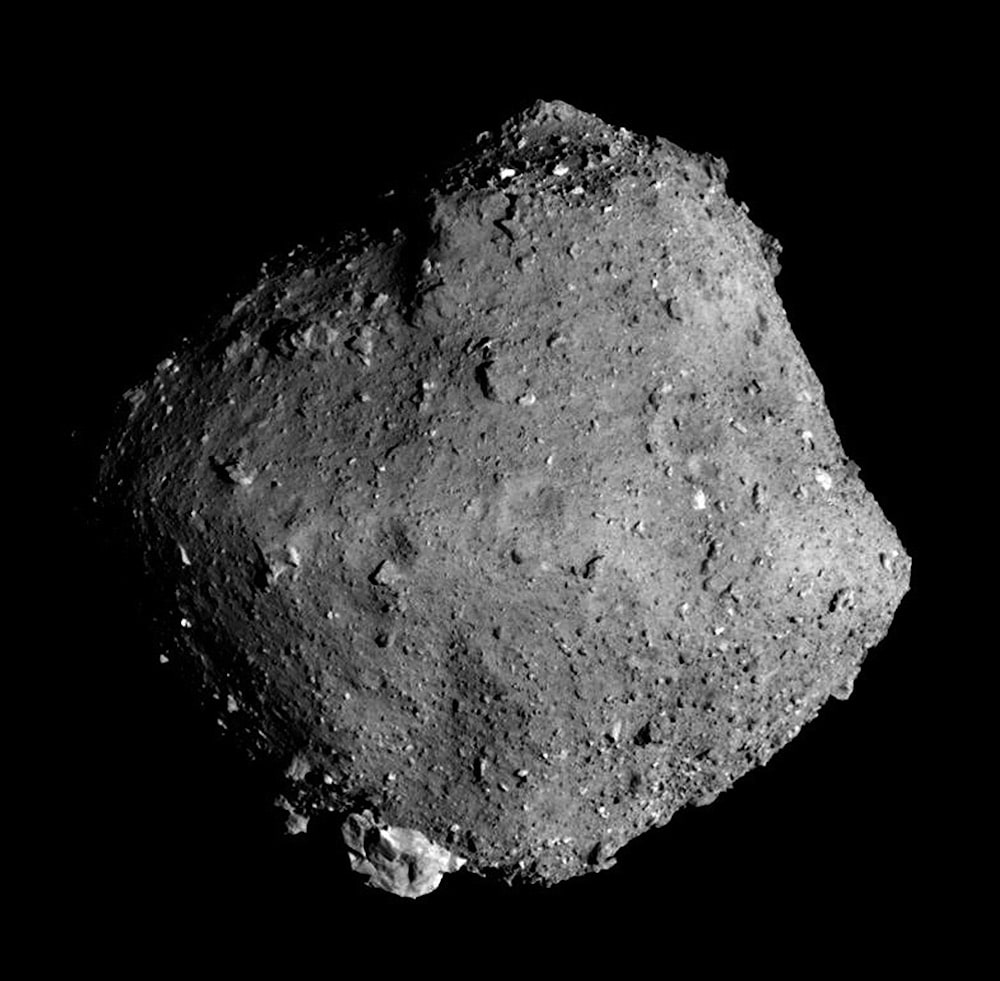
Launched on December 3, 2014, the Japanese probe Hayabusa2 reached the carbonaceous asteroid Ryugu in June 2018 after a three-and-a-half-year journey. During its main mission, the spacecraft mapped the surface and deployed several robots, including the Franco-German lander MASCOT designed by CNES and DLR. Hayabusa2 carried out two material samplings, including one at the bottom of an artificial crater formed by the impact of a projectile. On December 6, 2020, the probe dropped a sealed capsule over Australia containing 5.4 grams of extraterrestrial dust and rocks. These preserved fragments give scientists valuable information about the composition and early moments of the Solar System.

The samples brought back to Earth are from asteroid Ryugu.

© JAXA

An authentic asteroid fragment to discover at the Cité de l’espace

A fragment of Ryugu collected by Hayabusa2 can be seen at the Quai du Système Solaire

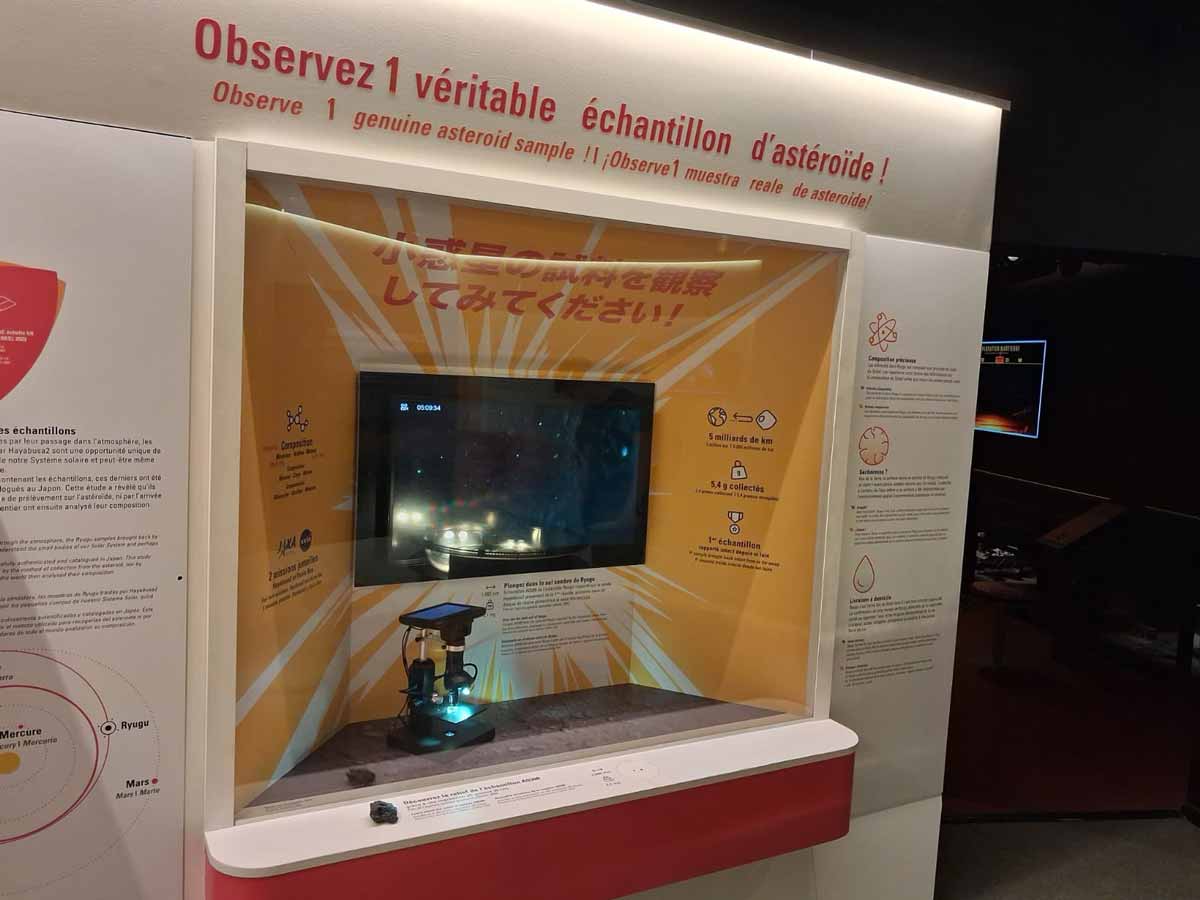
The Cité de l’espace presents to the public an authentic sample collected from asteroid Ryugu by the Hayabusa2 probe. Installed on the first floor of the exhibitions, in the Quai du Système Solaire, this unique sample allows visitors to directly observe material born at the origins of our planetary system. The exhibition also brings together scale models of the MASCOT lander and the Hayabusa2 probe.

The sample of a few mg is placed under an electron microscope to observe its details.

© Cité de l’espace

Related articles