• Crewed Flights

The last two next-generation solar arrays installed on the ISS

Published on 06 November 2026

Astronauts Anil Menon and Joshua Kutryk have finalized the installation of the International Space Station's last iROSA solar arrays to increase electrical output. The first ones had been deployed in June 2021 by Thomas Pesquet and Shane Kimbrough.

The last two next-generation solar arrays installed on the ISS

It is the end of a major project in orbit. As part of the International Space Station’s electrical power upgrade program, American astronaut Anil Menon and Canadian Joshua Kutryk completed two spacewalks in late October and early November. These operations allowed them to install and deploy the last two roll-out iROSA solar arrays. Thanks to these technical operations, the orbital complex now has its optimal power capacity for its final years of service.

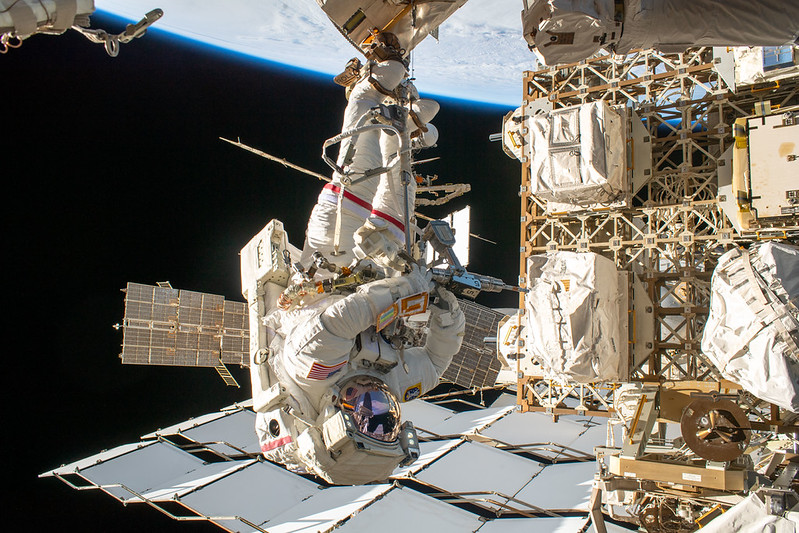
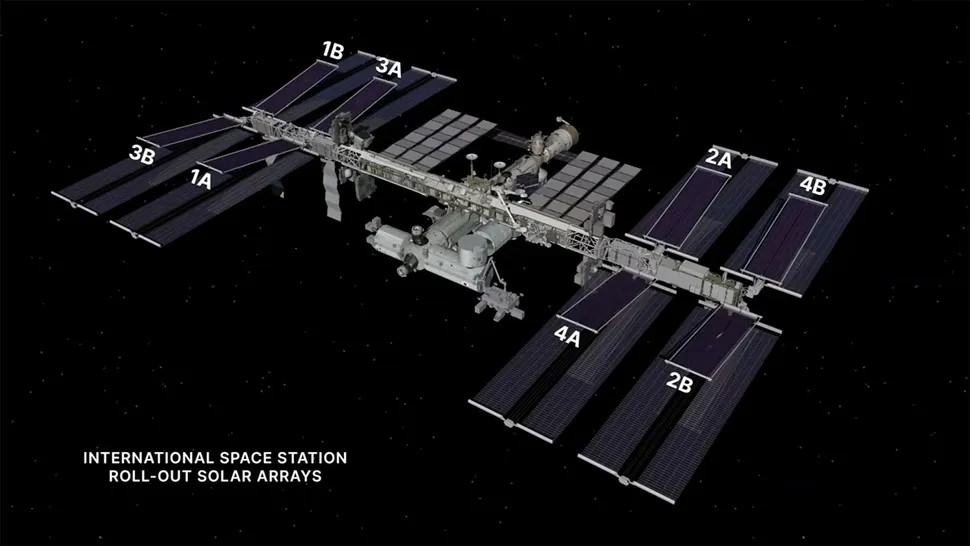
Anil Menon, during the first spacewalk on October 29. Inset, the diagram of the ISS’s eight solar arrays. 2B and 4B had been installed by Thomas Pesquet and Shane Kimbrough in June 2021. 3A and 4A were deployed by Americans John Cassada and Frank Rubio in December 2022. 1A and 1B were installed in June 2023 by Americans Steve Bowen and Warren Hoburg. That left 2A and 3B, which are now equipped as well.

© NASA

Deployment in orbit

Two consecutive spacewalks for the Expedition 75 crew

The first spacewalk took place on October 29, 2026 and lasted 7 hours and 11 minutes. During this mission, NASA astronaut Anil Menon and Canadian Space Agency astronaut Joshua Kutryk installed the seventh iROSA array on power channel 2A located on the port truss of the station. The second spacewalk, carried out on November 5, 2026, lasted 6 hours and 59 minutes. During this 101st U.S. spacewalk conducted from the ISS, the two crew members attached the eighth and final iROSA array on channel 3B of the starboard truss, this time. At the end of this second operation, Anil Menon, who had already taken part in the communication antenna replacement operations alongside Sophie Adenot in late August, confirmed completion of the task. “We did it!” he exclaimed. He also highlighted the scope of this teamwork. “Today marks the culmination not just of one solar array, but of eight arrays, more than 15 years after their development began.” And it was not without hurdles. During the November 5 spacewalk, the team encountered a technical anomaly. “We only see half the shunt current expected. In this current configuration, we’re not necessarily going to deploy,” announced Nichole Stilwell, lead spacewalk officer at NASA’s mission control in Houston. As a safety precaution, the astronauts therefore had to wait for the station to pass into Earth’s shadow to inspect the connectors and avoid any electrical hazard. Once the issue was resolved, Nichole Stilwell gave the go-ahead. “We see good shunt currents on the ground, you are go for deployment.”

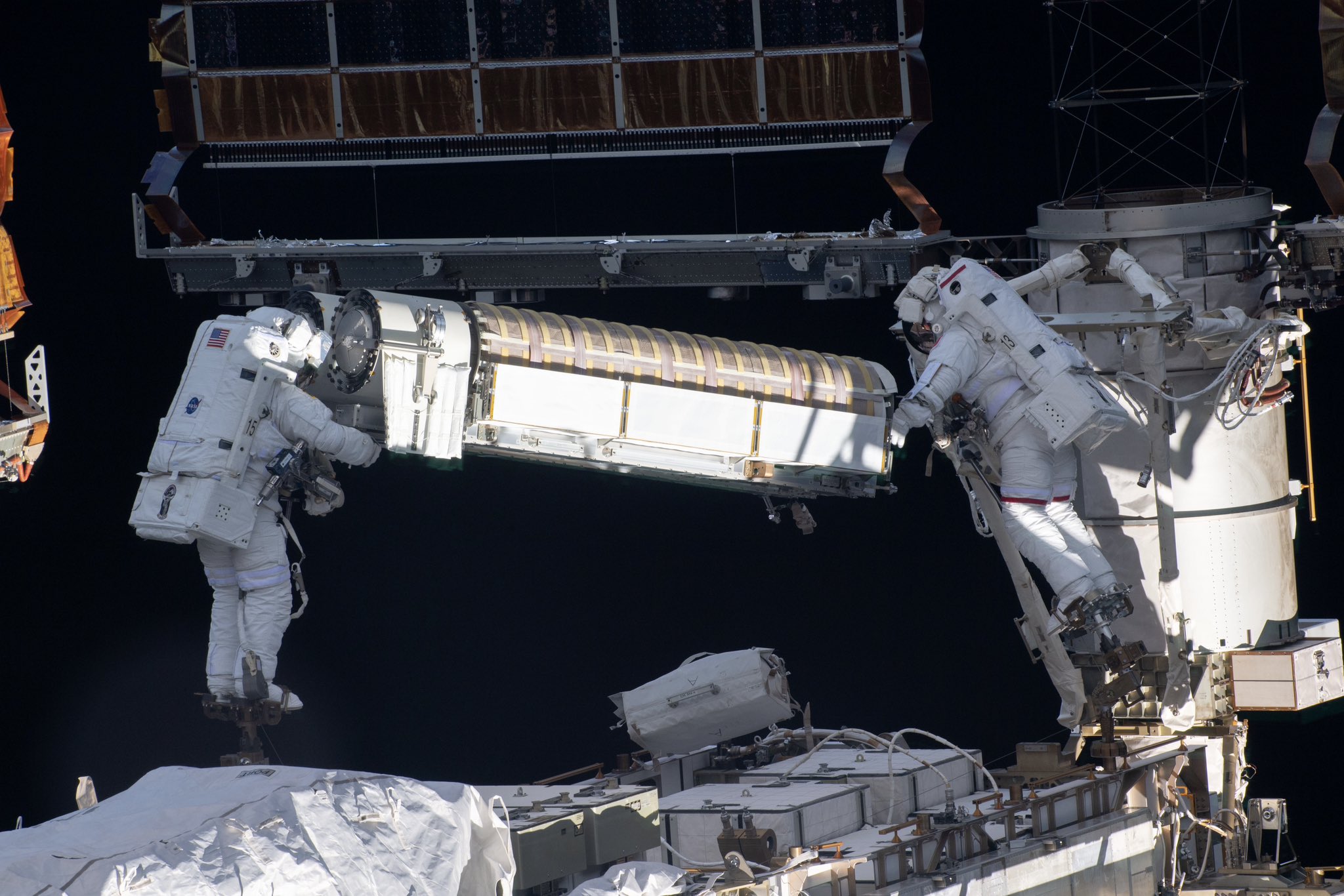
The iRosa arrays are shorter than the previous ones, but 30% more efficient. They are installed over the old solar arrays.

© NASA

Optimizing electrical output

How do these giant arrays work?

With a mass of 340 kilograms and a length of 19 meters once deployed, each iROSA array uses the potential energy stored in its carbon structures to roll out without a motor. This equipment was delivered to the station by SpaceX Dragon cargo spacecraft. They are installed directly over the aging original solar structures thanks to mounting kits attached to the ISS’s central truss. Although twice as small as the original arrays, they increase the station’s overall electricity production by about 30%, raising available power from 160 to nearly 215 kilowatts. When astronauts loosen two tension bolts during a spacewalk, the array unrolls automatically under the mechanical force of the structure, in just about ten minutes.

KSC-20260811-PH-RCR01_0191_medium

The iRosa arrays are rolled up and launched by cargo toward the ISS. Once attached, they unroll on their own in about ten minutes.

© NASA

In June 2021, Thomas Pesquet, on the right, and Shane Kimbrough had installed the first two next-generation iRosa arrays.

© NASA / ESA

18 spacewalks to give the station a facelift

Installing all eight of these iROSA structures required 18 spacewalks since the program began in 2021. In June 2021, Thomas Pesquet had taken part in three spacewalks, as lead, with Shane Kimbrough, to install the first two solar arrays of this new generation. This power increase had become necessary due to the progressive degradation of the original arrays, which had exceeded their initial 15-year design life. The energy boost from these new arrays will keep scientific equipment and onboard systems running. This electrical reinforcement thus ensures the continuation of International Space Station operational activities until its retirement and controlled deorbiting, planned in the 2030s.

Related articles