
• Earth

August 2026: the hottest month

Published on 11 September 2026

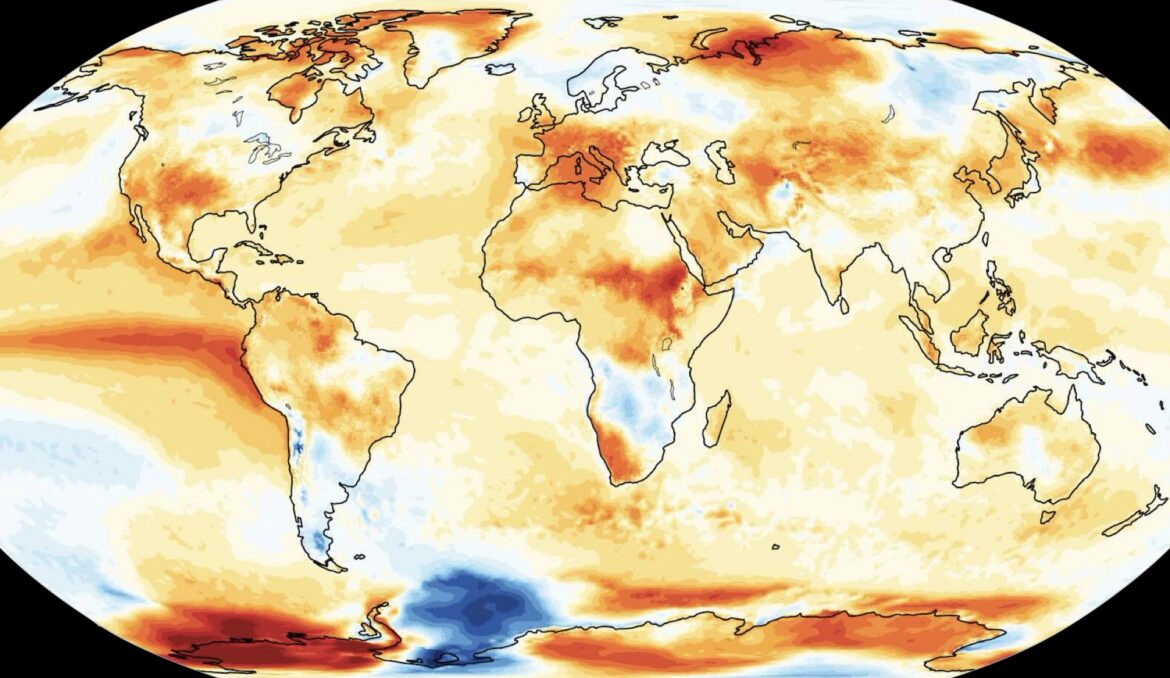
August 2026 stands out as the hottest month ever recorded. Higher than average temperatures affected Europe, for example, but also all the oceans.

August 2026: the hottest month

Initiated by the European Commission, Copernicus is an Earth observation program . Its space component relies on several Sentinel satellites that provide complementary data to monitor our planet (temperature, sea level, radar readings, and atmospheric analysis). At the International Space Summit held in Paris on September 9 and 10, the importance of the data collected, as well as its free and open access, were reaffirmed. Europe thus has an independent and unparalleled tool at its disposal, which notably allows it to monitor climate change .

Heat record for August 2026

The findings come from the Copernicus Climate Change Service (C3S ), one of the services of the European Commission’s Copernicus Programme and implemented by the European Centre for Medium-Range Weather Forecasts (ECMWF). This centre comprises 22 European countries and 12 associated nations.
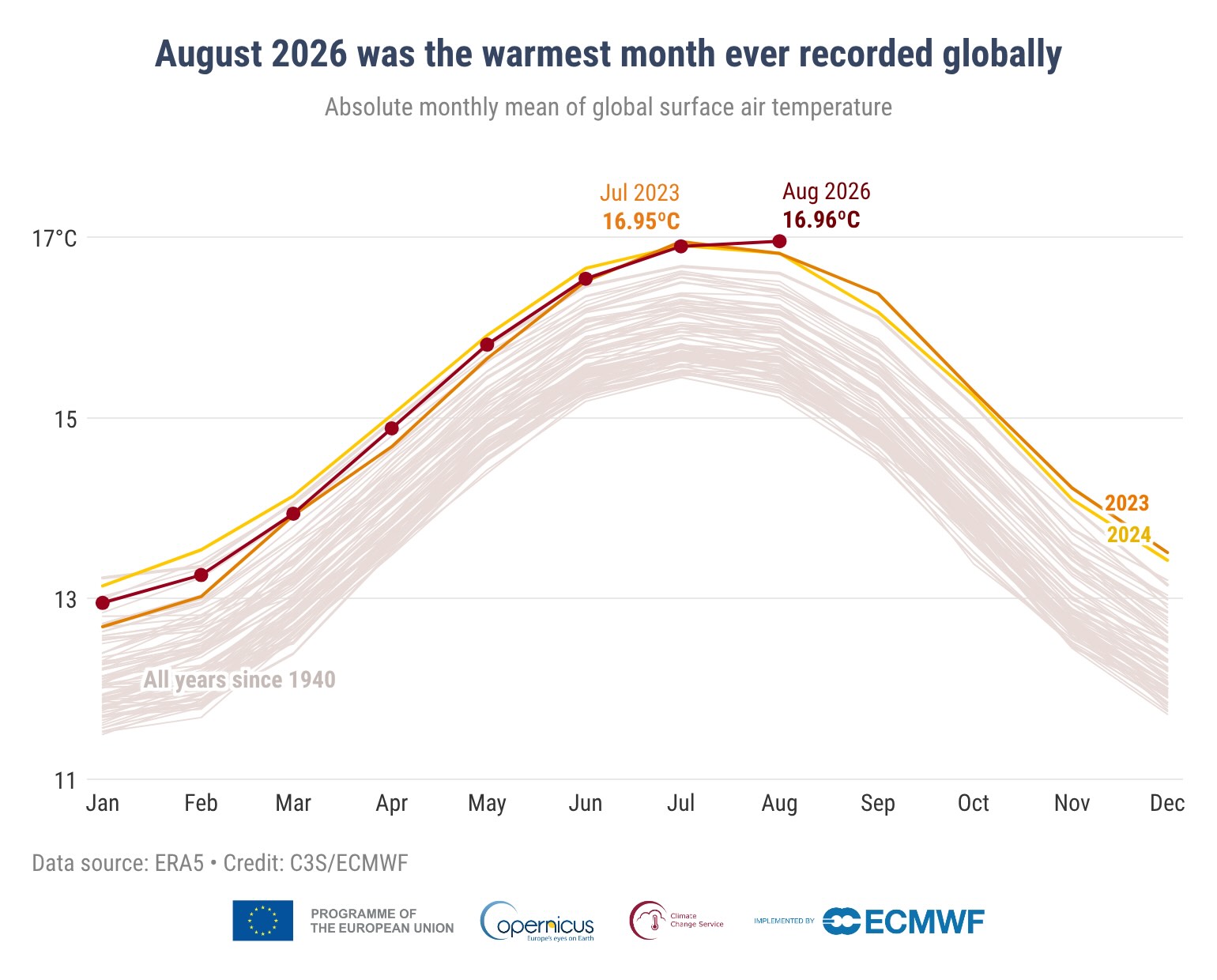
With a global average temperature of 16.96°C, August 2026 is, first of all, the hottest August ever recorded since 1940 , as shown in the diagram opposite. This is 0.85°C above the 1991-2020 average for August.
Most importantly, and C3S emphasizes this, August is also the hottest month (of any month) since records began in 1940, whereas August normally shows a decrease in global temperature after a peak in July.

Global Earth temperature curves since 1940. 2023 is orange, 2024 is yellow, and 2026 is dark red. Note that August 2026 does not show the usual decline and surpasses the record set in July 2023.

© C3S/ECMWF

AN UNUSUAL SITUATION

Admittedly, at 16.96°C, it is only 0.1°C warmer than the 16.95°C of July 2023 (the previous record), but this situation is described as “unusual“, August is normally expected to be less hot than July.

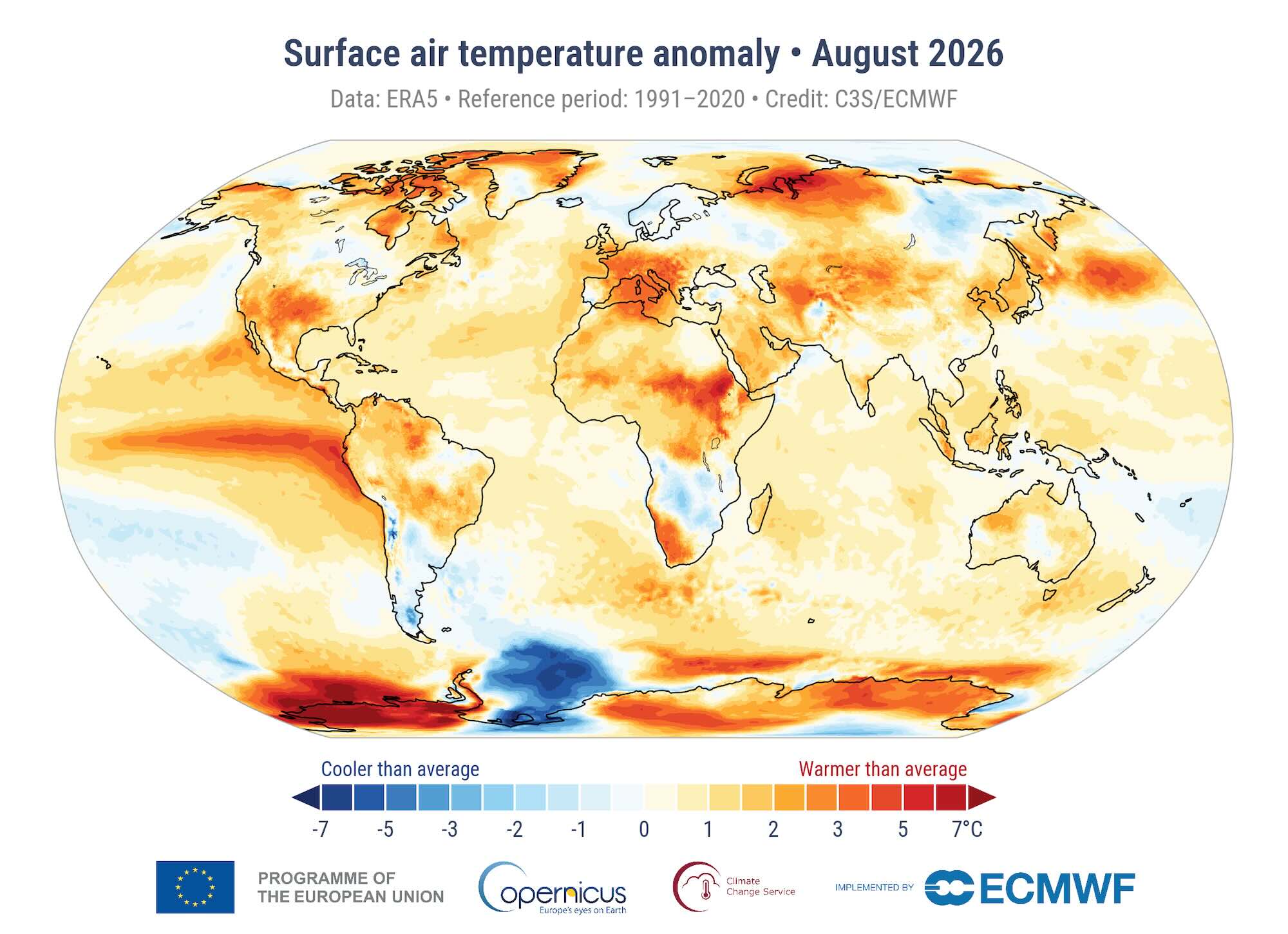
Temperature anomaly map for August 2026. Blue indicates lower anomalies and red indicates higher temperatures compared to a reference period from 1991 to 2020.
© C3S/ECMWF

1.65°C ABOVE THE PRE-INDUSTRIAL PERIOD

While this heatwave is affecting the entire planet (see map opposite), the regions experiencing the most pronounced temperature anomalies, according to C3S, are located ” in certain areas of Antarctica, particularly in the western part of the continent, as well as in Central Asia, East Africa, and Western Siberia. ” A few areas with cooler-than-average temperatures are noted across southern South America, a large region of southern Africa, much of eastern Russia, and the region around the Weddell Sea and the Filchner-Ronne Ice Shelf in Antarctica. These exceptions do not prevent the overall assessment from showing a global temperature in August 2026 that is 1.65°C above the estimated pre-industrial average for that month between 1850 and 1900 . This is also the first month above 1.5°C (compared to the pre-industrial average) since November 2025.

HEAT WAVE IN EUROPE

The data also allows us to visualize rising temperature anomalies in Europe .

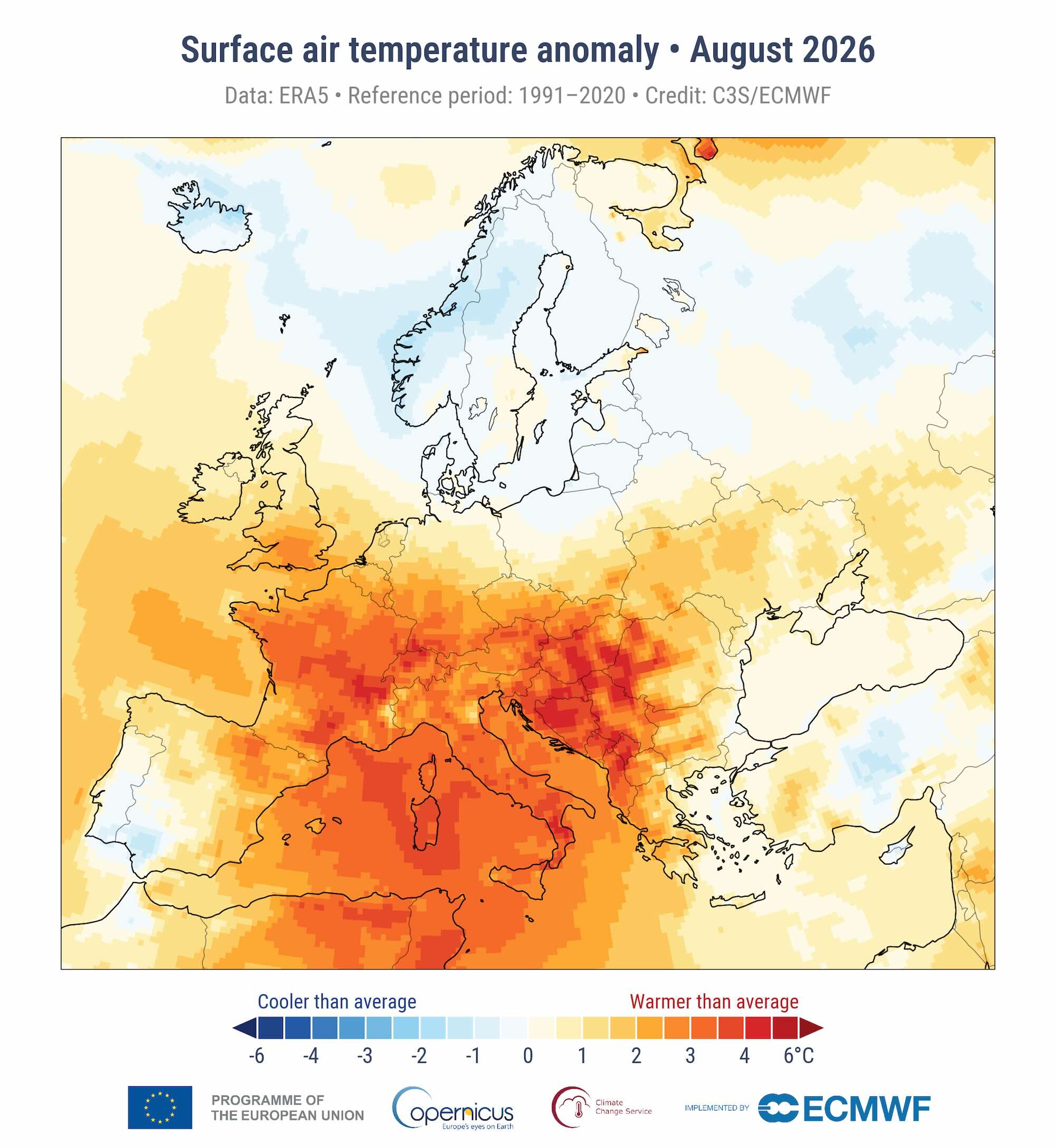
The Copernicus Climate Change Service (C3S) press release states that  “temperatures were significantly above average in France, Italy, Bosnia and Herzegovina, Croatia, Hungary, Romania and much of the Balkans, generally by 3 to 5 °C “.

The organization also concluded that ” this unusual heat was associated with heat wave conditions in certain regions of Europe .”

Map of temperature anomalies in Europe for August 2026 compared to the period 1991-2020.
© C3S/ECMWF

THE OCEANS ARE HOT TOO

August 2026 is the warmest August on record for the oceans extending from 60° North to 60° South (excluding polar regions), with an average temperature of 21.07°C . Indeed, August 2026 breaks the record of 20.98°C set in August 2023.
Furthermore, in this category, August 2026 is also the warmest month overall, tied with March 2024 (March is usually the month with the highest average ocean temperature between 60° North and 60° South).

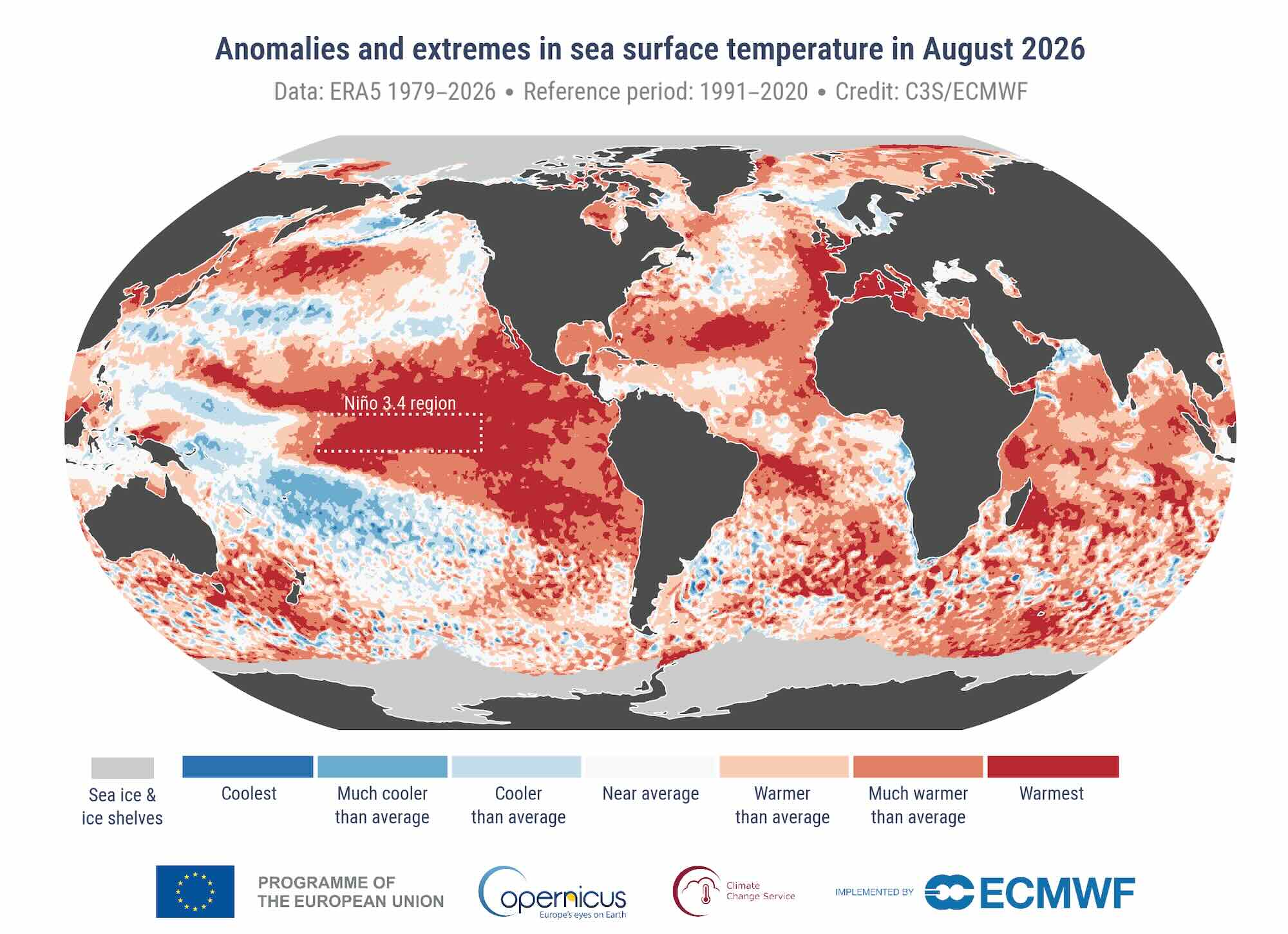
Finally, on August 24th and 25th, the global ocean temperature between 60° North and 60° South reached 21.11°C . This is unfortunately a new record , surpassing the 21.09°C measured in March 2024. For the C3S, these August 2026 conditions ” reflected not only the rapid development of the El Niño phenomenon in the equatorial Pacific, but also record temperatures for the season in many other ocean regions .” High temperatures were also measured along the European Atlantic coast and in the western Mediterranean.

Map of temperature anomalies for all oceans. In the middle left, the dotted rectangle identifies the El Niño zone.
© C3S/ECMWF

Related articles