
Space sovereignty: Europe refines its strategy at the Paris Summit

Published on 10 September 2026

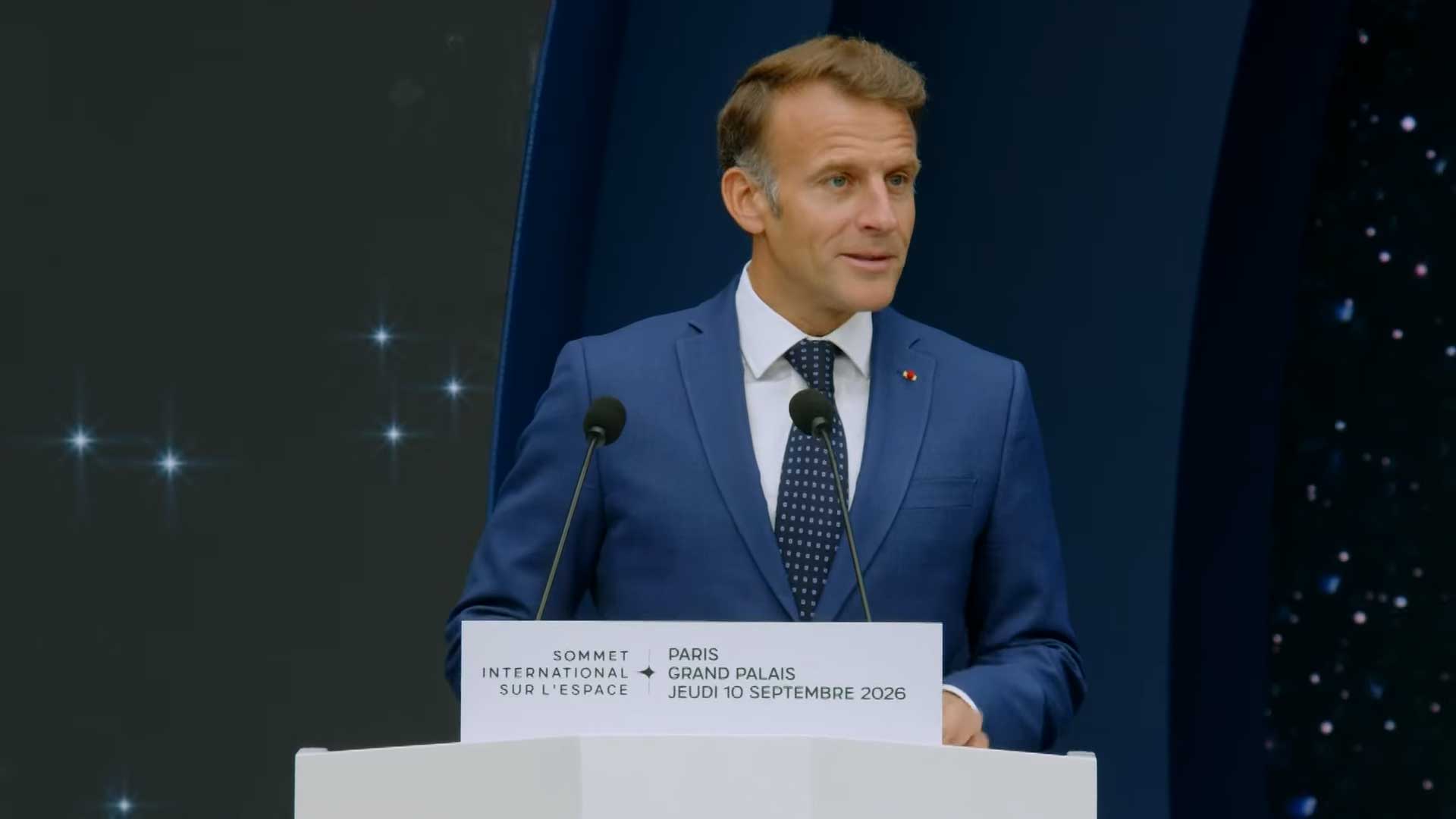
Speaking at the plenary session of the Paris Space Summit, Emmanuel Macron called for better regulation of orbits and greater European sovereignty. He called for increased cooperation, an end to the principle of geographic return, and preferential European procurement.

Space sovereignty: Europe refines its strategy at the Paris Summit

On September 9 and 10, 2026 , the Grand Palais in Paris hosted the first International Space Summit, bringing together nearly 2,000 delegates and representatives from some ninety countries. Organized by the French and German governments, this event aimed to foster dialogue on orbital traffic management, the sustainability of space activities, and European competitiveness . Despite the absence of American giants like SpaceX and Blue Origin , as well as German Chancellor Friedrich Merz, the summit reaffirmed key priorities and resulted in the signing of contracts . This marked a first step in a schedule of upcoming international negotiations and budgetary decisions .

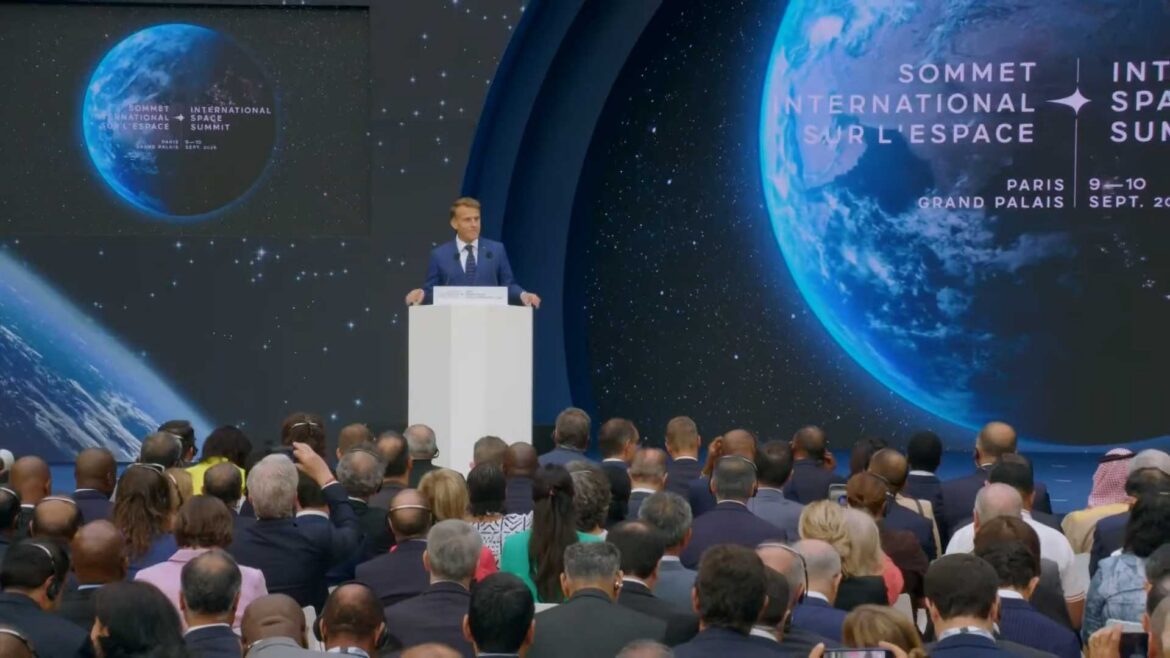
With just a few months left in his term, the French president said he hoped to see a European cargo ship fly within two years, the Argonaut cargo ship land on the Moon within five years and above all a manned flight take off from Kourou within ten years.

© Screenshot from the Elysée’s YouTube channel.

Governance and regulation of activities in orbit

Declarations of intent on space security and data sharing

During the proceedings, three joint declarations were presented by the participating community. The first addressed space safety and sustainability , reaffirming the central role of the United Nations committee and advocating for a conference on orbital traffic coordination to limit the risks associated with space debris . ” Clarity compels us to say that space is no longer a sanctuary ,” explained Emmanuel Macron in his speech. ” Despite the 1967 treaty, outer space remains the only major global commons that is not subject to regulation commensurate with the challenges. ” It is well known that regulating debris and satellite constellations is not to the liking of the United States and China. This appears to be one of the points that led SpaceX to cancel its participation.

The second statement concerns the continuity of the Copernicus Earth observation program as an open and accessible service . The third addresses the principles of access, openness, and integrity of space-based scientific data. The French president also reiterated the importance of multilateral alliances. ” Our space ambition is credible, but any future ambition will only be built through cooperation and never in isolation .”

Industrial announcements and financial commitments

Commercial partnerships concluded between public and private actors

The summit allowed companies and institutions to formalize some fifty agreements and contracts, representing a total value exceeding €20 billion . Among these commitments is the contract between Amazon and Arianespace for the launch of constellation satellites. Indeed, despite the absence of Blue Origin, Jeff Bezos still seems to have faith in Ariane 6. Six new launches will be added to the 18 already signed. It must be said that, lacking a launch pad since the explosion of a booster at New Glenn last June, the company no longer has access to orbit and will prefer to focus on the Moon as soon as its operations can resume .


Another significant announcement was the €450 million fundraising round for The Exploration Company . Its founder, Hélène Huby, was one of the summit’s “special envoys” alongside Thomas Pesquet . The President of the Republic also announced industrial agreements between Eutelsat and Skyopi, as well as between MaiaSpace , Loft Orbital, and the Emirati fund IHC. In parallel, Dassault and OHB formalized their collaboration on the Vortex S project, a cargo spacecraft that could eventually transport astronauts. Thales Alenia Space , for its part, announced that it had signed a protocol with Eutelsat to provide secure digital payloads for the 330 satellites of the Iris² constellation, which is intended to ensure European sovereignty in the field of satellite internet. This contract is worth €500 million. The summit also provided an opportunity to showcase new projects, such as Venturi Space’s Alta Luna model . This rover could enable astronauts to perform maintenance tasks on future lunar bases.

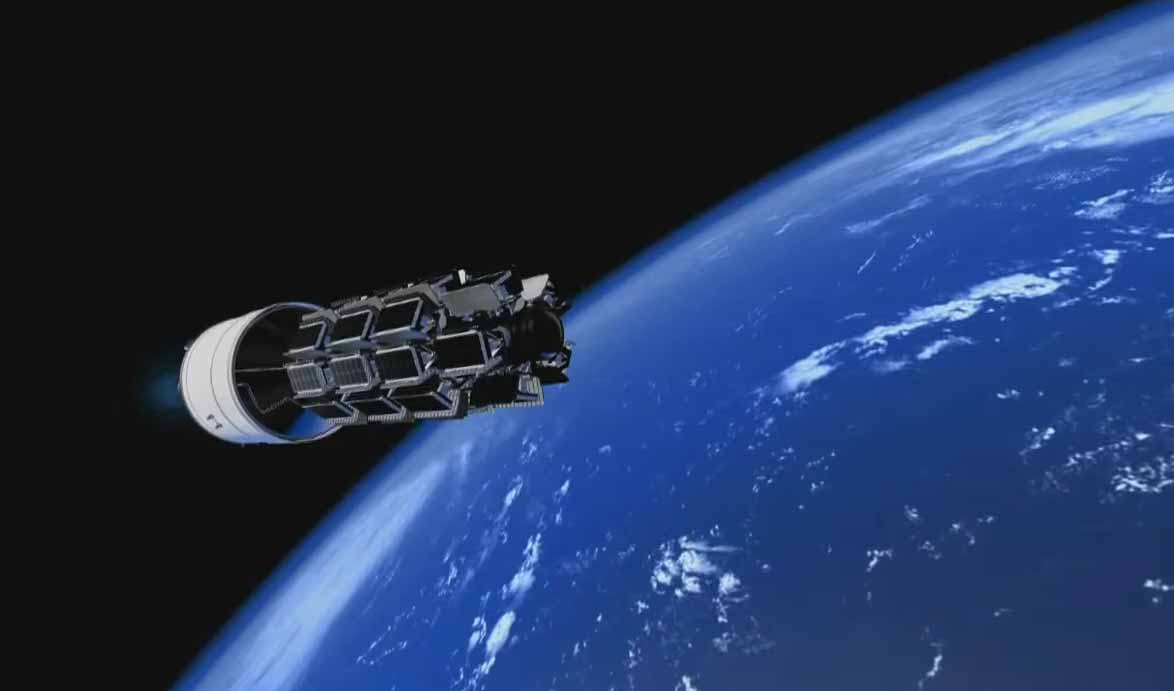
Amazon has reached an agreement with Arianespace. Six additional flights are planned to deploy the Amazon Leo satellite constellation.

© Arianespace

2000 delegates representing 120 countries were represented at the International Space Summit at the Grand Palais in Paris.

© Screenshot from the Élysée Palace’s YouTube channel

20 billion invested until 2030

In terms of national priorities, France reaffirmed its intention to invest €20 billion in the space sector by 2030 , through the France 20230 program, as well as the military programming law and the research programming law, including an additional €40 million in funding allocated by CNES for Earth observation . Emmanuel Macron also took a stand against the principle of “geographical return.” This mechanism guarantees that every euro invested by a country is spent in that country’s industry. While this mechanism slows down the process, it has enabled the development of the European space sector in recent decades. For the French president, however, European preference must be promoted. ” To strengthen the industrial ecosystem,” he stated, “we must dedicate the entire European institutional market to it without exception and direct public procurement towards our companies . “

For her part, Ursula von der Leyen, President of the European Commission, reiterated the strategic necessity of independent investment. ” Some capabilities are so important that we cannot always depend on other countries .” The European Commission is proposing, in particular, to aggregate demand for institutional launches and to include a €131 billion fund for space defense and security in its upcoming budget proposal, while also expanding the Iris² secure telecommunications constellation to more than 350 satellites by 2029.

European ambitions and roadmap for manned flights

EU and ESA Exploration Calendar and Strategic Visions

Space exploration and human presence in orbit were the subject of specific objectives, announced by Emmanuel Macron . The roadmap presented by the French authorities projects the flight of the European Nyx cargo spacecraft to the International Space Station within two years, the landing of the Argonaut lunar module in five years, and the development of a European crewed capsule launchable from Kourou in ten years . For short-term crewed missions, the President of the Republic highlighted the commercial partnership established with the American company Vast . This partnership provides for the deployment of European astronauts into orbit under the command of Thomas Pesquet . Czech astronaut Alès Svoboda and Greek astronaut Andrianos Golemis, who was not among the 2022 reserve astronauts selected , will accompany him under the ESA banner. ” Our shared history is one of explorers. It is this history that unites and distinguishes Europe in this adventure ,” Emmanuel Macron emphasized. “ Our greatest achievements have always been based on cooperation ,” added Ursula von der Leyen. “ This is the European way of doing things: being strong enough to act independently, but having enough confidence to work with others because the best opportunities in space can only be achieved when we work together. ”

For its part, the European Space Agency is preparing for upcoming decision-making meetings, notably the intermediate interministerial meeting scheduled for Rome in December. ” The big question is really: how independent does Europe want to be, how autonomous does it want to be? ” summarized Josef Aschbacher, the ESA’s Director General. Because to live up to these ambitions, all European partners will have to invest more. ” This is a political summit. We expect guidance and messages from political leaders ,” he concluded.

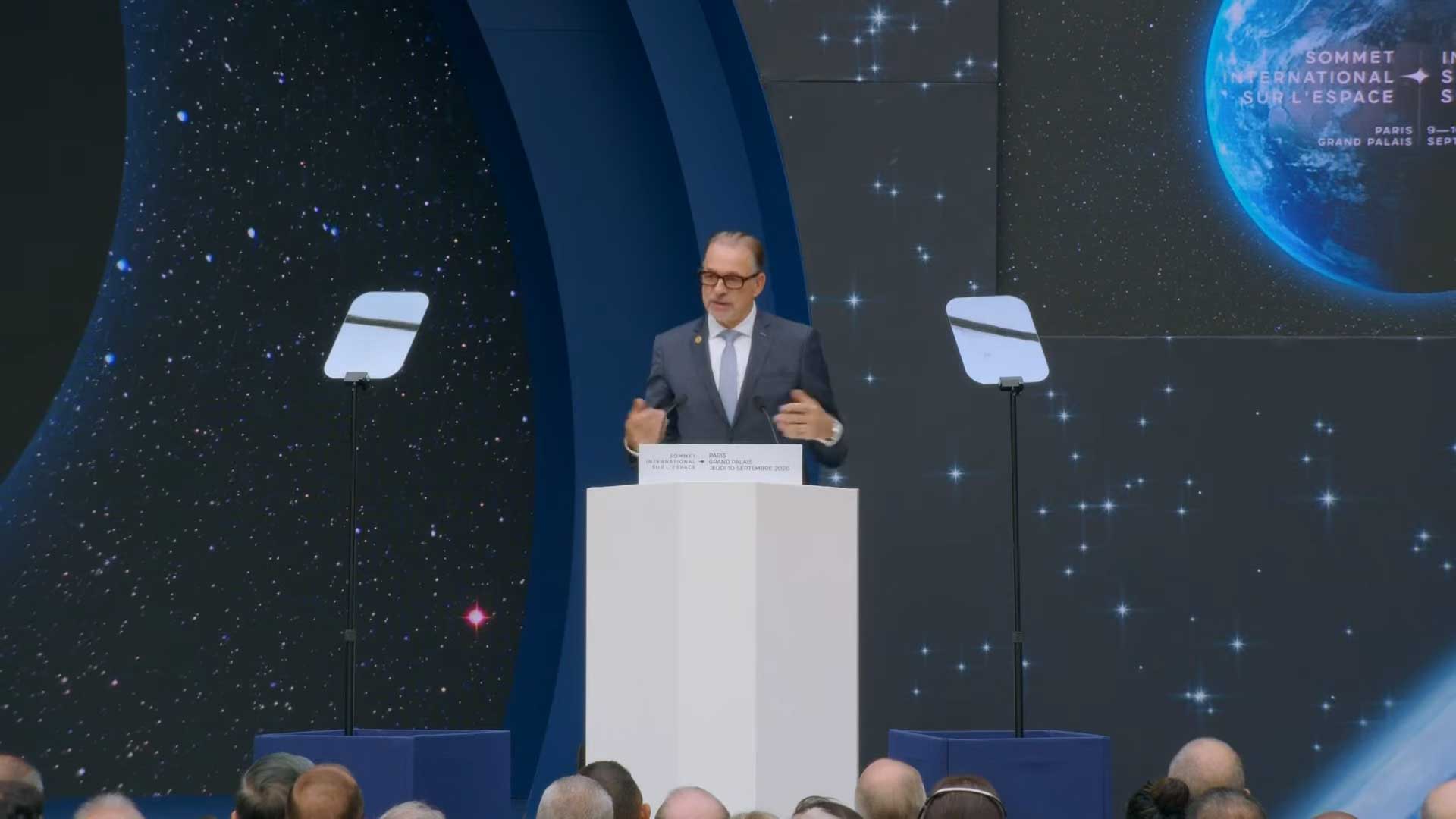
” The big question is really: how independent does Europe want to be, how autonomous does it want to be? ” summarized Josef Aschbacher, the Director General of the ESA.

© Screenshot from the Élysée Palace’s YouTube channel

Related articles