



• Earth

Satellites are monitoring the return of El Niño

Published on 22 June 2026

Earth observation satellites have recently noted a slight rise in the temperature of the waters of the South Pacific which seems to herald the return of El Niño, a phenomenon that favors extreme weather.

Satellites are monitoring the return of El Niño

Thanks to advancements in onboard instruments, satellites tasked with observing our planet are scrutinizing an increasing number of parameters with greater precision. A significant portion of these efforts focuses on weather and climate . Europe has several satellites dedicated to this purpose, including the Sentinel satellites of the Copernicus program, created at the initiative of the European Commission. And recently, measurements taken from Earth orbit seem to indicate the return of El Niño , a rise in temperatures in the South Pacific with global consequences.

EL NIÑO

WHEN THINGS HEAT UP IN THE SOUTH PACIFIC

Closely observed since the late 20th century, El Niño is part of the Southern Oscillation, or ENSO (El Niño-Southern Oscillation). This complex climatic phenomenon alternates between periods known as El Niño (abnormally high temperatures in the South Pacific), La Niña (the opposite, abnormally low temperatures), and a neutral phase. All of this is concentrated in a current that extends from off the coast of Peru to the equator . During an El Niño event, the water temperature in this area of ​​the South Pacific rises above normal, and the current shifts eastward. The consequences are numerous, including rain shifting eastward across the Pacific and blocking the upwelling of cold waters along the South American coast. The effects extend beyond the Pacific region, as El Niño can contribute to extreme weather events such as heat waves, torrential rains, or droughts, depending on the area.
The problem is that, while scientists have indeed identified an ENSO cycle, its periodicity is irregular, with El Niño returning every two to seven years! In short, the best way to prepare for an El Niño event is to detect the temperature variations in the South Pacific that signal its arrival. And for this task, satellites are particularly well-suited.

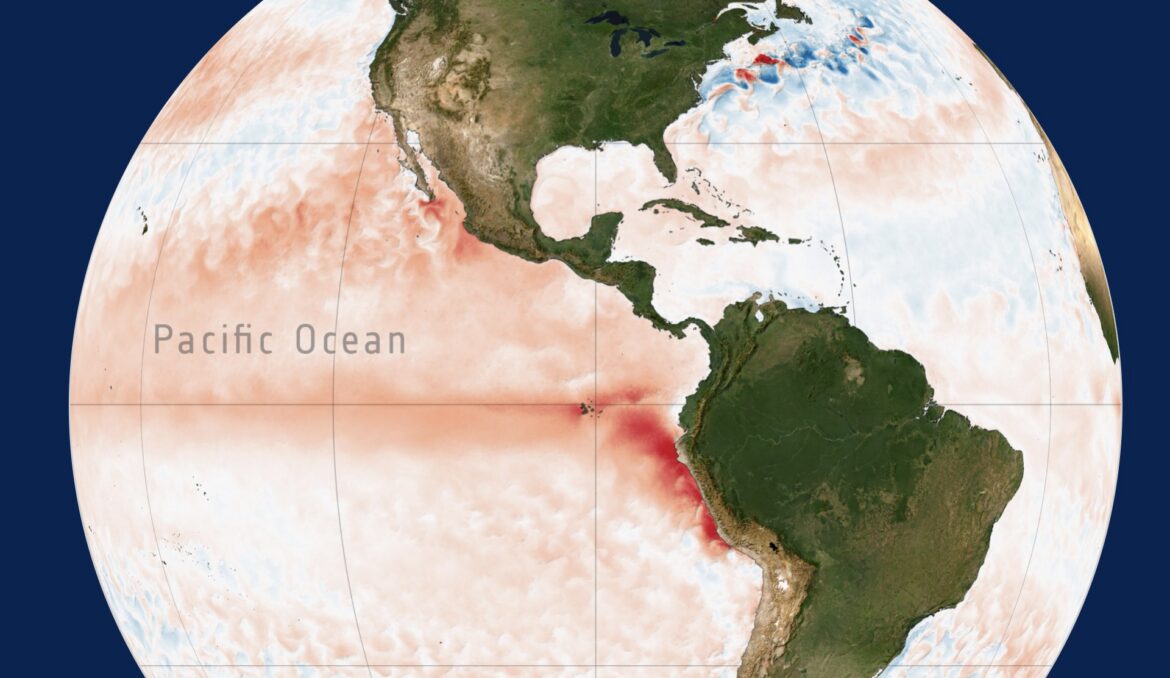
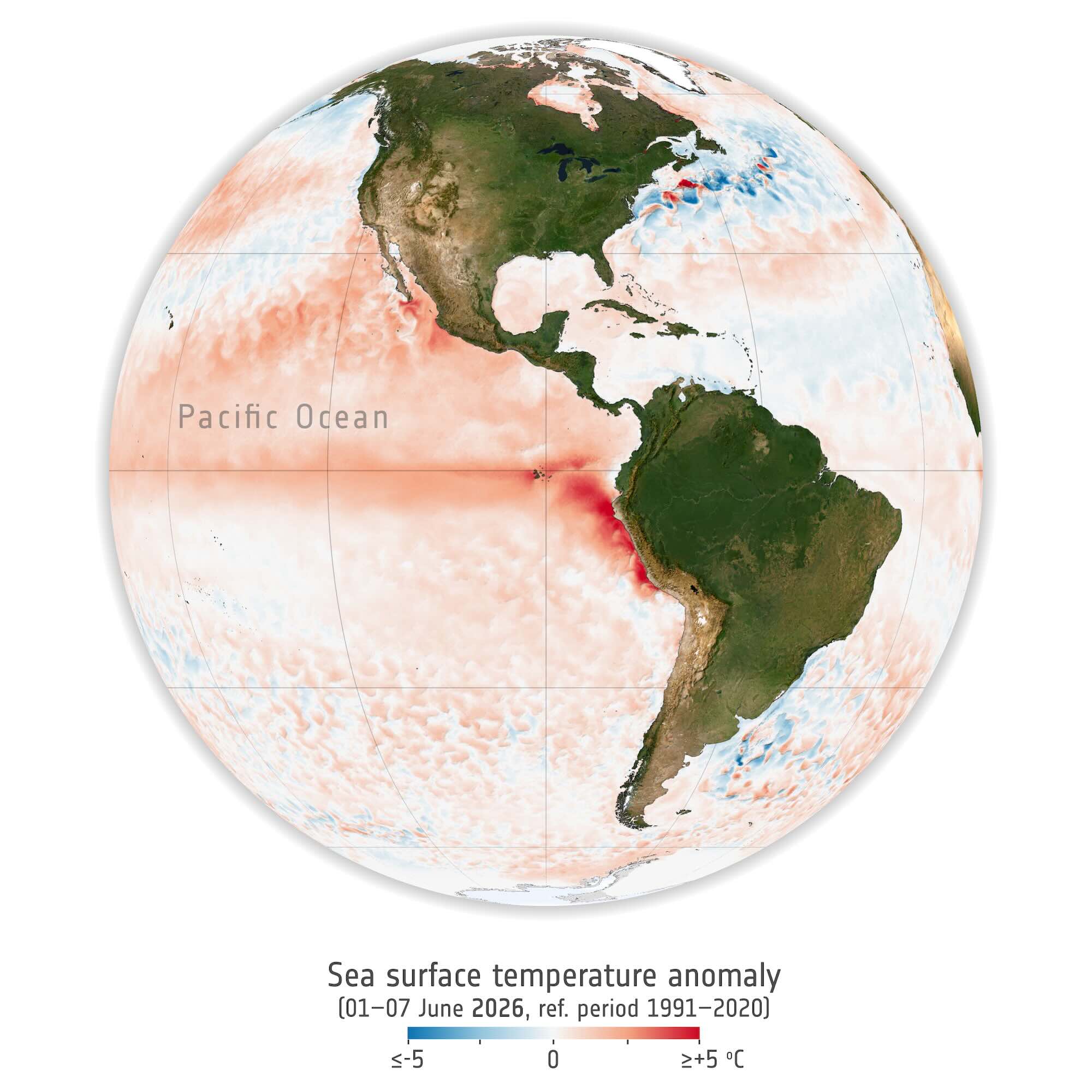
Created using satellite data, this map shows in red the temperature rise anomalies in the South Pacific, a precursor to an El Niño event.
© ESA (data sources: CMEMS/ESA SST CCI)

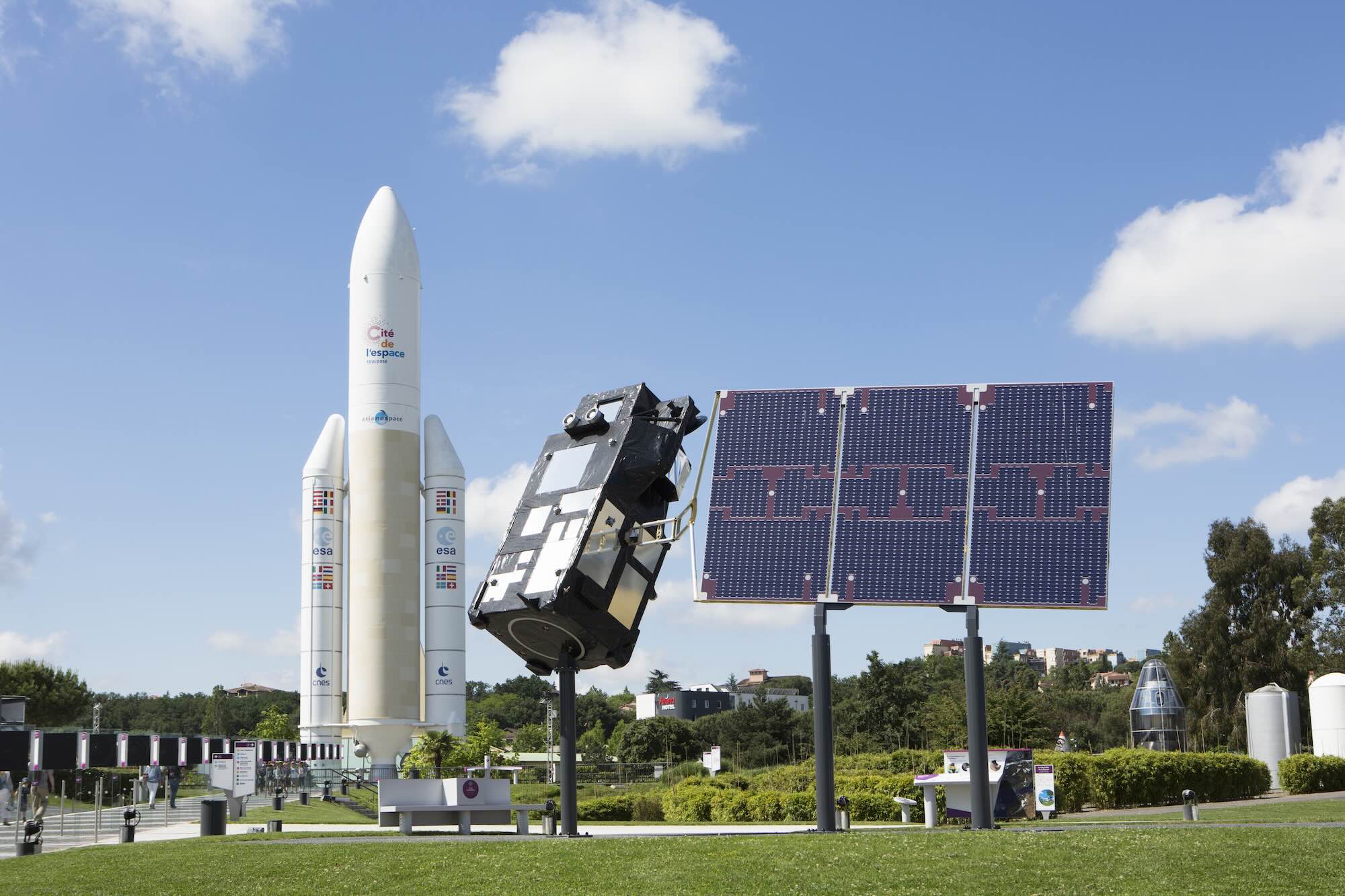
In its gardens, the Cité de l’espace (Space City) in Toulouse displays a full-size model of a Sentinel-3 satellite. Thanks to its instruments, it measures the temperature of seas and oceans with an accuracy of 0.3°C.
© Cité de l’espace/Manuel Huynh

THE SENTINELS OF EL NIÑO

Some satellites, such as the Sentinel-3A and Sentinel-3B twins of the European Commission’s Copernicus Earth observation program , are equipped with instruments that allow for precise measurements of sea temperatures . Craig Donlon, in charge of Earth observation systems at the European Space Agency (ESA), explains that ” El Niño often begins with a subtle change from what is considered normal, and these initial changes are easier to spot compared to a reference model .” Thus, in mid-June, the ESA estimated that El Niño was beginning to return , as satellite data from the beginning of the month indicated an abnormal rise in the temperature of the waters of the South Pacific compared to an average for the same reference period from 1991 to 2020. ” Although the temperature differences may seem small, the ocean stores and exchanges enormous amounts of heat, so even a slight warming can indicate very large changes in the energy flows between the ocean and the atmosphere ,” warns Donlon. 

The effects could even disrupt the jet stream and therefore affect the European continent . Weather forecasts will need to take this factor into account.

Measuring sea and ocean temperatures is so important that, starting this fall, the two current Sentinel-3 satellites will be supplemented by the launch of Sentinel-3C. In addition, other Earth observation satellites provide complementary data (for example, variations in sea level) to more accurately track the intensity of El Niño.

NASA AND NOAA CONFIRM

On June 18, a NASA press release confirmed the ESA data. It stated that, based on measurements from the US-European Sentinel-6 satellite, NOAA (responsible for ocean and atmospheric observations) declared that an El Niño event began on June 11. NASA added that the conditions resembled those of 1997, which saw a very strong El Niño.

Related articles