

• Astronomy

The Nobel Prize in Physics awarded for the search for neutrinos at the South Pole

Published on 07 October 2026

The 2026 Nobel Prize in Physics will be awarded to Francis Halzen for the creation of IceCube at the South Pole. This giant observatory, buried in the ice, captures the rare flashes of light produced by cosmic neutrinos, revealing the most violent events in the Universe.

The Nobel Prize in Physics awarded for the search for neutrinos at the South Pole

The 2026 Nobel Prize in Physics was awarded to Belgian-American researcher Francis Halzen for the design and development of the IceCube neutrino observatory . Located in Antarctica, this giant device detects neutrinos , extremely elusive particles emitted by cosmic phenomena. Traveling through the Universe at speeds close to that of light without being deflected, these particles offer scientists an unprecedented way to study the most distant celestial events.

Francis Halzen, IceCube principal investigator, Vilas Research Professor, and Gregory Breit Professor at the University of Wisconsin–Madison, is photographed in the studio on September 18, 2024. © Althea Dotzour / UW–Madison

What is a neutrino and what exactly does the IceCube observatory consist of?

A phantom particle that passes through matter almost without interacting with it

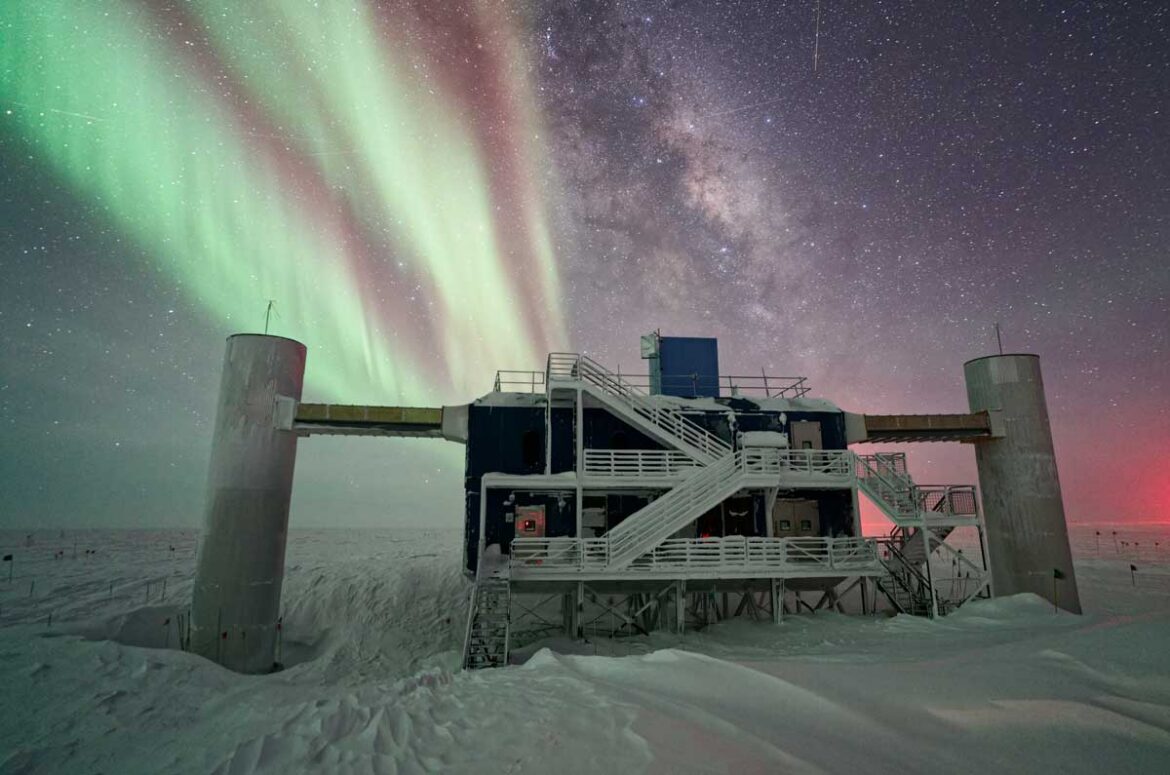
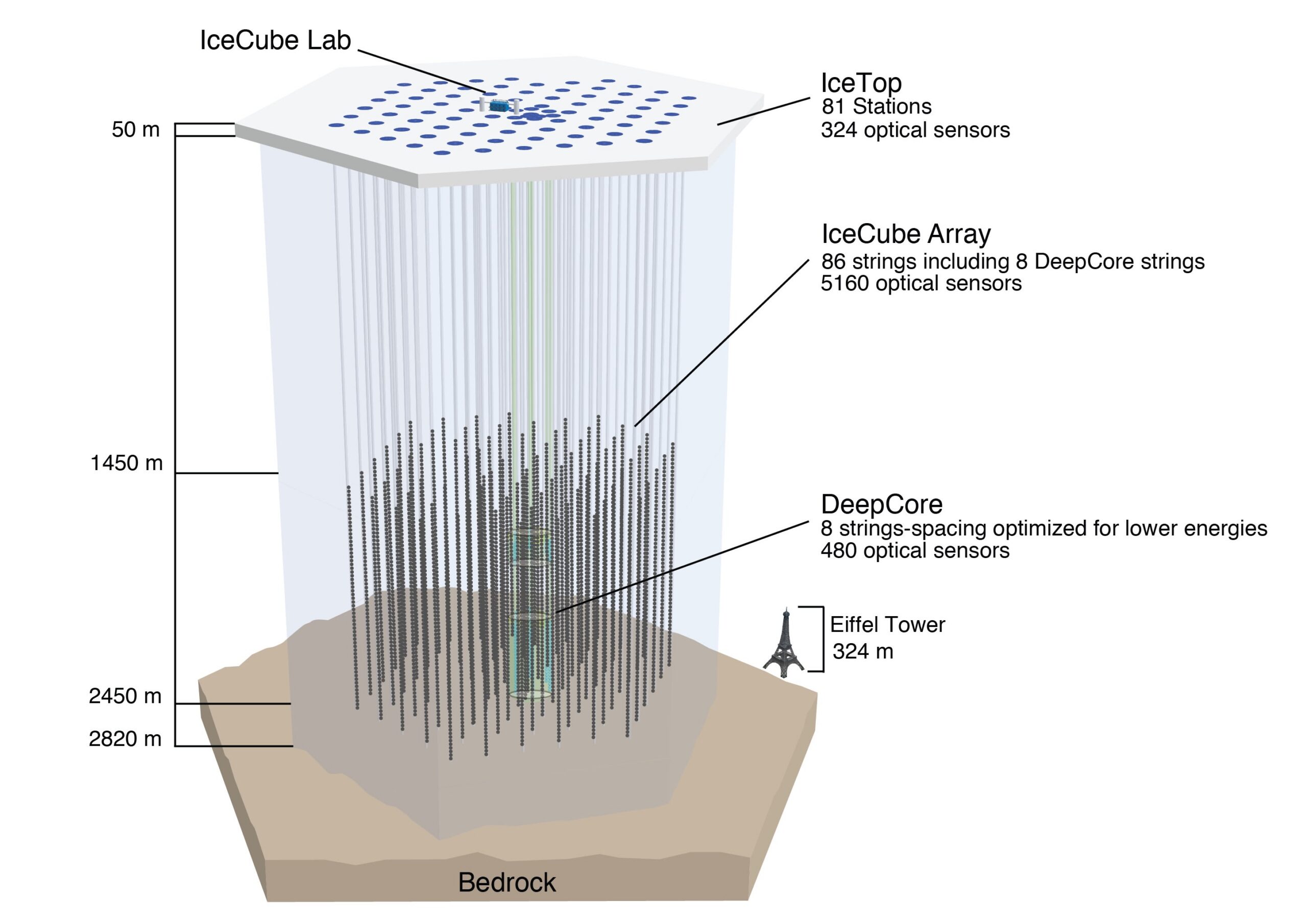
A neutrino is a tiny elementary particle, with no electric charge and almost no mass . It is produced during nuclear reactions in the heart of the Sun or during stellar explosions. Neutrinos interact so weakly with matter that they pass through it unimpeded. Every second, approximately 100 trillion neutrinos pass through the human body without leaving a trace. This ability to travel in a straight line through the cosmos without losing energy makes them excellent astronomical messengers, but also makes their observation very complex. To intercept these particles, Francis Halzen conceived, as early as 1988, a new type of installation called IceCube. Instead of using a traditional building, scientists transformed a cubic kilometer of ice at the South Pole into a giant detector. Specifically, the device extends between 1,500 and 2,500 meters below the polar surface. Networks of cables equipped with thousands of optical sensors were submerged in wells drilled with hot water and then sealed in clear ice. This highly complex installation was completed in 2011.

How does ice allow us to detect neutrinos?

The vast majority of neutrinos pass through the observatory without stopping. But, very occasionally, one of them directly strikes the nucleus of an atom within the block of ice . As these particles pass through the clear ice, they generate a very faint flash of blue light . Thousands of buried sensors record the precise position and time of this flash. By analyzing this data, the observatory’s computers reconstruct the particle’s exact trajectory and determine the precise direction of the celestial source from which it originated.

The IceCube neutrino observatory represents a volume of approximately one cubic kilometer of transparent Antarctic ice with 5,160 digital optical modules (DOMs) at depths between 1,450 and 2,450 meters.

© IceCube Collaboration

Related articles