




• Solar System

The Sun at its Maximum

Published on 18 October 2024

The Sun experiences activity cycles of 11 years. NASA has just announced that it has reached the solar maximum of the current cycle. The 25th since we started monitoring it. But this does not yet mean the end of strong solar flares and polar auroras.

The Sun at its Maximum

It is at its highest. During a press conference on October 15, representatives from NASA, the National Oceanic and Atmospheric Administration (NOAA), and the international Solar Cycle Prediction Panel announced that the Sun had reached its period of solar maximum. However, this does not mean that the peak of activity has been reached. This period of high solar activity could continue for much of next year and continue to produce, hopefully, polar auroras.

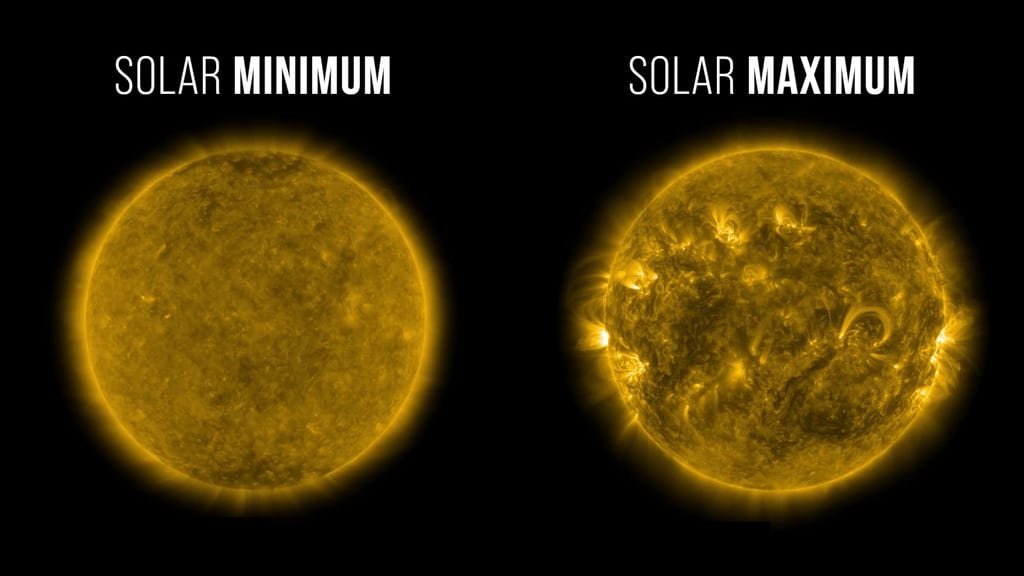
Left, the Sun at its minimum in December 2019 relative to solar maximum, right, in May 2024. Bottom, ultraviolet light images revealing active regions of the Sun that are more common during solar maximum. Top, in visible light, sunspots are more numerous.

© NASA, NOAA

What is a solar cycle?

Every eleven years, the Sun experiences a peak in activity linked to the reversal of its magnetic poles.

The solar cycle is a natural cycle that the Sun goes through as it transitions from low to high magnetic activity. Approximately every 11 years, at the height of the solar cycle, the Sun’s magnetic poles reverse. The Sun then goes from a calm state to an active and eruptive state. “During solar maximum, the number of sunspots, and therefore the amount of solar activity, increases,” explains Jamie Favors, director of the space weather program at NASA Headquarters in Washington. “This increase in activity offers an exciting opportunity to learn more about our nearest star, but it also has real effects on Earth and throughout our solar system.”

A danger not to be overlooked

Solar activity strongly influences conditions in space, which is called space weather. Eruptions of matter can cause magnetic storms. This can affect satellites and astronauts in space, as well as communication systems – such as radio and GPS – and power grids on Earth.

The solar maximum will last another year

Only in retrospect will we be able to determine where the peak of activity is in this period of solar maximum

If the solar maximum is reached, this does not mean that this is the peak of activity that we will see during the 25th solar cycle. Indeed, as indicated by Elsayed Talaat, director of space weather operations at NOAA. “While the Sun has reached the period of solar maximum, the month in which solar activity peaks on the Sun will only be identified in months or years.” It will only be identifiable after observing a constant decline in solar activity after this peak. However, scientists have observed a consistently high number of sunspots over the past two years. They therefore predict that the maximum phase will last about another year before the Sun enters the decline phase, which leads back to the solar minimum. Other solar storms are possible during this period and could again result in polar auroras observable at our latitudes. Last May, a series of major solar flares and coronal mass ejections (CME) sent clouds of charged particles and magnetic fields towards Earth, creating the strongest geomagnetic storm on Earth in two decades. Other magnetic storms offered a magnificent spectacle in September in the north of France and in mid-October over almost the entire territory.

On October 3, 2024, the Sun emitted a strong solar flare. At that date, this solar flare was the largest of solar cycle 25.

© NASA

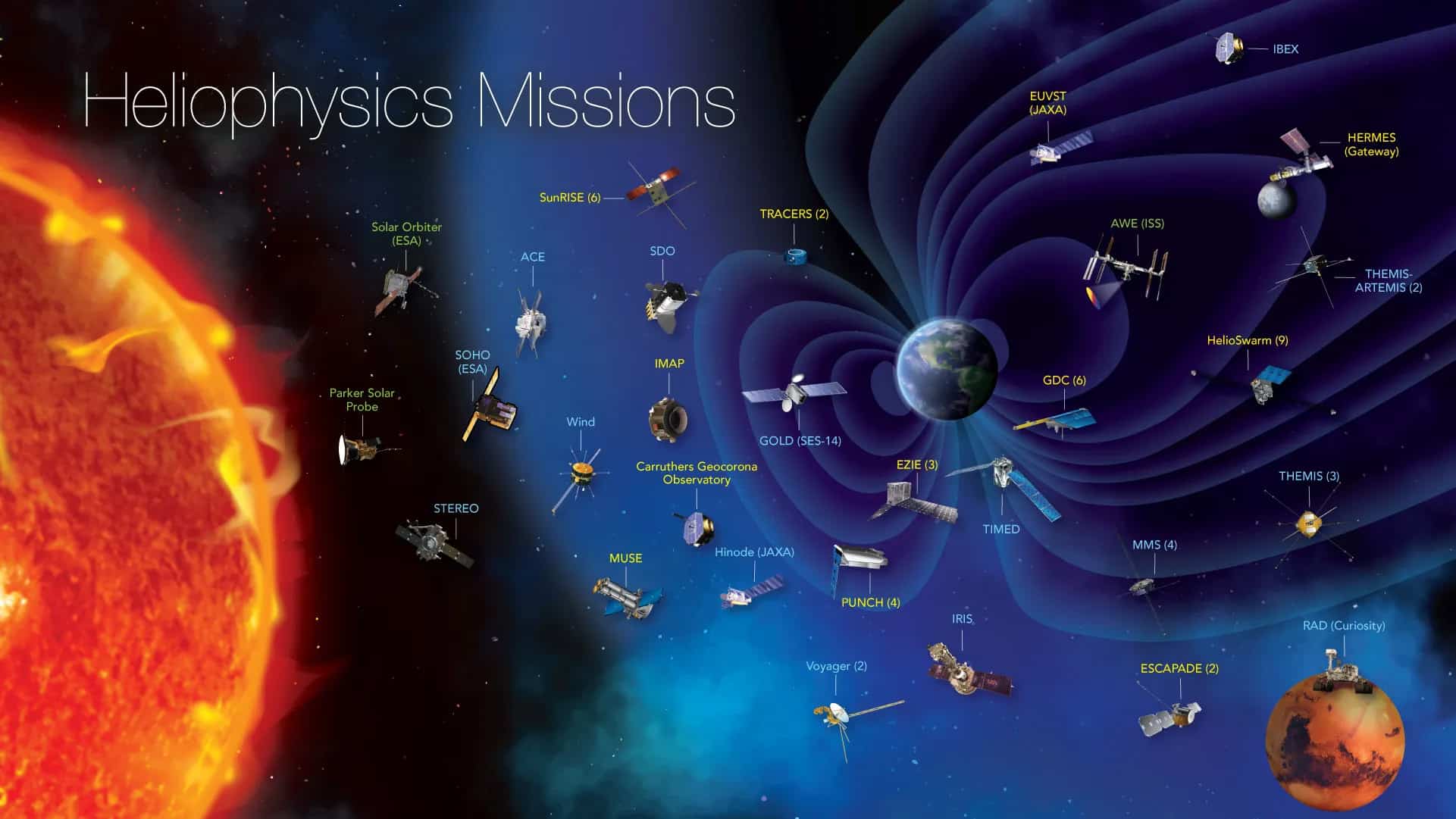
Missions studying heliophysics in July 2024. In green, current missions, in blue, missions currently in operation and in yellow, future missions.

© NASA

Missions to study the Sun

Numerous missions are planned to better understand the Sun’s activity

Predicting space weather is essential to avoid a major blackout of satellites in orbit during these periods of high solar activity. These events can also have serious consequences for electrical grids, as in Quebec in 1989. For this reason, several missions have been launched towards our star. These include the European mission Solar Orbiter. On November 6, Parker Solar Probe will fly over Venus to get closer to the Sun. A few weeks later, on December 24, it will become the fastest probe ever launched. It will reach a speed of 192 km/s, or 691,000 km/h. That’s 24 times faster than the International Space Station. It should thus make it possible to study our star more closely. Like it, a dozen missions are under development to study the Sun or the solar wind.

Related articles
