• Astronomy

The sky of September 2025

Published on 29 August 2025

This year, September brings us a lunar eclipse as well as some beautiful encounters between our natural satellite and several planets. The autumn equinox (for the northern hemisphere) will occur on the 22nd.

The sky of September 2025

The night is getting longer, as on September 22nd, during the equinox, it will begin to take over the duration of the day. In the northern hemisphere, the September equinox marks the transition to autumn.

The event of this month of September 2025 is of course the lunar eclipse of the 7th, the second part of which will be visible in metropolitan France. But don’t neglect some beautiful encounters of the Moon with planets, the Pleiades or Antares.

Reminder: Unless otherwise stated, times are those of legal time in metropolitan France . The maps are calculated for Toulouse, but remain in most cases applicable to the entire metropolitan territory.

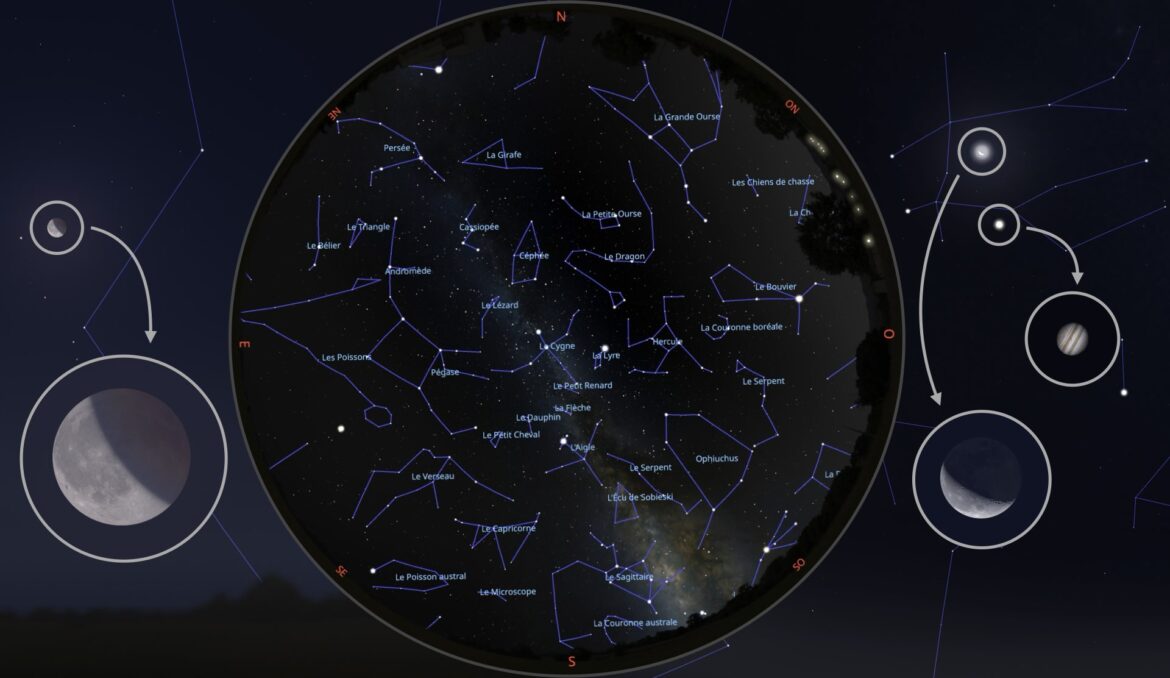
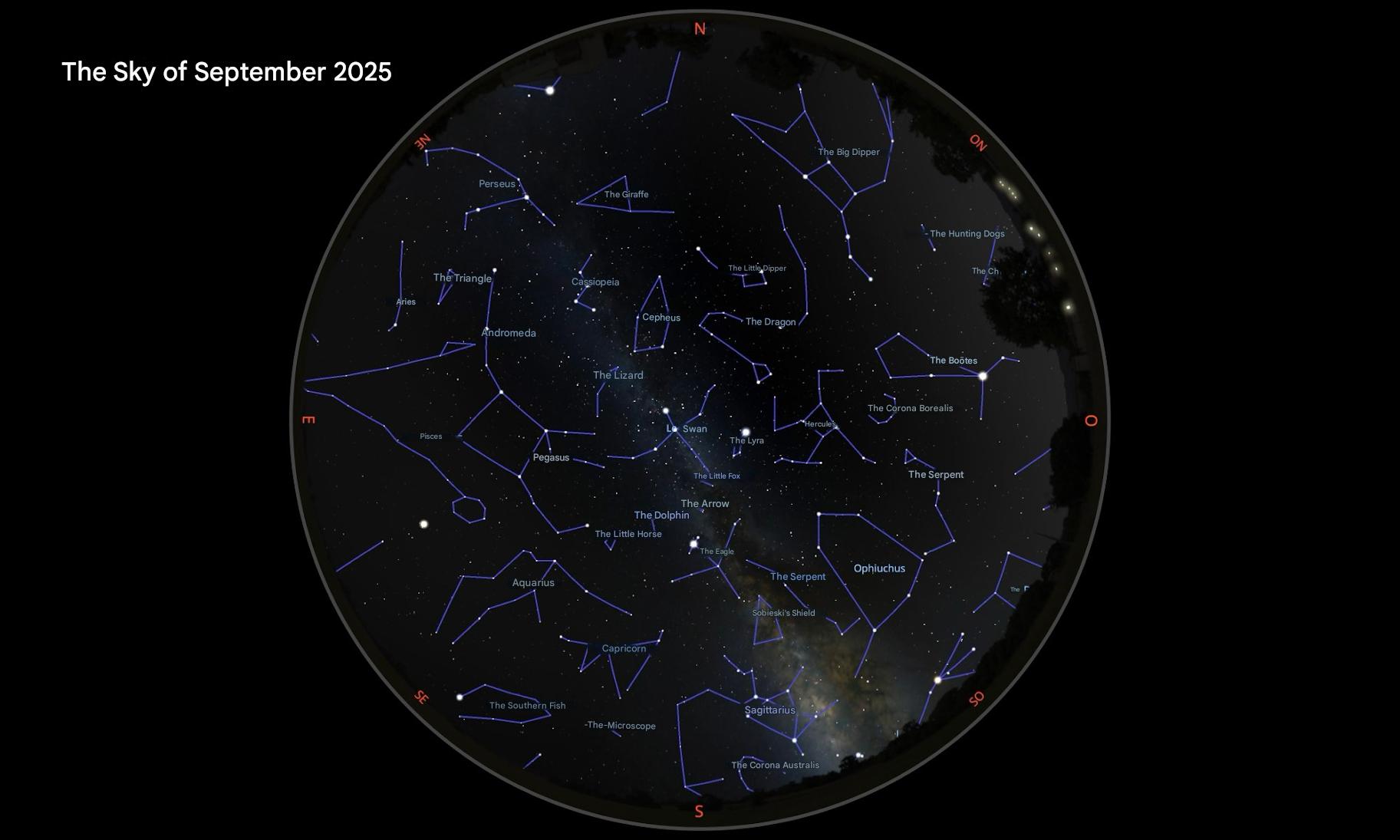
This map shows the sky for Toulouse on September 15 at 10:00 p.m. (legal time, i.e., the time on your watch).
It is valid for most of September across metropolitan France.
© Cité de l’espace/Stellarium

THE MODEST ALPHA AURIGIDES

The Alpha Aurigids are part of the very modest meteor showers comparable to those of the August sky (Iota Aquarids South, Eta Eridanids, etc.). Remember that these “shooting stars” are in fact dust particles that leave a fleeting bright trace as they burn up upon re-entering our atmosphere. These dust particles are most generally sown by a comet and for the Alpha Aurigids this is C/1911 N1 Kiess.

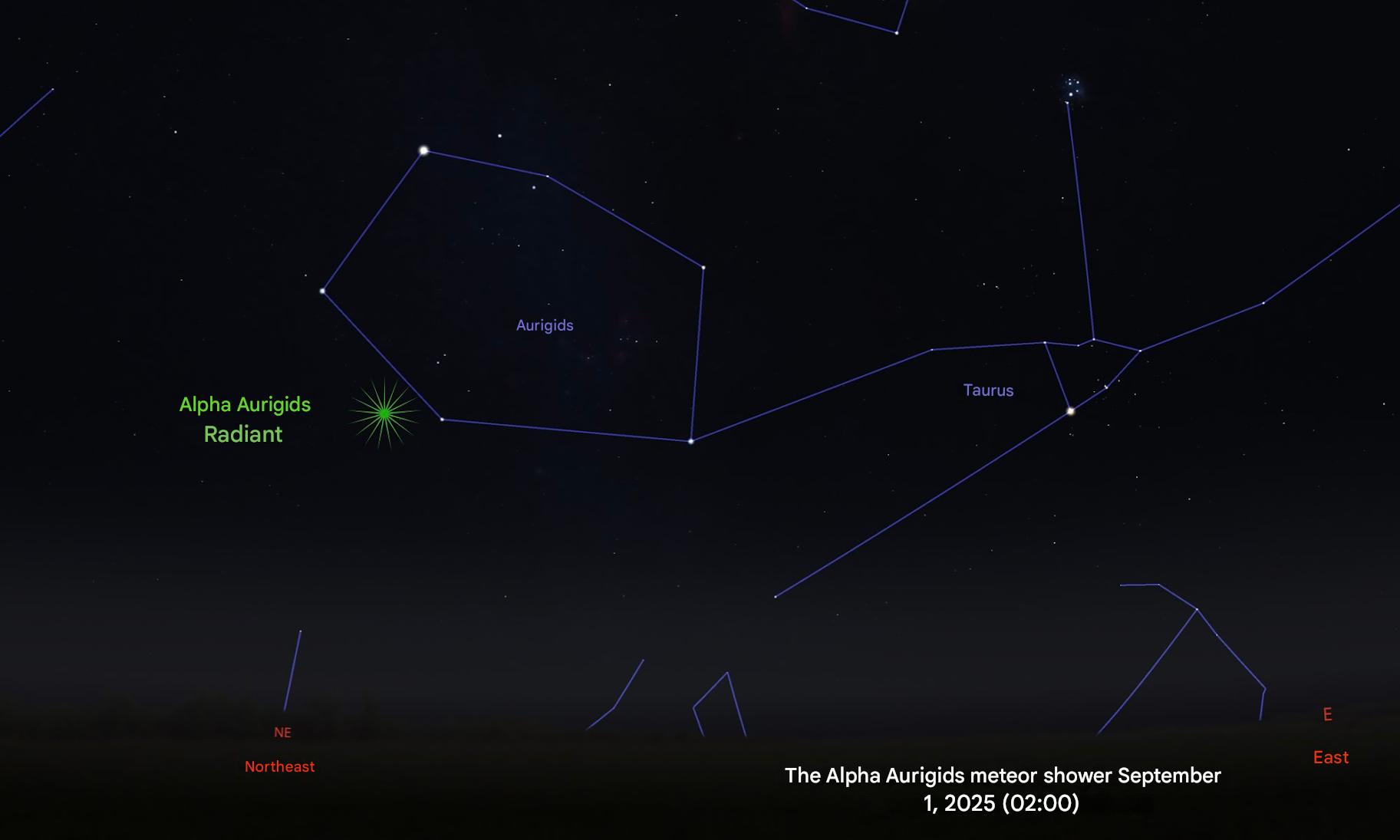
The peak of this meteor shower is expected on September 1st at 5am, so on the night of August 31st to September 1st . The radiant, the point in the sky from which the shower seems to come by perspective effect, is located in the constellation Auriga (Auriga in Latin). Don’t expect a spectacular event since the Zenithal Hourly Rate (ZHR) is only 6. The ZHR quantifies the number of meteors visible on average each hour for a perfect sky and if the radiant were at the zenith. In practice, you will see fewer, or even much fewer.
However, the Alpha Aurigids benefit from a Moon that will have set shortly after midnight and which will therefore not be a problem.

The observing advice remains the same. Don’t necessarily try to focus on the radiant, but gaze at the sky away from any light pollution (including your smartphone screen, which is glaring) and be patient.

The radiant of the Alpha Aurigids above the northeast horizon on September 1st at 2 a.m. (i.e., during the night of August 31st to September 1st ) . The peak is predicted at 5 a.m., about thirty minutes before the end of the dark sky (the Sun reaches 18° below the horizon). The Sun rises at 7:18 a.m. for Toulouse.
© Cité de l’espace/Stellarium

THE LUNAR ECLIPSE OF SEPTEMBER 7

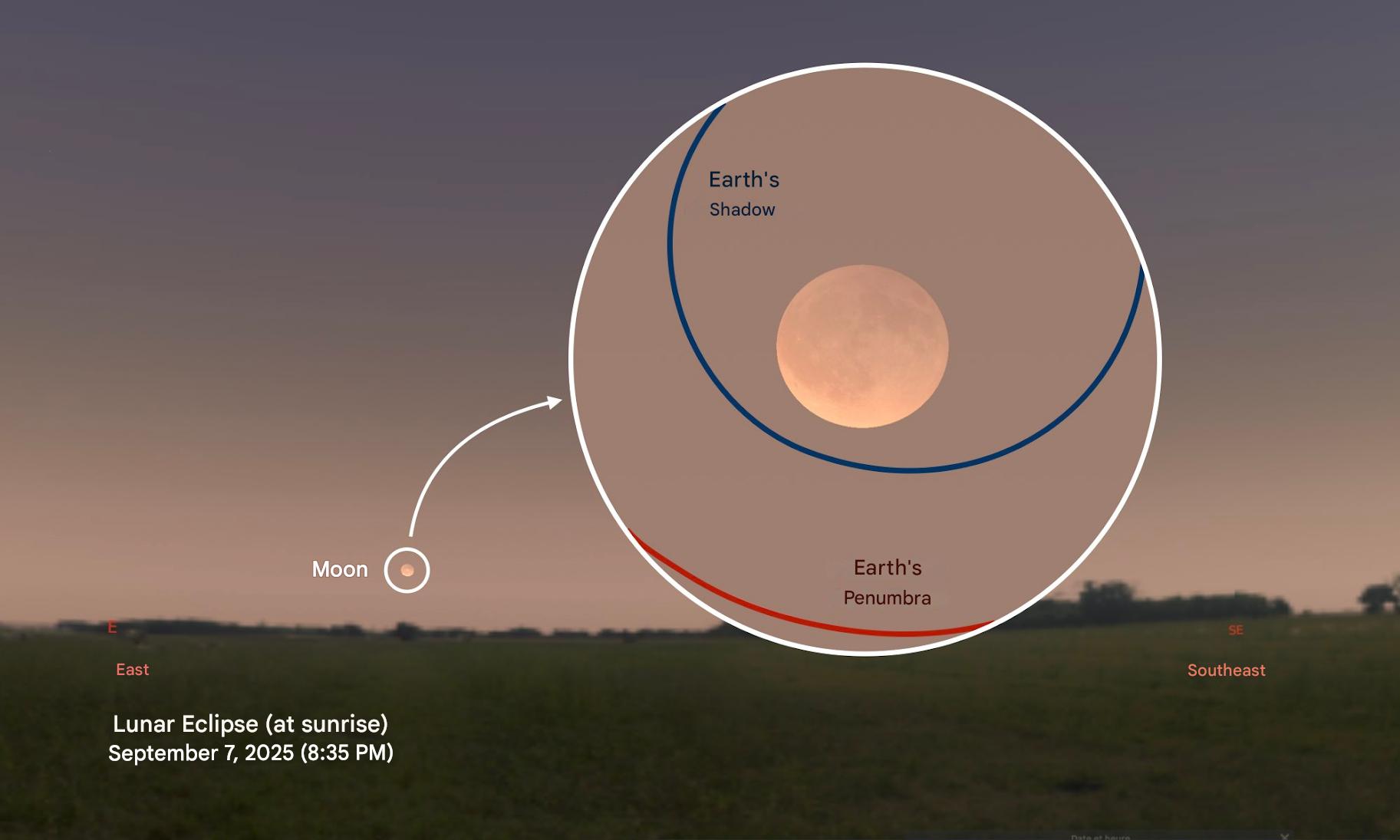
On Sunday, September 7, the Moon will rise in eclipse in metropolitan France while the Sun sets. Even if we will have missed the entry of our natural satellite into the shadow of the Earth, it will then be possible to observe its gradual exit. A spectacle not to be missed .

For our complete viewing advice for the September 7 eclipse, see our specific page .

On September 7, the Moon rises eclipsed slightly to the right of the eastern horizon. On this map calculated for Toulouse, the Moon is only 2.5° high at 8:35 p.m., 18 minutes after its rise at 8:17 p.m. Full article here.

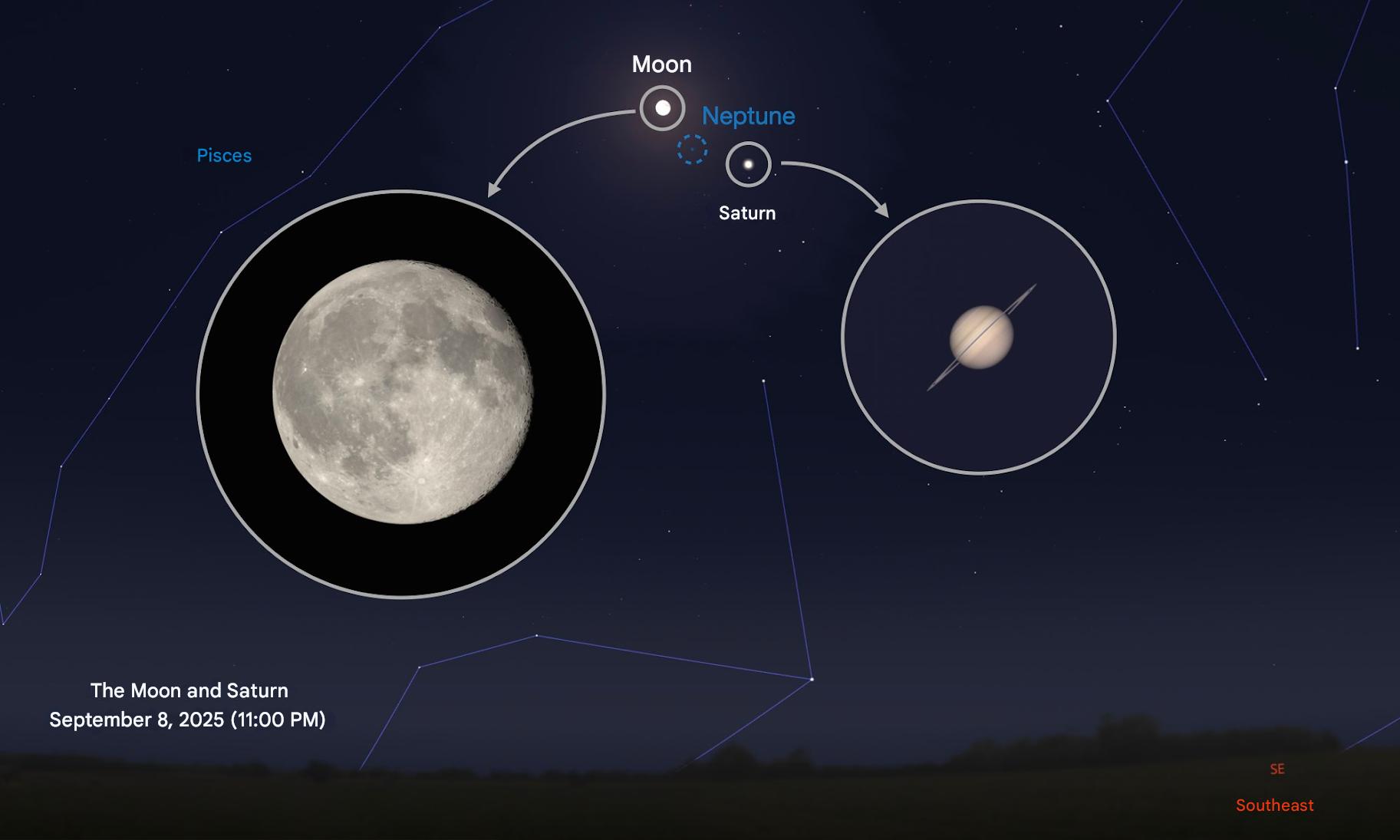
THE MOON AND SATURN

NEPTUNE AS A BONUS

On September 8th , a beautiful waning gibbous Moon (98% illuminated) will help us easily spot the Solar System’s “Lord of the Rings,” Saturn . The typical yellowish glow of this planet will be visible a little to the right and below Earth’s natural satellite. A little bonus: Neptune will be almost between the Moon and Saturn , but its faint brightness (magnitude 8 instead of 0.9 for Saturn) makes it invisible to the naked eye (the limit of perception is around magnitude 5/6 under a perfect sky).

On September 8, the Moon and Saturn form a duo as they rise shortly before 9 p.m. But until 11 p.m., the two stars will be higher in the sky (22° for Saturn), making them easier to observe.
© Cité de l’espace/Stellarium

THE MOON AND THE PLEIADES

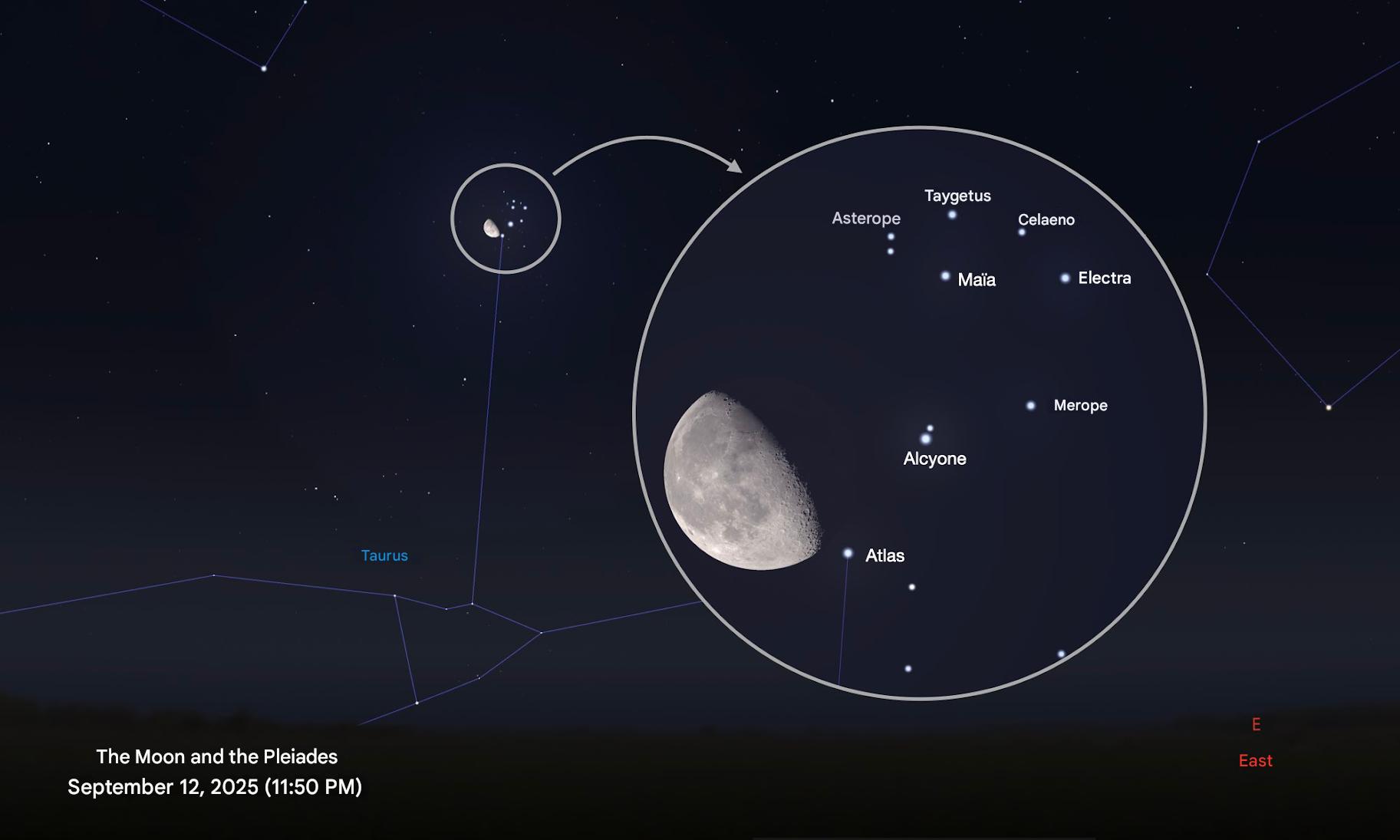
During its journey across the sky, our celestial neighbor occasionally crosses paths with the Pleiades . This will be the case on the night of September 13 to 14 .

This group of stars in the Pleiades immortalizes in the constellation of Taurus the famous seven sisters of Greek mythology  : Alcyone, Asterope, Maia, Taygete, Celaeno, Merope, and Electra. Their father and mother seem to watch over them nearby thanks to two stars named Atlas and Pleione. We now know that this is an open cluster of 3,000 young stars (only about ten are visible to the naked eye under good conditions) located about 440 light-years away from us. The delicate nebulae surrounding them were thought to be remnants of their formation mechanism, but it is now believed that we are observing an interstellar cloud that they pass through as they disperse.

The Pleiades already offer a beautiful object to scrutinize with the naked eye, especially since it resembles a miniature Big or Little Dipper (the size in the sky is equivalent to twice the full Moon). Under a good night sky, we can easily see 5 of them. Capturing the 7 or 9 main ones requires skies clear of any light pollution and/or the use of binoculars.

During the night, the Moon will gradually move away from this area, the star Pleione will no longer be masked from 00:05 on the 13th.

The Moon will meet the seven sisters of the Pleiades on the night of September 12-13.
© Cité de l’espace/Stellarium

VENUS, THE MOON AND JUPITER

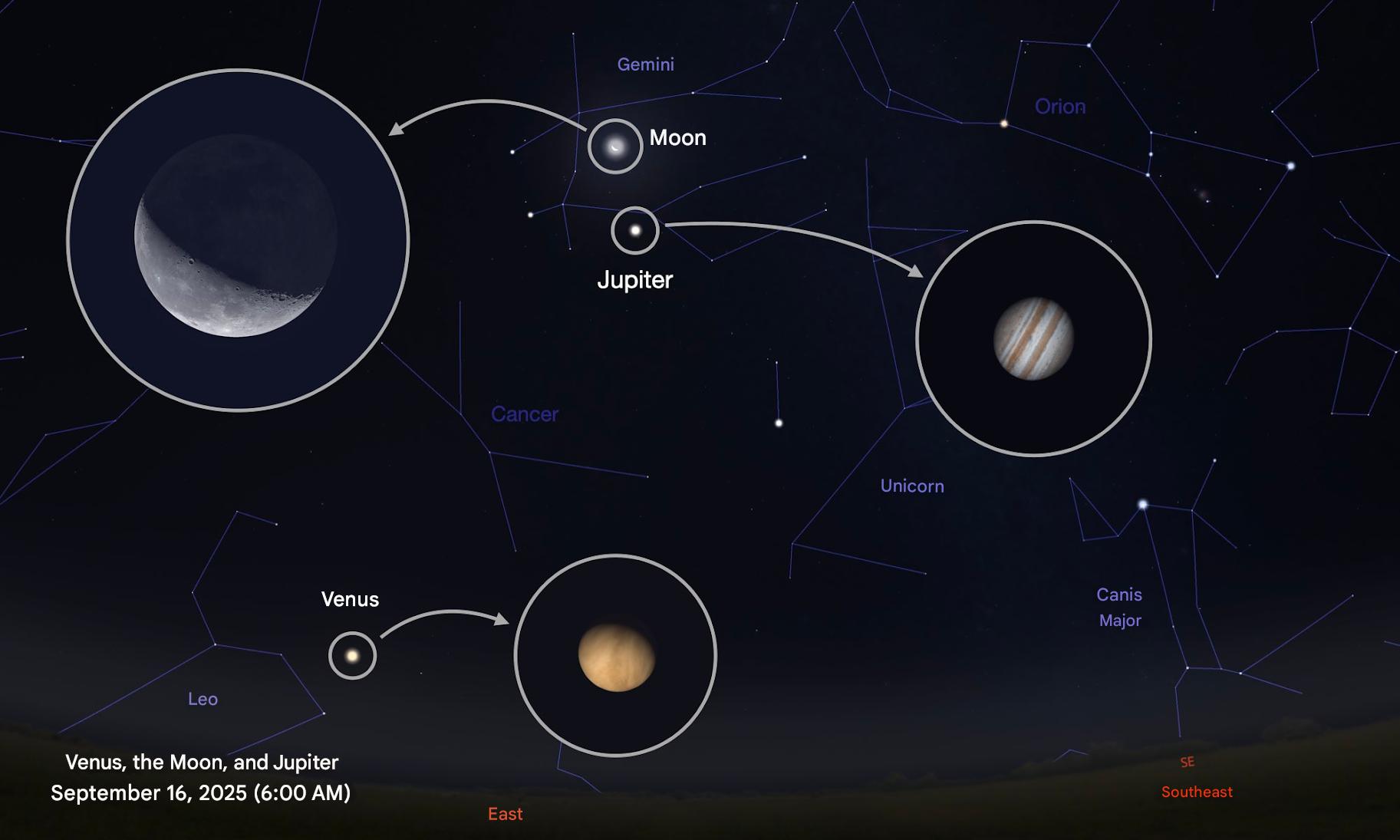
On the morning of September 16 , face east to observe a duet between the Moon and Jupiter . Near the horizon, the insolent brilliance of Venus seems to compete with them.

Our map suggests turning towards this spectacle at 6 a.m., or 1 hour and 35 minutes before sunrise. The sky will still be sufficiently dark. Jupiter and the Moon will be quite high, at 39° and 45° respectively above the eastern horizon. On the other hand, at 8°, Venus will require a completely clear horizon to be seen. Obviously, the longer we wait, the more Venus will “rise.”
The Sun rising in the east (at 7:35 a.m. for Toulouse), you will have to be careful not to endanger your vision.

A beautiful duo of the Moon and Jupiter in the constellation Gemini on the morning of September 16. A clear eastern horizon will also allow Venus to be seen.
© Cité de l’espace/Stellarium

THE MOON AND VENUS

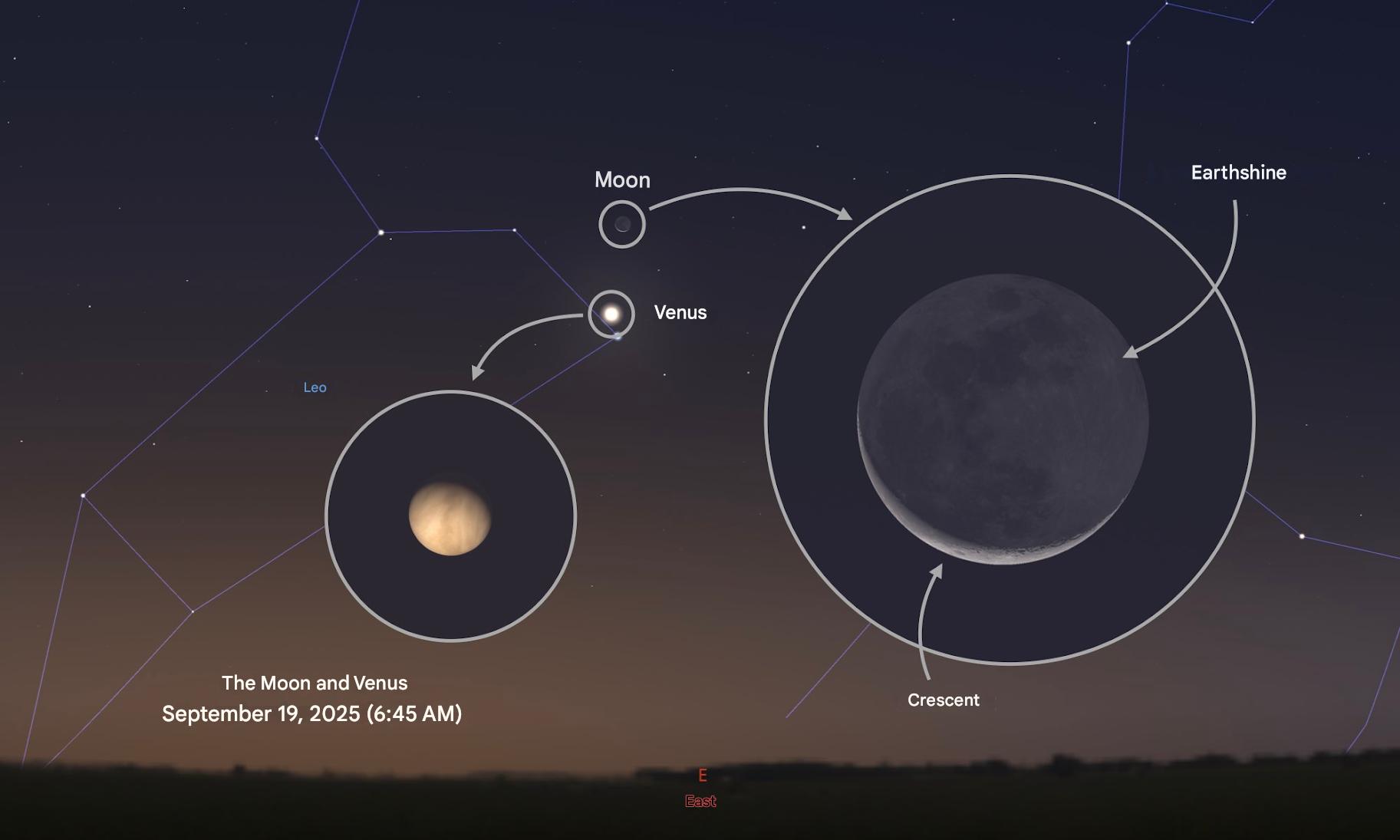
Our natural satellite is moving away from Jupiter this time to accompany the second planet in the Solar System. On the morning of September 19 , a thin crescent Moon (only 6.7% illuminated) will float above Venus . A clear eastern horizon is essential since Venus will be only 15° above. Even if at 6:45 a.m., the glow of the rising sun signals the end of the night, the strong brightness of Venus (magnitude -3.4) ensures its easy location.
The thin crescent Moon should highlight the earthshine , the part of the Moon that is weakly illuminated by the light of the Sun reflected by the Earth.
As a precaution, be aware that the Sun will rise on this side of the sky (in the East) at 7:38 a.m., for Toulouse. Do not endanger your vision.

A thin crescent Moon (with its ashen glow) will be above bright Venus on the morning of September 19.
© Cité de l’espace/Stellarium

THE MOON AND ANTARES

About 30 minutes after sunset on September 27 , the southwest horizon offers us a duo also seen in August: the Moon and Antares .

In Toulouse, with the Sun setting at 7:42 p.m., the sky should begin to darken slowly, enough for Antares of magnitude 1.5 to be visible. The horizon a little to the left of the Southwest will, however, need to be clear of any obstacles, as the star will be at a mere 13° high! And the Moon (a crescent illuminated at almost 30%) is lower at 11°.
We can certainly wait for the sky to become darker, but Antares and the Moon will descend further and further towards the horizon, our natural satellite setting first at 10:03 p.m. followed by the star 5 minutes later.
Conversely, we can try to catch when Antares becomes visible before 8:15 p.m. by looking towards the Southwest and using the Moon as a guide. As a precaution, to avoid endangering your vision , wait for sunset (7:42 p.m. in Toulouse).

Antares is the brightest star in its constellation, Scorpius, which is why it is called Alpha Scorpii. At 550 light-years away, Antares is a red supergiant star much larger than our Sun, encompassing Mars!

On September 27, if you have a clear southwest horizon, observe the Moon and Antares duo after sunset.
© Cité de l’espace/Stellarium

Related articles