• Astronomy
  • Moon

The Moon eclipses on September 7

Published on 22 August 2025

On Sunday, September 7, the Moon will rise in eclipse over metropolitan France. It will then be possible to observe its gradual emergence from Earth's shadow. A spectacle not to be missed.

The Moon eclipses on September 7

The total lunar eclipse of September 7 is the second of the year 2025 after that of March 14. This time, however, the observation conditions for metropolitan France are much more favorable . Indeed, on March 14, our natural satellite set before having completely entered the shadow of the Earth. On September 7, if the totality of the eclipse is not visible since our celestial neighbor will already be in the shadow at its rising, we will be able to admire its slow exit.

Important: Unlike a solar eclipse, a lunar eclipse can be observed without danger to the eyesight.

Reminder: Unless otherwise stated, times are those of legal time in metropolitan France. The maps are calculated for Toulouse, but remain in most cases applicable to the entire metropolitan territory.

THE MOON HAS A DATE WITH THE EARTH’S SHADOW

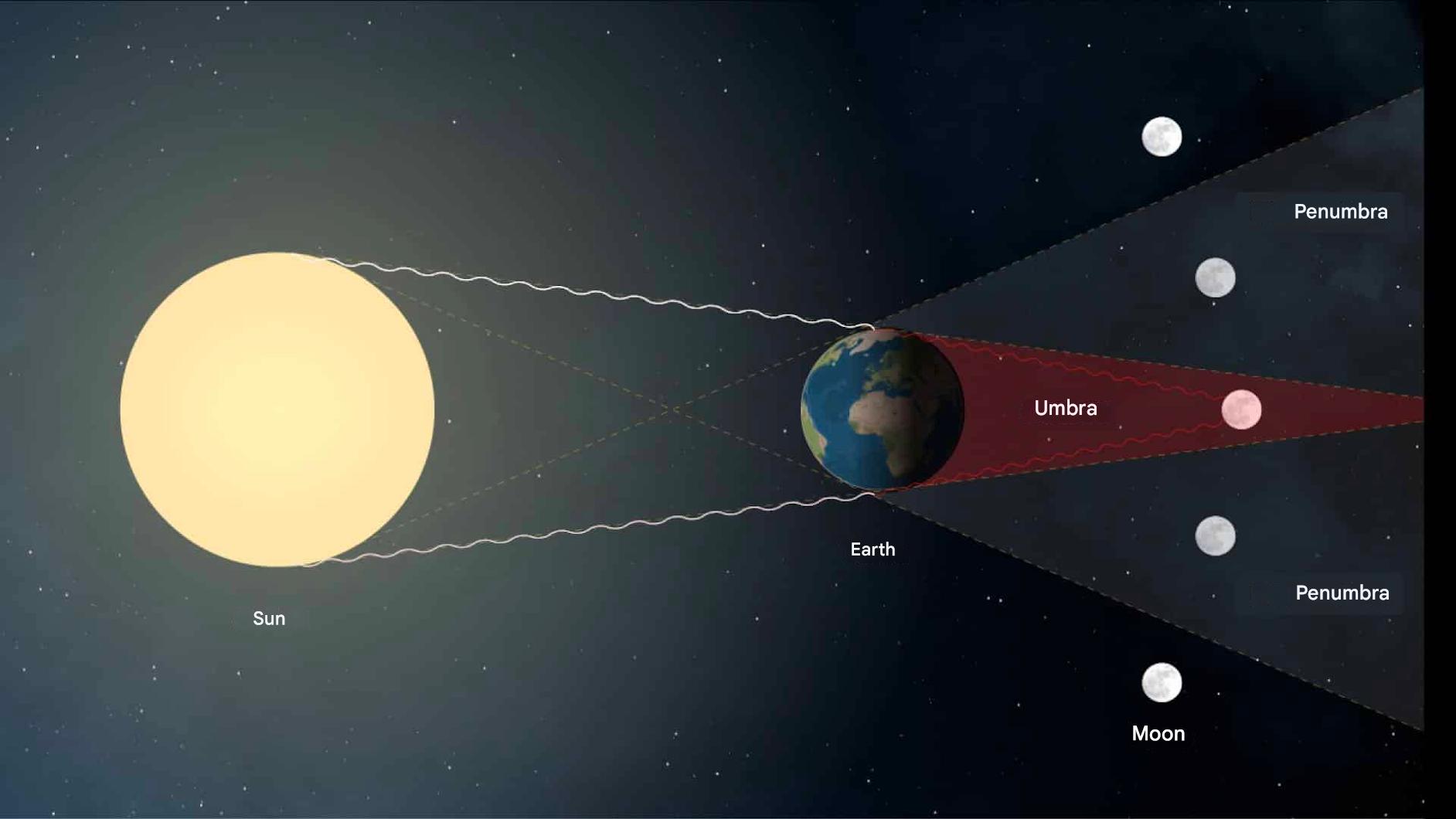
Remember that during a lunar eclipse, our natural satellite enters the Earth’s shadow , giving the impression of being gradually “nibbled away”. During totality, the Moon is entirely in this shadow and takes on more or less dark and pronounced red or copper hues depending on various factors, including the composition of the Earth’s atmosphere at that time.

Before and after totality, the Moon passes into penumbra, two phases where the decrease in brightness goes virtually unnoticed.
On September 7, the Moon will rise over metropolitan France already eclipsed , plunged into the shadow of our planet. See our observation tips below.

f this celestial phenomenon begins when the Moon enters the penumbra , the loss of brightness of our natural satellite is not then noticeable. On the other hand, as soon as the Moon enters  the shadow of the Earth, it takes on colors which depend on the state of the atmosphere of our planet at the time of the eclipse.

Credit: NASA/Adaptation: Cité de l’espace

AN ECLIPSED MOON RISES IN THE EAST

The map below and the two that follow were calculated for Toulouse. The times are those of the legal time in metropolitan France (that of your watch). The observation conditions remain similar for the entire metropolitan territory, except for the exact time of the rise of our natural satellite (which we discuss below).
To make the most of this eclipse, you must choose a place where the eastern horizon will be completely clear . This is because the Moon will rise already eclipsed and the longer you have to wait for it to emerge from a blocked horizon, the more the exit of our celestial neighbor from the shadow of the Earth will have begun (this exit begins at 8:52 p.m.).
Observing the eclipsed Moon as soon as it rises will not necessarily be easy since it will be darkened by the shadow of the Earth (with a more or less pronounced coppery/red tint) and the sky will not yet be dark (in Toulouse, the Sun sets at 8:19 p.m.)

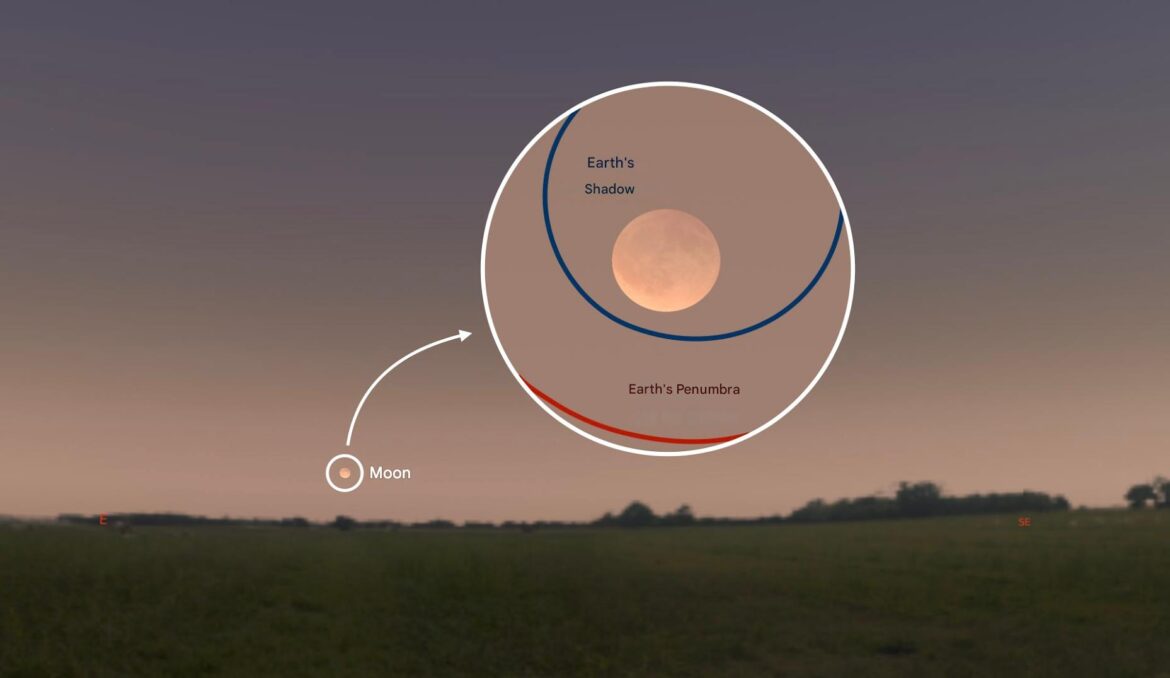
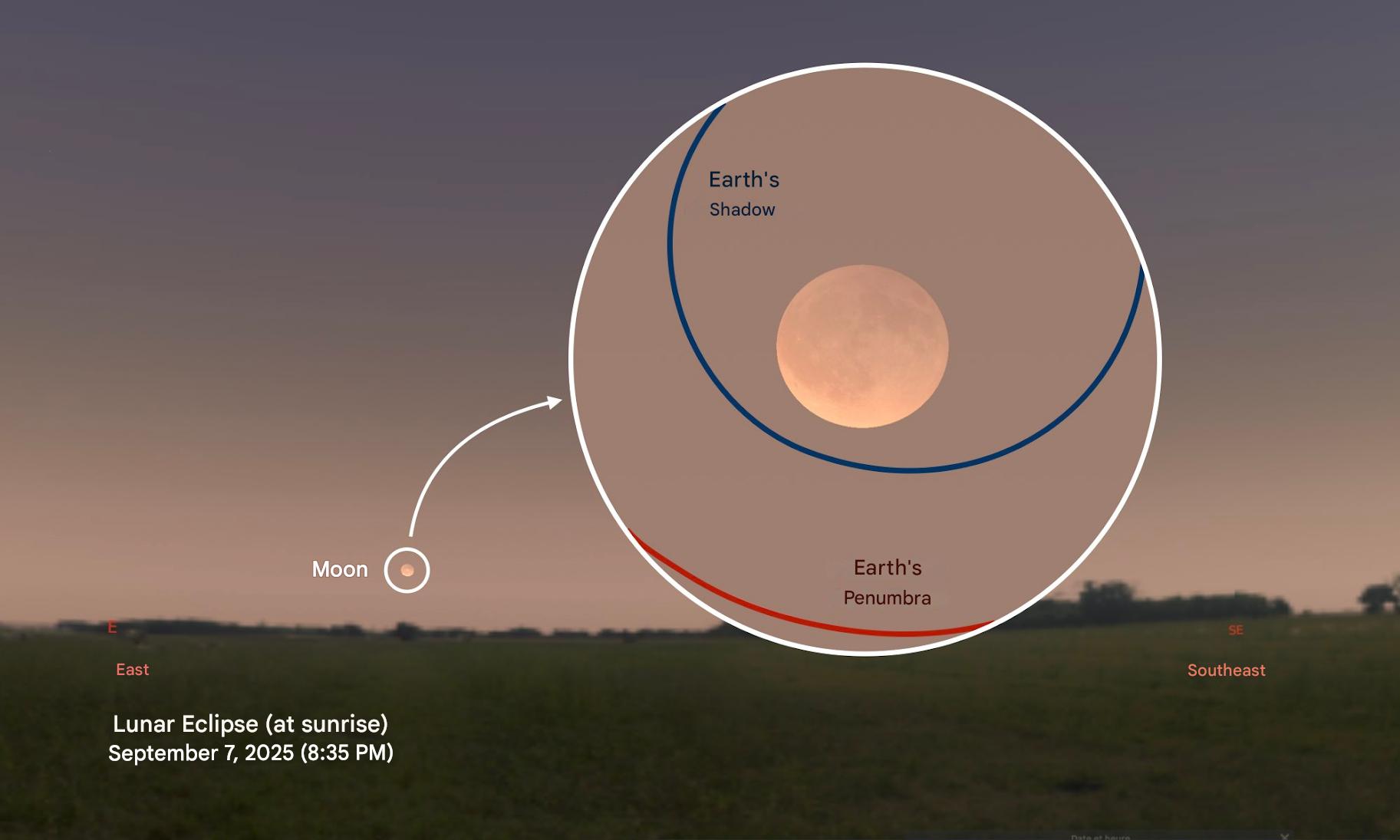
On September 7, the Moon rises eclipsed slightly to the right of the eastern horizon. On this map calculated for Toulouse, the Moon is only 2.5° high at 8:35 p.m., 18 minutes after its rise at 8:17 p.m.
© Cité de l’espace/Stellarium

The main events of the lunar eclipse of September 7, 2025 (standard time for metropolitan France).
P1 : entry into the Earth’s penumbra at 5:28 p.m.
O1 : entry into the Earth’s shadow at 6:27 p.m.
T1 : total entry into the shadow at 7:30 p.m.
M : maximum eclipse at 8:11 p.m.
T2 : beginning of the exit from the Earth’s shadow at 8:52 p.m.
O2 : end of the exit from the shadow at 9:56 p.m.
P2 : complete exit from the penumbra at 10:55 p.m.

© Paris Observatory

LUNAR ECLIPSE TIMES

THE TIME OF RISING CHANGES, BUT NOT THE EVENTS OF THE PHENOMENON

Depending on your location in metropolitan France, the time of moonrise (and sunset in the same proportion) will not be the one indicated for Toulouse.
Thus, in the West in Brest, you will have to wait until 8:46 p.m. to see our natural satellite emerge from the horizon or 8:34 p.m. for Rennes. It will be 8:17 p.m. for Toulouse, 8:19 p.m. for Paris, 8:03 p.m. for Metz or 7:54 p.m. for Nice. The further east you are, the earlier the moon rises.
An interactive map from the Paris Observatory indicates the main events of the eclipse depending on where you are in France (and even around the world, click on “Local circumstances” at the bottom of the page). You will notice that the events P1, O1, T1, M, T2, O2 and P2 (explained opposite) have the same time. On the other hand, the moonrise times logically change depending on the location. Please note that the times on this map are in Universal Time, add two hours for legal time in metropolitan France.
Note that the Moon will have fully entered the Earth’s shadow at 7:30 p.m. and that the maximum eclipse occurs at 8:11 p.m. Fortunately, a lunar eclipse is a relatively “slow” phenomenon, which will allow time in metropolitan France to fully enjoy the rest of the spectacle.
WATCH THE MOON EMERGE FROM EARTH’S SHADOW

Looking at the detailed timetables above, we can see that the maximum of the eclipse has already taken place when the Moon rises in mainland France (except very far in the East where it rises a little before the maximum). Don’t think, however, that the show will already be over! This celestial event lasts several hours and even if we “missed” half, the second part will not disappoint .

From 8:52 p.m., the Moon will begin to emerge from the Earth’s shadow . It will still be quite low on the horizon, at only 5° above the horizon for Toulouse (we repeat, a clear eastern horizon is essential). For comparison, further south and east, it will be higher at 9° in Nice and conversely lower towards the west and north, for example, just above the horizon in Brest.
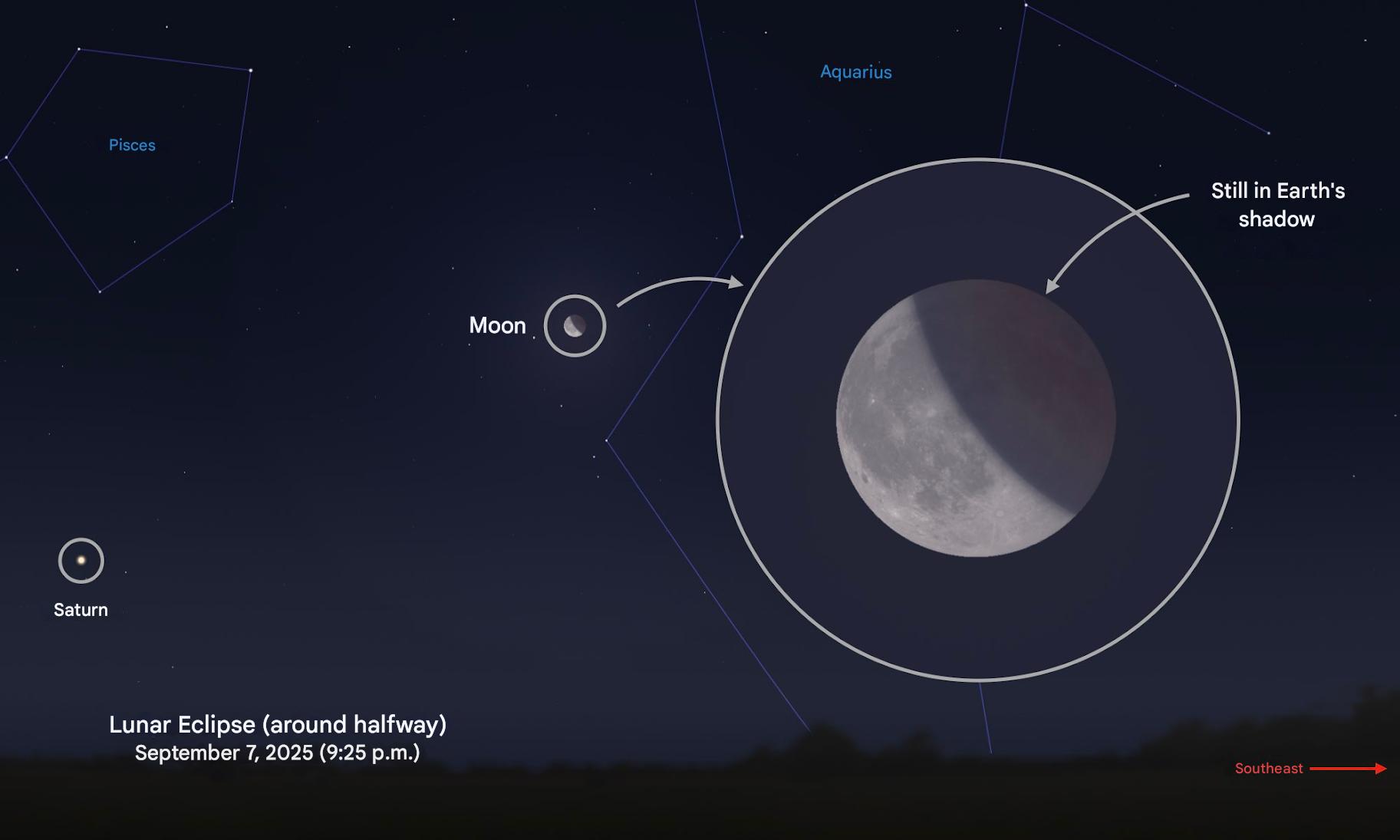
The passage of time will therefore be our ally since our natural satellite will rise in the sky as it leaves the shadow of our planet. A very aesthetic lunar disc hidden at a little less than halfway around 9:25 p.m. will be at 11° above the horizon for Toulouse (5° for Brest and 15° for Nice).

As the Moon moves out of Earth’s shadow, it “climbs” in the sky, making it easier to observe. Saturn’s yellowish glow should become increasingly prominent in the evening as the planet rises in the sky.
© Cité de l’espace/Stellarium

FROM SHADOW TO PENUMBRA

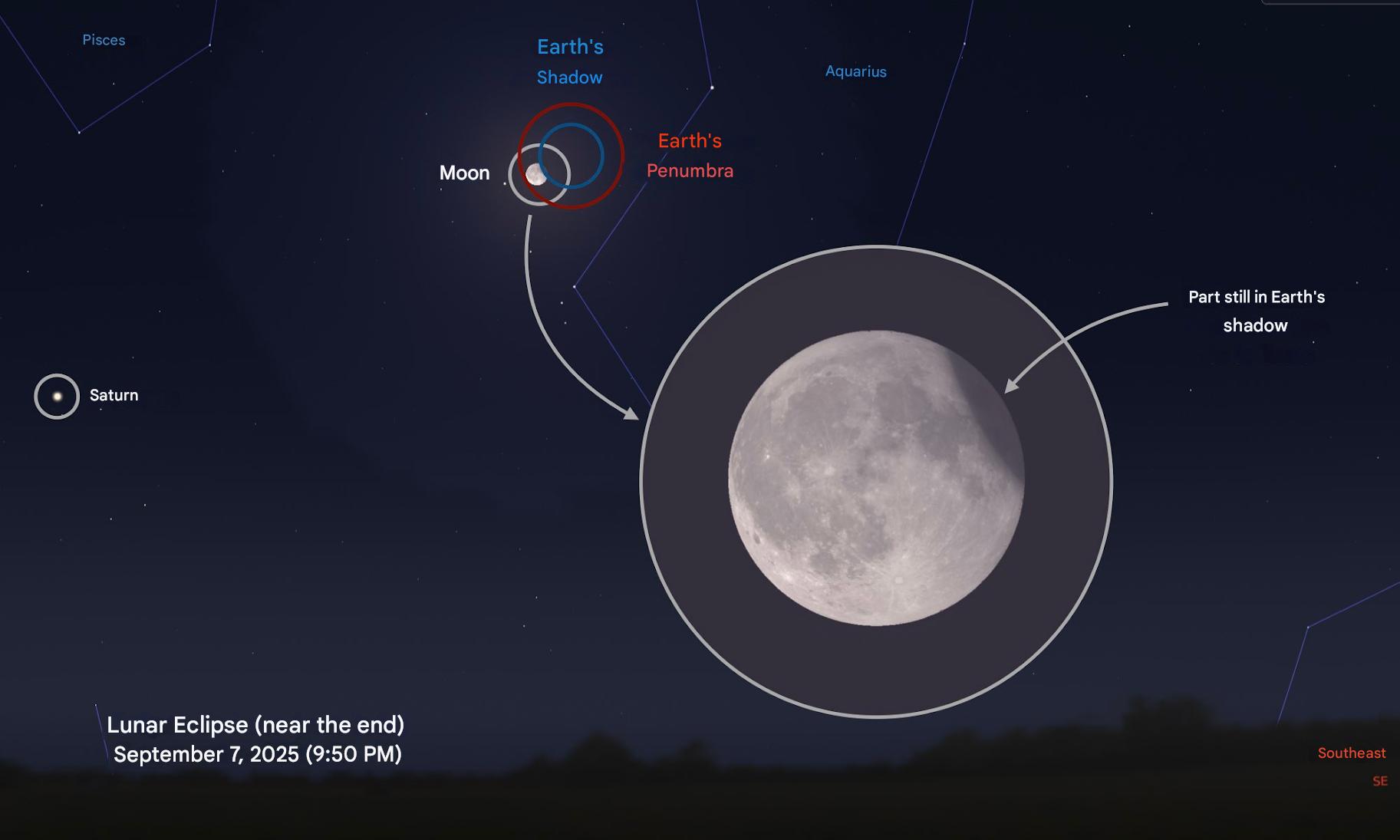
The moon will not fully emerge from Earth’s shadow until 9:56 p.m. As you can see, the phenomenon leaves a wide window of time to be observed. Your eyes are more than enough to enjoy the spectacle and observe the shadow slowly receding . Note that the shadow is curved, because our planet is round!

Binoculars, binoculars, or telescopes allow you to “zoom in” on the event. This is an opportunity to better see certain nuances, for example, that the side of the Moon closest to the center of the shadow is darker. There are other nuances to be captured on the border between the eclipsed Moon and the one outside the shadow. The darkening factor depends on the composition of the Earth’s atmosphere at that time, however, it is difficult to say whether these nuances will be more or less clearly visible.
Once the 9:56 p.m. mark has passed, the Moon appears to shine normally, but it is in the Earth’s penumbra and does not emerge until 10:55 p.m. In concrete terms, this passage into and out of the penumbra produces nothing visually notable. The spectacle therefore ends at 9:56 p.m.

At 9:50 p.m., six minutes before the complete exit from the Earth’s shadow, the Moon will be at an altitude of 15° for Toulouse (9° for Best and 19° for Nice).

© City of Space/Stellarium

Related articles