• Astronomy

The sky in September 2026

Published on 01 September 2026

In September, the nights grow longer and several conjunctions can be observed: Venus and Spica, the Moon with Mars, Jupiter, Venus and Saturn, as well as the September Perseid meteor shower. The equinox also marks the month.

The sky in September 2026

September gradually marks the return of longer nights. Throughout the month, the planets and the Moon offer several easily observable conjunctions, while Venus remains very bright in the evening sky. Finally, the equinox on September 23rd marks the beginning of autumn in the Northern Hemisphere.

Reminder: unless otherwise stated, times are those of metropolitan France . Maps are calculated for Toulouse, but in most cases remain applicable to the entire metropolitan territory.

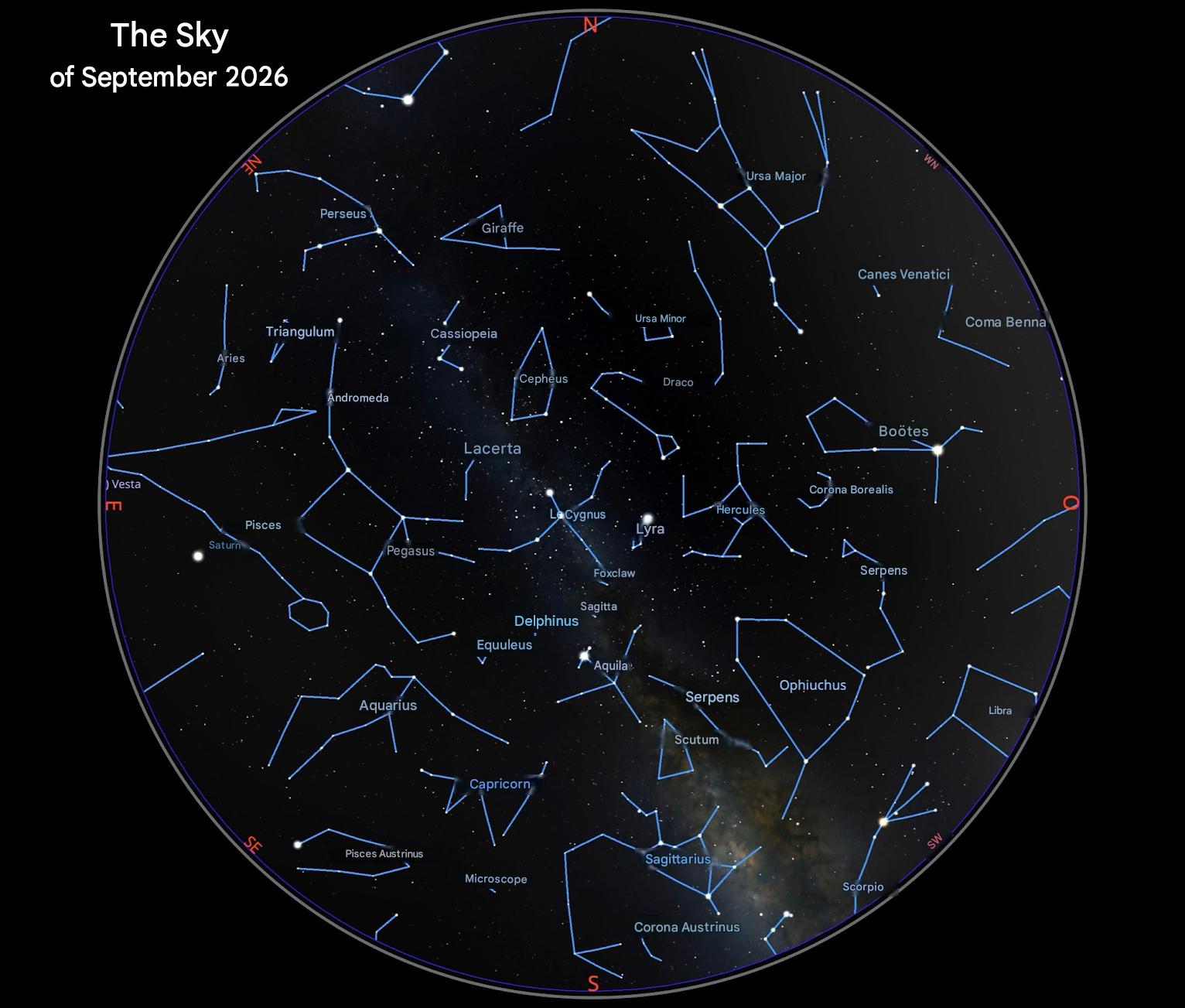
This map shows the sky for Toulouse on September 15th at 10:00 PM (local time, i.e., your watch time).
It is largely valid for the month of August across mainland France, except for the position of the Moon (which has set at that time).
© Cité de l’espace/Stellarium

SEPTEMBER 1ST AND 2ND: THE AURIGIDES CONCLUDE THEIR PERIOD OF ACTIVITY

A LIGHT SHOWER OF SHOOTING STARS

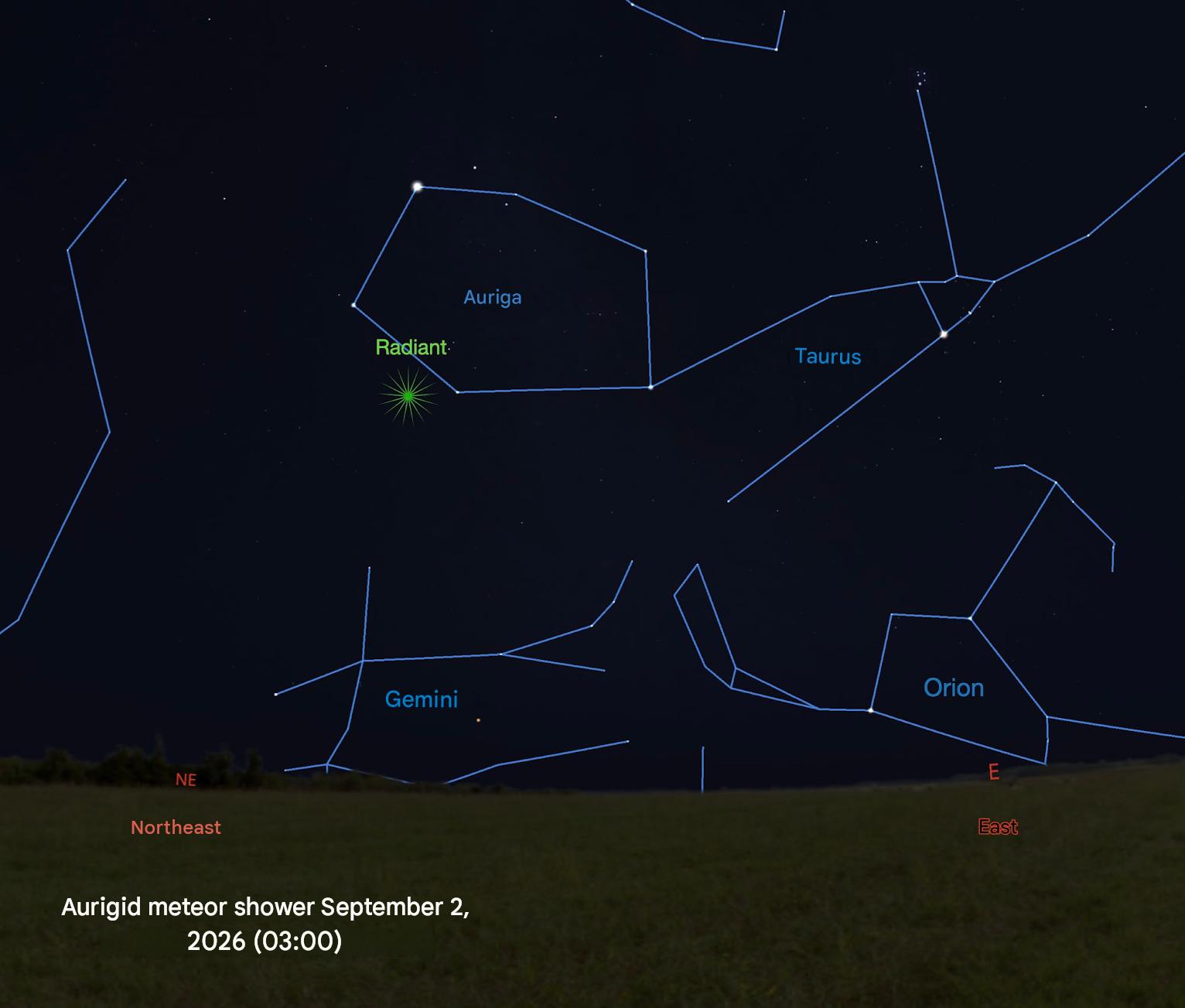
The Aurigid meteor shower is active from late August to early September, with a peak expected around the night of September 1st to 2nd. This shower remains modest, with approximately six meteors per hour under ideal conditions. Furthermore, this year, the still very bright Moon will make observing the fainter shooting stars more difficult. The radiant is located in the constellation Auriga, which rises during the night.

As always with meteors, choose a location away from city lights and look at a wide portion of the sky rather than the radiant itself.

This year, the peak of the Aurigid meteor shower is expected on the night of September 1st to 2nd, but the Moon will obscure a large portion of the meteors.
© Cité de l’espace/ Stellarium

SEPTEMBER 2: VENUS MEETS SPICA

A DUO LOW ON THE HORIZON IN THE EVENING SKY

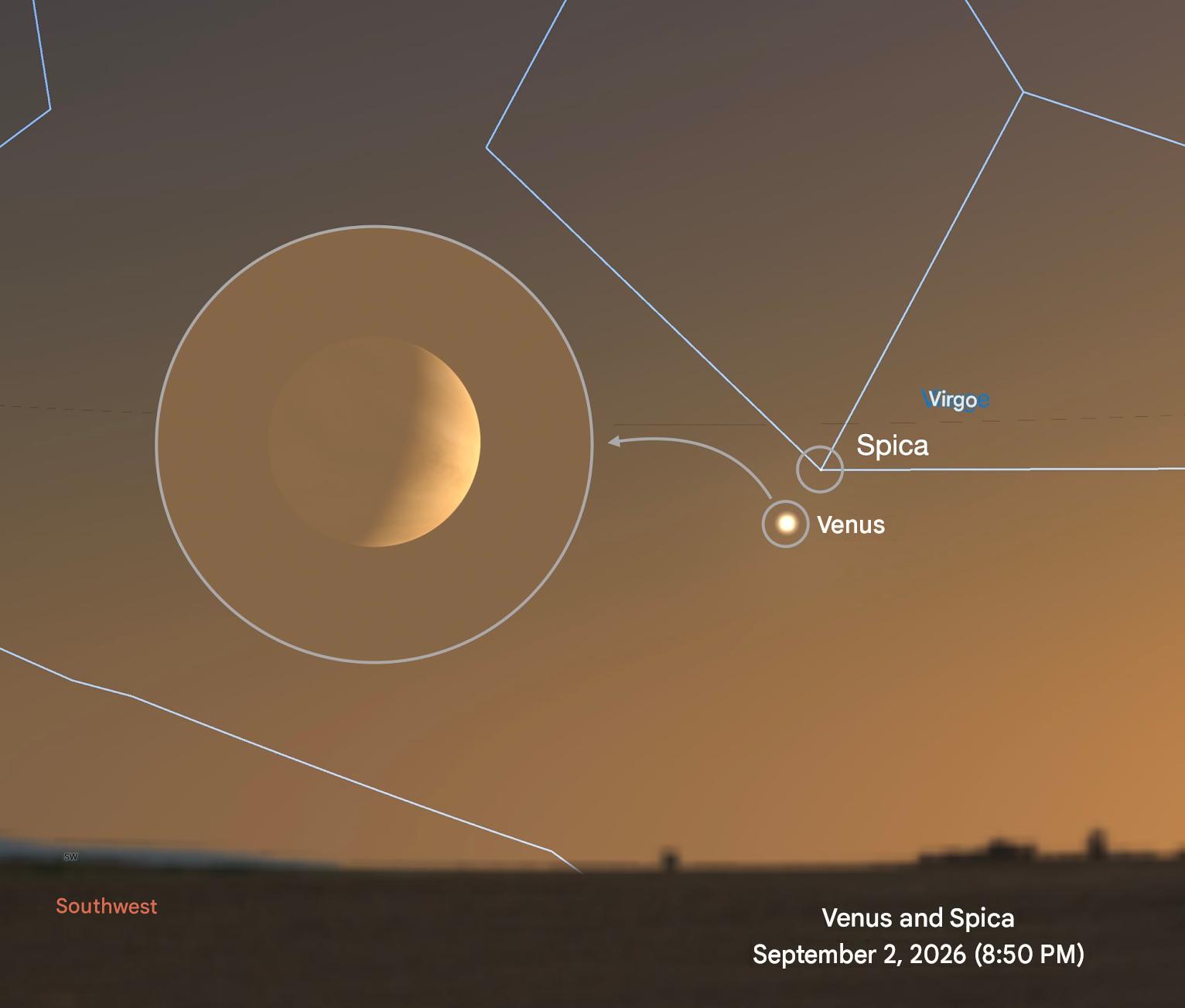
On September 2nd, Venus will pass within about 1.5° of Spica , the brightest star in the constellation Virgo. With a magnitude close to -4.6, Venus is easily visible to the naked eye, even though it will be low on the horizon , at an altitude of 8° at 8:50 PM, or 20 minutes after sunset (for Toulouse). Spica, much fainter, will appear nearby as a point of light.

The closest approach is to be found in the west after sunset. Both celestial bodies are bright enough to be observed without instruments, but binoculars can help to better appreciate their proximity. To protect your eyes, be sure to wait until the Sun has completely set before looking for Venus and Spica.

Venus will be 8° above the southwest, 20 minutes after sunset.
© Cité de l’espace/ Stellarium

SEPTEMBER 3: THE MOON PASSES NEAR THE PLEIADES

A HALF-MOON NEAR THE SEVEN SISTERS

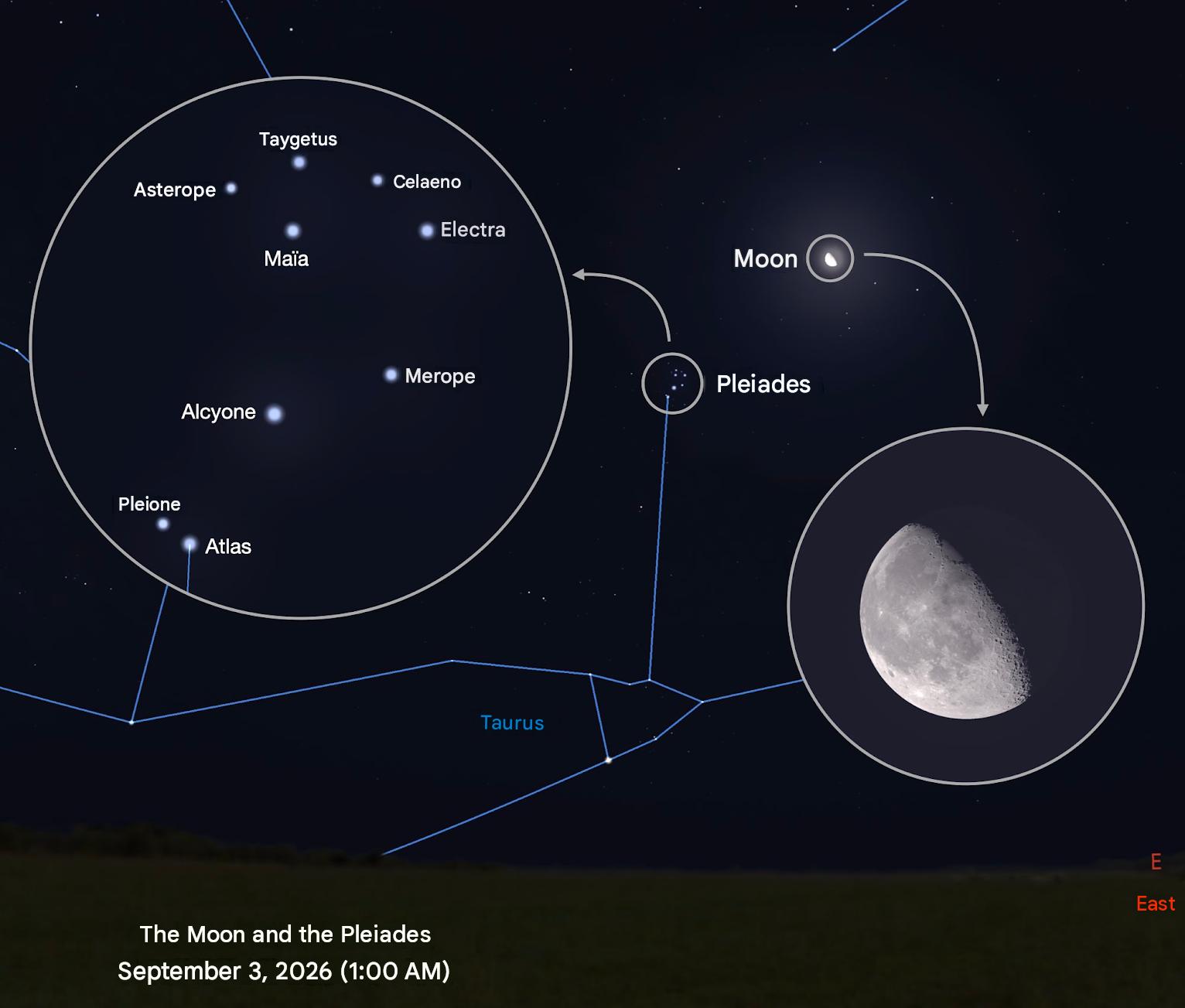
During the night of September 2nd to 3rd , and then on the morning of the 3rd, the Moon approaches the Pleiades cluster , in the constellation of Taurus.

The Pleiades are already visible to the naked eye as a small group of stars. Binoculars, however, offer a more spectacular view of this cluster, which contains several hundred stars, although only the brightest are visible without instruments.

The Pleiades immortalize in star form the seven ancient sisters named Alcyone, Asterope, Maia, Taygete, Celaeno, Merope, and Electra. They are watched over by their father and mother by two stars named Atlas and Pleione.

At 1 a.m., the Pleiades will already be 17° above the horizon. During the night, the Moon will move slightly closer to them.
© Cité de l’espace/ Stellarium

SEPTEMBER 7: THE MOON ACCOMPANIES MARS

A VISIBLE RAPPROCHEMENT BEFORE SUNRISE

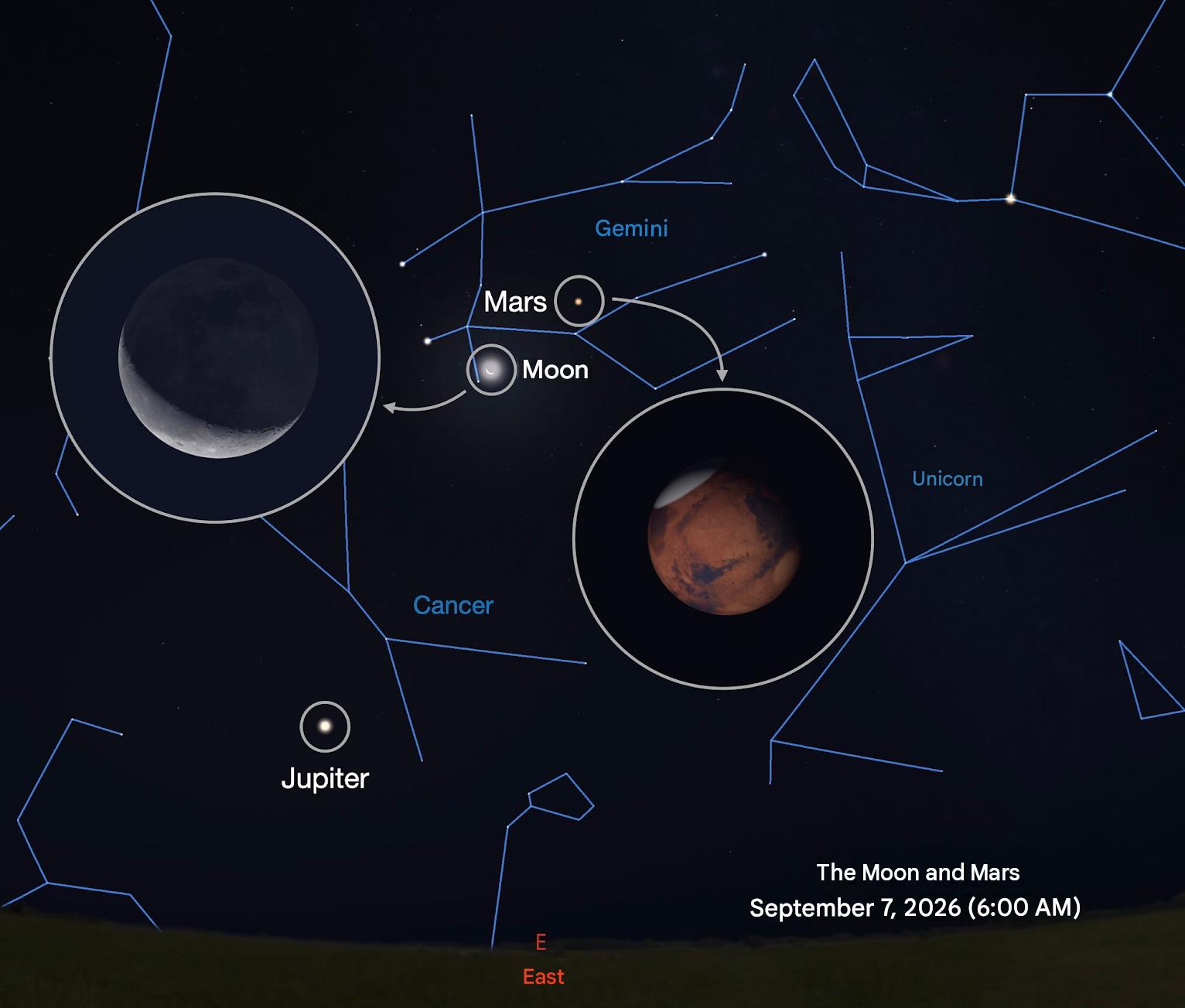
On September 7, a thin crescent Moon will pass within a few degrees of Mars in the constellation Gemini. The conjunction will be visible in the morning sky, before sunrise.

Mars is relatively inconspicuous at this time, but its slightly orange color makes it distinguishable from the stars. The Moon is a good reference point for finding it. For this observation, choose a clear east-northeast horizon and start looking early enough, before the first light of dawn obscures the fainter celestial bodies. In Toulouse, the Sun rises at 7:25 a.m. that day.

Around 6 a.m., Mars and the Moon will be high enough (about 30 degrees) to be easily visible. Lower down, you’ll see the bright glow of Jupiter 11° above the horizon. 
© Cité de l’espace/ Stellarium

SEPTEMBER 8: THE MOON APPROACHES JUPITER

JUPITER ACCOMPANIES THE LAST CRESCENT MOON

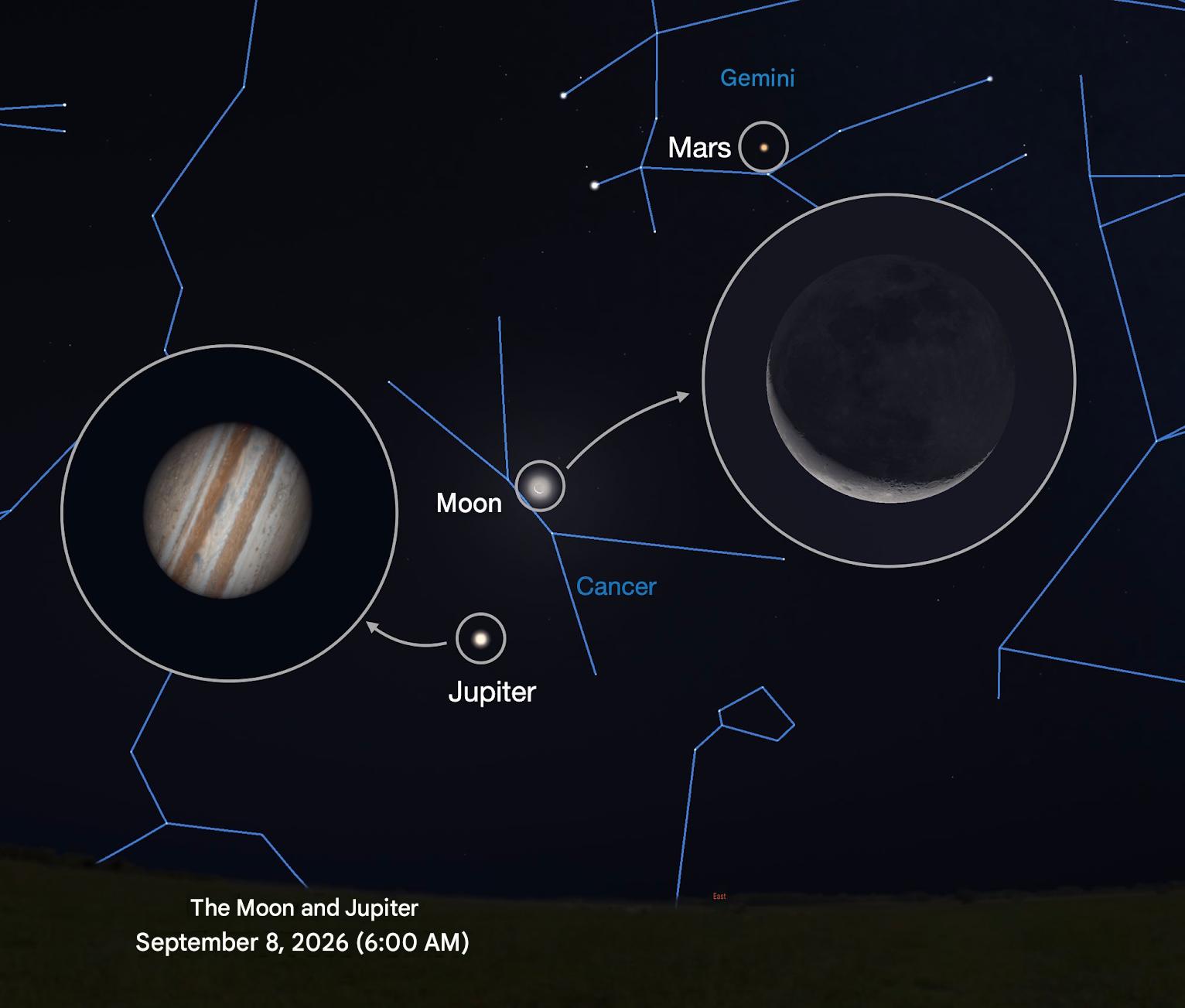
On September 8th, the Moon will pass close to Jupiter in the morning sky . This is an opportunity to observe the proper motion of our natural satellite from one night to the next. The conjunction is visible before sunrise, in the direction of the east.
Jupiter, being much brighter than the surrounding stars, is easy to identify.

Jupiter will then be 12° above the horizon. So choose a spot with a clear view to the east. Higher up, Mars will dominate the scene.
© Cité de l’espace/Stellarium

SEPTEMBER 9: THE SEPTEMBER PERSEIDS REACH THEIR PEAK

A SHOWER OF SHOOTING STARS TO OBSERVE UNDER A DARK SKY

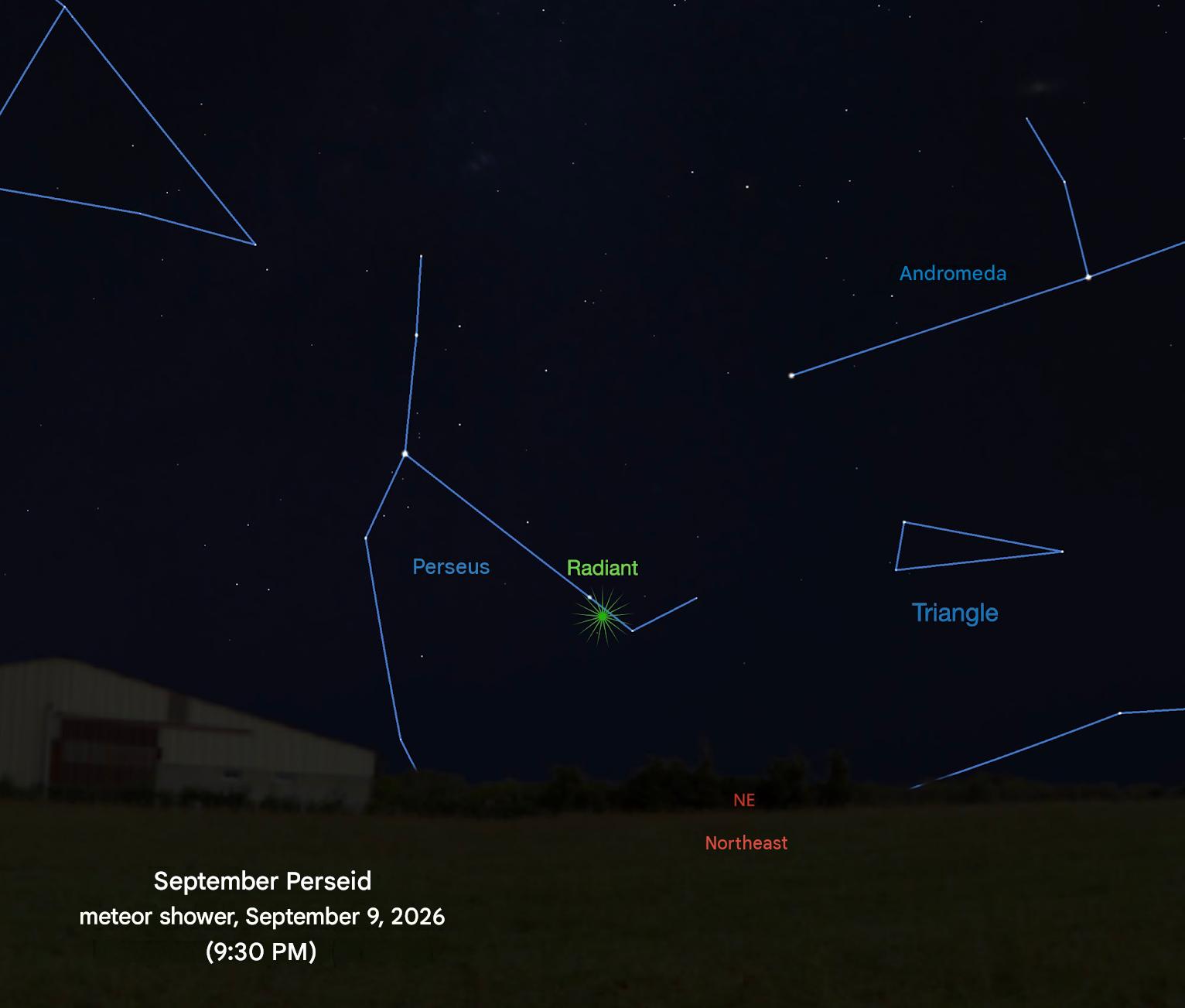
The September Perseids, also known as the Perseids epsilon, are active from the beginning to the end of September. Their peak is expected around September 9th , with a theoretically modest activity of about five to eight meteors per hour.

The conditions are favorable this year: the New Moon occurs on September 11th, meaning the sky will be only partially illuminated by our satellite. The best viewing conditions will be from a dark location in the second half of the night. No instrument is necessary: ​​meteors move quickly across a large portion of the celestial sphere and can be observed with the naked eye.
The International Meteor Organization predicts a peak on September 9th at 8 p.m., when the sky will not yet be completely dark. However, observing even a little later is still worthwhile.

The September Perseids are much less spectacular and well-known than the classic August Perseids.
© Cité de l’espace/Stellarium

SEPTEMBER 14: THE MOON PASSES CLOSE TO VENUS

A CLOSE ENCOUNTER TO OBSERVE AFTER SUNSET

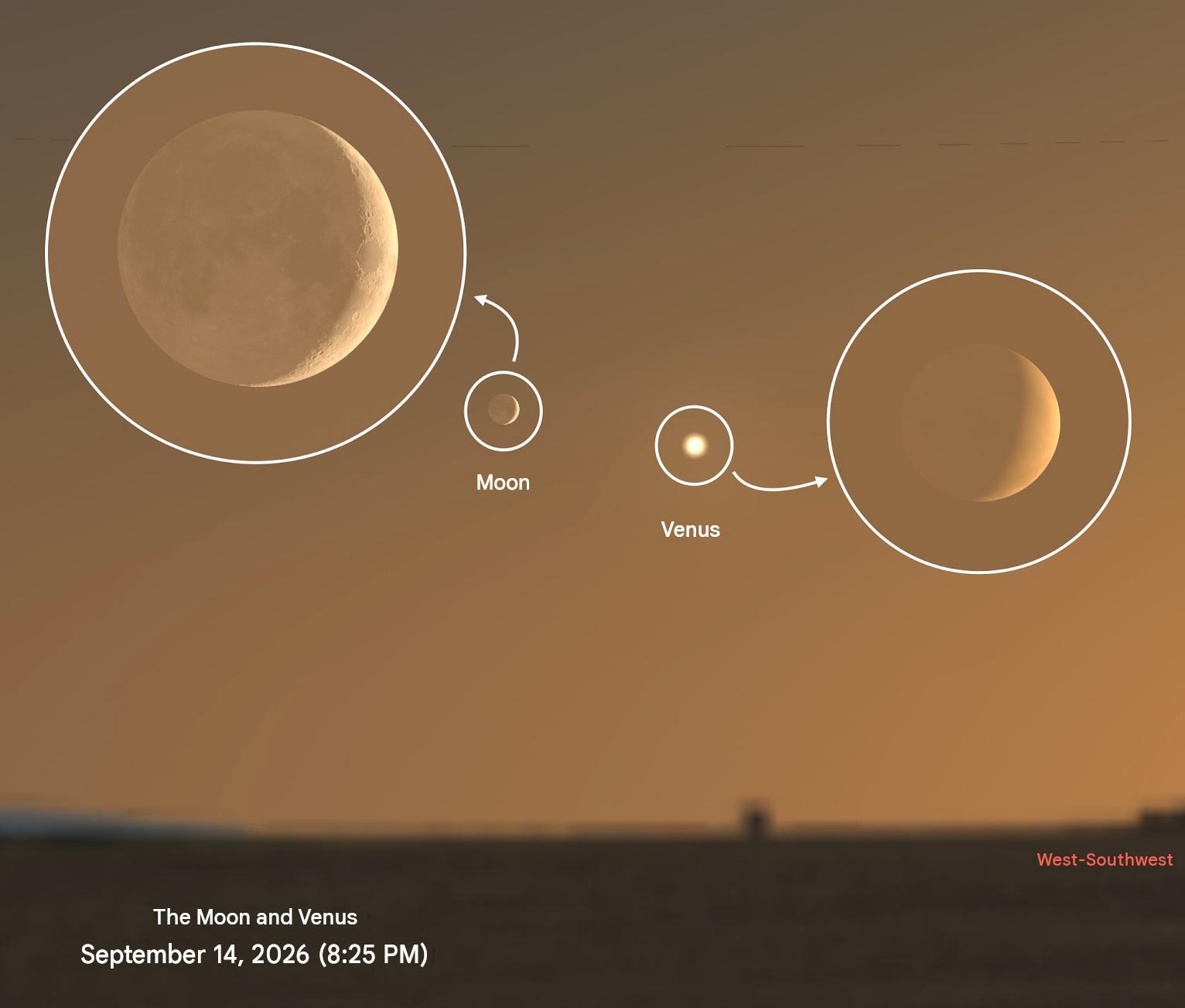
On September 14th, a thin crescent Moon approaches Venus . The two celestial bodies are visible in the evening sky and form an easily identifiable pair, even when the sky is still clear after sunset.

A lunar occultation of Venus will occur that day, but it will not be visible from France: it primarily affects certain regions of Asia. From France, the two celestial bodies will simply remain close together in the sky.

Caution when searching for Venus: never scan the sky near the Sun with binoculars or a telescope . Wait until the Sun has completely set (8:06 PM for Toulouse).

As a precaution, our map is calculated for 8:25 PM, a little less than 20 minutes after sunset in Toulouse. Venus will be only 5° above the horizon. A completely clear southwest and west horizon is essential.
© Cité de l’espace/Stellarium

SEPTEMBER 26: THE FULL MOON AND SATURN

THE FULL MOON TAKES PLACE ON SEPTEMBER 26 AT 6:49 PM, PARIS TIME.

The Full Moon can obviously be spotted without instruments and remains interesting to observe with simple binoculars. However, it is during the phases that one best appreciates the contours on the terminator, the boundary between the illuminated and dark parts of the Moon.

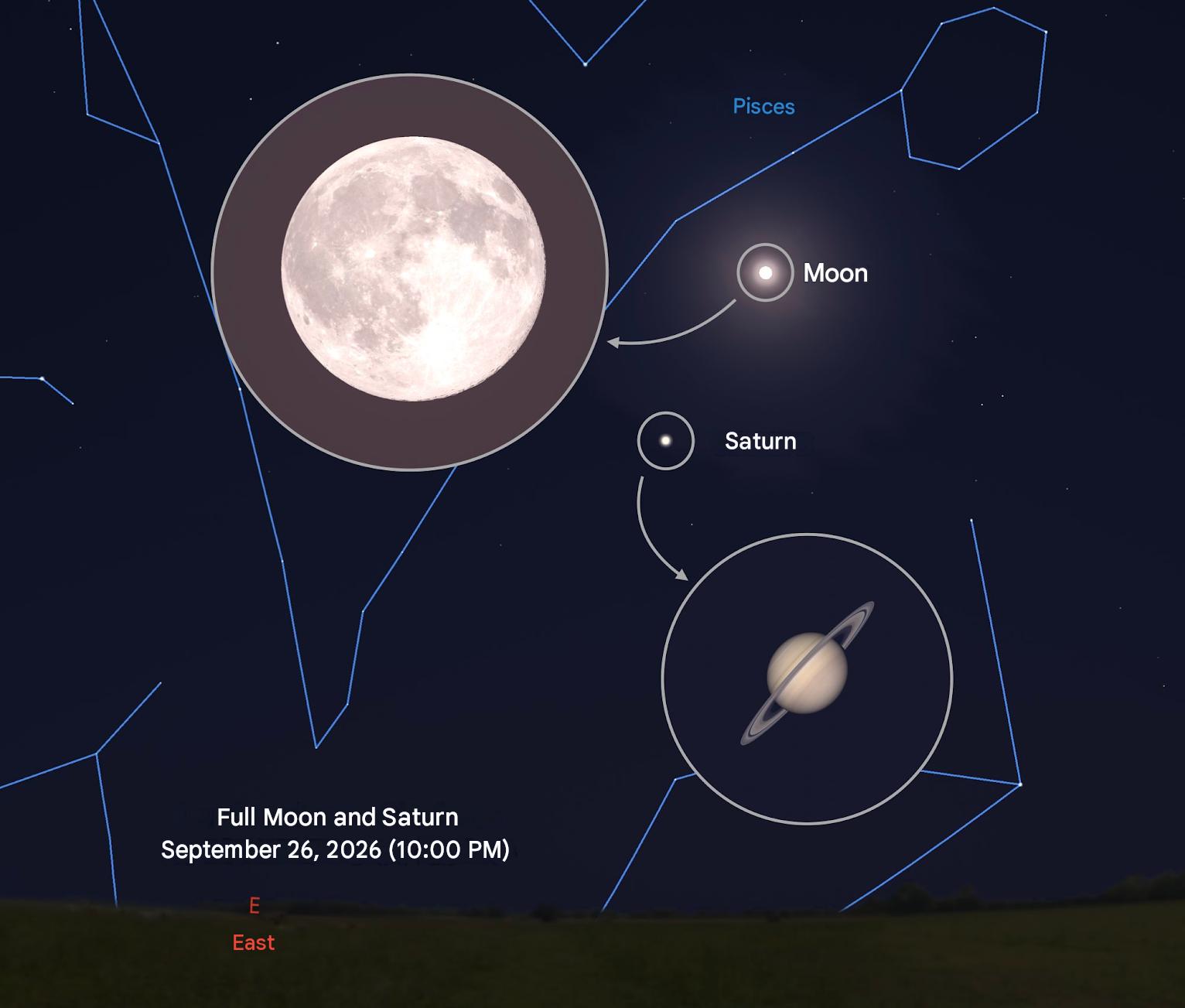
On September 26, the Moon will be full and will pass close to Saturn . In short, it offers an unmistakable landmark for finding the ringed giant and its yellowish glow.

Note that the exact time of the Full Moon (6:49 PM) occurs when it hasn’t yet risen. But it will still be a Full Moon tonight!

Saturn is then visible for much of the night and is located a few degrees from the Moon. With a telescope, its rings are visible to amateur instruments. Their inclination and apparent orientation change slowly over the months.

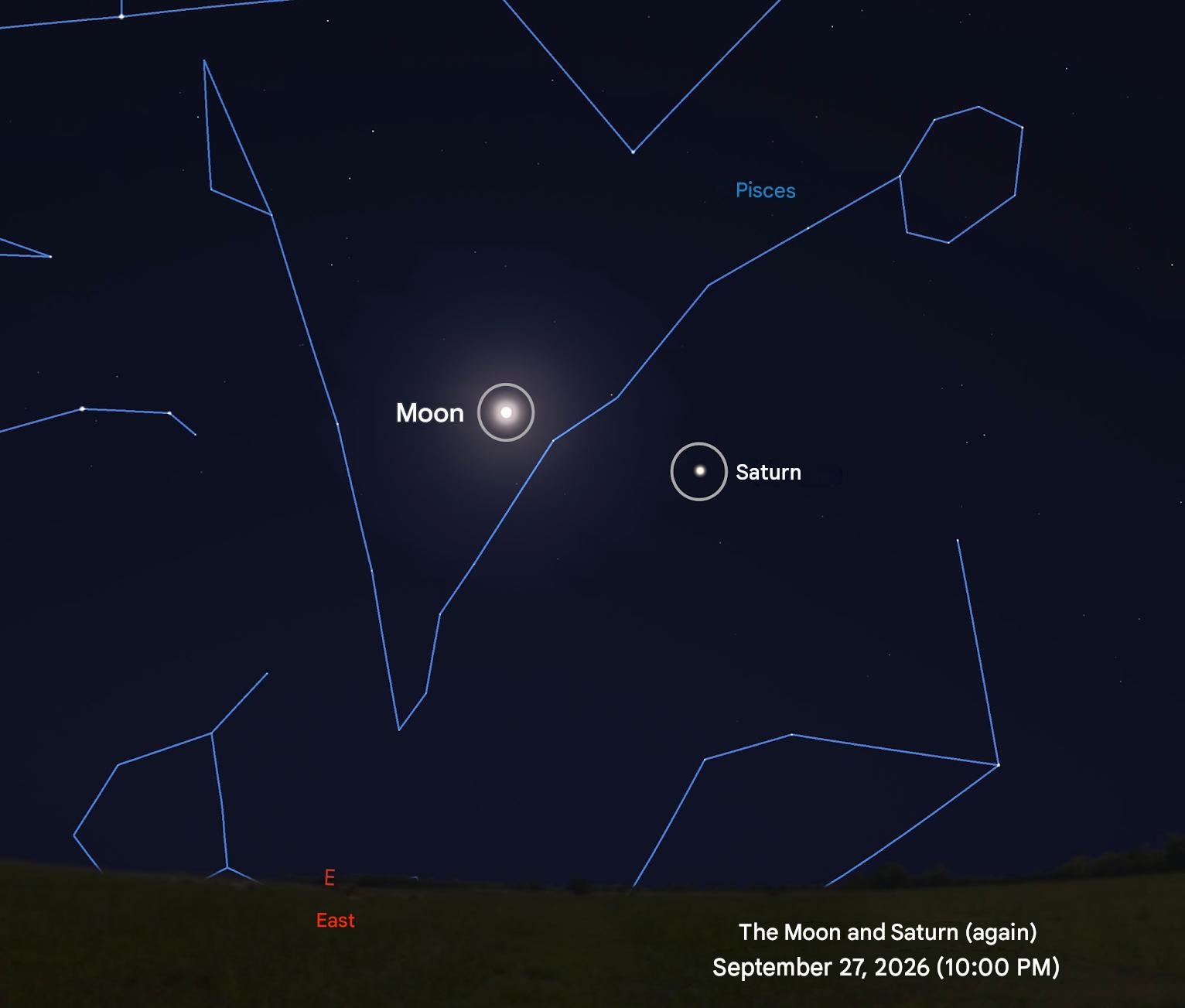
The following day, September 27, the Moon will still be close to Saturn .

A beautiful full moon makes it easy to find Saturn, which will already be 19° above the horizon at 10 p.m.
© Cité de l’espace/Stellarium

On September 27, the Moon is still close to Saturn, but its position in the sky has changed. This provides another opportunity to observe the proper motion of our satellite from one night to the next.
© Cité de l’espace/Stellarium

THROUGHOUT THE MONTH: CASSIOPEIA REGAINS A PROMINENT PLACE

A LANDMARK FOR NAVIGATING THE SKY

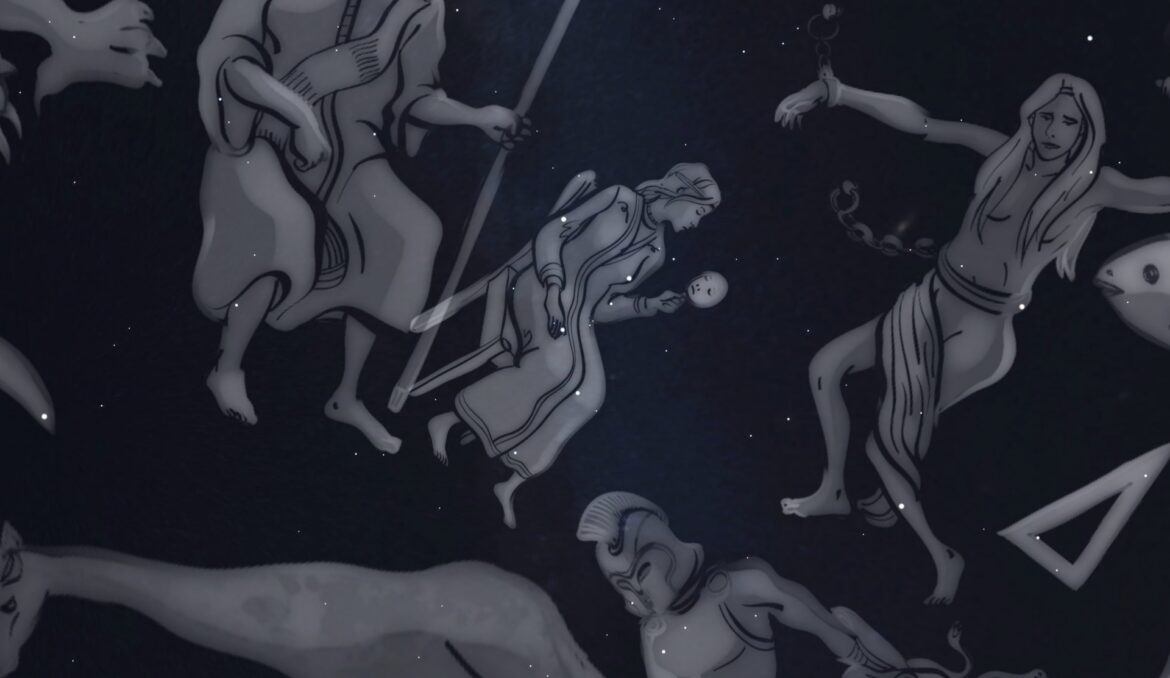
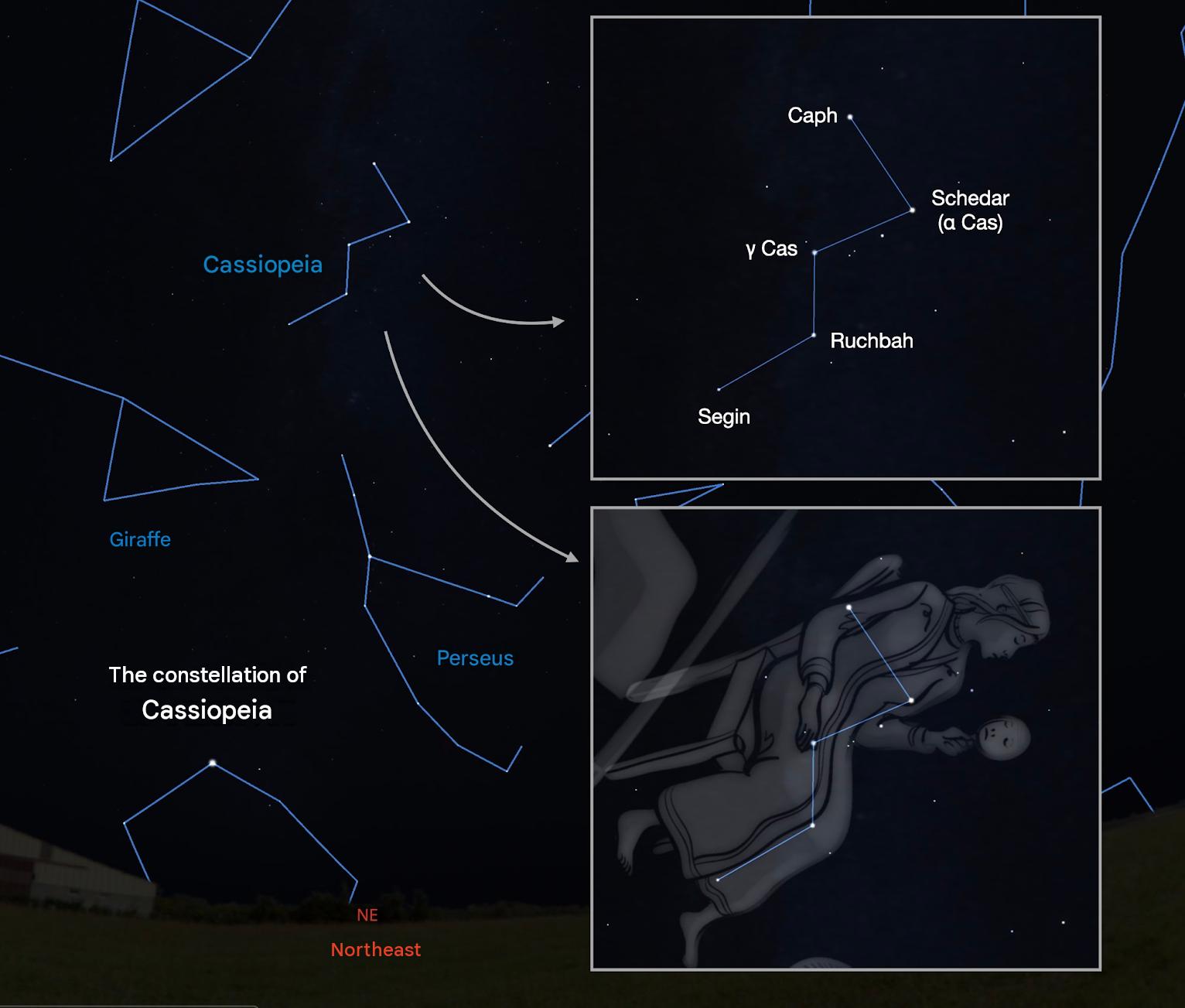
With the lengthening nights, the constellation Cassiopeia becomes particularly easy to spot in the evening sky from France. Its five main stars form a characteristic “W” or “M” shape depending on its orientation.

Cassiopeia is also a good starting point for exploring the autumn sky and the Milky Way. Nearby are the constellation Cepheus, the Andromeda Galaxy, and several star clusters visible with binoculars. From a location free from light pollution, part of the Milky Way can also be seen with the naked eye.

In Greek mythology, Cassiopeia is the mother of Andromeda, who married Perseus. The two constellations associated with Andromeda and Perseus are also located near Cassiopeia.

Cassiopeia is now better known for its W or M shape than for representing the mother of Andromeda.
© Cité de l’espace/Stellarium

Related articles