• Astronomy

The sky in February 2026

Published on 27 January 2026

In 2026, the February sky will offer the Moon the opportunity to pass close to several stars (Regulus, Spica, or Antares) and planets. Six planets will even be visible in the night sky at the end of February, though not necessarily.

The sky in February 2026

With the winter solstice of December 21st in the Northern Hemisphere having passed more than a month ago, it’s easy to see that the night sky is less imposing . Next month, at the equinox on March 20th, day and night will share the day equally.
February offers us some beautiful conjunctions between the Moon, stars, and planets . There will also be a new planetary panorama.

The times indicated are based on the legal time of metropolitan France.

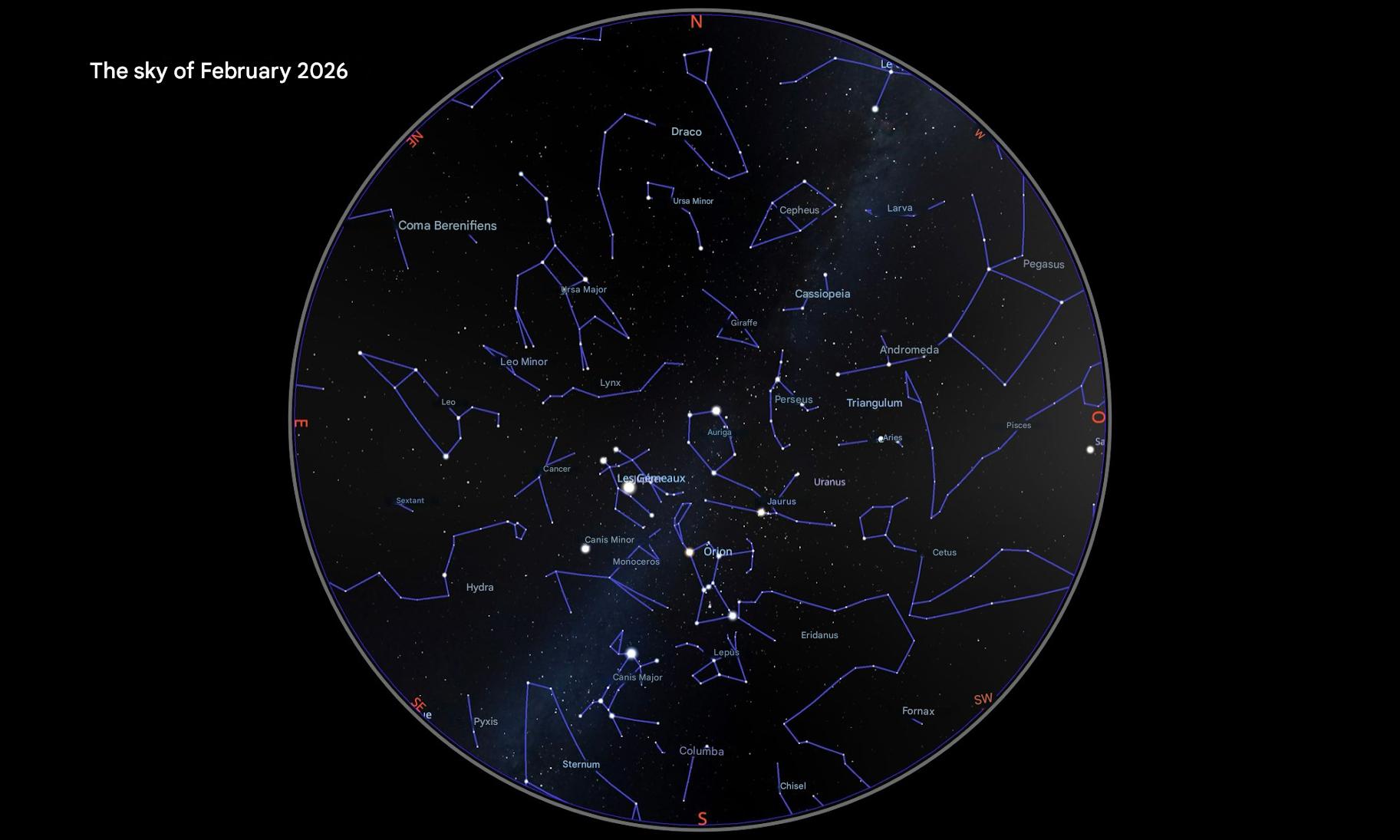
Cette carte montre le ciel pour Toulouse le 14 février à 21h00 (heure légale, donc celle de votre montre).

Elle est valable en grande partie pour le mois de février sur toute la France métropolitaine, sauf en ce qui concerne la position de la Lune (qui n’est pas levée ce jour-là).

© Cité de l’espace/Stellarium

THE MOON AND REGULUS

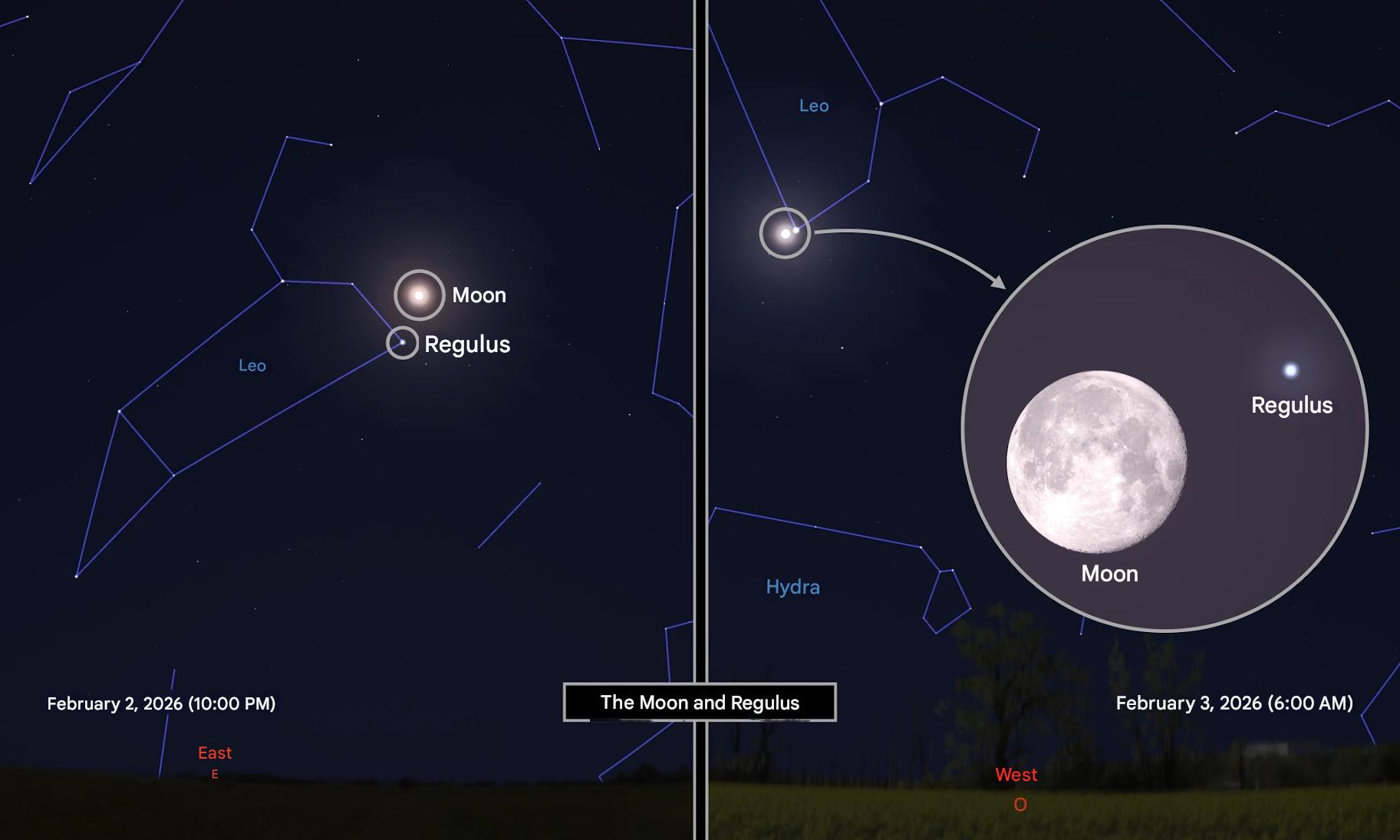
On the night of February 2nd to 3rd, the Moon will pass close to the star Regulus . Regulus is the brightest star (magnitude 1.4) in the constellation Leo. It is part of our “galactic neighborhood” as it is “only” 79 light-years away . As a reminder, our galaxy, the Milky Way, has a diameter of approximately 100,000 light-years. The Moon’s light, which it reflects from the Sun, takes a little over a second to reach us. This is a good opportunity to reflect on astronomical distances.
Due to its orbit around the Earth, our natural satellite moves relative to the stars, and its encounter with Regulus offers a clear opportunity to observe this . Thus, on February 2nd at 10 p.m., you will see the Moon about 30° above the eastern horizon. Regulus will be easily visible below it. During the night, the Moon will approach Regulus (closest at 4:42 a.m. on the 3rd) and then move away. If you are an early riser, at 6:00 a.m. on February 3rd, you will observe in the West that the relative positions of the Moon and Regulus have changed compared to the previous evening.

The Moon passes close to Regulus on the night of February 2nd to 3rd. The evolution of the conjunction between the two celestial bodies can be observed by looking at it on the 2nd at 10 PM and then on the 3rd at 6 AM.

© Cité de l’espace/Stellarium

THE MOON AND SPICA

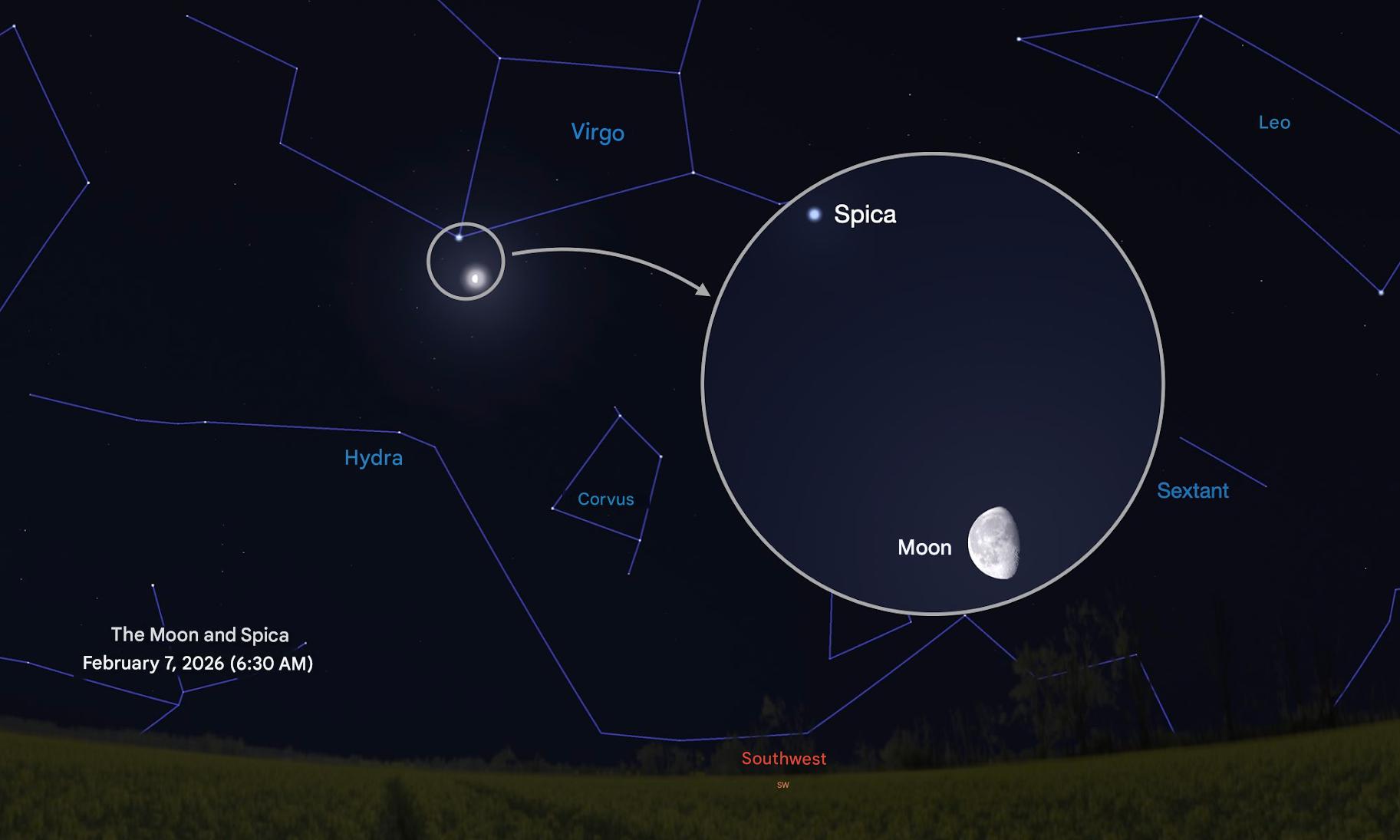
On the morning of February 7, the Moon will be close to Spica , the brightest star in the constellation Virgo. With a magnitude of 1, Spica is nicknamed the Virgo Spike . It is also the fifteenth brightest star in the sky.
Spica is 250 light-years away from us.

On the morning of February 7, Spica will be slightly above and to the left of the Moon. The pair will be about 30 degrees above the southwest horizon.
© Cité de l’espace/Stellarium

THE MOON, PAIKAUHALE AND ANTARES

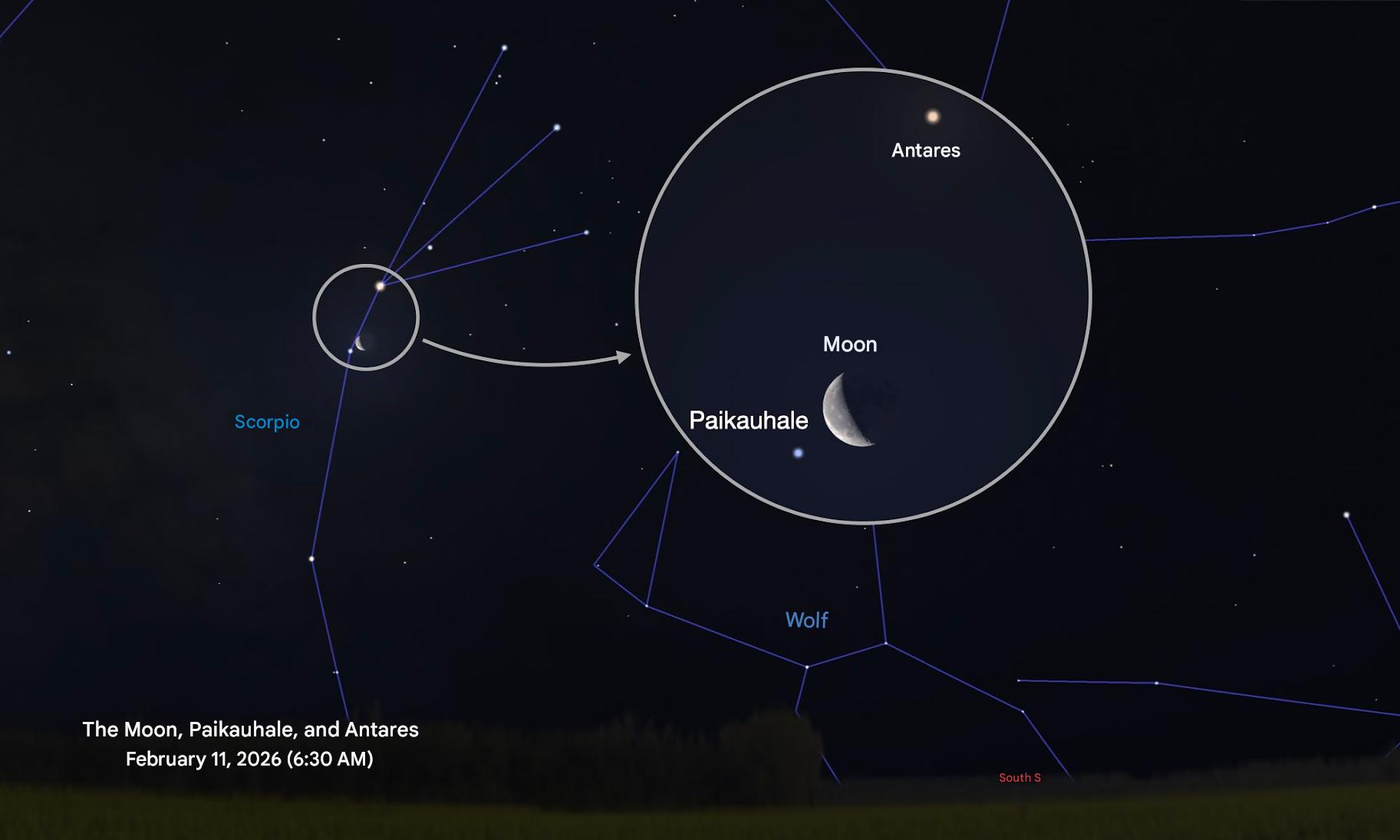
The celestial rendezvous with our neighbor continues! On the morning of February 11, a crescent Moon will be near the star Paikauhale and not far from Antares . Choose a clear southern horizon, as at 6:30 a.m., the Moon will be only 15° above the horizon.
The brightness of the crescent moon could obscure the view of Paikauhale , which has a magnitude of 2.8. Also known as Tau Scorpii, this star, located 470 light-years away, was named Paikauhale (meaning “wanderer” in Hawaiian) in 2018 by the International Astronomical Union. As a reminder, the IAU is the only organization authorized to officially name celestial bodies. Companies that offer to name a star for a fee are simply registering your request in their own records.

Above the crescent moon, you can easily spot the red supergiant Antares , the brightest star in the constellation Scorpius. The term “supergiant” is well-deserved, because if Antares were placed where the Sun is, it would easily engulf Mars!

On the morning of February 11, a crescent moon will be below Antares, not far to the south.
© Cité de l’espace/Stellarium

AN ANNULAR SOLAR ECLIPSE

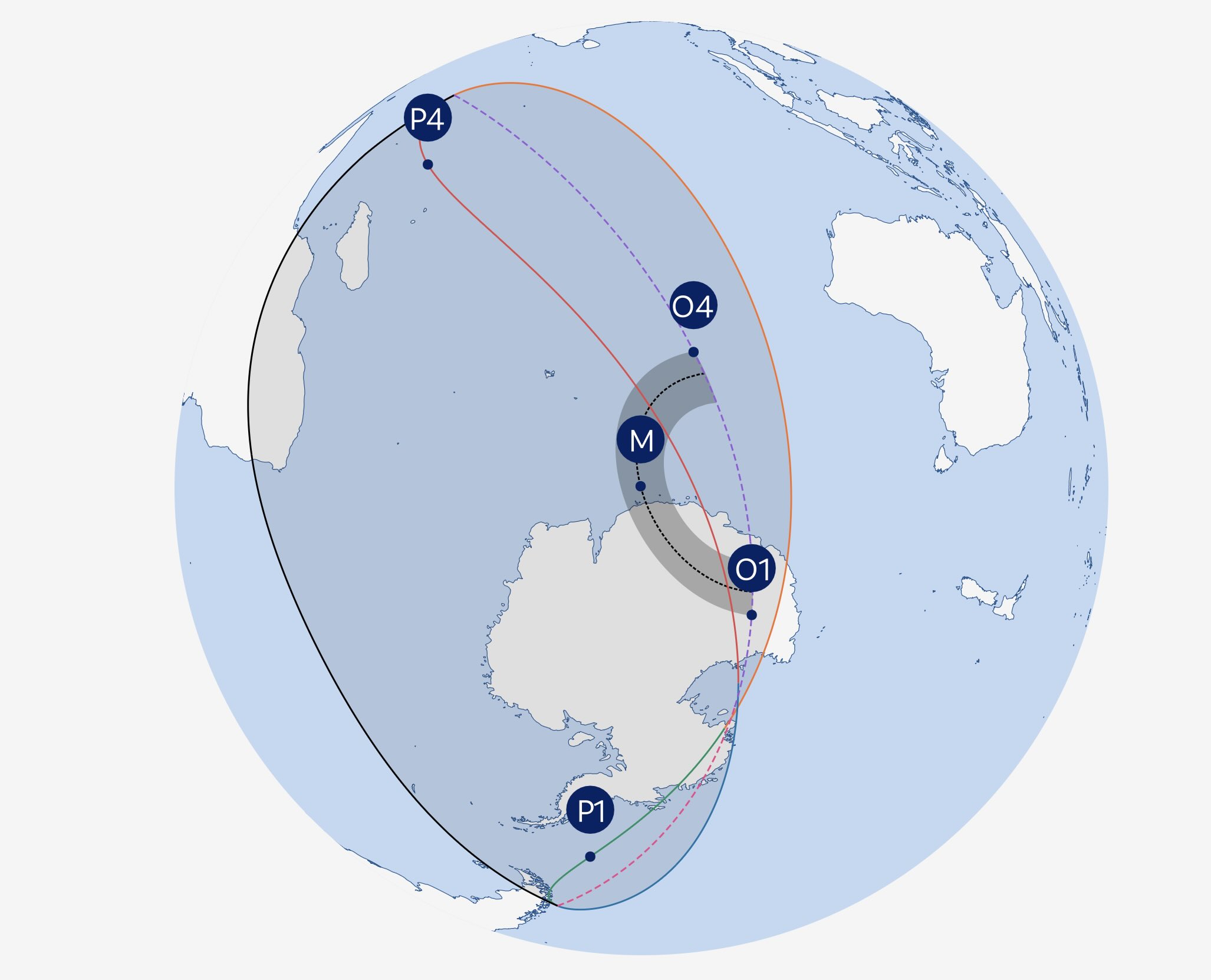
The first solar eclipse of 2026 will occur on February 17th . It will be an annular eclipse , as the Moon will not be large enough to cover the entire solar disk. The phenomenon will not be visible in mainland France . The path of totality (where the Moon will be completely surrounded by the Sun’s ring of fire) passes through Antarctica. In France, however, the overseas department and region of Réunion will be in the zone of partial visibility , and the Moon will cover up to 32% of the solar disk there.
Reminder: never observe a solar eclipse without adequate protection .

The next solar eclipse of 2026 will be that of August 12 (total in Spain and very pronounced partial in metropolitan France).

Visibility map of the annular solar eclipse of February 17. See also the special page of the Paris Observatory.
© Observatoire de Paris

VENUS, THE MOON, AND MERCURY

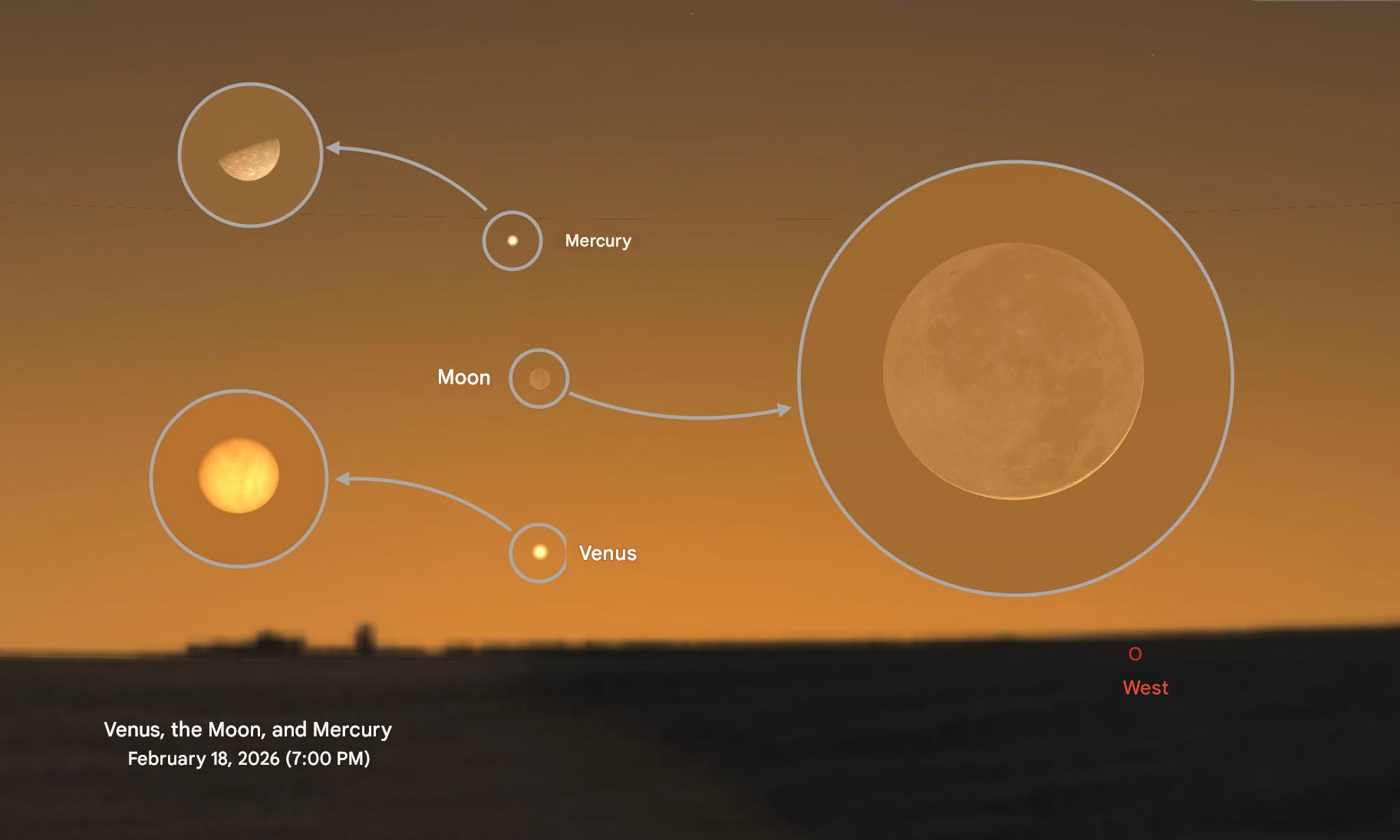
On February 18th, Venus, the Moon, and Mercury will form a trio very low on the western horizon . Be aware that this is a challenging observation .
First, since you must observe from the west, it is essential to wait until after sunset (expected at 6:30 PM in Toulouse).
We remind you that looking directly at the Sun without proper eye protection can cause blindness .
At 7:00 PM in Toulouse, the Sun will be 6° below the horizon, and the sky should begin to darken, allowing you to spot the bright light of Venus (magnitude approximately -2). However, the second planet will be only 2.4° above the horizon. A completely clear western view, ideally from a high vantage point, is essential . Just 7° higher, a very thin crescent Moon (1.6%) awaits you. Then, at an altitude of 10° (which is already more comfortable), Mercury should be detectable thanks to its magnitude 0.

In short, a somewhat extreme observation that requires ideal conditions.

Venus, a very thin crescent Moon, and Mercury will skim the western horizon on February 18 after sunset.
© Cité de l’espace/Stellarium 

THE MOON AND SATURN WITH MERCURY

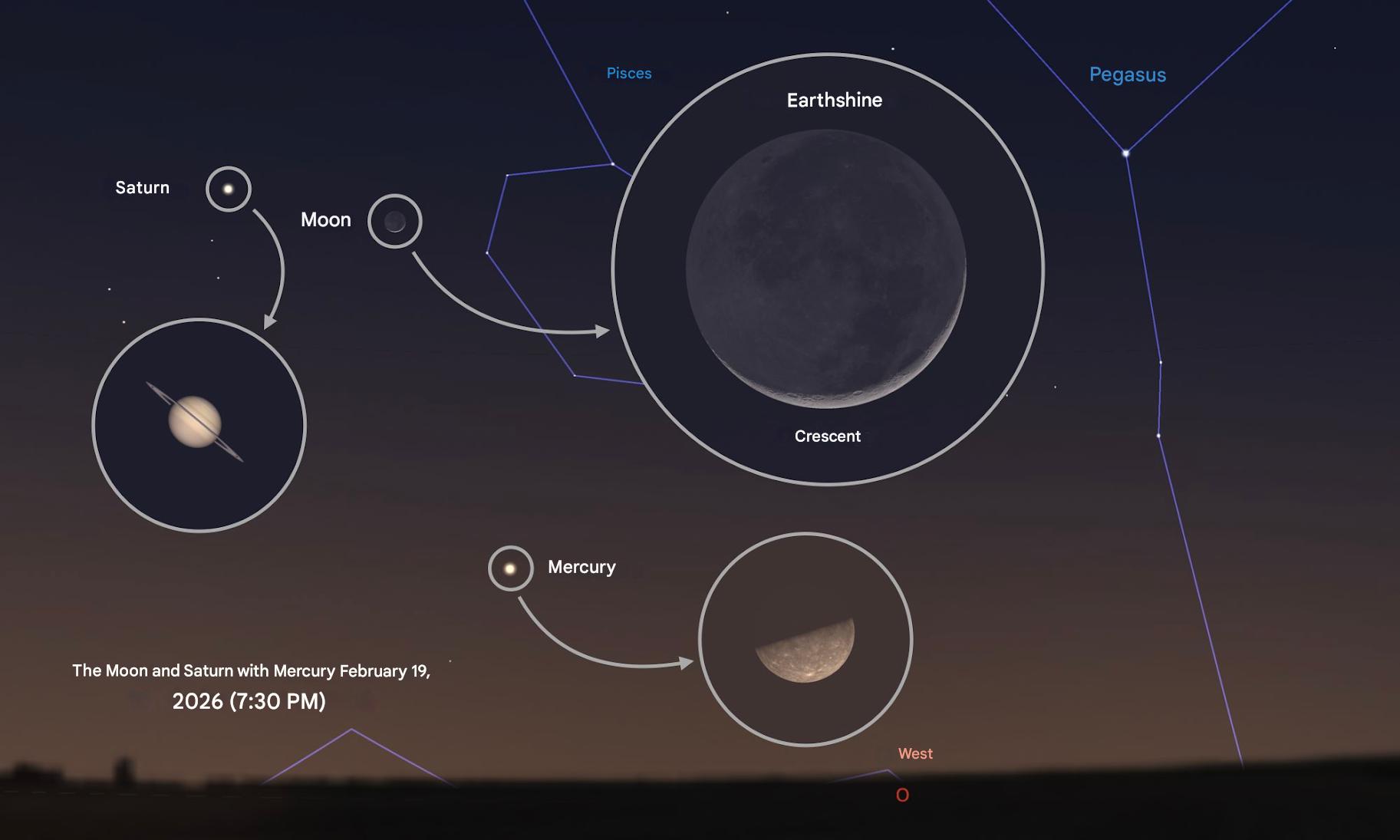
The following day, February 19th, the Moon will be close to Saturn, with Mercury nearby. While this trio again requires a clear western horizon , observing conditions are less challenging than the previous day.
Looking west, about an hour after sunset (for Toulouse), try to spot Mercury at an altitude of 5°. Even more importantly, and more easily, look 14° above it for a thin crescent moon, corresponding to a 5.6% illuminated Moon (instead of 1.6% the previous day). To the left of our natural satellite, Saturn will be prominent in this part of the sky with a magnitude of 1.5 and its characteristic yellowish glow.

The conjunction of Saturn, the Moon, and Mercury on February 19 will be easier than that of the 18th, but a clear western horizon remains essential. Mercury, at only 5° altitude, will be the most difficult target.
© Cité de l’espace/Stellarium

THE MOON AND JUPITER

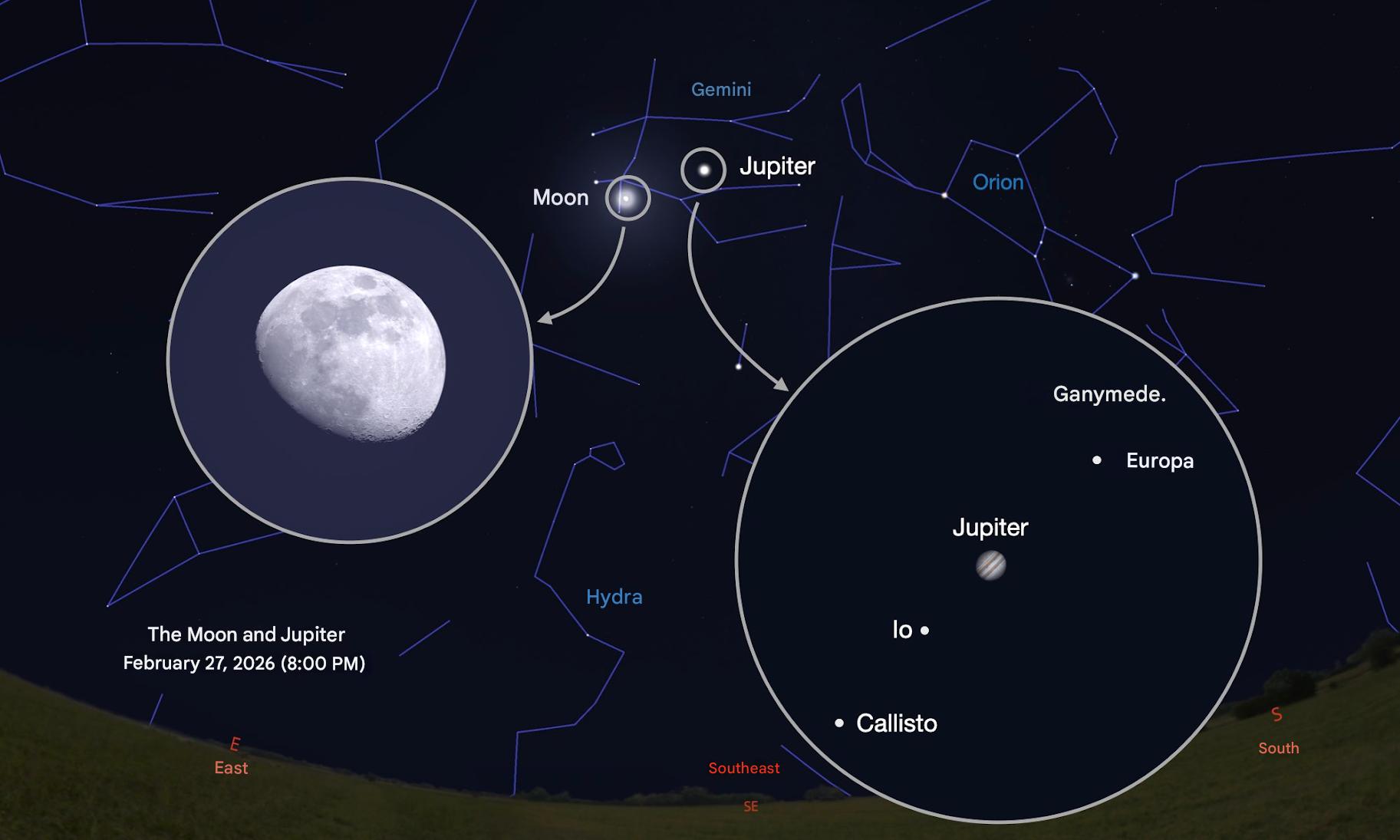
On February 27, the Moon and Jupiter will dominate the upper sky above the southeast. At about 60 degrees above the horizon, this striking duo in the constellation Gemini will be easy to spot!
If you have good binoculars, try to see the four Galilean moons of the largest planet in the Solar System. Tonight, they will be in the configuration detailed on our map. Jupiter’s four main moons are called Galilean because they were discovered by the Italian astronomer Galileo in 1610.

The Moon and Jupiter: a high-flying duo in the sky on February 27.
© Cité de l’espace/Stellarium

PLANETARY PANORAMA

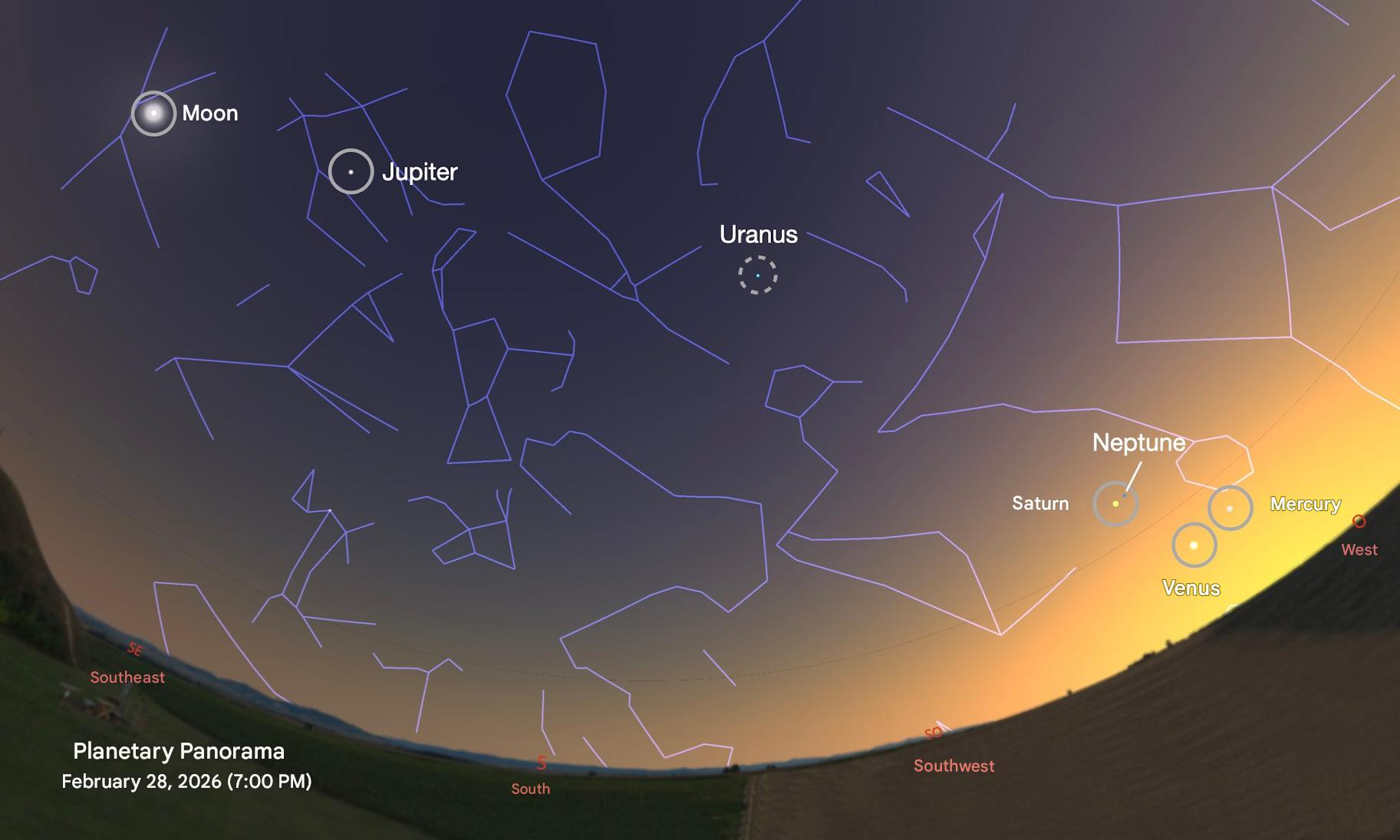
Perhaps you’ve read sensational headlines about an impressive planetary gathering… It’s true that, at the end of February, the evening sky will potentially offer us six planets at once  !
But we’ll temper the enthusiasm surrounding this kind of “planetary panorama” or “planetary parade.” For all six planets to be clearly visible, you need to observe shortly (about 30 minutes) after sunset. This is because Mercury and Venus will be very close to the horizon (as we observed on February 18th and 19th) and will set around 7:40 PM. Seeing these two planets is therefore not guaranteed and depends on a perfectly clear western sky (Venus will only be 6° above the horizon).
At 15° above the horizon, Saturn will be more easily spotted, but its glow will compete with that of the setting sun. Nearby, Neptune will not be visible to the naked eye.
Comfortably perched at an altitude of 68°, Uranus is too faint to be seen without astronomical instruments. The easiest target is obviously Jupiter , which will be at 52° with its bright light. In addition to the planets, the Moon, illuminated at 84%, will also be impossible to miss.
It’s easy to see, then, that not all the planets will be visible and that the exercise will be primarily symbolic.

On February 28, after sunset, six planets will be visible in the sky, but not all of them will be!
© Cité de l’espace/Stellarium

Related articles