• Astronomy

The sky in April 2026

Published on 27 March 2026

Although the nights are getting shorter inexorably, the April night sky still brings us beautiful encounters between the Moon, stars and Jupiter, as well as the Lyrid meteor shower.

The sky in April 2026

On the night of March 28-29, daylight saving time put our clocks about two hours ahead of astronomical time. We then have to wait until after 10 p.m. for astronomical twilight to pass, giving way to a truly dark night sky (the Sun is more than 18° below the horizon). And at the end of the month, 45 minutes will be added. Despite its nights being shortened by the days, April 2026 promises some beautiful displays and a meteor shower .

The times given in this section are in Metropolitan France time (the time on your watch), unless otherwise indicated.

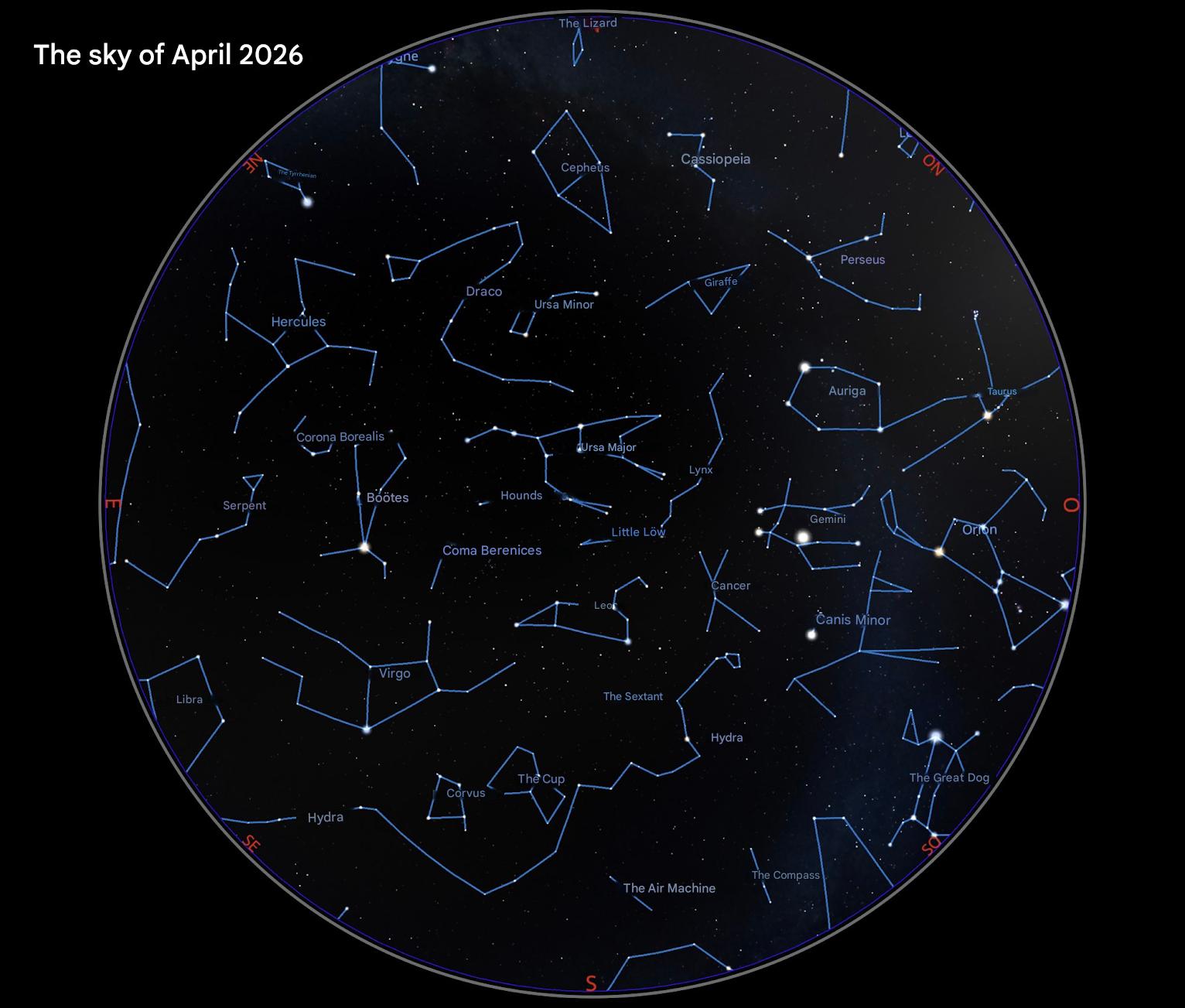
This map shows the sky for Toulouse on April 15th at 11:00 PM (local time, i.e., your watch time).
It is largely valid for the month of April across mainland France, except for the position of the Moon (which, on this map, had not yet risen at that time).
© Cité de l’espace/Stellarium

THE MOON AND SPICA

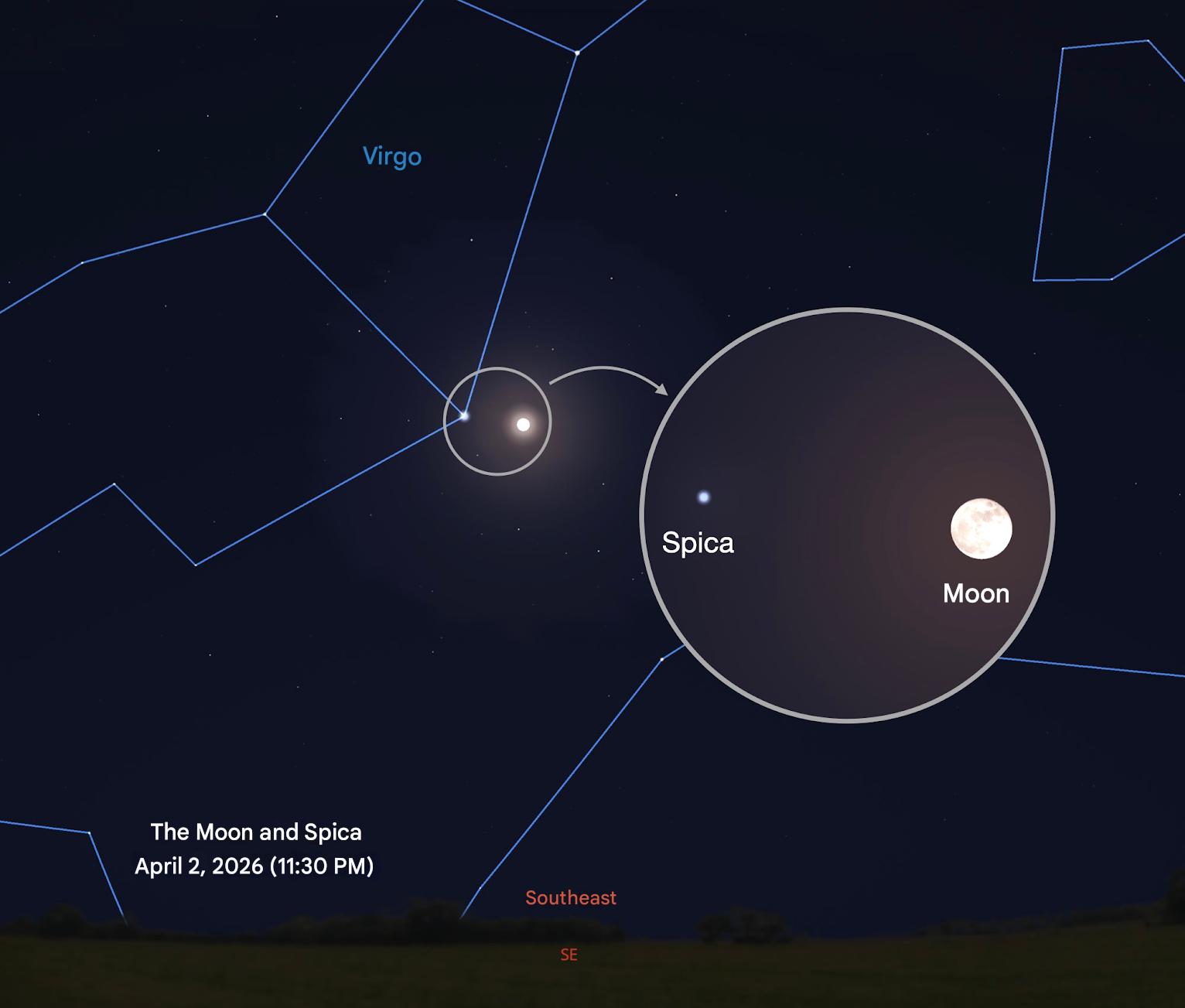
On April 2nd, the Moon will be close to Spica , the brightest star in the constellation Virgo. This will recreate a pairing seen last February.
Nicknamed the ” Stalk of Virgo ,” Spica has a magnitude of 1, making it the fifteenth brightest star in the sky. It is 250 light-years away from Earth.

On April 2nd, during the night, around 11:30 PM, Spica and the Moon will be about 20 degrees above the southeastern horizon.
© Cité de l’espace/Stellarium

THE MOON AND ANTARES

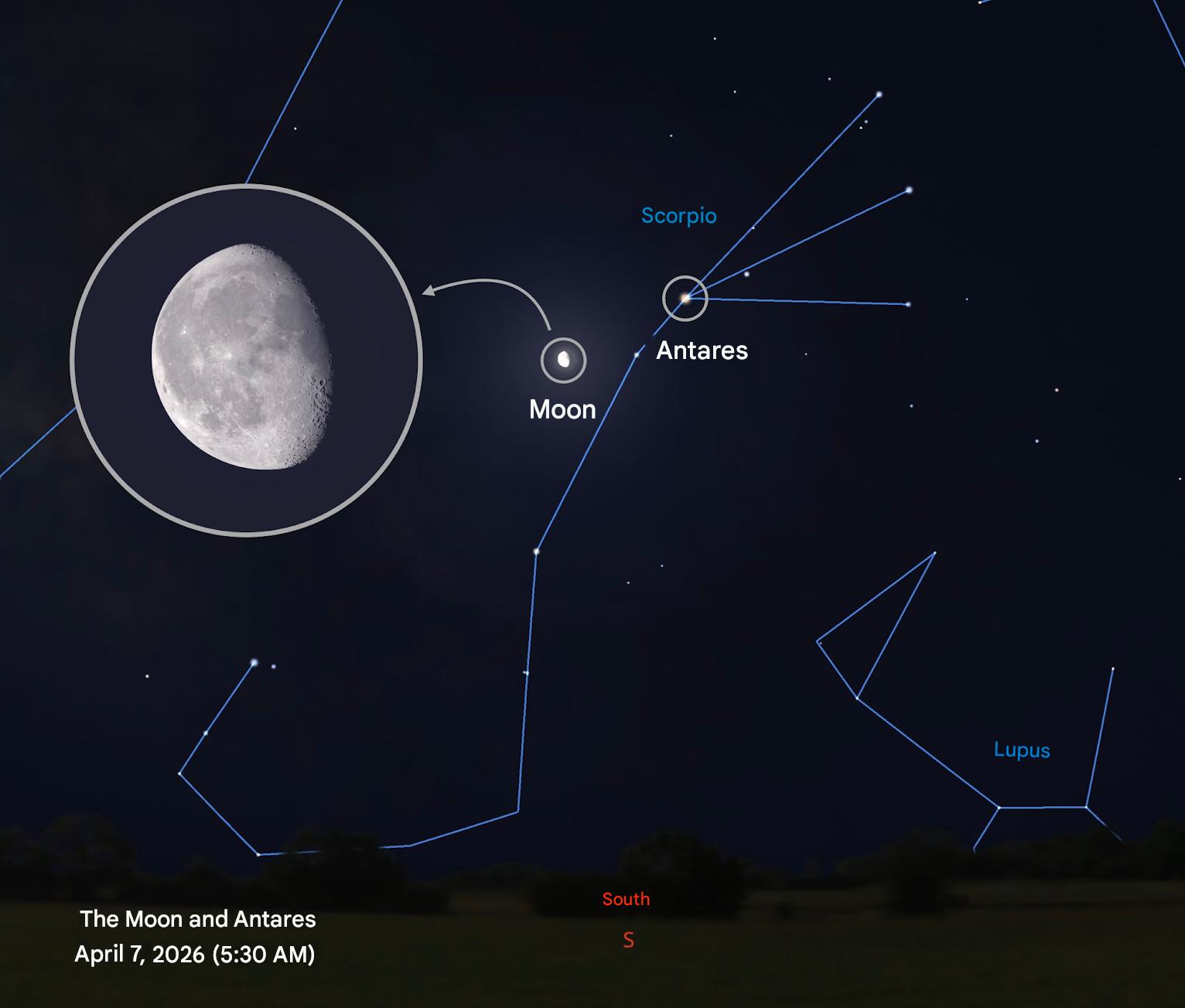
Five days later, but this time early in the morning of April 7, the Moon will share the southern horizon with Antares . The brightest star in the constellation Scorpius will stand out in this area of ​​the sky due to its brilliance (magnitude 1.2) and especially its characteristic red color . While our natural satellite will be barely more than a light-second away, the light from Antares will have taken 550 years to reach us. This star is a red supergiant that would largely encompass the orbit of Mars if it were in the position of our Sun.

Antares and the Moon dominate the southern sky on the morning of April 7, a little over two hours before sunrise.

©Cité de l’espace/Stellarium

EARTHSHINE AND THE PLEIADES

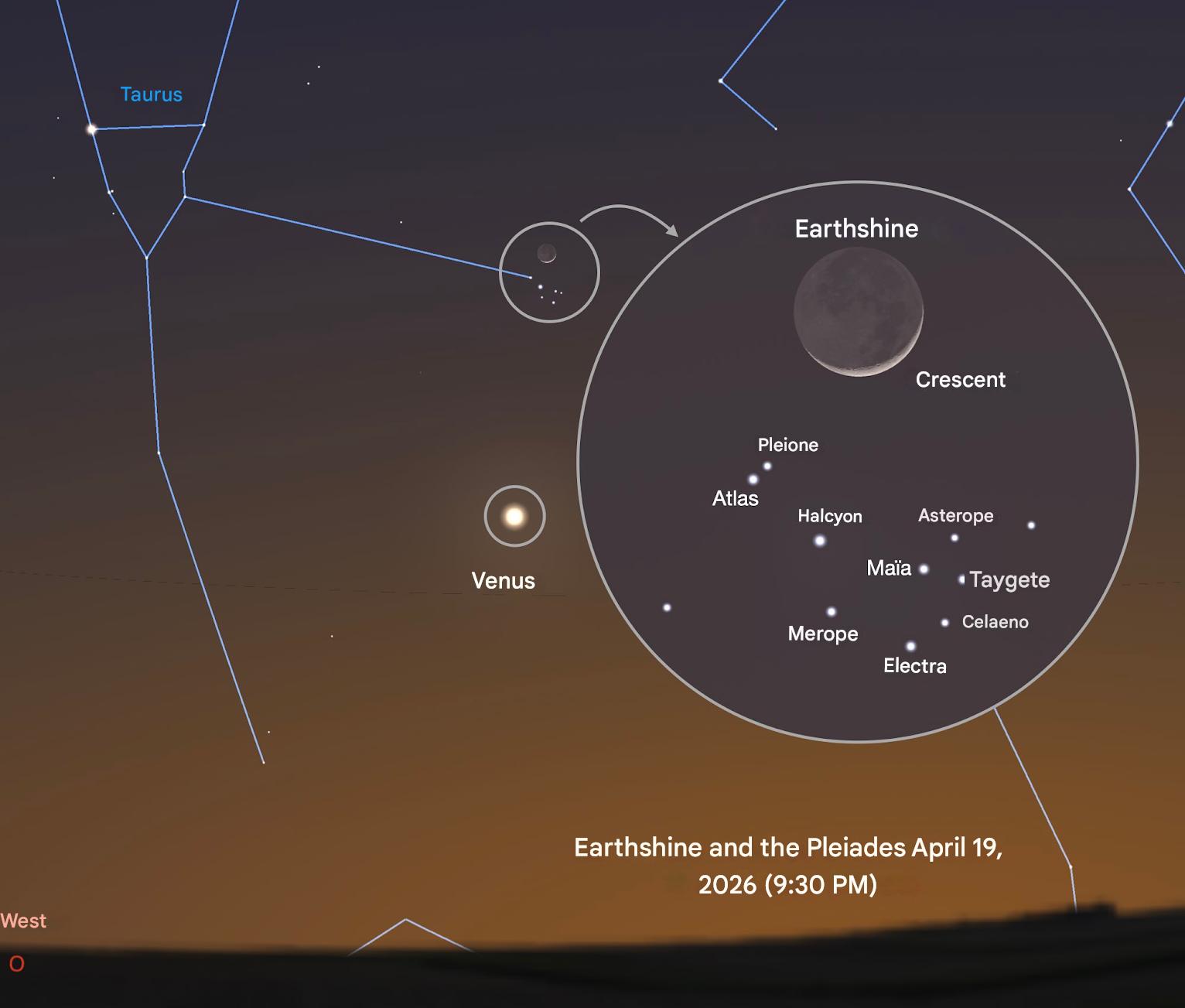
On April 19th, a thin crescent moon with its earthshine will be slightly above the Pleiades. These stars immortalize the seven ancient sisters: Alcyone, Asterope, Maia, Taygete, Celaeno, Merope, and Electra. They are watched over by their parents, the stars Atlas and Pleione. Together, they form a miniature version of the Big Dipper, a constellation that is always a marvel to behold.

On April 19th, the Seven Sisters will be topped by a thin crescent moon (7% illumination), which will showcase earthshine ( this part of the moon is illuminated by sunlight reflected from the Earth). The spectacle promises to be quite beautiful! To enjoy it safely, look west about 45 minutes after sunset, which will occur at 8:42 PM in Toulouse (this time may vary depending on your location). That’s why our map below indicates 9:30 PM. The sky will then begin to darken sufficiently to highlight earthshine and the Pleiades.

The Pleiades are an open cluster of 3,000 young stars (only about ten are visible to the naked eye under good conditions) located approximately 440 light-years from Earth. The delicate nebulae surrounding them were once thought to be remnants of their formation, but it is now believed that we are observing an interstellar cloud through which they pass as they disperse.

The Pleiades already offer a beautiful object to observe with the naked eye. Under a clear night sky, five are easily visible. Capturing the seven or nine main stars requires skies free from light pollution and/or the use of binoculars. But on April 19th, the proximity of the horizon on the west side will not make it easy to see them all.

On April 19, 45 minutes after sunset, you will see the bright Venus in the west, 13° above the horizon. The Moon and the Pleiades will be slightly higher, at about 20 degrees.
© Cité de l’espace/Stellarium

JUPITER AND THE MOON

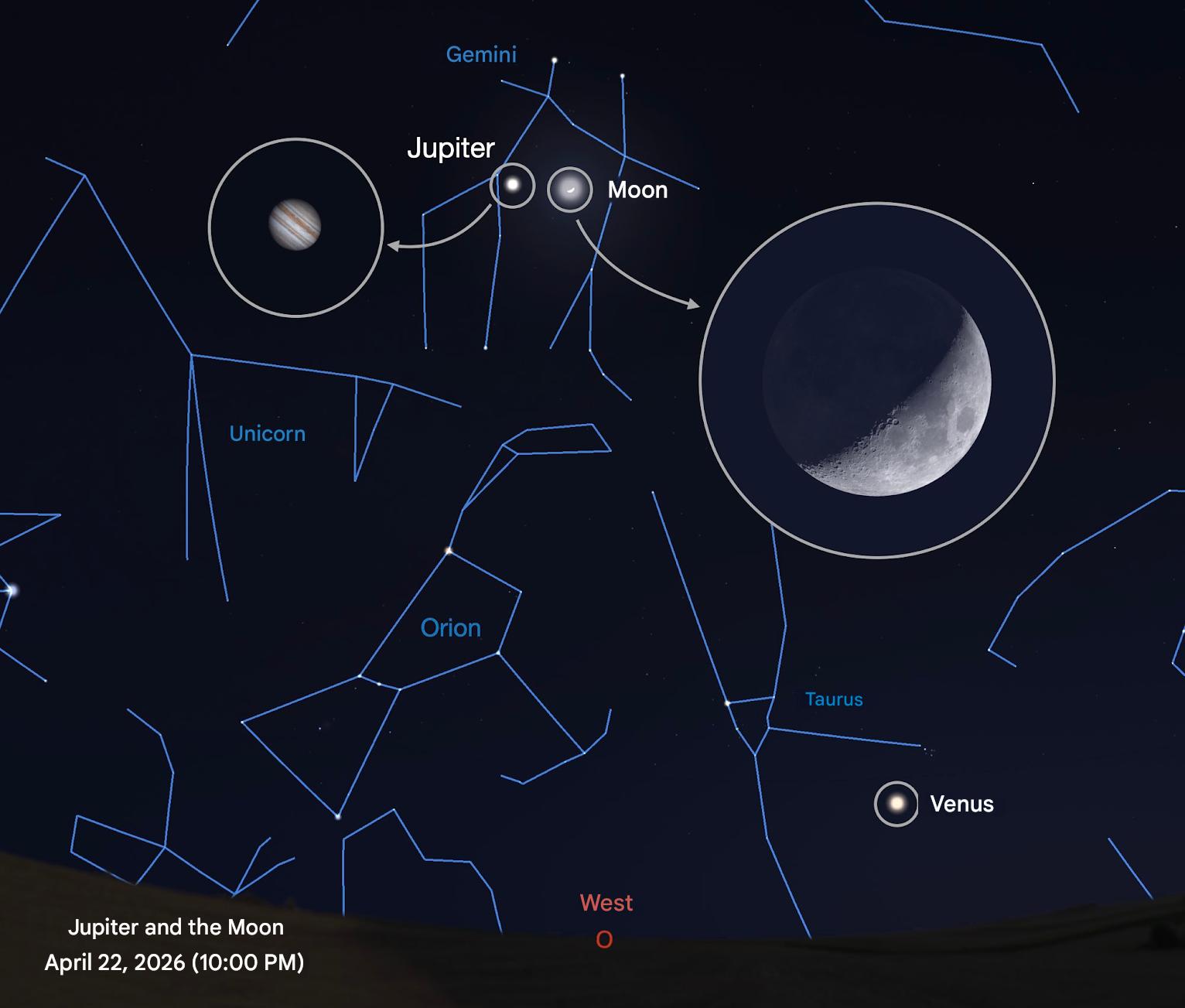
On April 22nd, a classic duo, Jupiter and the Moon, will be visible in the west, in the constellation of Gemini . This time, the pair will dominate the western horizon, reaching an altitude of almost 50° around 10 PM.
Much lower and to the right of the west, at only 9° altitude, Venus will be noticeably bright if the horizon is clear.

A beautiful Jupiter and Moon duo on April 22nd.

© Cité de l’espace/Stellarium

THE LYRID METEOR SHOWER

The peak of the Lyrid meteor shower is expected in 2026, on the night of April 22-23.
Yes, the term “shooting stars” is very popular, but it’s completely inaccurate . They are actually dust particles (usually from comets or asteroids) that vaporize upon entering the atmosphere, creating a fleeting streak of light. While they can be seen every night, “meteor showers” refer to periods of more sustained activity, as the Earth passes through a specific stream of dust. The name given to these events comes from the constellation where the radiant is located—the point from which the “shooting stars” appear to originate.

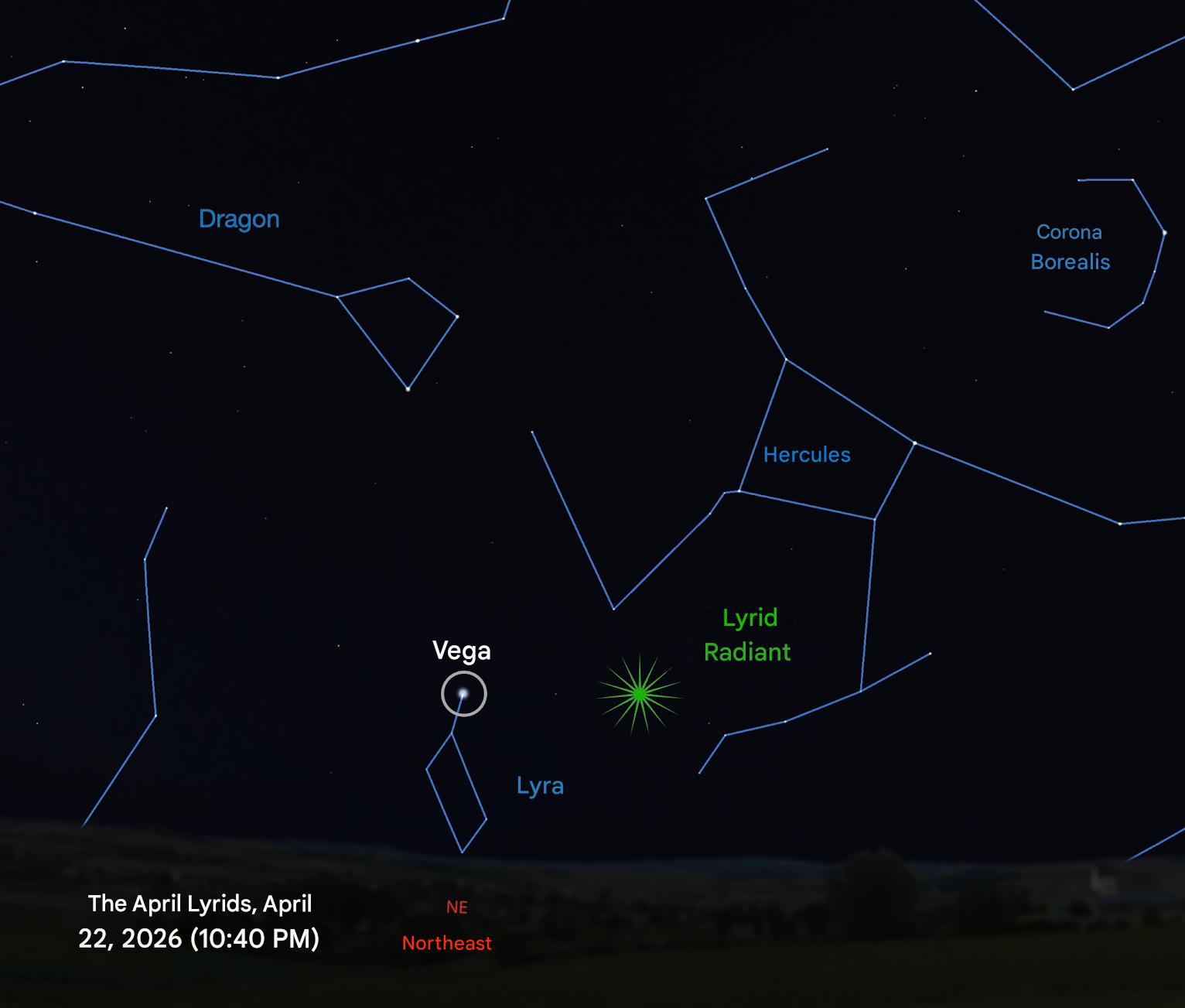
The Lyrids, and more specifically the April Lyrids, are caused by a radiant in the constellation Lyra, home to Vega, the fifth brightest star in the night sky (magnitude 0). Observed for over 2,500 years, the Lyrids originate from dust scattered by comet C/1981 G1 (Thatcher). Considered active from April 16 to 26, this meteor shower peaks around April 22. For 2026, the International Meteor Organization predicts a maximum on April 22 at 7:40 PM Universal Time, or 9:40 PM in mainland France . This time is quite favorable for France and Europe. Admittedly, the radiant will be barely 3° above the northeastern horizon at that precise moment. For clarity, our map is set to 10:40 PM.
However, there’s no need to focus solely on this region; the best approach is to take in as much of the celestial vault as possible (a deckchair is ideal) away from light pollution. The Moon, only 33% illuminated, will be a slight distraction . The most daring will wait until it sets at 3:04 a.m. on the 23rd!

Position of the radiant of the April Lyrids above the Northeast horizon on April 22 at 22:40, one hour after the peak as predicted for 2026.

© Cité de l’espace/Stellarium

Of course, and if possible, don’t just wait for the exact moment of the peak. Such a timing is still a forecast, and the peak of the Lyrids could occur slightly before or after. Furthermore, a meteor shower peak is by no means instantaneous. Patience is key . The nights before or after the peak can also offer beautiful Lyrids.

Don’t expect a spectacular meteor shower, however , as the April Lyrids are rather modest with a ZHR of 18. The ZHR (Zenital Hourly Rate) is an estimate of the number of meteors a person could see from a radiant at the zenith (which, incidentally, isn’t the case) under a perfectly dark sky (maximum visible magnitude of 6.5, the limit for the naked eye). By comparison, the ZHR of the famous Perseids in August is typically 100.

Related articles