

• Moon

The second stage of a SpaceX rocket crashed on the Moon

Published on 05 August 2026

The second stage of a SpaceX Falcon 9 rocket, which had launched two landers to the Moon in early 2025, crashed on August 5th. The impact was unintentional and resulted from a trajectory deviation.

The second stage of a SpaceX rocket crashed on the Moon

On January 15, 2025, a SpaceX Falcon 9 rocket launched from Florida to send two landers from the private companies Firefly Aerospace (USA) and ispace (Japan) to the Moon. The first stage, registered B1085, returned to land on a barge at sea, as SpaceX reuses this component of its launch vehicles (along with the fairings) as much as possible. However, the second stage of a Falcon 9 is not recovered and, in most cases, burns up in Earth’s atmosphere at the end of its mission to avoid becoming space debris. But in the case of a launch to the Moon, this “end of life” was not possible. Eighteen months later, the second stage impacted our natural satellite .

Note: The NASA photo of the Moon at the top of this article (which shows part of the far side) was taken during the Artemis II mission and is not related to this news from August 5.

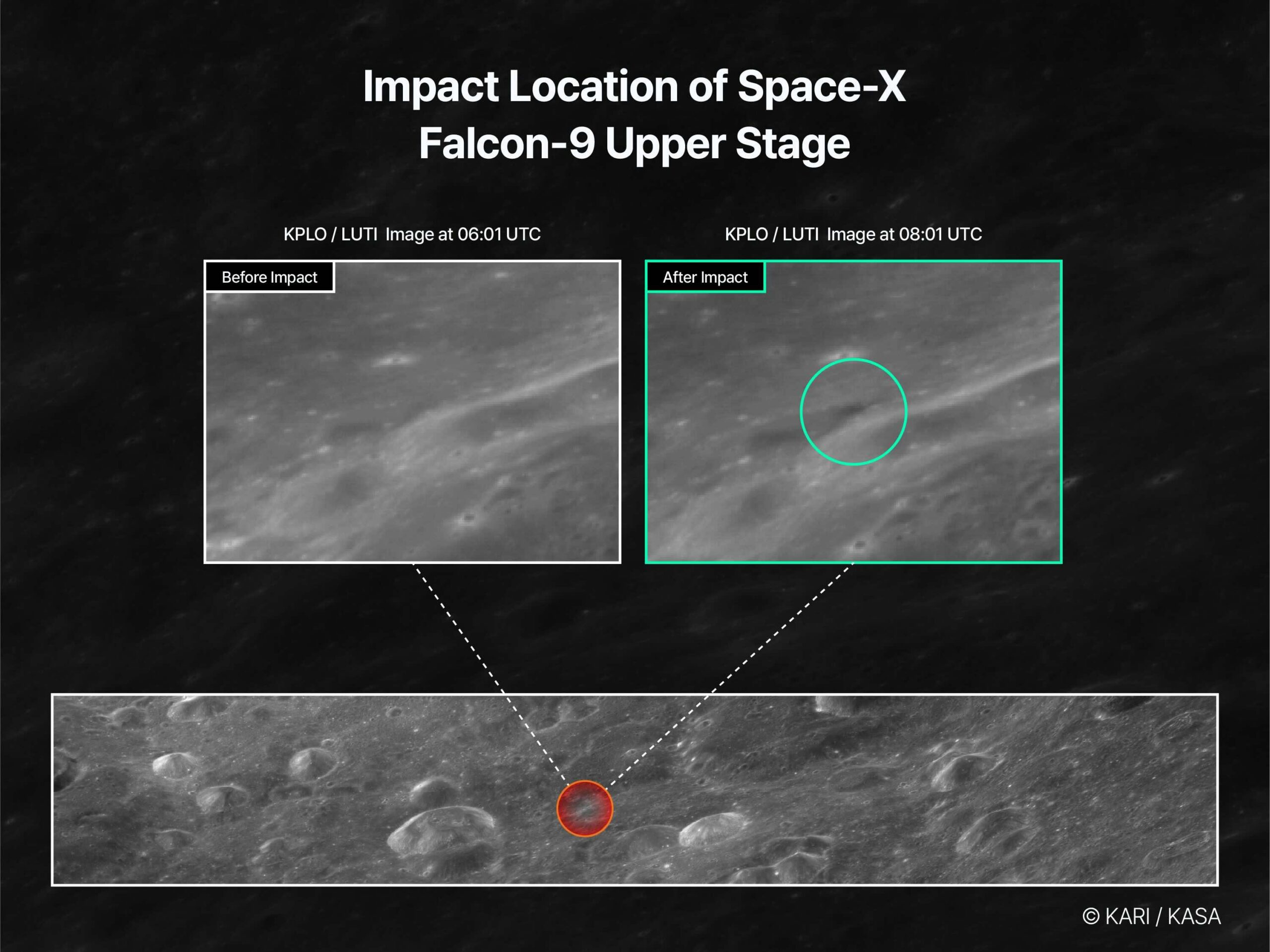
Top left: a photograph of the affected lunar region before the impact; right: after . Within the green circle, a dark alteration of the surface is visible, the mark left by the crash of the Falcon 9’s second stage.
© KARI/KASA

THE DANURI PROBE PHOTOGRAPHS THE IMPACT SITE

UPDATED AUGUST 6

Capturing the crash of the second stage of SpaceX’s Falcon 9 (see details below) on the Moon on August 5 proved very difficult, as the location was on the far side, close to the boundary with the near side.

However, in anticipation of this event, the KARI (South Korea Aerospace Exploration Agency) lunar probe Danuri was programmed to photograph the affected area 30 minutes before the crash and then pass over it again for a total of eight imaging sessions. The photographs obtained clearly show a darkening of the lunar surface, which KARI believes corresponds to the impact mark left by the second stage.

AN UNINTENTIONAL CRASH

After deploying Firefly Aerospace’s Blue Ghost lander (successful landing on March 2, 2025) and iSpace’s Resilience lander (failure on June 5), the Falcon 9 rocket’s second stage was placed in a distant orbit to prevent it from becoming debris and threatening Earth’s orbit. SpaceX had therefore not planned to crash this part of its launcher into our natural satellite .
However, tracking of the stage by independent astronomers, using publicly available data from NASA’s CNEOS (Center for Near Earth Object Studies), showed that the stage’s orbit was unstable due to a combination of solar activity and gravitational forces, and that it was on a collision course with the Moon.

A SCIENTIFIC OPPORTUNITY

The most recent calculations indicated an impact on August 5 at 06:35 Universal Time (08:35 Paris time) not far from the Einstein and Bell craters on the far side of the Moon. Even though the location is close to the boundary between the far and near sides, it appears that no telescope has yet been able to capture the dust plume that must have been kicked up. The second stage of a Falcon 9 rocket weighs almost 4 tons without fuel (all of it had been used for the mission), so the impact should have created a crater estimated by NASA to be 18 meters wide and 4 meters deep .
The lack of images of the moment of impact does not prevent the event from being a scientific opportunity . Indeed, NASA plans to photograph the crash site with its Lunar Reconnaissance Orbiter (LRO) in the coming days. Comparison with previous images of the same region will allow scientists to identify the new crater. With the mass of the stage and its approach characteristics (speed and angle) known, the appearance of the crater will provide valuable indications of the nature of the lunar surface at that location.

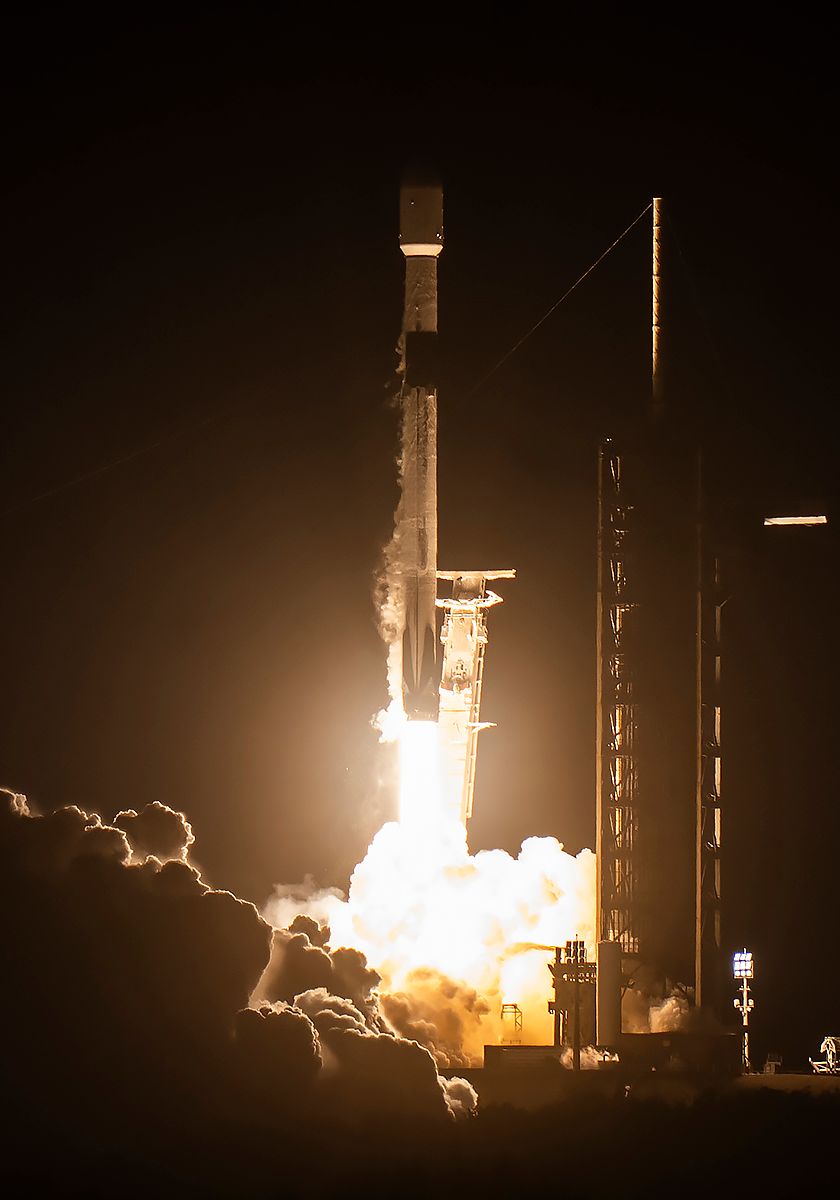
The SpaceX Falcon 9 launched on January 15, 2025, sending two landers to the Moon. The object that impacted our natural satellite on August 5, 2026, was the second stage, located between the black section of the fuselage and the fairing (the slightly wider part at the top). This second stage is 13.8 meters tall with a diameter of 3.7 meters and an empty mass of 3.9 metric tons. The tanks contain 92 metric tons of kerosene and liquid oxygen, but for the purposes of the mission, this fuel and oxidizer had been almost entirely used.
© SpaceX

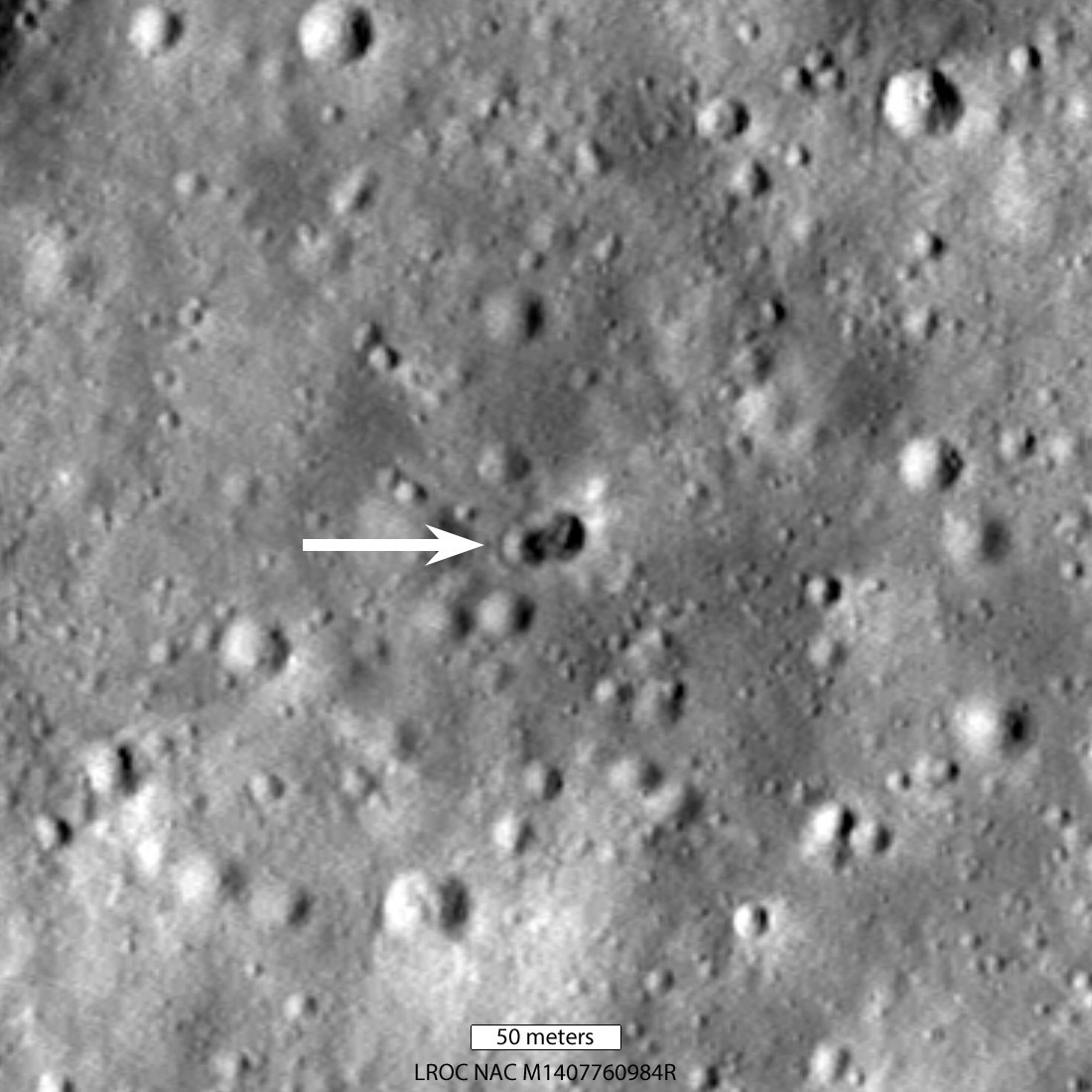
The Lunar Reconnaissance Orbiter (LRO) has documented several craters caused by spacecraft impacts. Here, the double crater, 28 meters in diameter, was caused by a Chinese rocket stage in 2022.
© NASA/Goddard/Arizona State University

MORE THAN 200 TONS ON THE MOON

This second stage of a Falcon 9 rocket is not the first man-made object to hit the Moon . Several probes, landers, and rocket stages have ended up (intentionally or unintentionally) crashing on our celestial neighbor. For example, several upper stages of the Saturn V rockets from the Apollo missions met this end. The upper part of the Lunar Modules was often intentionally aimed toward the lunar surface. The resulting impacts were then recorded by seismometers installed on the Moon by the astronauts, providing scientifically important measurements. Another example: in 2022, an upper stage of the Chinese rocket used for the 2014 Chang’e 5-T1 mission ended up hitting the Moon. In total, it is estimated that our natural satellite hosts more than 200 tons of space objects that have landed or crashed.

A KEY ISSUE FOR RETURNING TO THE MOON

NASA is also interested in the impacts of lunar landings, particularly the recent impact of the Falcon 9’s second stage,   as part of its program to return to the Moon and its ambition to establish a base there. Since lunar landings are achieved using retropropulsion, the engines eventually raise significant volumes of dust, which are ejected at high speed . Due to the absence of an atmosphere to quickly slow the ejecta, this dust, known to be highly abrasive, could pose a danger to nearby equipment by impacting it. Specifically, at what distance can future spacecraft (cargo or crewed) land (and take off) without risking damage to the lunar base or other installations?
The American agency has even planned to equip several robotic landers with instruments to study this phenomenon. The August 5 crash could also provide additional information by showing how far ejecta were projected , helping to determine safety distances if necessary (since some types of missions will probably result in neutralizing rocket stages or spacecraft components by sending them to collide with the Moon).

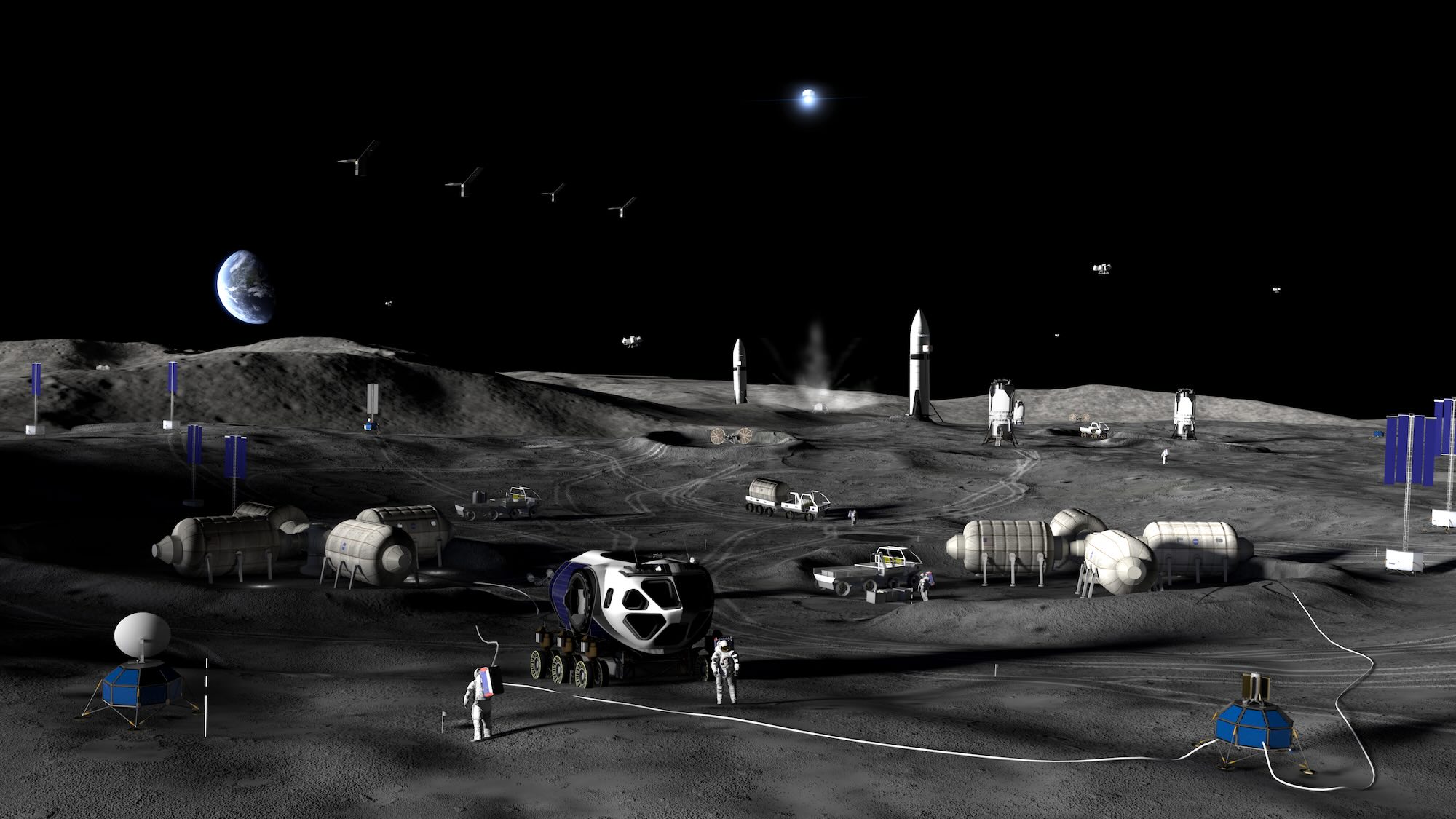
NASA illustration of its future lunar base. Its establishment and operation will require landings (and launches) in close proximity. What will be the safe distance to maintain between habitats and transport spacecraft?
© NASA

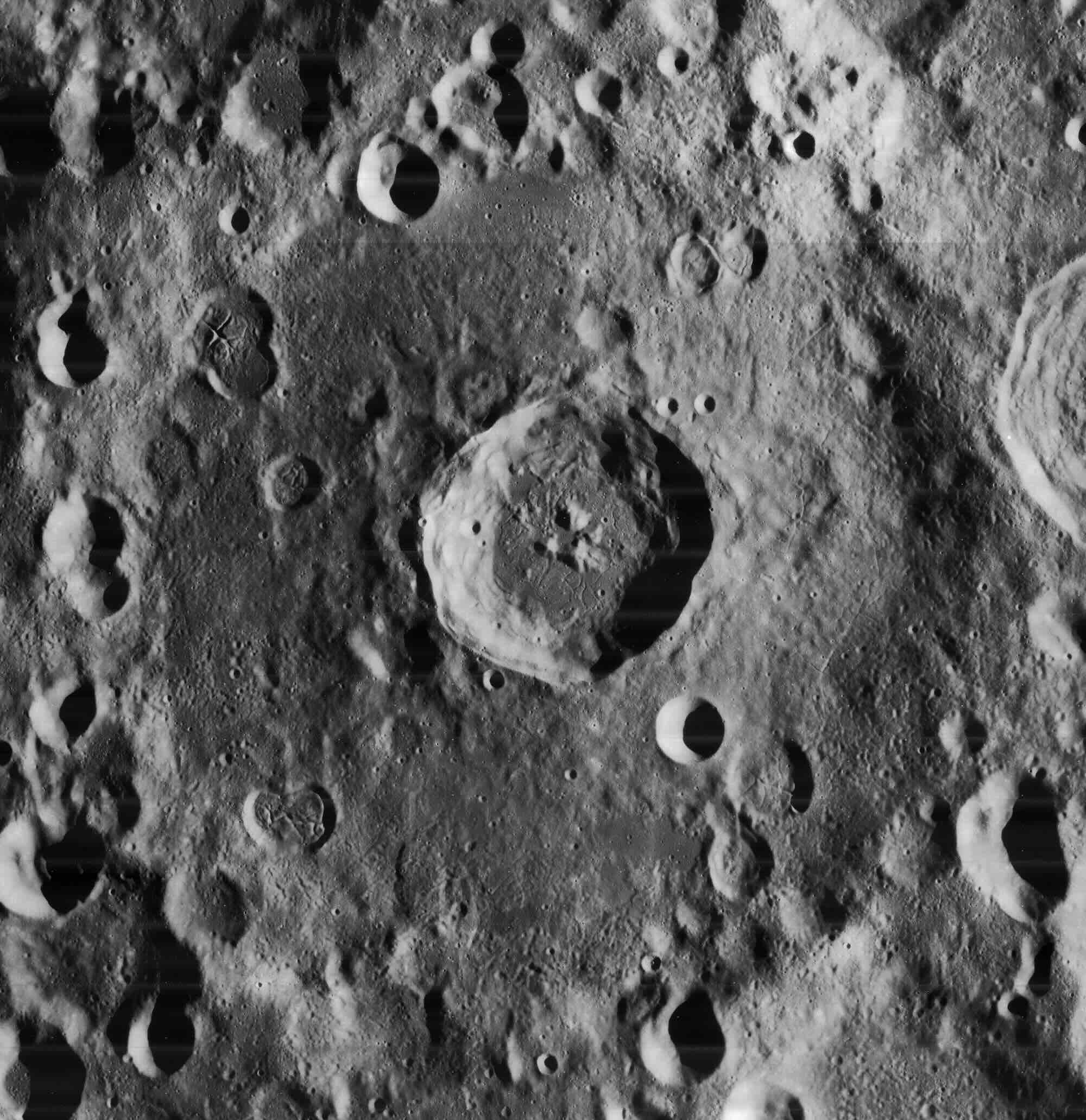
The 181-km-wide Einstein crater on the Moon. This measurement refers to the large eroded rim near the edges of the image. The smaller crater in the center (called Einstein A) is about 50 kilometers wide. The second stage of the Falcon 9 rocket crashed near this crater, but the exact location will be determined after analysis of images taken by space probes.
© NASA

A SIMILAR IMPACT EVERY 6 DAYS

It’s important to remember that this crash was in no way intentional. Given the size of the Moon’s surface (equivalent to the African continent), the consequences are thankfully negligible.

Furthermore, NASA points out that due to its lack of atmosphere, our natural satellite is hit every 6 days by a small asteroid of a size similar to the upper stage of the Falcon 9.

THE RETURN TO THE MOON AT THE CITÉ DE L’ESPACE

As we have just seen, this Falcon 9 second-stage crash is of interest to NASA in the context of its program to return to the Moon. The Cité de l’espace (Space City) in Toulouse helps visitors understand the context of this return through its “Moon – Episode II” exhibition , as well as the LuneXplorer, which allows you to experience a journey to our natural satellite. Not to mention a full-scale replica of the Apollo 11 Lunar Module Eagle.

The LuneXplorer : experience a journey to the Moon and land at the south pole of our natural satellite.
© Cité de l’espace

Related articles