

• Moon

Blue Ghost is on the Moon!

Published on 10 March 2025

On March 2, 2025, at 9:34 AM, the Blue Ghost lander from the company Firefly Aerospace successfully landed on the Moon, in the Sea of Crises. Blue Ghost even sent its first image of the Moon's surface.

Blue Ghost is on the Moon!

The journey was long, but the success was there. After 25 days in orbit around the Earth, 4 days of travel between the Earth and the Moon, and 16 days in lunar orbit, Blue Ghost reached the end of its journey. On March 2, 2025, the company Firefly Aerospace landed its lander on the near side of the Moon, in the Sea of Crises. A remarkable achievement considering that Firefly Aerospace was performing this maneuver for the first time. The company is acting within the framework of the CLPS contract between NASA and private companies. Before it, two other missions took place. The Peregrin mission of Astrobotic had failed to reach the Moon. As for Intuitive Machines, its Odysseus lander had made a chaotic arrival as the spacecraft had landed on its side. Firefly Aerospace has thus become the first private company to achieve a perfectly controlled moon landing. Blue Ghost has already sent a first image of the Moon’s surface. It now has a lunar day (about 14 days) to carry out a whole series of experiments with the 10 scientific instruments it carries, largely provided by NASA.

On this telemetry image, we can see that three of the four landing legs of Blue Ghost confirm contact with the Moon’s surface.

© Firefly Aerospace / NASA

“We are on the moon!”

On March 2, 2025, at 9:34 AM, Blue Ghost landed on the Moon

Everything went as planned. Nine hours before the scheduled landing time, the Firfly Aerospace teams programmed the descent sequence. It was to begin while communications were still cut off. Indeed, during its passage on the far side of the Moon, it was impossible to communicate with the lander. A little less than an hour before landing, the ground teams thus re-established contact with Blue Ghost and they realized that it was on the right trajectory. It then began its descent with all engines off. Then, at an altitude of 20 km, Blue Ghost launched its PDI (Power Descent Initiation). In clear terms, Blue Ghost restarted its main engine and its auxiliary engines. This essential maneuver allowed it to slow down and avoid crashing on the Moon. Still lying on its side, it thus reduced its speed from 6000 km/h to 100 km/h. Arriving at an altitude of 10 km, it then turned over to be able to touch the ground. Exactly on schedule, three of the four pads located at the end of Blue Ghost’s legs turned blue on the telemetry images, indicating that they were in contact with the ground. “We are on the moon” then confirmed one of the Blue Ghost descent managers, which allowed the Firefly Aerospace teams to burst with joy.

As soon as contact with the Moon’s surface was confirmed, the Firefly Aerospace teams burst with joy.

© Firefly Aerospace / NASA

A first image of the Moon

A few minutes after landing, Blue Ghost sent an image of the Moon

It didn’t take long to get a first image of the Moon’s surface. 32 minutes after landing, Blue Ghost transmitted this first image of the Moon’s surface, which confirms the success of the landing. This is the fastest image transmitted from the surface of the Moon. Blue Ghost beat Surveyor 1’s record by three minutes. We can see a part of Blue Ghost, the same ones that were seen in previous in-flight images. We can also see the regolith and a small crater. It is thanks to its S-band antenna that Blue Ghost managed to transmit this first photo so quickly. The lander has three antennas of this type to transmit data in low resolution. Another X-band antenna is planned to send a much larger volume of data. A second, splendid image of the Moon’s surface taken by Blue Ghost was then sent a few hours later. We can see the shadow of the lander standing out on the ground.

Blue Ghost transmitted this first image of the Moon’s surface thanks to its S-band antennas, which allow for rapid transmission of low-resolution images.

© Firefly Aerospace

This second image of the Moon’s surface taken by Blue Ghost was transmitted a few hours later

© Firefly Aerospace

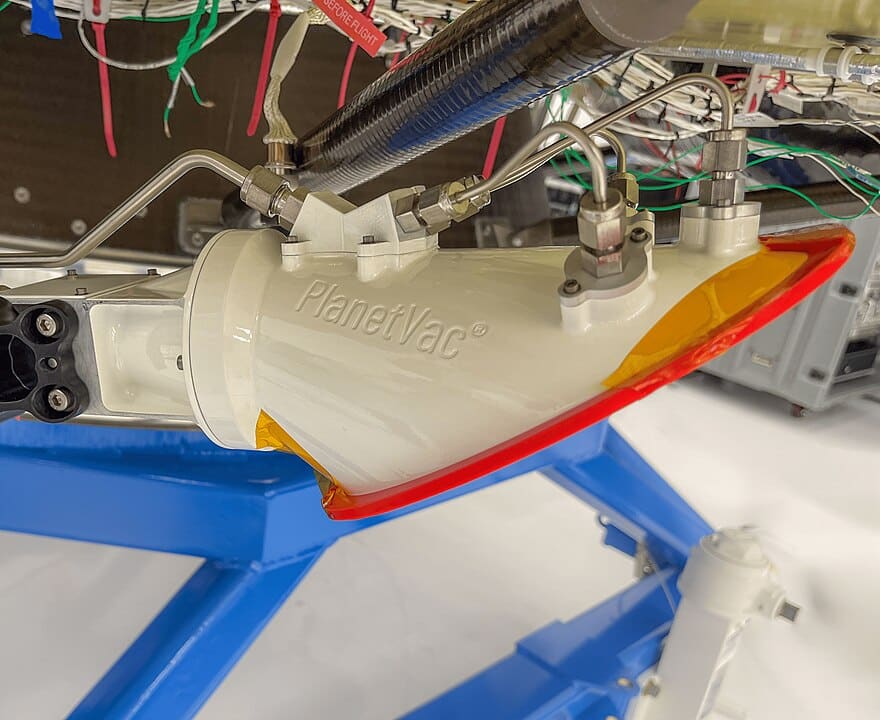
The PlanetVAC should allow for the collection of lunar regolith samples.

© NASA

Now it’s time for science

Blue Ghost only has 14 days to carry out the planned experiments

Blue Ghost is on the Moon, the work can begin. As part of the Artemis program, NASA has signed contracts with private companies like Firefly Aerospace. The goal is to deposit equipment and materials on the Moon to carry out experiments in order to prepare for the return of astronauts to the Moon announced for 2027. The contracts of CLPS (Commercial Lunar Payload Services) must also make it possible to deposit instruments or tools that will be used by astronauts.

Blue Ghost will now spend its lunar day on the Sea of Crises (about 14 Earth days) activating the ten instruments provided largely by NASA. Many experiments will concern the lunar regolith, the dust on the surface of the Moon. The VAC will test in real conditions a system for collecting samples of the lunar regolith, allowing its transfer to instruments. A dust shield will also be tested. This technology could make it possible to automatically clean elements, while it is known that lunar dust, particularly abrasive, can be dangerous for equipment as well as for astronauts.

Image taken by Blue Ghost a few hours before landing.

© Firefly Aerospace

Other lunar missions

Several Firefly Aerospace missions are planned and other companies are on their way

Other Blue Ghost missions are expected in the coming years. In total, NASA has signed three contracts with Firefly Aerospace to deposit instruments on the Moon. Blue Ghost 2 is planned for 2026 and Blue Ghost 3 for 2028. Furthermore, other missions are expected to reach the Moon in the coming days and months. On February 27, Intuitive Machines’ IM-2 mission launched its Athena lander towards the Moon’s south pole. Still within the framework of CLPS, this Nova-C, the same model as the one that landed in February 2024 near the Malapert crater, will study the Moon’s water ice. Then, in May/June, a Japanese Hakuto-R mission from the company ispace, which departed at the same time as Blue Ghost, is expected to reach the Moon, this time outside the framework of the Artemis program.

Relive the landing of Blue Ghost

The lander of the company Firefly Aerospace landed in the Sea of Crises on March 2, 2025, at 9:34 AM

Discover the high-definition images transmitted by Blue Ghost and published by Firefly Aerospace.

© Firefly Aerospace

Related articles