• Moon

Artemis IV: NASA will later choose between SpaceX and Blue Origin

Published on 26 October 2026

During a press conference on October 23, NASA stated that the return of Americans to the Moon with Artemis IV will be done either with Starship or with Blue Moon MK2. For the moment, it has not chosen between these two options.

Artemis IV: NASA will later choose between SpaceX and Blue Origin

Since taking the helm at NASA, Jared Isaacman has reorganized the organization’s lunar program. While Artemis III has become an Earth-orbit test of dockings between Orion and the SpaceX and Blue Origin lunar landers , the timeline remains extremely tight . After Artemis III in the second half of 2027, Jared Isaacman still anticipates 2028 for the arrival of American astronauts on the Moon with Artemis IV .

Recording of the NASA press conference of October 23.

ON THE MOON BEFORE CHINA

The desire to successfully return to space before China sets foot there remains a priority for US space policy.
On October 23, at a press conference at the Kennedy Space Center in Florida, which largely reiterated the roadmap presented at the IAC conference in Antalya , NASA clarified that the Starship Human Landing System (HLS) version was not automatically the lander that would be used. NASA wants to be able to choose based on the progress made by its two private suppliers, SpaceX and Blue Origin.

ARTEMIS IV
IN STARSHIP VERSION

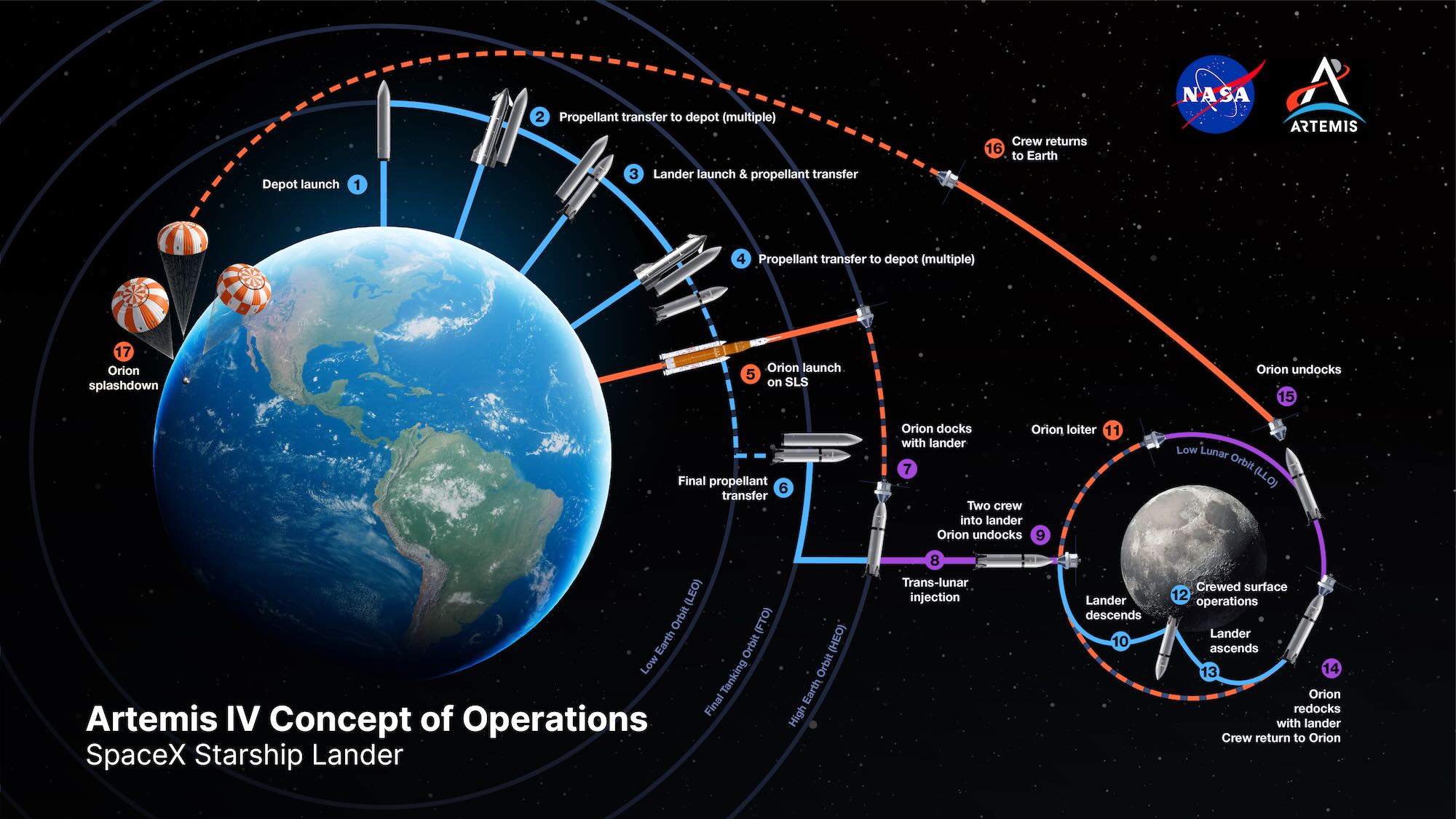
While testing its giant Starship launcher , SpaceX is also working on its lunar version , or HLS (NASA’s acronym for landers provided by the private sector). The Artemis IV scenario with a Starship HLSincorporates some of the main features already presented, but with a few modifications.

A PROPELLANT DEPOT IN ORBIT

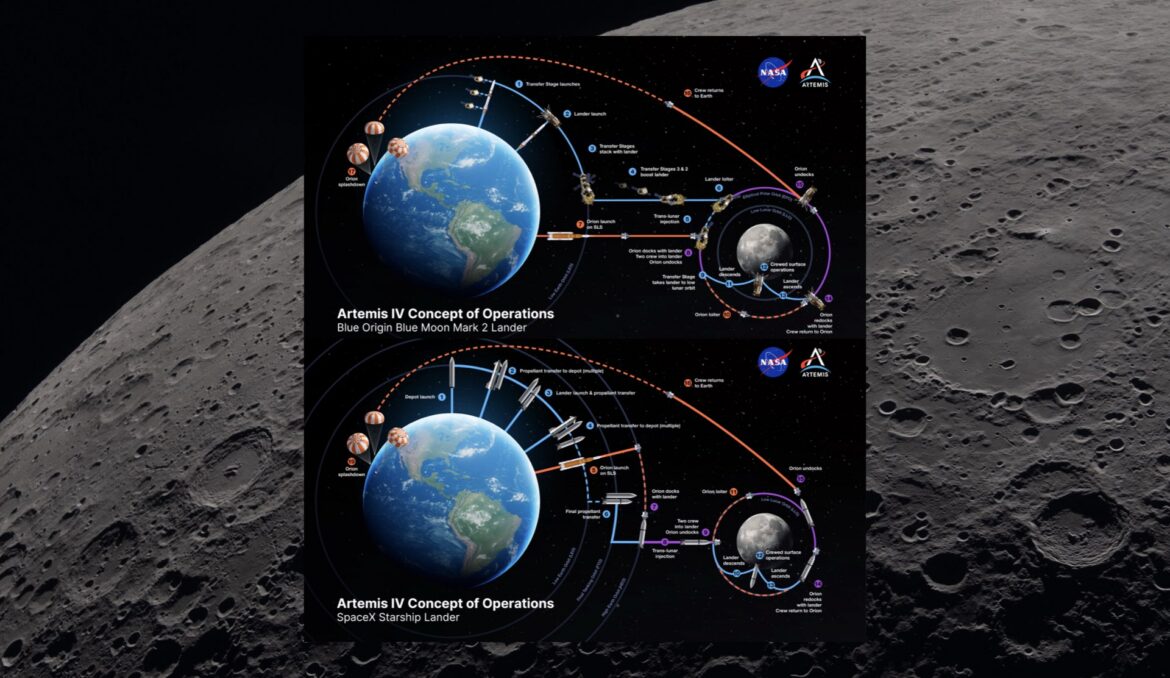
The mission always begins with the refueling of a propellant depot (liquid methane and oxygen) in Earth orbit using several Starship “tanker” launches (steps 1 and 2 in the diagram). SpaceX has yet to demonstrate its ability to do this . The Aerospace Safety Advisory Panel (ASAP) estimated the number of flights required at 22, a solution deemed risky. Elon Musk believes that 6 to 8 will suffice.
Next, the Starship HLS launches and refuels from the depot (step 3). The new element is that the depot is refueled again by other Starship “tankers” (step 4). The Orion capsule with the four astronauts launches from Florida with the SLS and rendezvous with the Starship HLS in high Earth orbit (steps 5 and 7). In the meantime, the Starship HLS will have refueled from the depot (step 6).

THE STARSHIP SENDS ORION TO THE MOON

Another change under consideration and confirmed is that Starship, rather than Orion’s European Space Module (ESM), will perform the translunar injection (stage 9) using its propulsion system. This allows the spacecraft to reach a low lunar orbit. There, two astronauts will descend to the Moon in Starship HLS while two others remain in Orion (stages 9 to 13).

BACK TO EARTH WITH ORION

After exploring the surface (two spacewalks are planned), the two lunar walkers return to the Starship HLS to rejoin their colleagues in Orion (stage 14). Once the NASA capsule separates from the lander, it ensures the return to Earth , which concludes with a splashdown (stages 15 to 17).

ARTEMIS IV
IN BLUE MOON VERSION

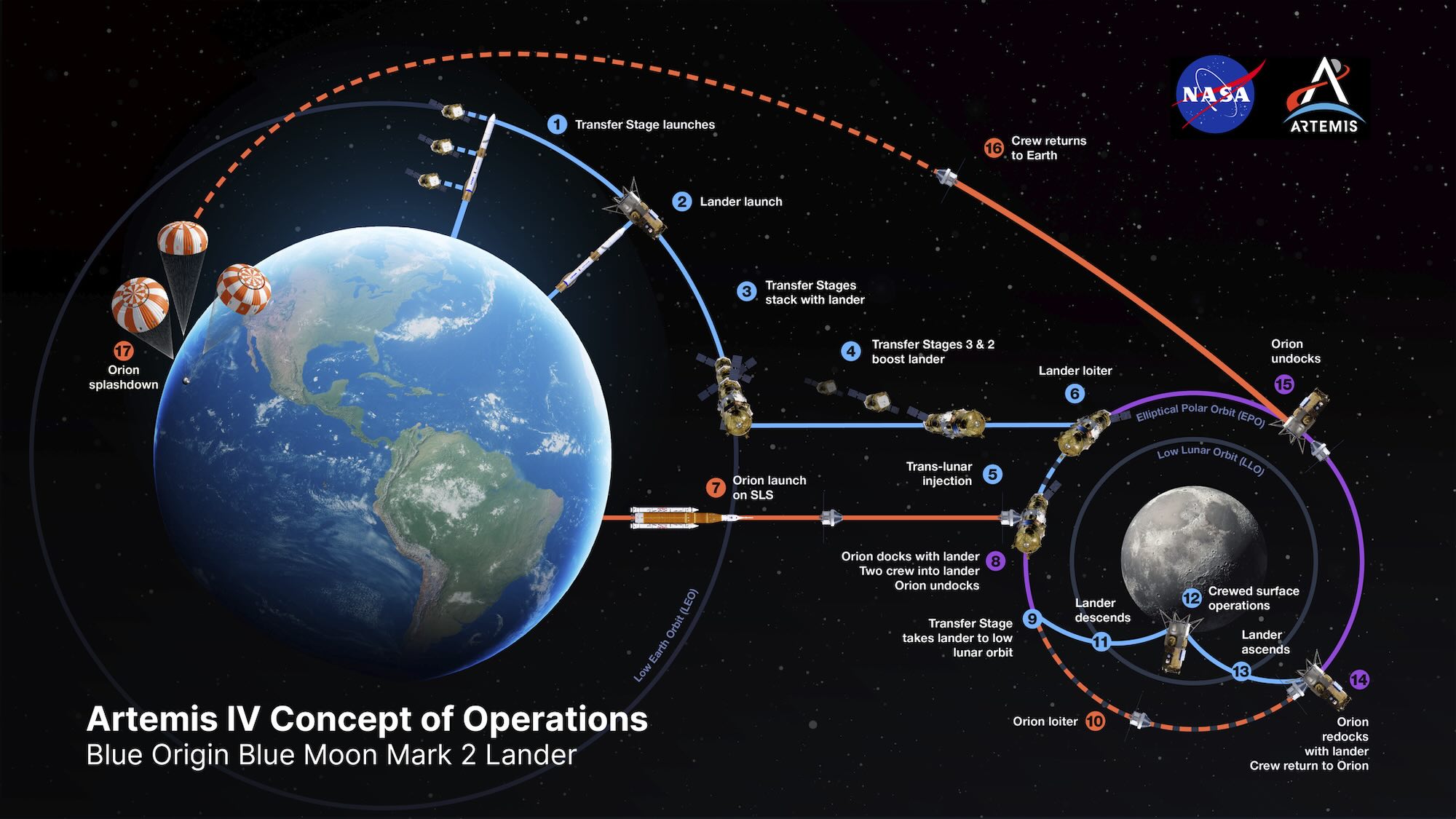
Here too, it all begins with launches from the private provider, in this case Blue Origin . Using its New Glenn rocket , the company founded by Jeff Bezos first sends three transfer stages into Earth orbit (stage 1). These are derived from the automated cargo version of the Blue Moon MK1 lander.

SEE YOU IN ORBIT

Then, a New Glenn rocket places the Blue Origin version of the HLS, the Blue Moon MK2, into orbit(stage 2). This stage docks with the three transfer stages , two of which will help it reach an elliptical orbit around the Moon (stages 3 through 6). They are jettisoned once this is complete. Next, we see Orion’s launch with a SLS . This time, with its ESM, Orion completes the journey to the Moon.

ORION AND THE BLUE MOON MK2 MEET AGAIN AROUND THE MOON

Around our natural satellite, Orion docks with the Blue Moon MK2 so that two of the four astronauts can board the lander (stage 8). At this stage, the third transfer stage will take the MK2 into low lunar orbit(stages 9 and 11) while Orion waits (stage 10). Once the surface operations are complete, the lunar walkers return with the Blue Moon MK2 to rejoin Orion (stages 12 to 14). Finally, Orion separates from the Blue Moon MK2 and returns the four astronauts to Earth (stages 15 to 17).

NO PROPELLANT TRANSFERS ARE PLANNED.

Blue Origin’s solution, even though it involves several rendezvous (especially those with the transfer stages), has the advantage of requiring fewer launches and does not require propellant transfer .

EVEN MORE OPTIONS

When will NASA choose between the Starship HLS and Blue Moon MK2 options? No date has been announced for this decision. On October 23, Jeremy Parsons, the Artemis program manager for the American agency, set the tone by stating that ” we intend to wait as long as possible before making a decisionregarding the provider that will ultimately return the first American astronauts to the Moon in 2028. ” He added that both SpaceX and Blue Origin are preparing for lunar missions in 2028.

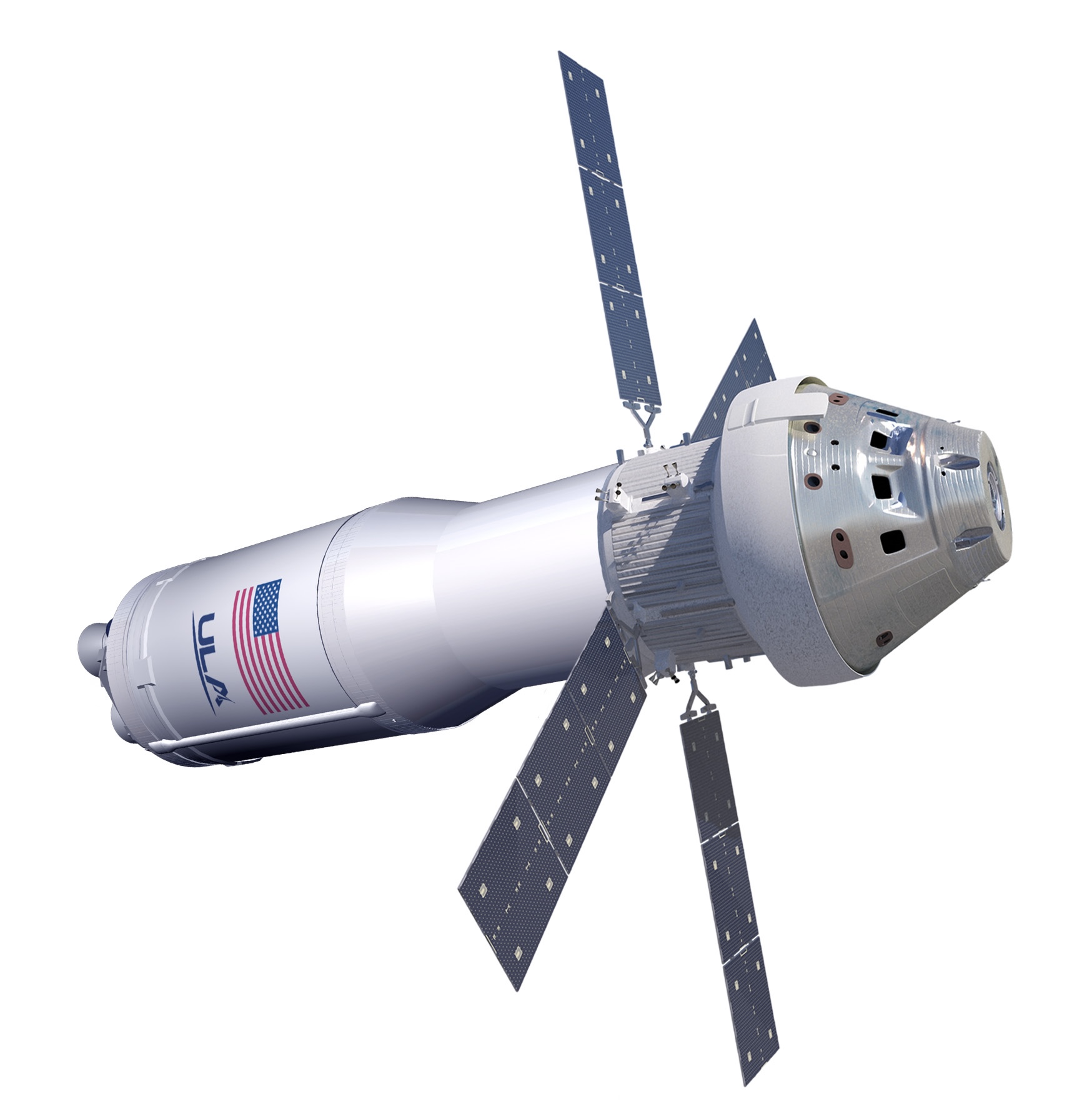
At the same time, NASA is studying additional options , or rather, variations. As it stands, Orion launched with the SLS cannot reach a low lunar orbit due to insufficient performance. The capsule with the ESM aims for an elliptical orbit around our natural satellite. However, a low lunar orbit is preferable and considered safer . To achieve this without using Starship HLS for translunar injection, an extended version of the SLS’s Centaur second stage has been presented . The performance gain should allow Orion to reach a low lunar orbit. One more option.

Illustration showing the Orion capsule and its European Service Module (ESM) atop an elongated Centaur second stage. The performance gain aims to achieve low lunar orbit.
© NASA

Related articles