




• Mars
  • Solar System

The Psyche probe flies over Mars to gain speed

Published on 20 May 2026

The Psyche probe made a close flyby of Mars on May 15 at an altitude of 4,500 km. This gravitational assist provides it with the extra speed needed to reach asteroid 16 Psyche in 2029, while also allowing its scientific instruments to be calibrated during this technical flyby.

The Psyche probe flies over Mars to gain speed

This is a welcome boost. On May 15, 2026, NASA’s Psyche mission performed a flyby of Mars at an altitude of approximately 4,500 km . Launched in October 2023, this spacecraft’s objective is not to directly study the Red Planet, but rather to use its gravity to accelerate . This technical maneuver allows it to adjust its trajectory and increase its speed to reach the metallic asteroid 16 Psyche , located in the main asteroid belt between Mars and Jupiter, by July 2029.

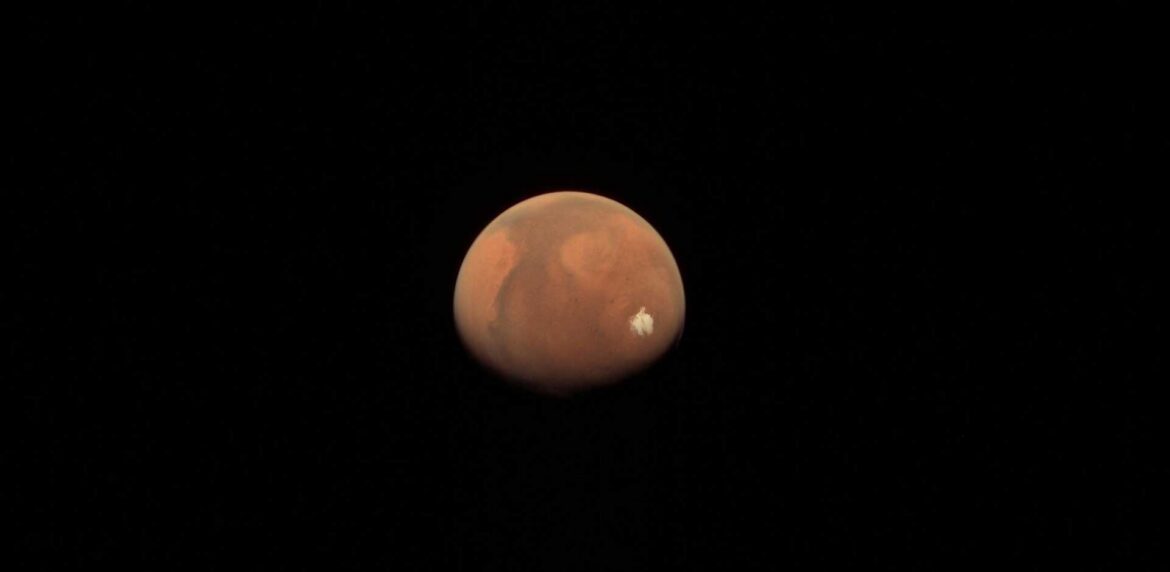
Cover image © NASA/JPL-Caltech/ASU/Thomas Appéré

Video from NASA and JPL to showcase Psyche’s flyby of Mars.

© NASA / JPL

A gravity-assisted navigation maneuver

The principle of Martian gravitational assistance

To conserve its fuel, xenon, the probe exploited Mars ‘ gravity . Psyche approached at a speed of approximately 19,850 km/h relative to the surface of Mars . This flyby gave it a speed gain of about 2 km/s compared to the Sun. This energy transfer would have been virtually impossible to achieve using only the onboard engines, as it would have required far too much fuel and mass at launch. The European probe JUICE , launched in April 2023, uses the same technique. It has already performed a flyby of the Moon and Earth in August 2024 and a flyby of Venus last summer. It still needs to perform two more flybys of Earth, this summer and in 2029, before reaching sufficient speed to reach the Jupiter system in 2031.

Crescent of Mars captured a few hours before the flyby by the Psyche probe.

© NASA/JPL-Caltech/ASU/ Thomas Appéré

An operational test for scientific instruments

Calibration and technical observations in flight

Although the primary objective of this flyby was ballistic, the mission team took advantage of the proximity to Mars to test and calibrate its onboard equipment . The multispectral imager, in particular, captured Mars as a thin, luminous crescent, a specific viewing angle due to the approach from the planet’s night side. These images reveal how the Martian atmosphere and its dust scatter sunlight, providing excellent practice for fine-tuning camera settings before arrival at the asteroid. At its closest approach, the imager was able to capture images of the surface, specifically of the Syrtis Major Planum region and, further east, Isidis Planitia. Simultaneously, the magnetometer and spectrometer were activated to measure interactions with the Martian magnetic field. This ensured that all systems will be operational for the study of the metallic core of 16 Psyche . The probe is scheduled to arrive at its destination in 2029 .

55275683881_d5690243d5_k

Assembly of several images of the regions of Syrtis Major Planum and Isidis Planitia taken by Psyche.

© NASA/JPL-Caltech/ASU/ Thomas Appéré

Related articles
