




• Mars

The Perseverance rover breaks the record for distance traveled on Mars

Published on 14 October 2026

By crossing the 45.22 km mark on Mars, the Perseverance rover surpassed Opportunity's record. Thanks to its autonomous navigation, the NASA robot is now embarking on a new phase of exploration of Jezero Crater, at least until the end of 2028.

The Perseverance rover breaks the record for distance traveled on Mars

Record broken! On October 11, 2026, during its 2,006th Martian day, NASA’s Perseverance rover reached 45.22 kilometers traveled on the surface of Mars . This distance surpasses the previous exploration record set on the Red Planet by the Opportunity rover in 2018. Achieved over five and a half years in the heart of Jezero Crater , this record was made possible by the continuous improvement of its autonomous driving technologies. Perseverance can now plan its routes with great efficiency.

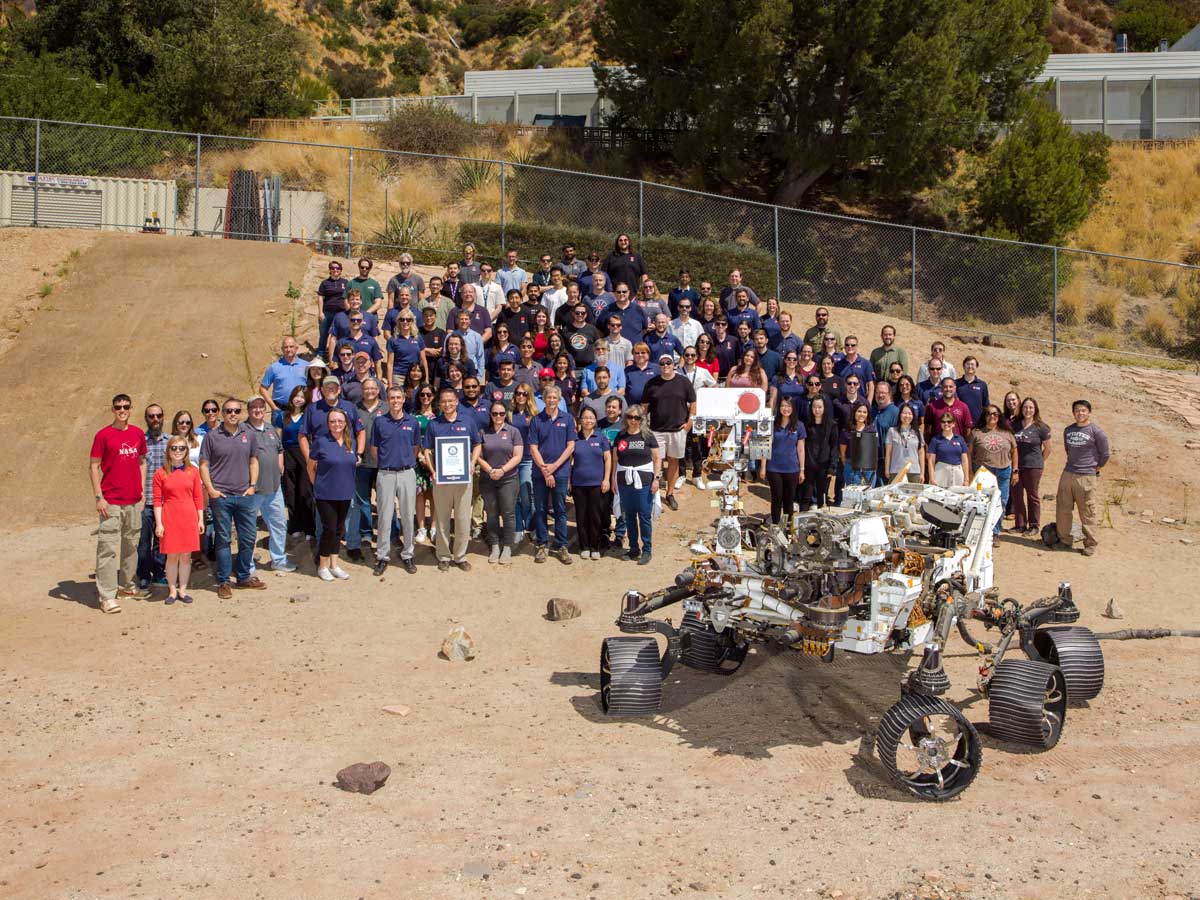
In the Mars Yard at the Jet Propulsion Laboratory (JPL) in California, the Perseverance mission team poses with the Guinness World Records certificate recognizing the rover for its record distance traveled on Mars. In the foreground, OPTIMISM, a full-scale replica of Perseverance, allows engineers to test the rover’s movements and prepare for its scientific activities on the Red Planet. This is the rover that NASA is considering sending to the Moon.

© NASA/JPL-Caltech

How did Perseverance manage to break this record?

The Perseverance rover went further than any other vehicle on the Moon and Mars

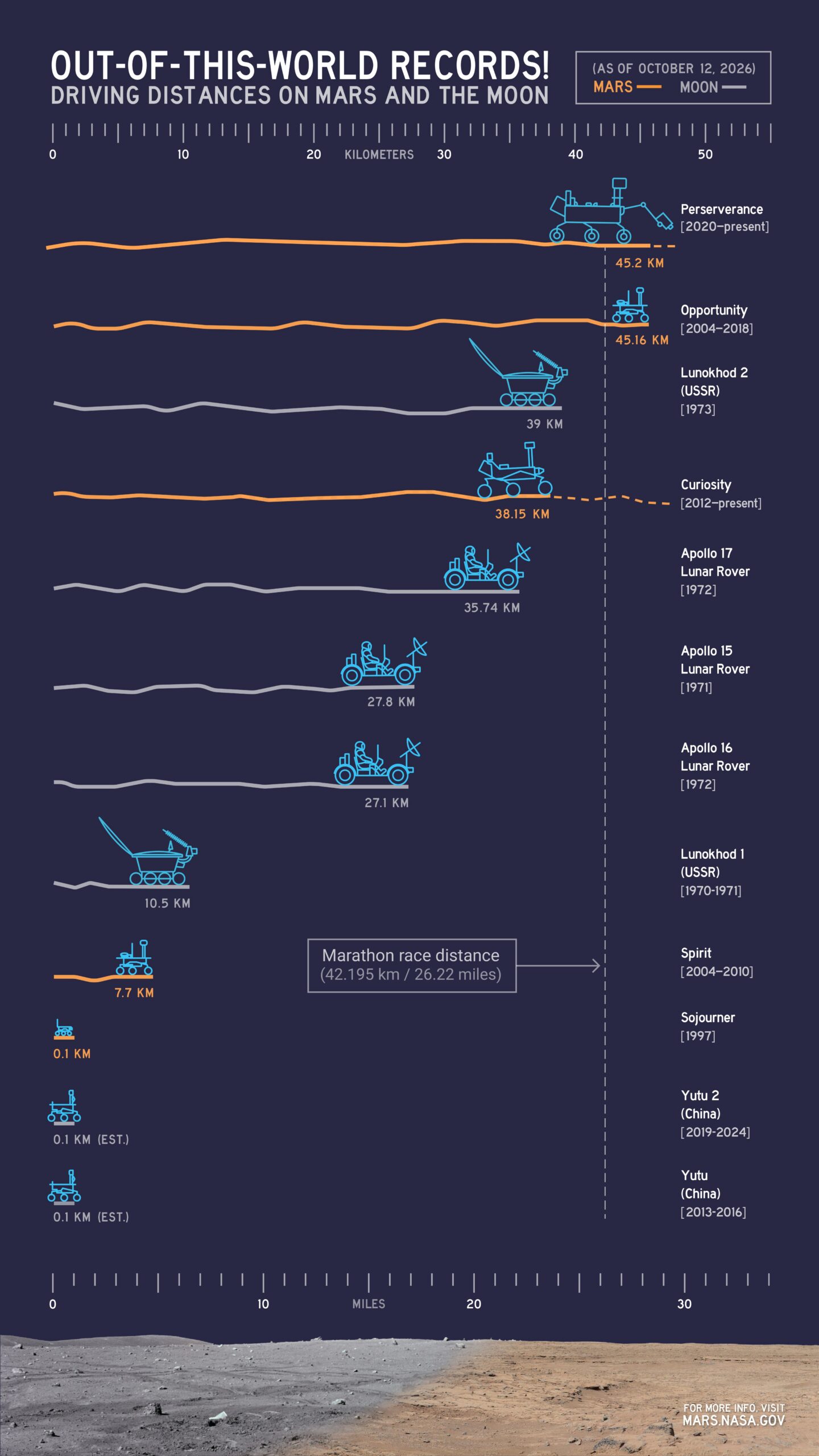
Perseverance’s rapid progress relies primarily on its AutoNav autonomous navigation system . This software allows the vehicle to analyze the terrain while driving and choose its trajectory, avoiding obstacles . At the Cité de l’espace (Space City), the “Rovers Take Center Stage” exhibit helps the public understand the challenges of piloting rovers on Mars and how AutoNav enables Perseverance to choose its own route. Thanks to this technology, the rover completed more than 90% of its journey autonomously , processing 600,000 data points with each terrain analysis. By comparison, the first Mars rover, Sojourner, evaluated only 20 data points in 1997 to travel 100 meters, while Opportunity used autonomous driving for only about 5% of its journey. During its 45.22-kilometer journey, Perseverance surpassed the distances traveled by other spacecraft on the Moon and Mars. On the lunar surface, the Apollo 17 astronauts covered 35.7 kilometers in 1972, and the Soviet rover Lunokhod 2 reached 39 kilometers in 1973. On Mars , Perseverance now surpasses the Curiosity rover , which has traveled over 38.07 kilometers despite having arrived in Gale Crater in August 2012. ” It’s an honor to work on Perseverance at a time when technology has advanced to the point where journeys like these have become routine ,” said Steven Lee, project manager for the Curiosity and Perseverance rovers at NASA’s Jet Propulsion Laboratory. ” The initial mission plan called for no more than 20 kilometers of driving. We’ve far exceeded that goal .”

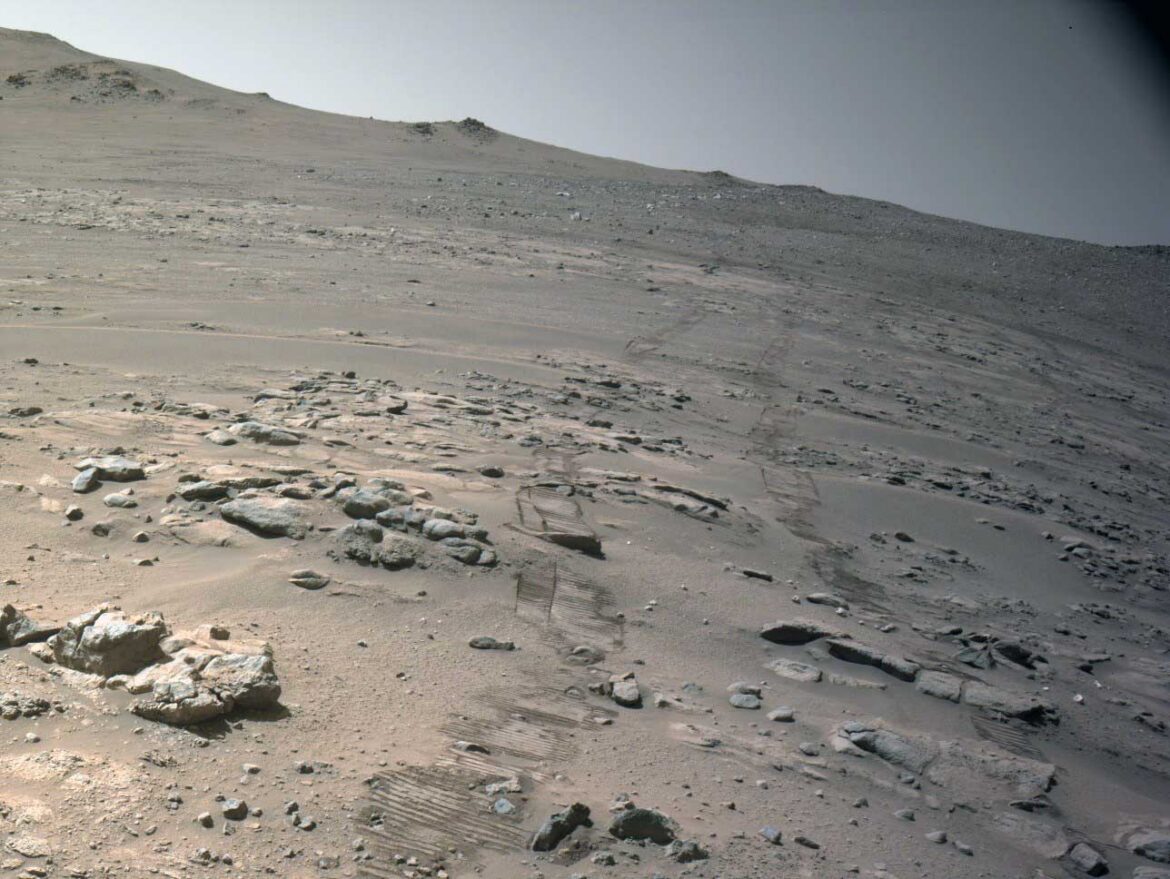
This photo was taken by Perseverance’s right NavCam on October 11, 2026, on sol 2006 of the rover on Mars.

© NASA/JPL-Caltech

What are the next steps in the mission?

The Mars 2020 mission extended until 2028

Since arriving in Jezero Crater in February 2021, Perseverance has collected and sealed 29 rock and regolith samples . These samples include the “Cheyava Falls” rock , in which scientists identified a potential biosignature . More recently, during its visit to the “Lake Charmes” region, the rover analyzed igneous and impact rocks dating back approximately 4 billion years and created 13 abrasion impressions to study their geological composition. Building on this achievement, Perseverance is now entering its 39th year on Mars , having received NASA’s approval for its first mission extension until the end of 2028. The rover is currently exploring the “Idubi” sector, characterized by the presence of light-colored gabbro blocks, where it has abrasiond the “Badger Peak” rock and is studying the outcrop known as “Gardenia.” The rover will then travel along the rim of Jezero Crater southward toward Rainbow Falls, a 100-meter-wide block of ancient crust uplifted by an asteroid impact. Engineering teams are also working on a software update to help the rover optimize its movements in the face of sunlight glare. ” The glare from the navigation cameras is why we park in the middle of the afternoon if we’re driving toward the sun ,” explains Mark Maimone, deputy team leader for Perseverance robotic operations at NASA’s Jet Propulsion Laboratory. ” If we can teach the rover to see through these artifacts, every rover that follows will benefit from a longer workday .” A record that is just waiting to be broken.

The greatest distances traveled on the Moon and Mars as of October 11, 2026. Only Curiosity and Perseverance are still operational and continuing their journey on Mars.

© NASA/JPL-Caltech

Related articles
