
• Astronomy

The Geminid meteor shower

Published on 03 December 2025

With a potential number of shooting stars close to that of the famous Perseids, the Geminid meteor shower is one to watch for at the end of 2025. The peak is predicted for the night of December 13-14.

The Geminid meteor shower

The December 2025 sky offers some beautiful observations accessible to everyone, even without binoculars or a telescope (see our article on the December 2025 sky). And as for shooting stars, December is the month of the Geminids , a meteor shower that the International Meteor Organization (IMO) ranks as being of equal interest to the famous Perseids of August.

Unless otherwise stated, all times shown on this page are those of legal time in metropolitan France.

GEMINIDS: SOWN BY PHAETHON

When it comes to meteor showers (actually dust from asteroids or comets burning up in our atmosphere), the Perseids in August are the most famous . There are many others each year, as explained in this article on our website . The cold nights of December may explain why the Geminid meteor shower (considered active from December 4th to 17th this year) is much less popular, even though the International Meteor Organization (IMO) calls it the “strongest meteor shower of the year.” While the American organization is known for its reliability, it’s important to remember that meteor showers, even large ones, can be more or less impressive depending on when the peak activity occurs and whether or not the Moon interferes with the display. 

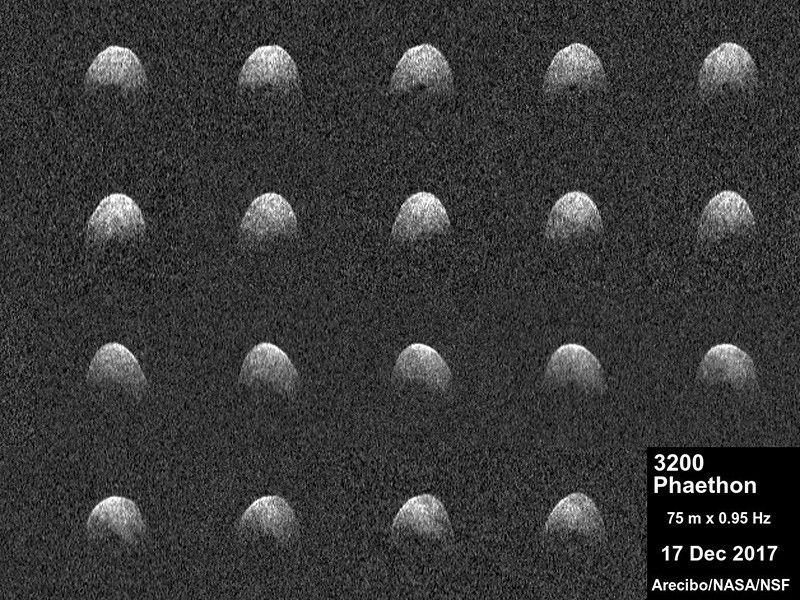
The Geminids originate from dust scattered by the asteroid Phaethon , which may be a “dried-out” comet nucleus. The name Geminids comes from the constellation Gemini, which houses the radiant, the point from which the meteors appear to originate due to perspective.

Asteroid Phaethon observed by radar waves with the Arecibo Observatory’s giant radio telescope in December 2017.
© Arecibo Observatory/NASA/NSF

A PEAK IS EXPECTED DURING THE NIGHT OF DECEMBER 13TH TO 14TH.

The peak of the Geminid meteor shower in 2025 is predicted for the night of December 13-14 . Unlike 2024, conditions are expected to be much more favorable, as the Moon will be relatively faint with only 30% illumination and, most importantly, will rise at 2:57 AM. The first part of the night is therefore quite ideal . However, the IMO forecast predicts a maximum around 9:00 AM on the 14th (it will be daylight). Despite this less than ideal time, a zenithal hourly rate of 100 to 150 meteors per hour
should be considered, assuming a perfect sky with no light pollution and the radiant at its zenith. These two conditions are rarely met, but with 100 to 150 meteors per hour, even a significant decrease in light pollution offers the chance to see some beautiful meteors, as the Geminids are known to be quite bright at times . In addition, the Geminids are characterized by a peak that lasts quite a long time, sometimes 10 to 12 hours around the time of the maximum.

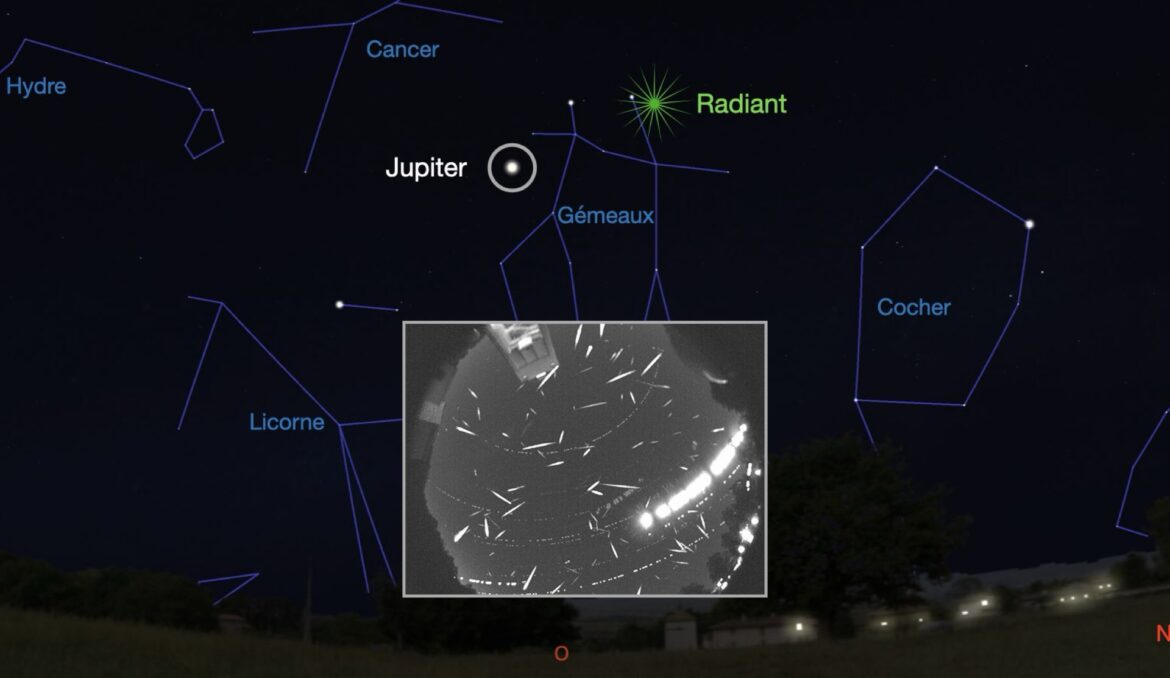
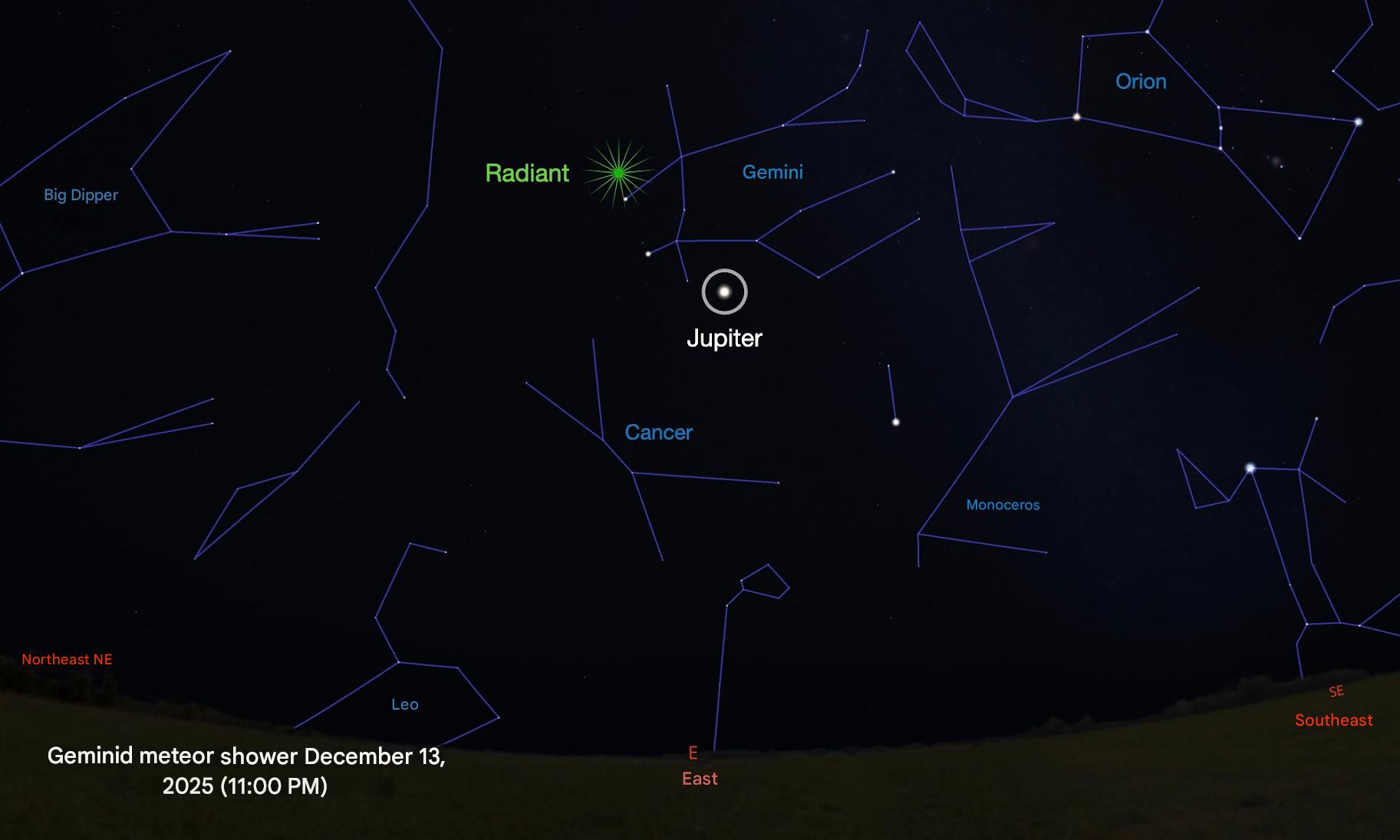
The Geminid radiant will be 42° above the eastern horizon on December 13 at 11 p.m.
© Cité de l’espace/Stellarium

Thus, bearing in mind that peak forecasts remain forecasts and that meteor showers can disappoint, we will not neglect the night of December 13-14 and those a little before and a little after.

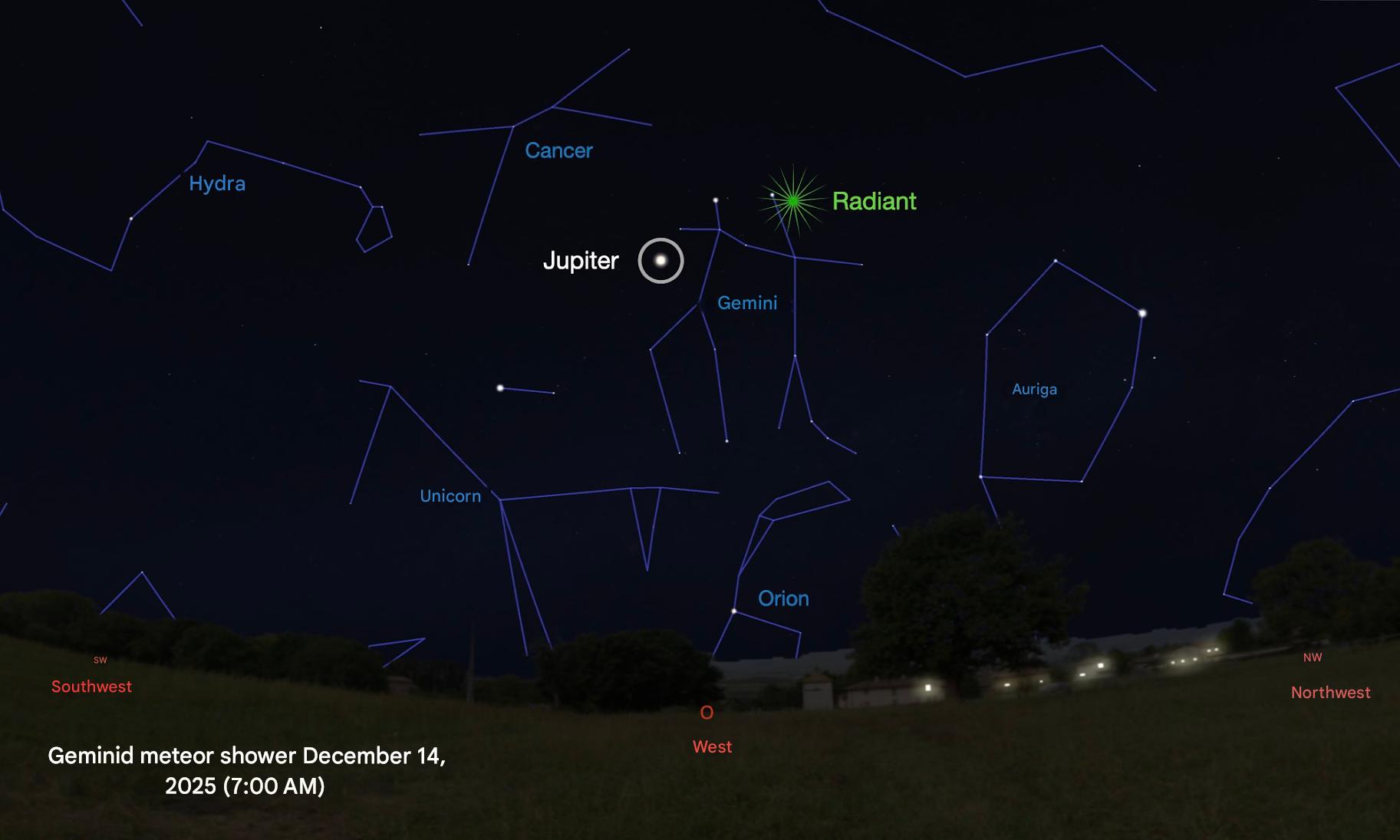
About one to two hours before the predicted peak in 2025, the Geminid radiant will still be above the horizon, this time in the west, on the morning of December 14.
© Cité de l’espace/Stellarium

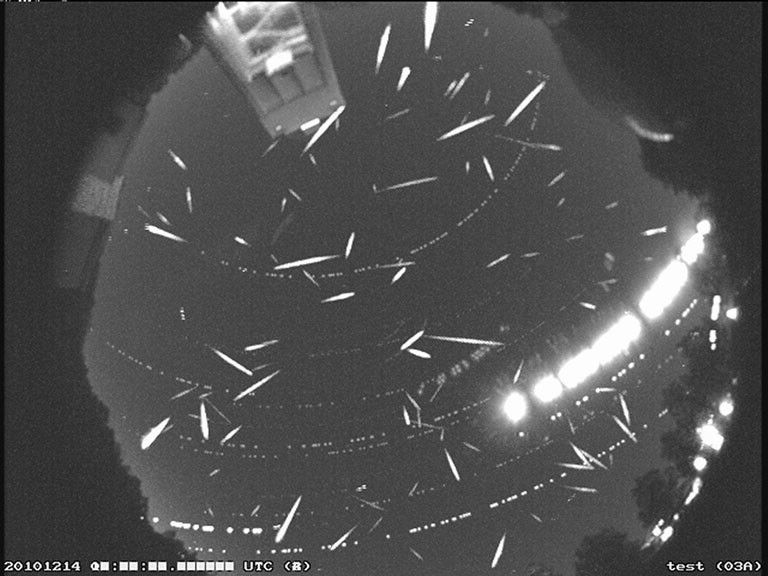
Several Geminid meteors captured by a camera that covered the entire sky in December 2014.
Note: This is not what you will see! This image combines several “shooting stars” thanks to a very long exposure time (several hours).
© NASA/MSFC/Danielle Moser, NASA’s Meteoroid Environment Office

SOME OBSERVATION TIPS

You don’t need to look directly at the radiant to enjoy a meteor shower. As with other showers, simply gaze at the celestial vault far from any light pollution.

Indeed, the most important thing is to get away from urban centers, whose lights are a source of light pollution . This pollution degrades the quality of the night sky, and you’ll miss some of the shooting stars.  Also, be careful not to create light pollution yourself!  If you’re outside on a terrace or balcony, for example, turn off all outdoor lights, as well as any indoor lights that will be a nuisance if the shutters aren’t closed. Avoid using your smartphone, as the screen’s light will dazzle you and cause your pupils to constrict. Remember that it takes about 15 minutes for your vision to adapt to nighttime conditions (maximum pupil dilation).

THE BEST INSTRUMENT?
YOUR EYES!

As for equipment,  your eyes are the ideal instrument . No need for binoculars or telescopes; their field of view is too narrow.  The best approach is to gaze at the celestial vault… and wait! Yes, patience is an essential quality. A meteor shower can be disappointing if, for example, the peak doesn’t occur at the predicted time or if the number of meteors is lower than expected.
To avoid straining your neck while facing the zenith, it’s best to get comfortable by lying on the ground (bring a blanket) or in a deck chair. Finally, in December, the nights are cool, even very cold, so dress accordingly.

Related articles