• Astronomy

The sky in December 2025

Published on 26 November 2025

For the last month of the year, the sky offers us a "Super" Moon, conjunctions between our natural satellite and the Pleiades, Regulus, Jupiter, or Saturn. Not to mention the Geminid and Ursid meteor showers.

The sky in December 2025

For 2025, the winter solstice in the Northern Hemisphere will occur on December 21 , as in the previous and following years. Due to the intricacies of celestial mechanics, this solstice can occur on December 20, 21, 22, or 23 according to the Gregorian calendar. In the 21st century, there will be a total of 5 solstices on December 20, 82 on the 21, and 13 on the 22 (none on the 23rd, the rarest date, occurring, for example, once in the 20th century).

Once the solstice has passed, even though the night will remain longer than the day, the latter will gradually nibble away at minutes until the duration is equal at the spring equinox on March 20th.

Unless otherwise stated, all times shown on this page are those of legal time in metropolitan France (that of your watch) .

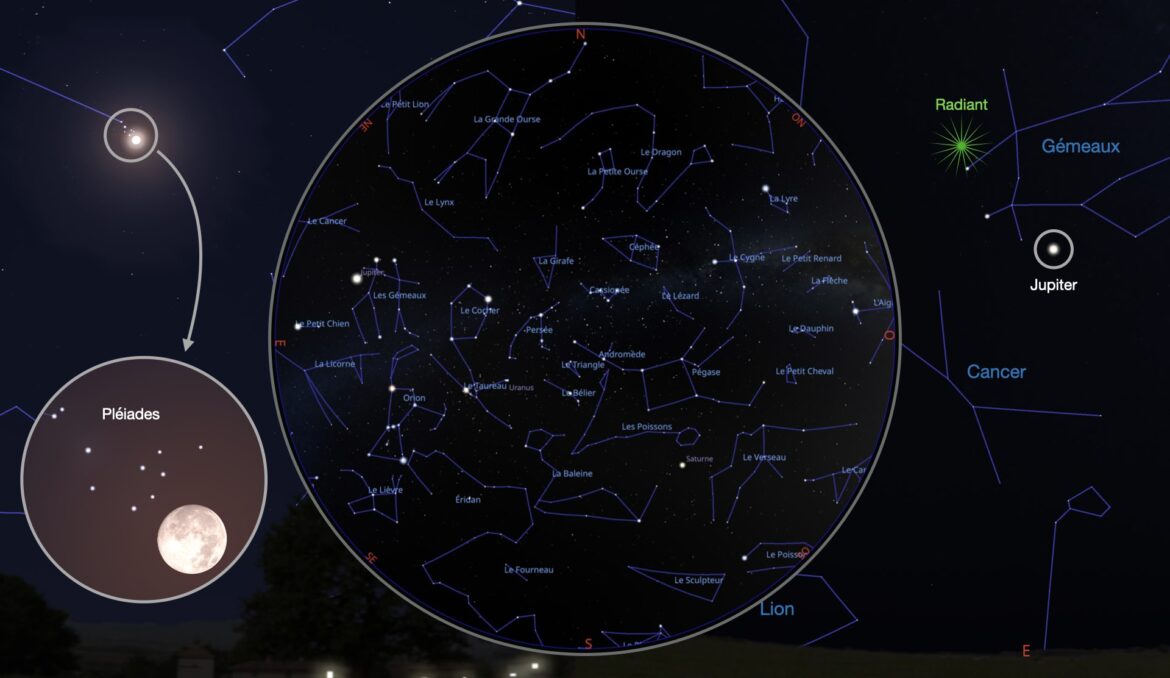
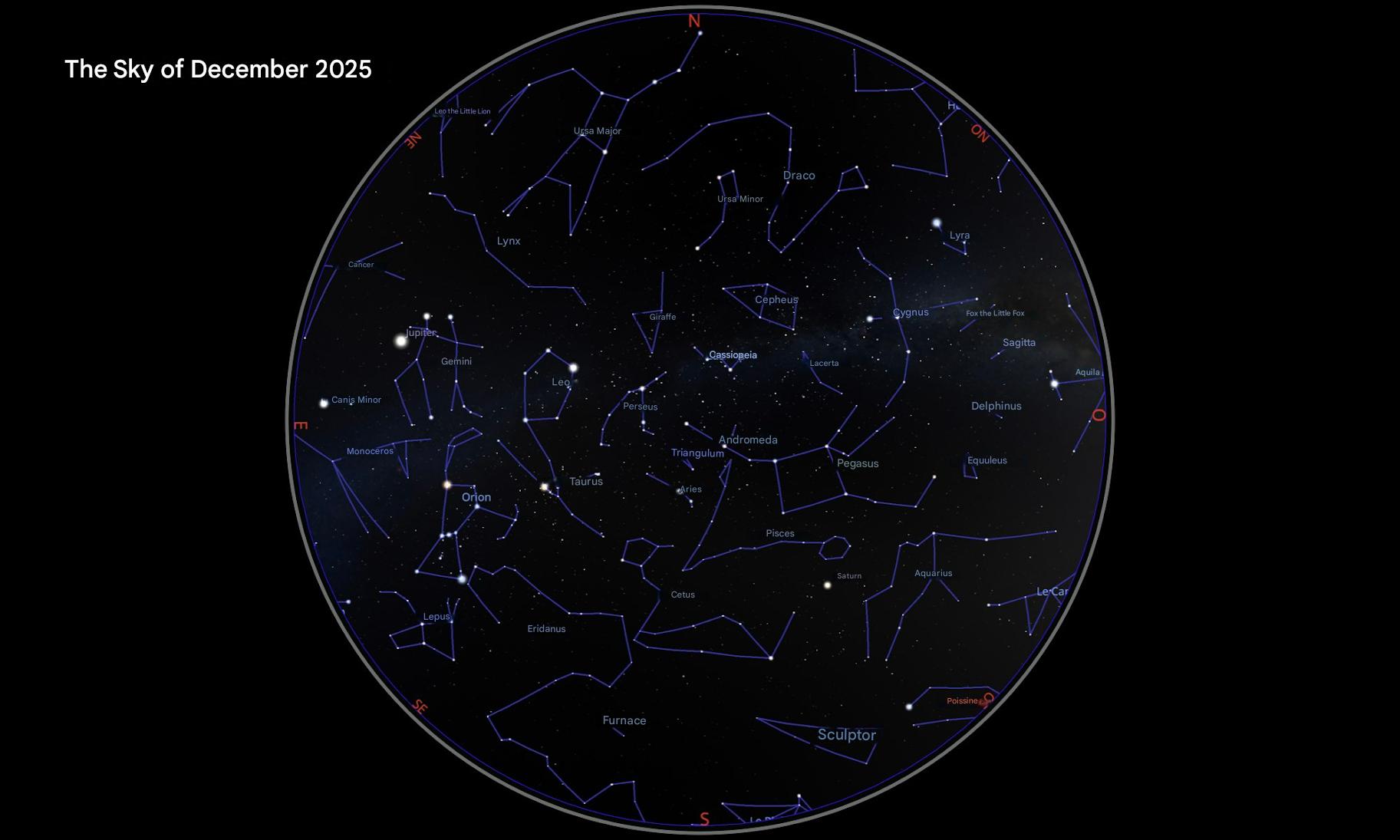
This map shows the sky over Toulouse on December 15th at 9:00 PM (local time, i.e., the time on your watch).
It is largely valid for the month of December across mainland France.
© Cité de l’espace/Stellarium

THE MOON AND THE PLEIADES

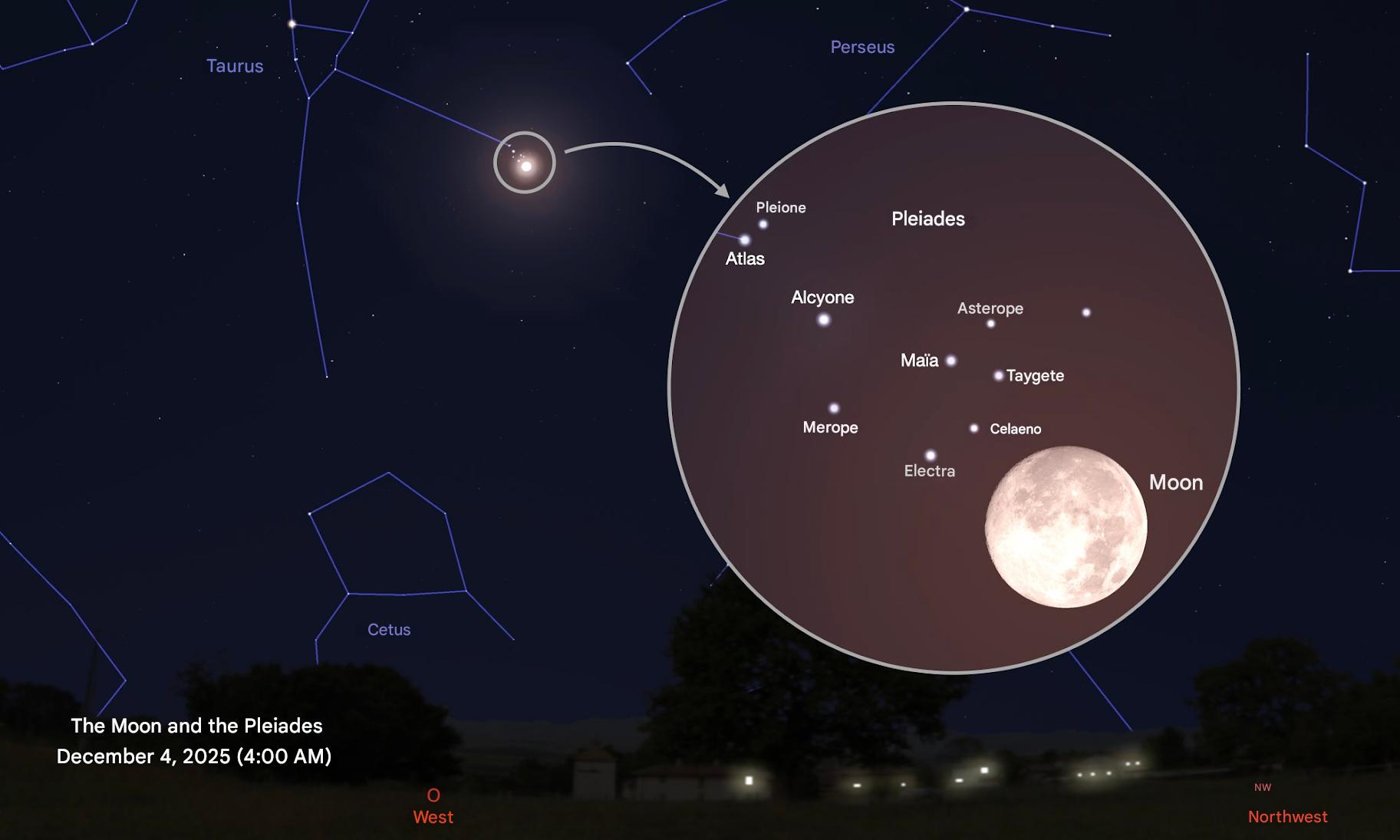
On the night of December 3rd to 4th, the Moon encounters the Pleiades , the famous seven sisters from Greek mythology , immortalized as stars resembling a miniature Big Dipper. Alcyone, Asterope, Maia, Taygete, Celaeno, Merope, and Electra are watched over by their parents by two stars named Atlas and Pleione.

This is an open cluster of 3,000 young stars (only about ten are visible to the naked eye under good conditions) located approximately 440 light-years from Earth. The delicate nebulae surrounding them were once thought to be remnants of their formation process, but it is now believed that we are observing an interstellar cloud through which they are dispersing.

The Pleiades already offer a beautiful object to scrutinize with the naked eye . Under a good night sky, 5 are easily visible. Capturing the 7 or 9 main ones requires skies free from all light pollution and/or the use of binoculars.

For the conjunction between the Moon and the Pleiades, our map is set for 4:00 AM on December 4th, approximately four hours before sunrise. It is possible to observe this conjunction earlier (on the 3rd in the early evening), but the Moon will be further to the right of the Pleiades. The Moon’s proper motion relative to the stars explains why, if we wait a few hours, we will see it join the seven sisters.
© Cité de l’espace/Stellarium

THE LAST (SUPER) MOON OF 2025

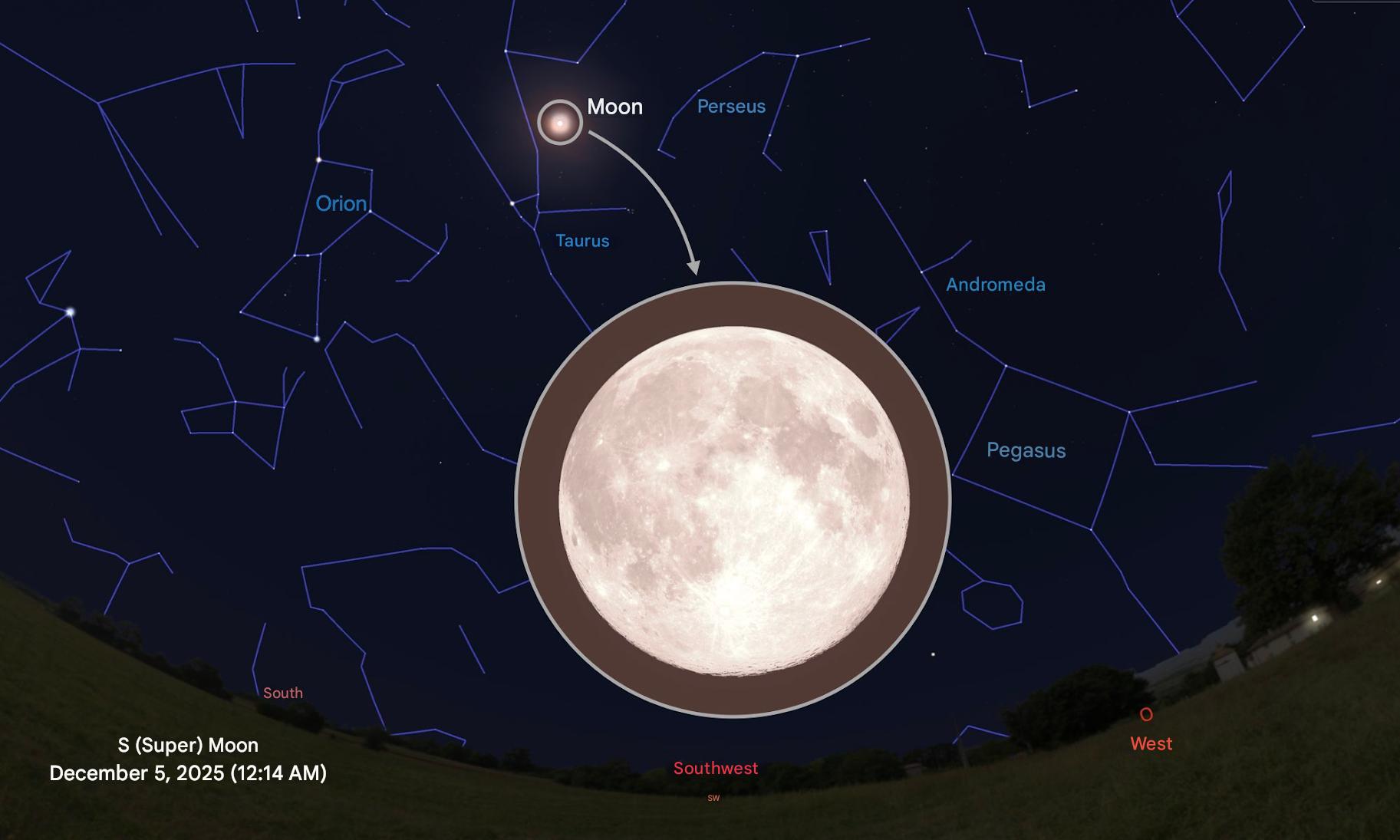
In 2025, the highly publicized Supermoon will occur during the last three months of the year. Following October 7th and November 5th, the third “Super”moon will take place on December 4th at 11:14 PM UTC, or 12:14 AM on December 5th in mainland France . However, it will already be considered “Super” when it rises at 4:29 PM in Toulouse.
It’s worth noting that a Supermoon isn’t actually anything extraordinary or exceptional . It’s simply a Full Moon, which is considered “Super” when it occurs while our natural satellite is at its closest point to Earth in its orbit . The late American scientist Fred Espenak established a scale based on the Earth-Moon distance, ranging from 0 to 1 (0 being the farthest point and 1 the closest). A Full Moon is designated Superb, with a magnitude of 0.9 to 1. The one on December 4th/5th has a magnitude of 0.995, slightly lower than in November (0.997), but higher than in October (0.964). The Moon will be 357,219 km from Earth. 

The Full Moon (designated a Supermoon) will occur on December 5th at 12:14 AM. It will dominate the southern horizon high in the sky at 72°.
© Cité de l’espace/Stellarium

THE MOON AND JUPITER

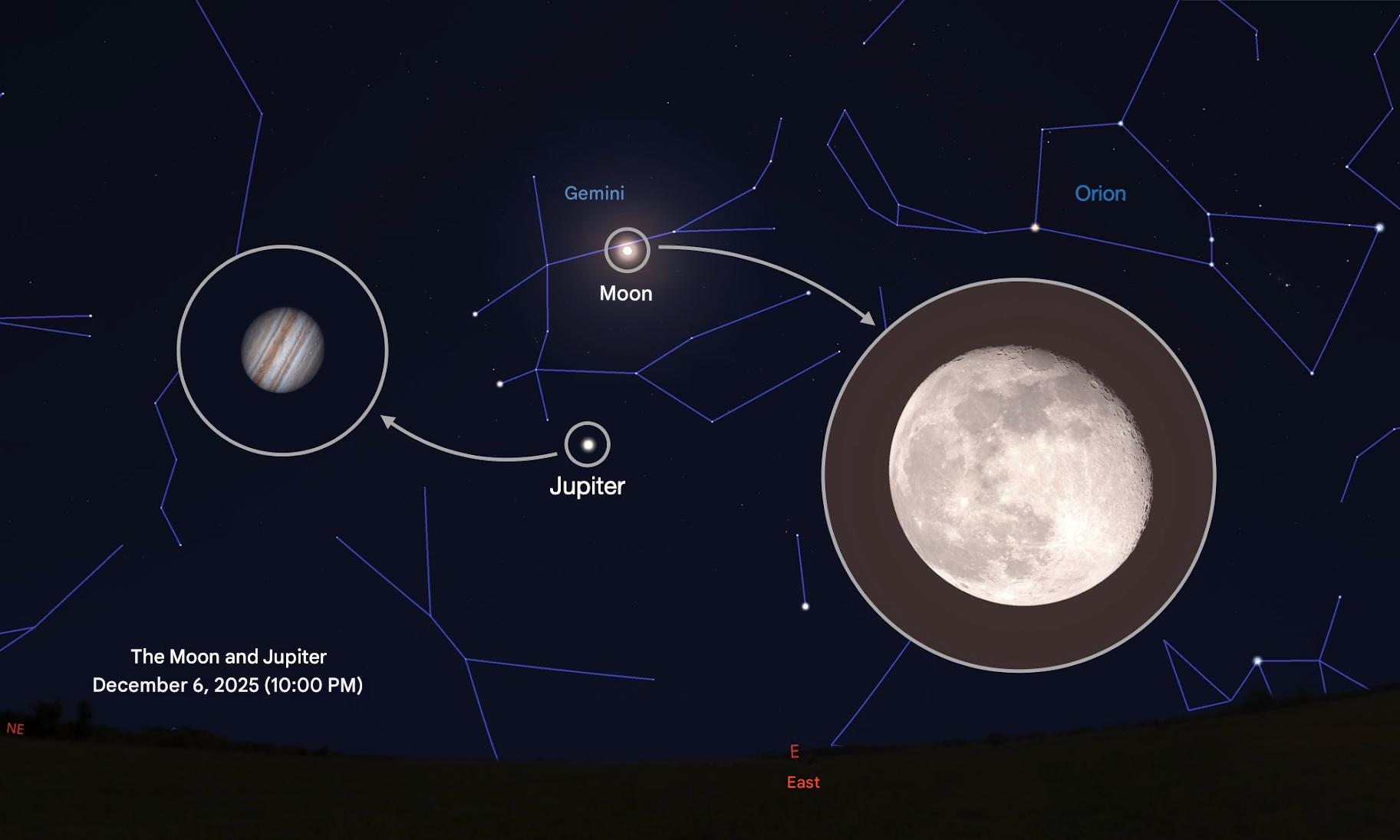
On December 6th, a nearly full Moon will appear in the constellation Gemini above Jupiter . Even though the two celestial bodies aren’t actually very close, it’s a great opportunity to spot the largest planet in the Solar System without any risk of error!
We suggest looking east around 10 p.m. The Moon will be at an altitude of 30°. Below it, at an altitude of 19°, Jupiter’s bright light will be impossible to miss . Another opportunity to reflect on distances in our Solar System. The gas giant will be 658 million kilometers away tonight, while our celestial neighbor will be relatively “close” (everything is relative…) at 359,244 kilometers.

Easily spot the Moon and then Jupiter above the eastern horizon on December 6.
© Cité de l’espace/Stellarium

THE MOON AND REGULUS

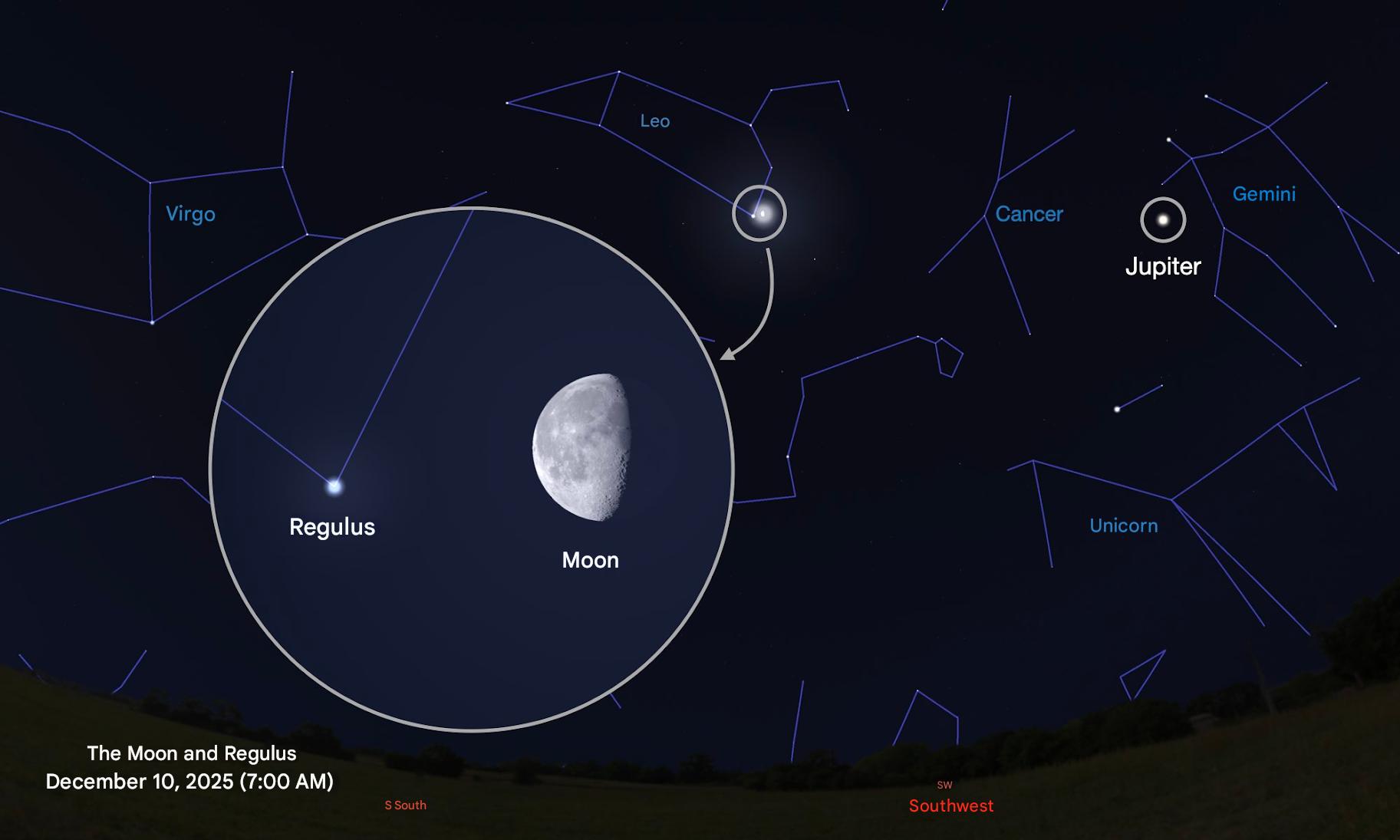
On the morning of December 10th , about an hour before sunrise (8:17 AM for Toulouse), observe the conjunction of the Moon and the star Regulus high in the south (54° altitude) . This conjunction can be seen earlier in the night, but the Moon will then be further from the star.

In the constellation Leo, Regulus, with its magnitude of 1.4, will stand out as the brightest star in this part of the sky . This provides yet another opportunity to reflect on the vastness of astronomical distances. Although Regulus is a “neighbor” in the grand scheme of our Milky Way galaxy, it is still 79 light-years away, while the Moon is approximately 1 light-second distant.

On the morning of December 10, one hour before sunrise, observe the conjunction of the Moon and Regulus.
© Cité de l’espace/Stellarium

FAVORABLE GEMINIDS

When it comes to meteor showers (actually dust from asteroids or comets burning up in our atmosphere), the Perseids in August are the most well-known. There are many others each year, as explained in this article on our website . The cold nights of December may explain why the Geminids (considered active from December 4th to 17th this year) are much less popular, even though they are one of the strongest and most regular meteor showers according to the International Meteor Organization (IMO).

SOWN BY PHAETHON

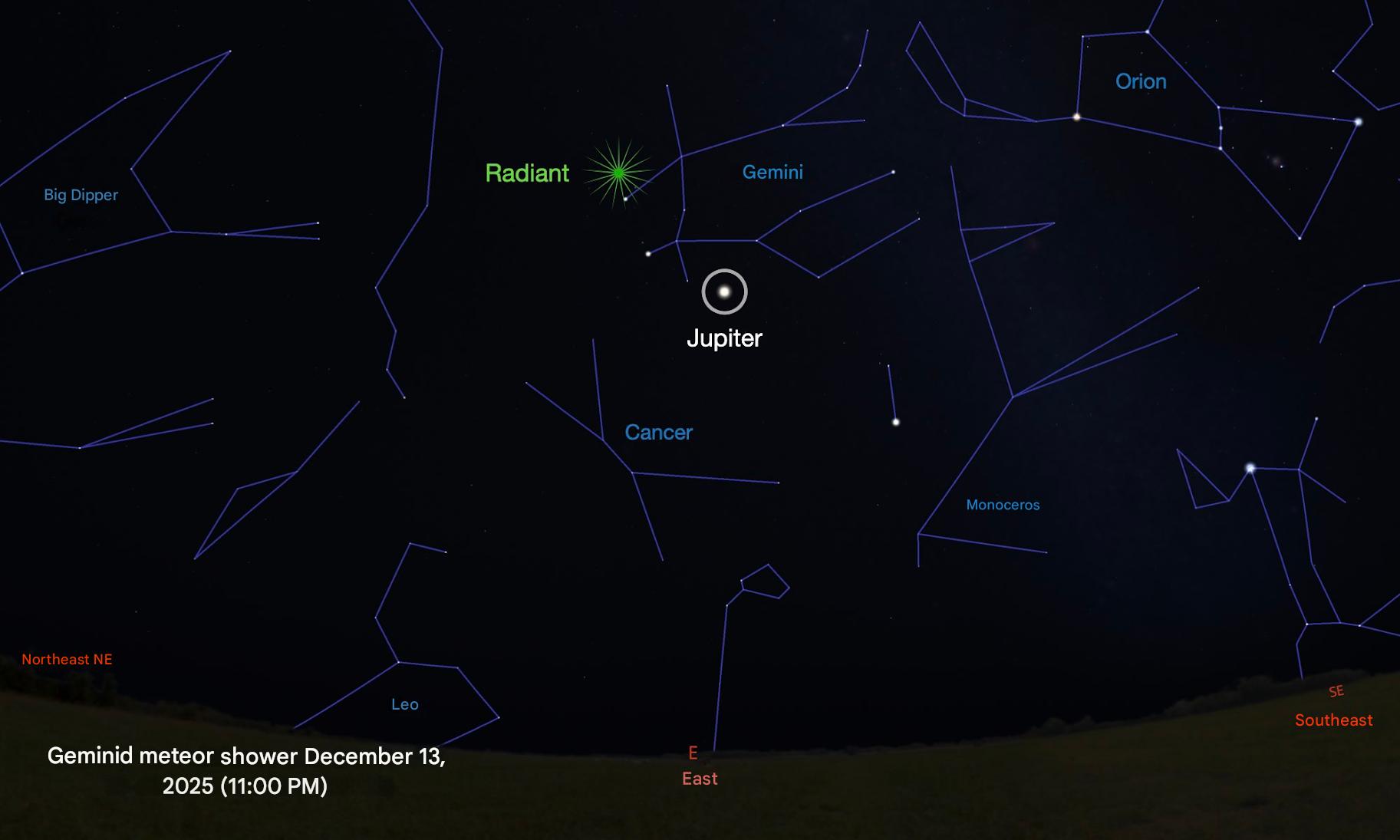
The Geminids originate from dust scattered by the asteroid Phaethon , which may be a “dried-out” comet nucleus. The name Geminids comes from the constellation Gemini , which houses the radiant, the point from which the meteors appear to originate due to perspective.

The peak of the 2025 meteor shower is predicted for the night of December 13-14 . Unlike 2024, conditions are much more favorable, as the Moon will be relatively faint with 30% illumination and, most importantly, will rise at 2:57 AM. The first part of the night is therefore quite ideal . However, the IMO forecast predicts a maximum around 9:00 AM on the 14th (it will be daylight). Despite this unfavorable time, a zenithal hourly rate of 100 to 150 meteors per hour must be considered, meaning 100 to 150 meteors per hour for a perfect sky without light pollution and if the radiant were at the zenith. These two conditions are rarely met, but with 100 to 150 meteors, even a significant decrease in brightness offers the chance to see some beautiful meteors. In addition, the Geminids are characterized by a peak that lasts quite a long time, sometimes 10 to 12 hours around the time of the maximum.

Thus, bearing in mind that peak forecasts remain forecasts and that meteor showers can disappoint, we will not neglect the night of December 13-14 and those a little before and a little after.

The Geminid radiant will be 42° above the eastern horizon on December 13 at 11 p.m.
© Cité de l’espace/Stellarium

SOME OBSERVATION TIPS

Remember that you don’t need to look directly at the radiant to enjoy a meteor shower .
As with other showers, gaze at the night sky far from any light pollution (which includes the glare from your smartphone screen) and be patient . Also, dress warmly; December nights are usually (very) chilly.

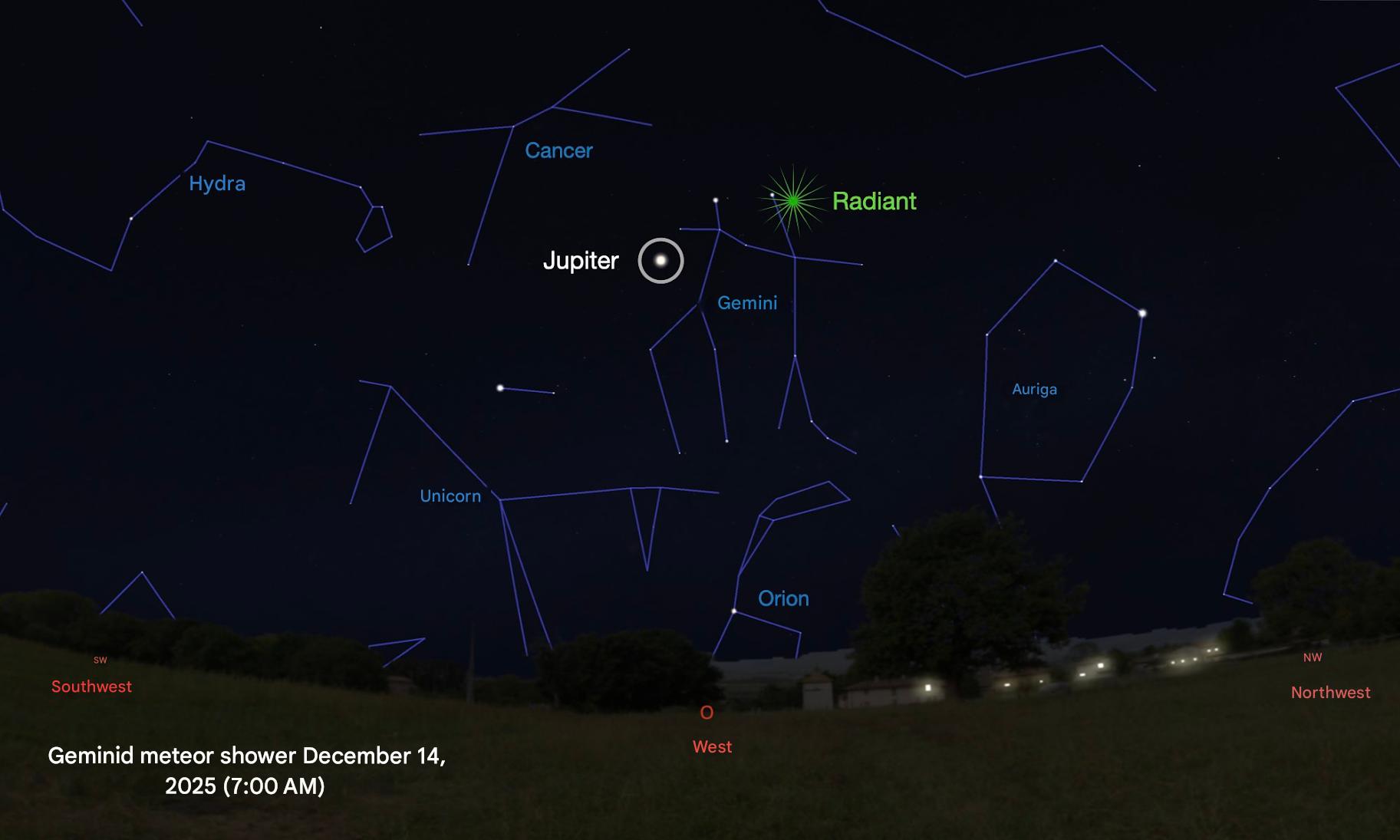
About one to two hours before the predicted peak in 2025, the Geminid radiant will still be above the horizon, this time in the west, on the morning of December 14.
© Cité de l’espace/Stellarium

THE HUMBLE URSIDES

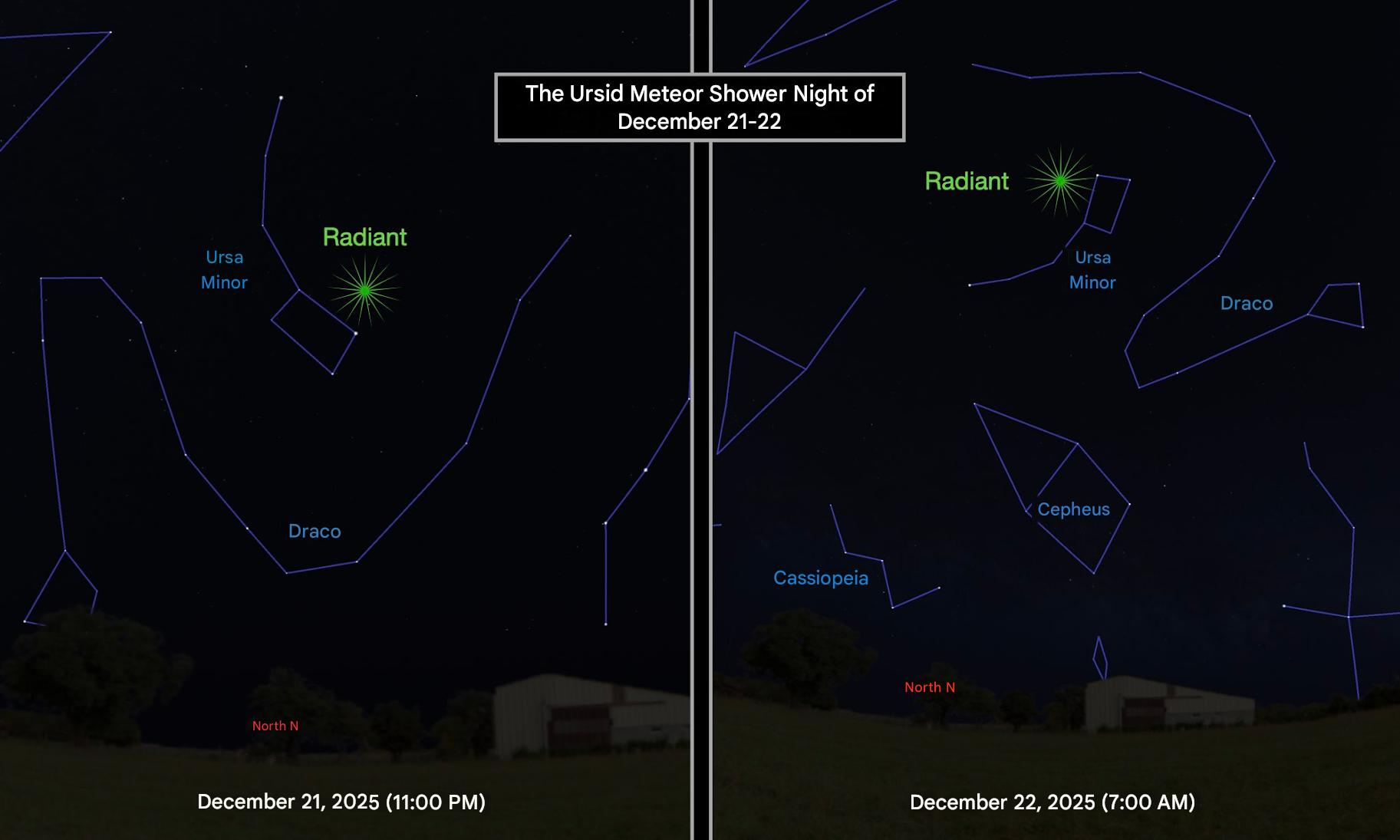
So named because their radiant is in the constellation Ursa Minor (the Little Dipper), the Ursids are much more modest than the Geminids, with a zenithal hourly rate of 10. Remember, this rate is calculated for ideal conditions (radiant at the zenith and no light pollution). In short, you won’t see 10 shooting stars per hour with the Ursids… But in 2025, they will benefit from an absent moon, as the New Moon will have occurred the day before. Active from December 17th to 26th in 2025, their peak is predicted for the night of December 21st to 22nd . The dust that burns up in our atmosphere for the Ursids comes from that scattered by comet 8P/Tuttle . 

The International Meteor Organization (IMO) lists two peak forecasts, the first for December 22nd around 6:40 AM and a second at 11:00 AM (it will be daylight) . Therefore, the night of December 21st to 22nd seems the most likely time.

Located in the constellation Ursa Minor, the Ursids radiant never sets at our latitudes. In the evening as in the morning (like the monster on this double map), it will be on the northern horizon. But it’s not essential to scrutinize the radiant to spot shooting stars; on the contrary, it’s better to take in the entire celestial vault.
© Cité de l’espace/Stellarium

THE MOON AND SATURN

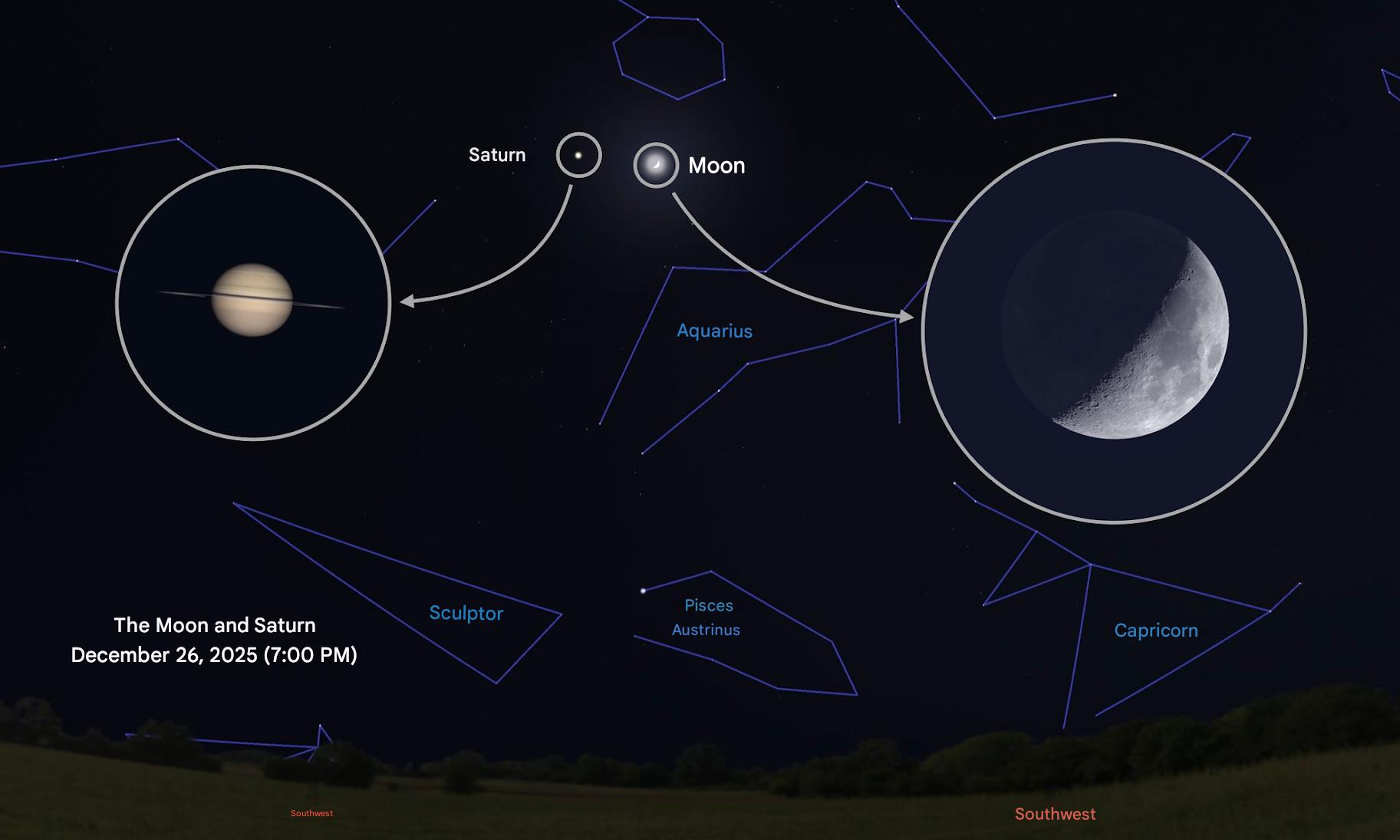
On December 26, the classic Saturn-Moon duo will be visible above the southern horizon in the early evening. Our natural satellite (close to the half-moon) and the ringed giant will be at an altitude of 40°, making observations easier. With a telescope, binoculars, or good binoculars, Saturn’s rings will be visible. However, they are currently “discreet.” This is because in March 2025, Earth will pass into the plane of the rings, which are therefore seen edge-on, an event that occurs approximately every 15 years. Then, for the next 7 years, the angle with the rings will become increasingly favorable, reaching a maximum of 27° in 2032.

The South will be dominated by a beautiful Moon-Saturn conjunction on December 26.
© Cité de l’espace/Stellarium

THE MOON AND THE PLEIADES (AGAIN)

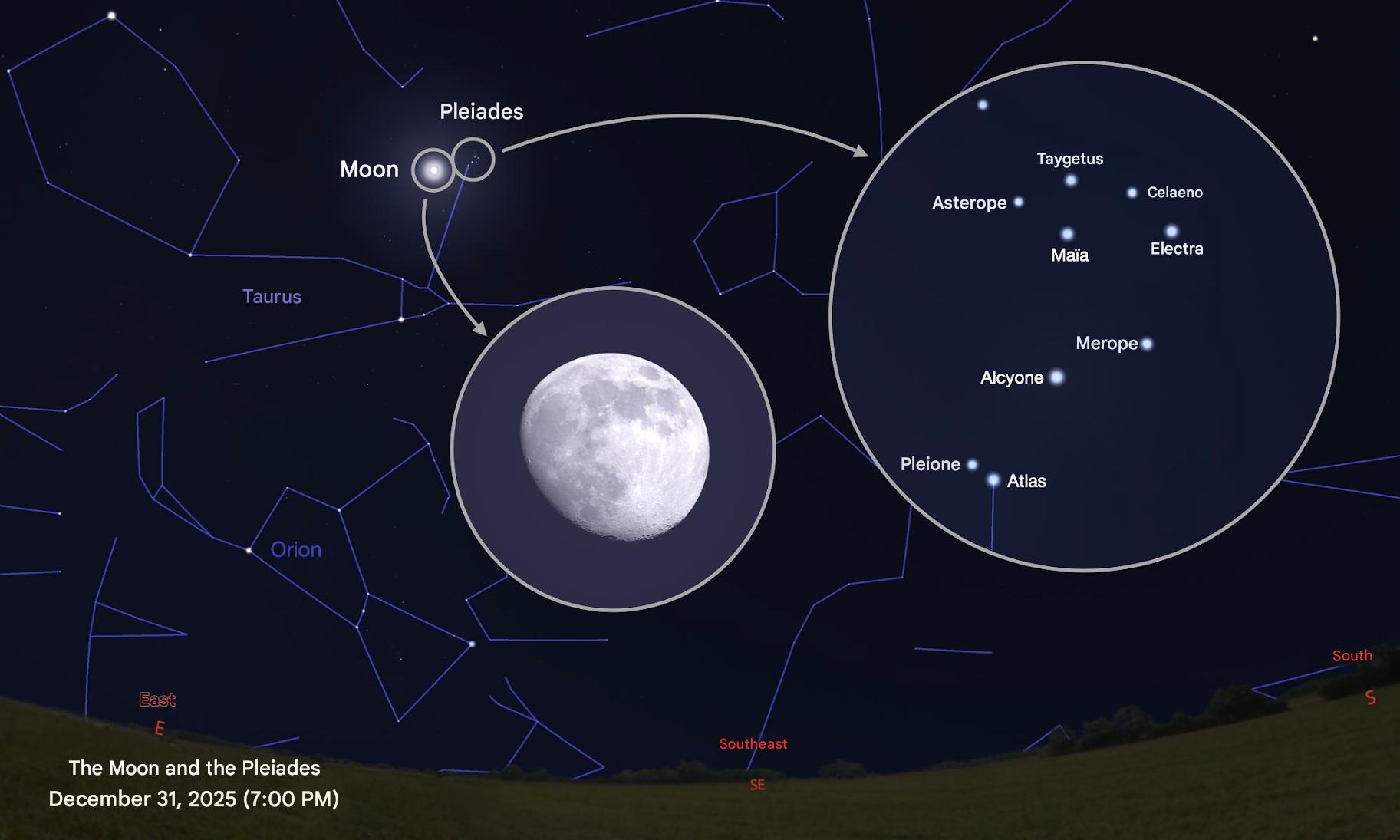
On December 31st, the Moon will once again pass close to the Pleiades . The encounter will be less close than at the beginning of the month, but we won’t miss this rendezvous between our celestial neighbor and the seven sisters, which will seem to mark the last day of 2025 and the beginning of 2026.

On December 31, the Moon will once again greet the seven Pleiades stars.
© Cité de l’espace/Stellarium

Related articles