• Solar System

New moon detected around Uranus

Published on 20 August 2025

The James Webb telescope has revealed a new moon, S/2025 U1, orbiting Uranus, bringing the total to 29. Small and inconspicuous, it enriches our understanding of the planet's complex system of moons and rings.

New moon detected around Uranus

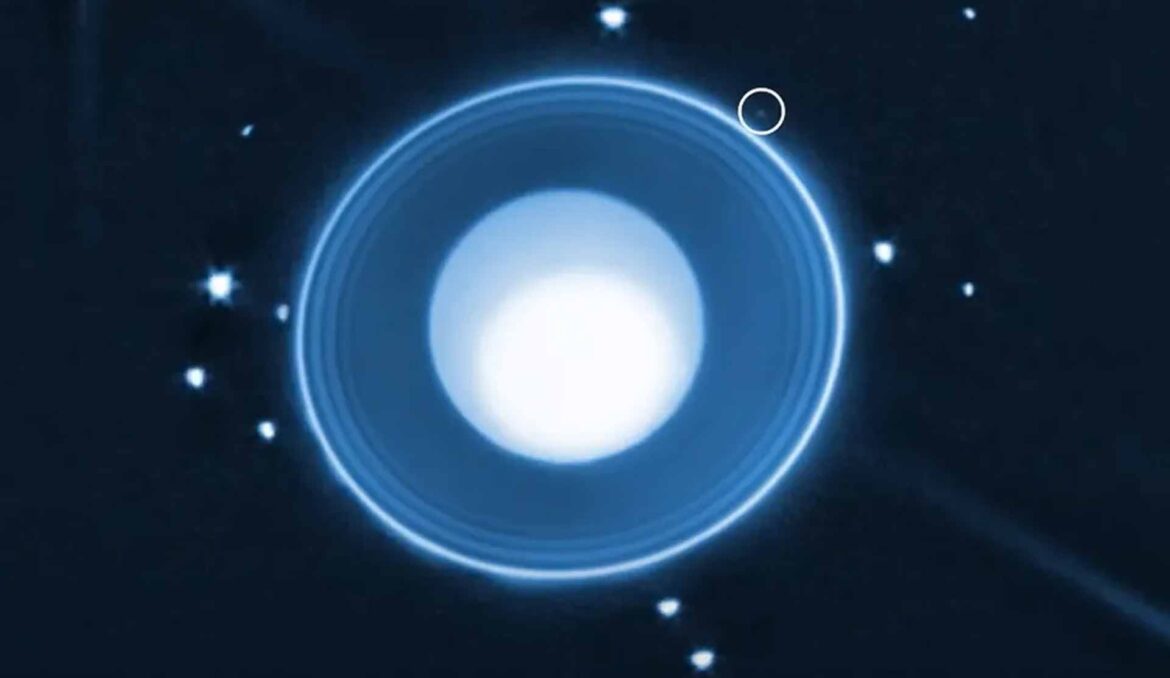
A new moon has been identified orbiting Uranus , the seventh planet in our solar system. Provisionally designated S/2025 U1 , the discovery was made possible by the James Webb Space Telescope . It brings the total number of confirmed natural satellites of the ice giant to 29 .


 © NASA, ESA, CSA, STScI, M. El Moutamid (SwRI), M. Hedman (University of Idaho)

A discovery from the James Webb Space Telescope

The discovery of S/2025 U1 was announced on August 19, 2025. A team of scientists, including Maryame El Moutamid of the Southwest Research Institute and Matthew Hedman of the University of Idaho, used the James Webb Space Telescope’s near-infrared camera, NIRCam . They made ten 40-minute exposures of Uranus. Until now, this very small satellite, estimated to be only about 10 km in size, had never been detected. Even Voyager 2, which flew by in 1986, failed to spot it.

Characteristics and place in the Uranian system

A small interior satellite

” It is located about 56,000 kilometers from the center of Uranus , orbiting the planet’s equatorial plane, between the orbits of Ophelia (which lies just outside Uranus’s main ring system) and Bianca ,” Maryame El Moutamid explains in the NASA press release. ” Its near-circular orbit suggests that it may have formed near its current location .” It is classified as an inner moon of Uranus . The Uranus moon system is divided into three distinct groups: thirteen inner moons (now fourteen with S/2025 U1), five large main moons, and ten irregular moons. The inner moons share common properties and origins with Uranus’s rings.

S/2025 U1 orbits between the already known satellites, Ophelia and Bianca.

© Domaine public – Cité de l’espace

Discover the model of the James Webb space telescope at the Cité de l’Espace

A life-size model, 6.5 m wide, is installed in the gardens of the Cité de l’espace.

Implications for the study of Uranus

The detection of S/2025 U1 provides new insights into the Uranian system. Uranus’s inner moons are closely related to the planet’s rings, likely originating from the fragmentation of one or more small inner moons. This system is considered chaotic and potentially unstable, with simulations showing that the moons can disrupt each other, potentially leading to collisions. ” No other planet has as many small inner moons as Uranus ,” said Matthew Tiscareno of the SETI Institute, who participated in the discovery. ” Their complex relationships with the rings suggest a chaotic history that blurs the line between a ring system and a moon system .”

What are the moons of Uranus called?

A tribute to English literature

Confirmed moons of Uranus are named after characters appearing or mentioned in the plays of William Shakespeare and Alexander Pope’s poem , The Rape of the Lock . This naming tradition was established by John Herschel, the son of William Herschel, the discoverer of Uranus, in 1852. Initially, the names were inspired by magical spirits from English literature, such as Oberon and Titania from A Midsummer Night’s Dream , and Ariel and Umbriel from The Rape of the Lock . The moon S/2025 U1 would later receive an official name from the International Astronomical Union (IAU) , following this literary convention.

Uranus par NirCam du JWST

In April 2023, the James Webb Space Telescope’s NIRCam instrument captured this unprecedented image of Uranus and highlighted its rings.

© NASA, ESA, CSA, STScI, J. DePasquale (STScI)

Related articles