




• Exploration

NASA’s budget under pressure

Published on 07 May 2025

In early May, the White House announced plans to cut NASA's budget by almost 25%, notably by eliminating the return of Martian samples, the SLS launcher, and the Gateway station around the Moon.

NASA’s budget under pressure

After general statements such as favoring a manned mission to Mars, Donald Trump’s second-term space policy is now taking a more specific turn. Indeed, on May 2, the White House Office of Management and Budget (part of the Executive Office of the President) released a budget proposal for fiscal year 2026. The announced cuts for NASA amount to almost 25% .


NGC 1512

Barred Spiral Galaxy

Horologium Constellation

The galaxy NGC 1512 is located 30 million light-years away. Thanks to Webb’s NIRCam, millions of stars appear in shades of blue. The MIRI instrument highlights glowing dust, revealing its location behind, around, and between the stars. The vast gas regions in the spiral arms also show intricate details in red and orange. Astronomers study the spacing of these features to understand how a galaxy distributes its gas and dust.

On the Moon in the 21st Century before China

According to the White House, the US agency’s budget must drop from $24.9 billion to $18.8 billion . The share allocated to manned exploration, however, increases by $647 million compared to 2025, but the surplus appears meager compared to the dual stated objective of ” returning to the Moon before China and putting a man on Mars .” The equation seems difficult given the delays in the Artemis return to the Moon program, which must therefore share funds with the manned Mars ambition pushed by Elon Musk. The Office of Management and Budget document puts forward as a solution ” a program aimed at replacing the SLS and Orion flights to the Moon with more cost-effective commercial systems .” The Space Launch System (SLS) launcher and the Orion capsule inaugurated with Artemis I and which are to be used for future Artemis missions would therefore soon be replaced by vehicles supplied by the private sector . It is also proposed to remove the Gateway lunar station around the Moon.

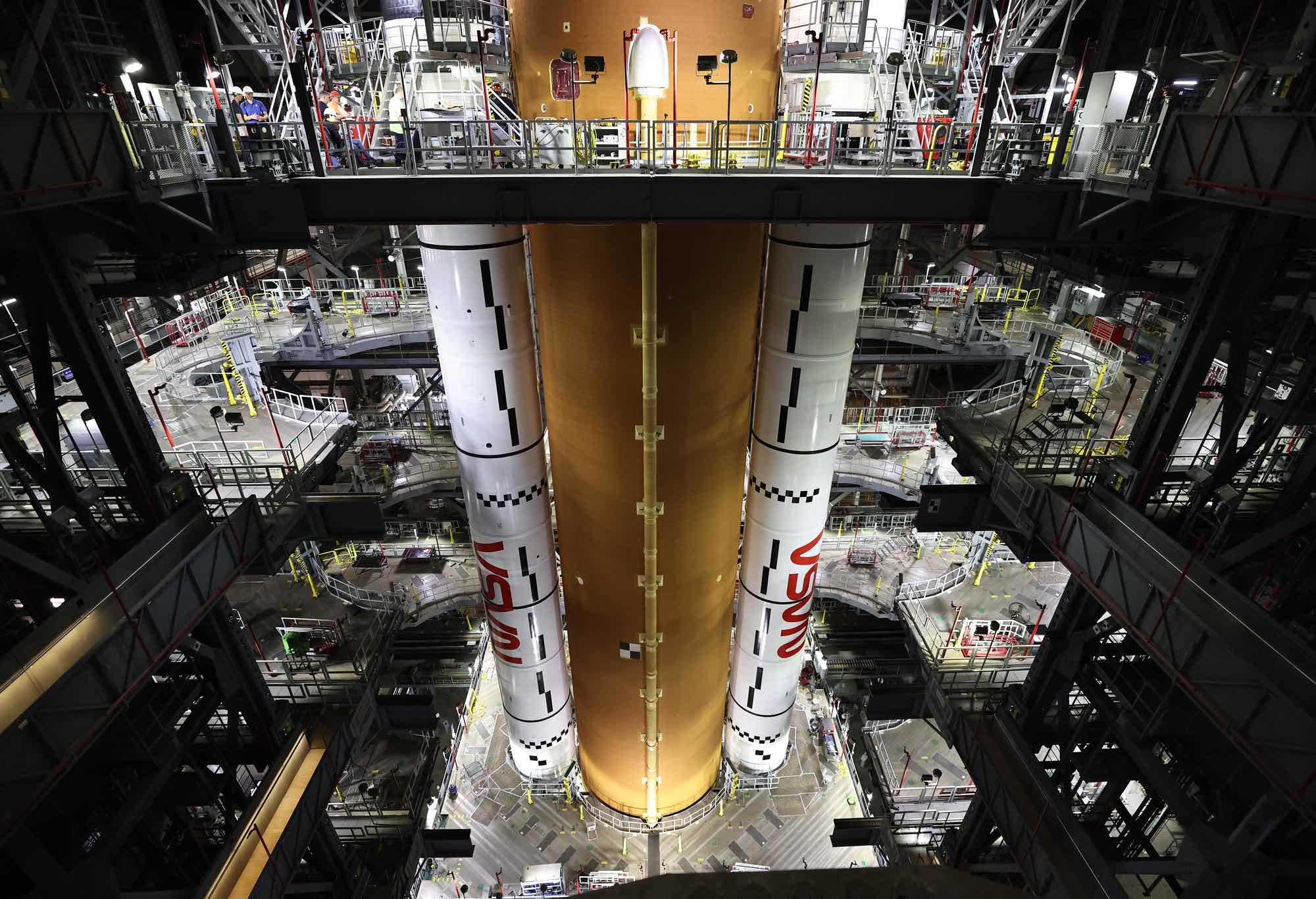
At NASA’s Kennedy Space Center in Florida, teams are moving forward with the assembly of the SLS launch vehicle for the Artemis II mission, scheduled for 2026. The White House wants to scrap the launch vehicle, which it describes as ” extremely expensive ,” but Artemis II is not currently in doubt.

© NASA/Frank Michaux

The White House’s proposal for NASA’s 2026 budget. The figures are in the millions of dollars. For example, -2.265 for Space Science represents a budget cut of $2.265 billion.

© Cité de l’espace based on a White House document


Cuts affecting science, climate and the ISS

The cuts announced for Artemis therefore affect cooperation with partner agencies, including the European Space Agency (ESA), which provides, among other things, certain modules of the Gateway. In a press release dated May 7, the ESA emphasized that a more detailed document was expected in late May or early June, while also reiterating that the final budget will result from a process that involves a vote in the US Congress. For the European agency, ” it is therefore important to keep in mind that this is still a work in progress .”

The extent of NASA’s cuts also affects its space science (more than $2 billion less) with the desire to end the Mars Sample Return program (MSR – Mars Sample Return, in which the ESA also participates) or programs related to climate, Earth observation and even the ISS . By removing $508 million from the station’s operations, the stated logic is to reduce the size of its crews and the science carried out on board given its deorbiting in 2030.
These cuts have provoked several oppositions, notably from the Democratic Party, Donald Trump being supported by the Republican Party. 

But beyond this classic political divide in the United States, there is a forthcoming vote on the NASA budget that will be under tension . Thus, Texas Senator Ted Cruz, although a Republican, is rather in favor of the SLS launcher, which brings economic benefits to his state. Moreover, during Jared Isaacman’s Senate hearing for his nomination as NASA administrator, Ted Cruz had shown his full support for the lunar effort and Artemis , emphasizing that “an extreme change in priorities at this point would almost certainly mean a Red Moon ” (meaning China up there before the US returns), seeing it as a ” catastrophic mistake .” When asked about the Gateway, Jared Isaacman dodged the question with: ” I have no intention of saying at this point that I would cancel a program ,” while promising more telescopes, more probes, more rovers… With a budget down 25%, the exercise is looking difficult for the moment.

Related articles
