






Got something weighing you down? Shake it off (like Curiosity)!
— NASA Mars (@NASAMars) May 5, 2026
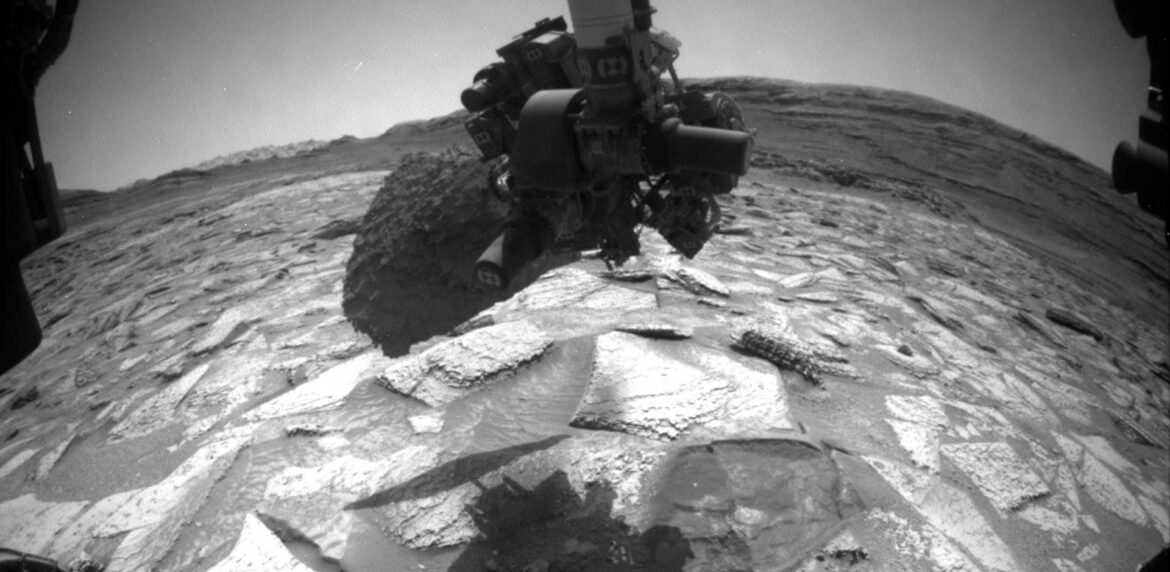
The Martian explorer unintentionally picked up a rock while drilling a recent sample, but the team was able to dislodge it by having the rover move its robotic arm and vibrate the drill until the rock fell off. pic.twitter.com/LnLYjIBW2H
The 13 kg rock ended up stuck on Curiosity’s robotic arm.
© NASA JPL-Caltech
Atacama, a recalcitrant block
An unprecedented mechanical failure
The incident occurred while the rover was performing a routine drilling operation in this block of rock , approximately 45 cm in diameter and 15 cm thick . The Atacama drilling, the 47th since Curiosity landed on Mars , was part of a regular characterization campaign of the sulfate layers of Mount Sharp. ” It’s a routine drilling operation. We’re covering ground, climbing higher and higher in the stratigraphy ,” explains Gwenaël Caravaca, a planetary geologist at GET (Géosciences Environnement Toulouse) and a member of the Curiosity mission . ” Every 20 or 30 meters we gain in elevation within the stratigraphic column, we drill to gather statistics and data on mineralogical and chemical evolution .” However, unlike usual operations where the drill bit retracts automatically, the entire rock remained attached to the drill sleeve . Images from the HazCam instrument clearly show the large 13 kg block above the ground, held by Curiosity’s robotic arm. This is the largest rock ever moved on Mars. ” We’ve broken rocks before. We also sometimes break blocks by driving over them. With Perseverance, we carried pet rocks (rocks that get stuck in the wheels and sometimes travel for kilometers). But here, we’ve broken the record for the largest natural object moved by human hands on Mars ,” marvels Gwénaël Caravaca.



