
• Exploration

JUICE: The road to Jupiter passes through Venus

Published on 19 September 2025

Launched by Ariane 5 in 2023, the European JUICE probe successfully flew past Venus on August 31. The gravitational assist it received will allow it to reach Jupiter in 2031, after two flybys of Earth in 2026 and 2029.

JUICE: The road to Jupiter passes through Venus

It was its penultimate mission: on April 14, 2023, Ariane 5 took off from the Guiana Space Center to launch JUICE (JUpiter ICy moons Explorer), the first European probe to Jupiter , the largest planet in the Solar System. This marked the beginning of a long 8-year journey with 4 gravity assists on the program. The one on August 31 was the second.

Venus to get ‘free fuel’

Gravity assistance involves a probe flying over a planet so that the latter’s gravitational field modifies the trajectory followed and provides additional speed (or allows speed to be lost) without using fuel or at least considerably less. This navigation trick , commonly used by other exploration missions, sometimes even simply makes the trip possible (carrying the necessary fuel without the maneuver(s) would result in a craft that is too massive).
After its takeoff in 2023, JUICE thus experienced a first gravitational assistance by flying over the Moon and then the Earth on August 19, 2024. Incidentally, this double assistance was a first! With this trajectory modification, the probe was heading towards Venus.

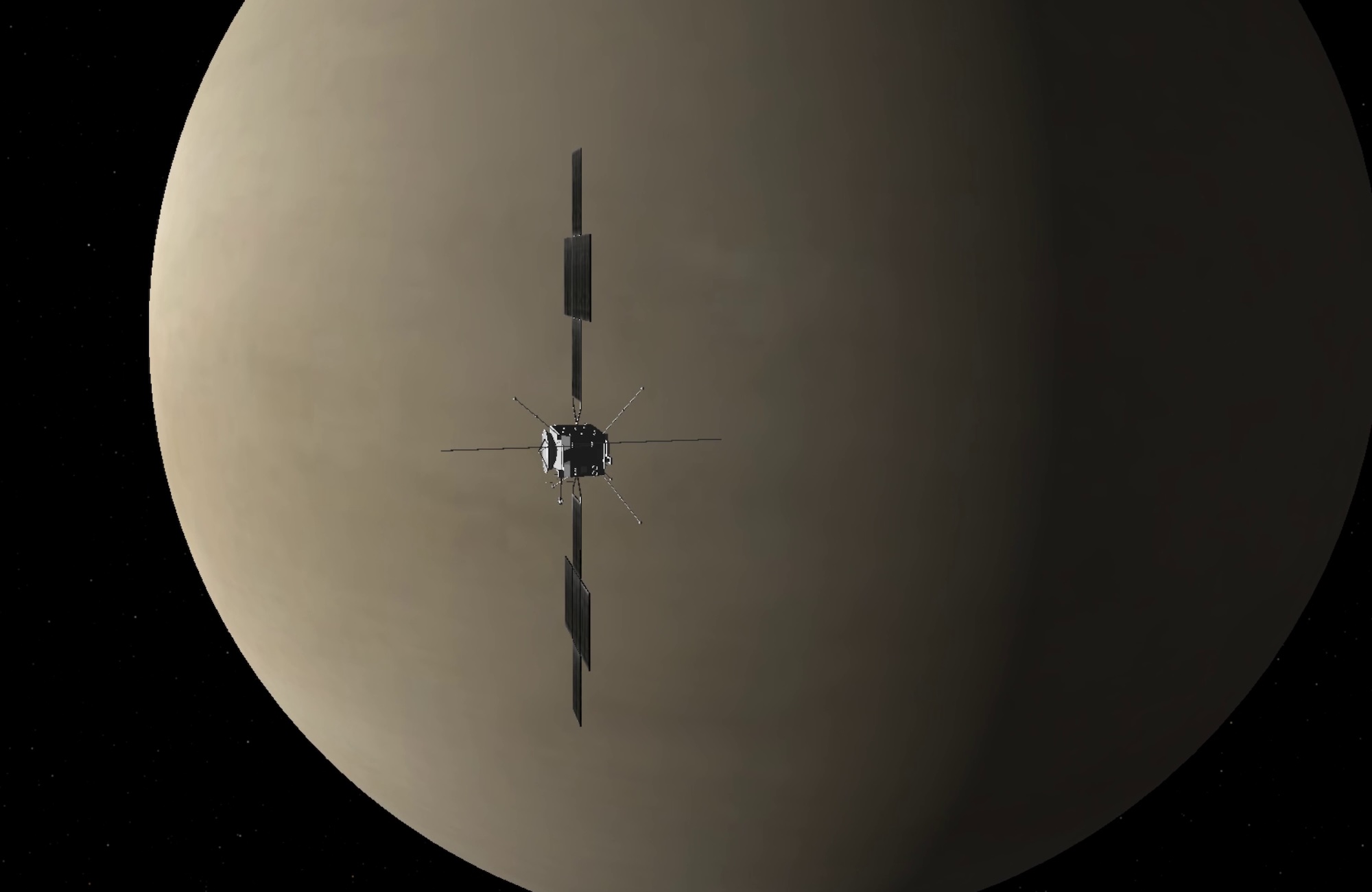
Just over a year later, on August 31, JUICE flew by the second planet in the Solar System as planned, passing closest at 5,088 km . Two more flybys of Earth remain to be completed before reaching Jupiter in 2031.

ESA illustration showing JUICE passing 5,088 km from Venus on 31 August.
© ESA

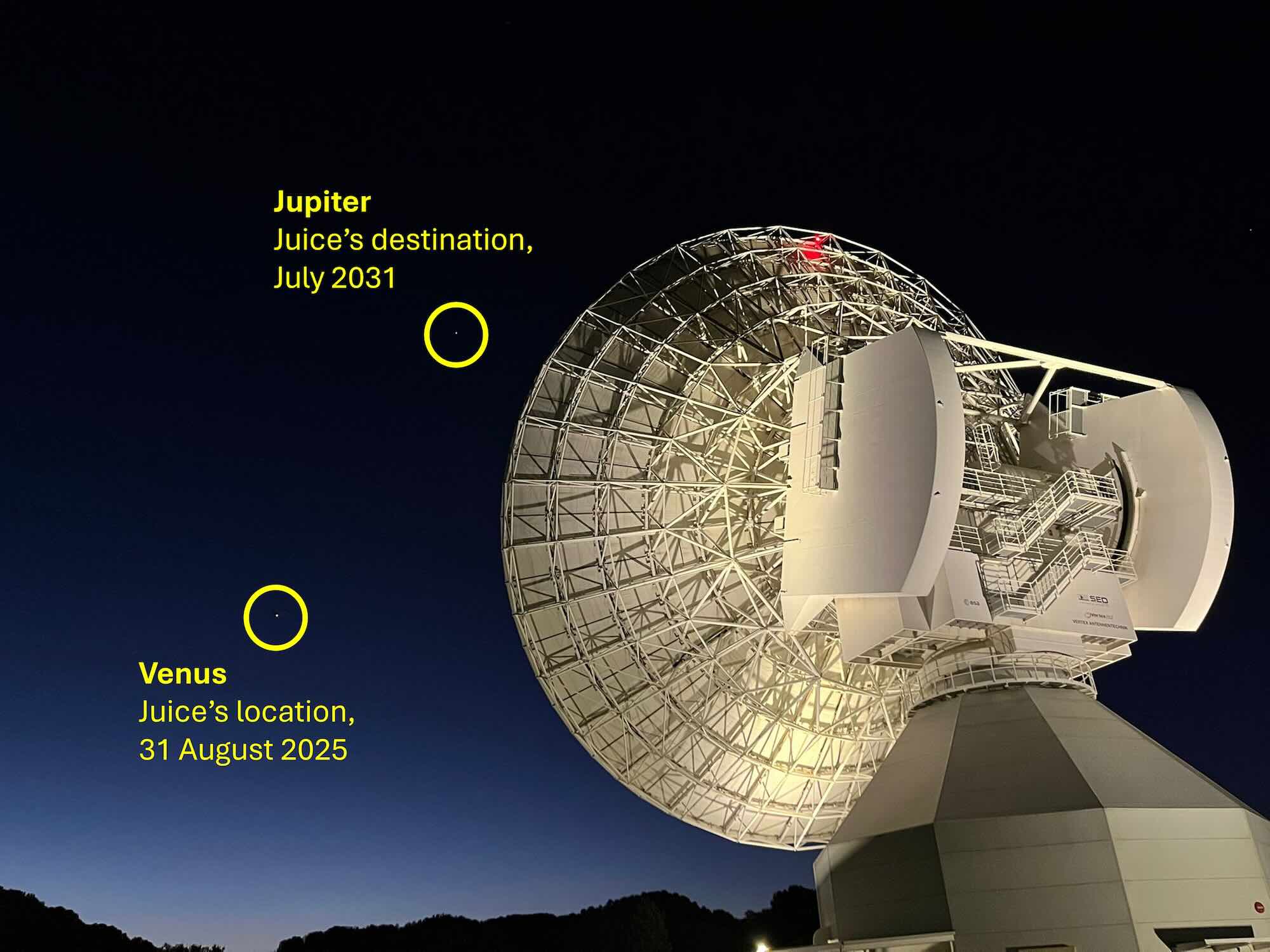
This photo of the 35m diameter antenna at Cebreros in Spain, one of the ESA antennas used to communicate with JUICE, was released to celebrate the successful flyby of Venus on 31 August.

On that day, Venus was 202 million kilometers from Earth and Jupiter was 773 million kilometers. However, JUICE will have to travel a much greater distance than these figures suggest. In total, the journey will represent 6 billion kilometers.

© ESA

Hello? When JUICE stops responding…

The flyby of Venus on August 31 was not without suspense for the teams of the European Space Agency (ESA). Indeed, on July 16, the communications antenna at Cebreros in Spain failed to contact the probe, which was then traveling 200 million kilometers from Earth! This means that any signal sent takes 11 minutes to reach the craft and that it is necessary to wait just as long for a possible response… It will take the ground teams about twenty hours to resolve the problem and reestablish contact .
In the end, more fear than harm since the information received shows that no equipment was faulty. The problem originated from a computer program that performed a sort of reset every 16 months, which temporarily cut off a much-needed radio signal amplifier 200 million kilometers away. With the problem resolved once and for all, the flyby on August 31 took place as planned, but without turning on the onboard instruments. This is because JUICE wasn’t primarily designed to fly close to the Sun as it did during the Venus flyby. The trick was to use the probe’s communications antenna as a heat shield and not use the instruments in an environment for which they weren’t designed.

JUICE’s long journey

A journey of 6 billion kilometers

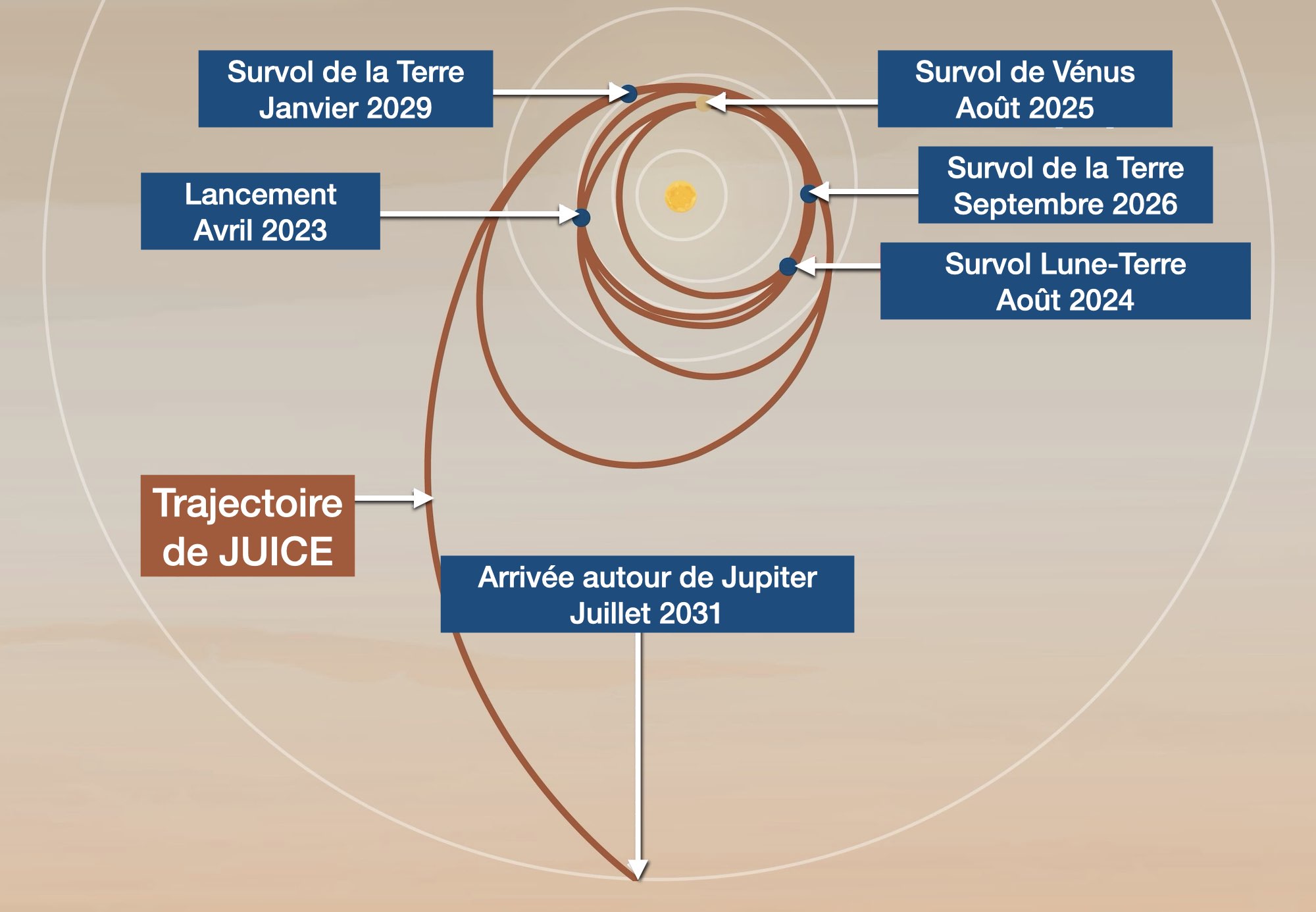
The gravity assist from the August 31st Venus flyby gave JUICE enough speed to continue its long journey to Jupiter. However, the European probe is scheduled to complete two more flybys , this time using Earth to refine its trajectory toward the largest planet in the Solar System. First in about a year in September 2026 , and then in January 2029. After this fourth and final gravity assist, the European probe will head much more directly (but still on a curve) toward its destination. In total, since leaving Earth, JUICE will have traveled 6 billion kilometers to reach Jupiter .

JUICE’s long journey from Earth in 2023 to Jupiter in 2031 with four gravity-assist flybys.
© ESA, adapted by Cité de l’espace

The challenge of life

From July 2031 to November 2034, JUICE will orbit Jupiter and study the Jovian environment and the gas giant’s icy moons (the “Icy Moons” by its acronym). Finally, from December 2034, it will orbit the moon Ganymede (the largest moon in the Solar System), becoming the world’s first artificial satellite. The goal is to determine whether or not Ganymede hosts conditions favorable to life (particularly in an ocean located under an ice crust). The mission is scheduled to end in September 2035.


Related articles