
Has Zhurong Found Traces of an Ancient Ocean on Mars?

Published on 15 November 2024

Examination of data from the small Chinese rover supports the thesis of the presence of an ocean on Mars more than 3.5 billion years ago. Zhurong is believed to have surveyed part of its coastline in the Utopia Planitia region.

Has Zhurong Found Traces of an Ancient Ocean on Mars?

Zhurong is no longer functioning. But its data can still teach us more about Mars. New analyses of data collected by the Chinese rover, which explored the Utopia Planitia region on Mars between 2021 and 2022, suggest the presence of an ancient coastal zone, a possible vestige of an ocean that disappeared billions of years ago. These discoveries, based on the study of geological formations and the composition of the Martian soil, provide new insights into the history of the red planet.

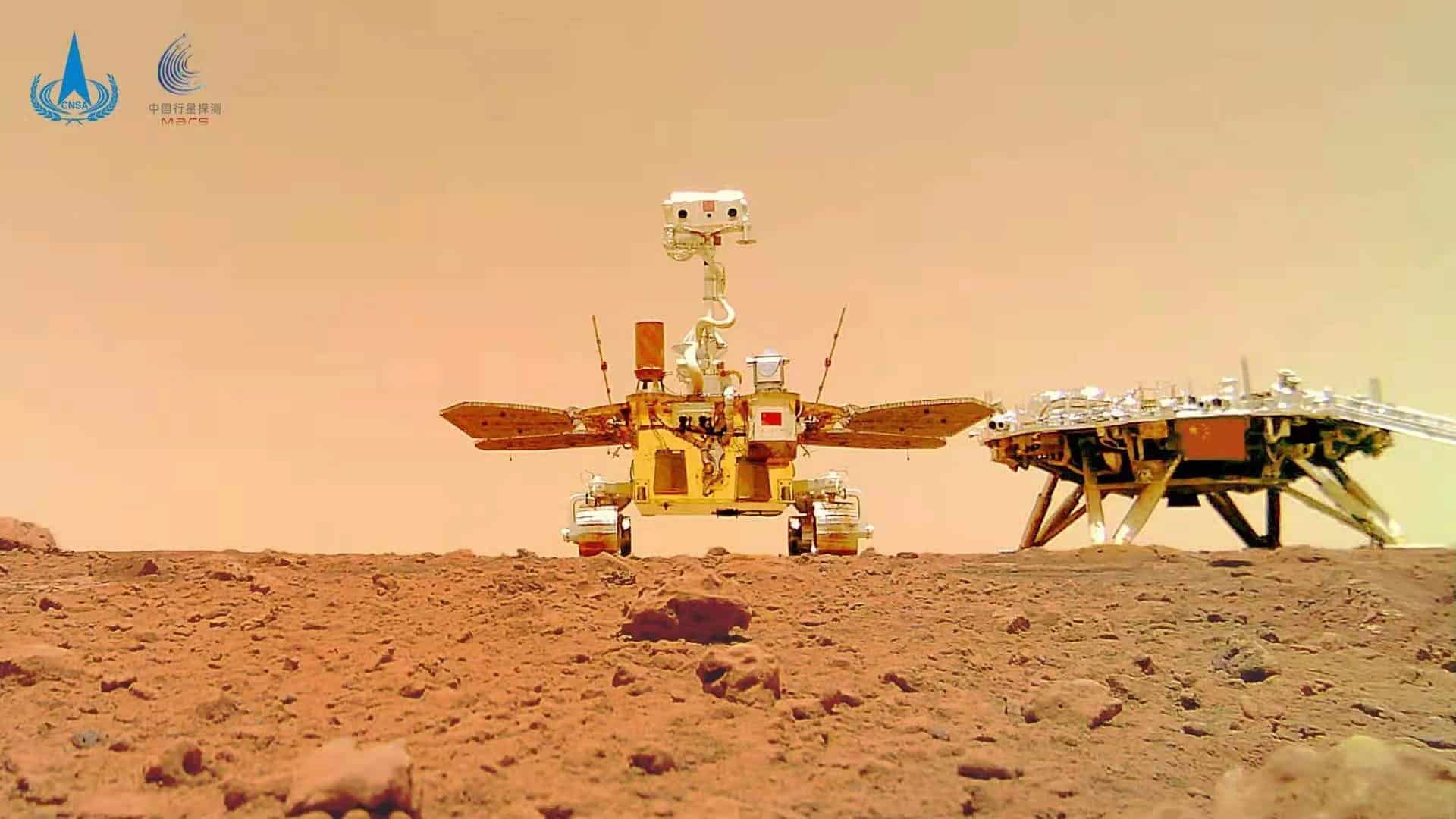
Zhurong, and its landing module upon arrival in the Utopia Planitia region in May 2021.

© CNSA

A Vast Ocean on Mars ?

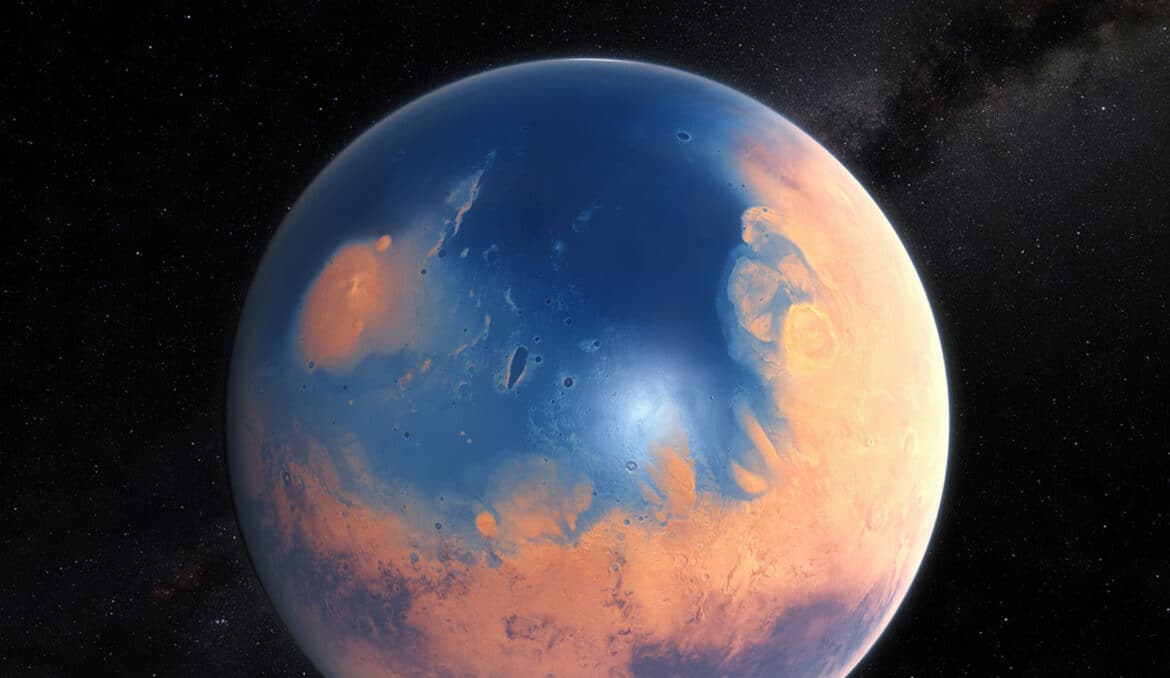
Nearly a third of the planet Mars is believed to have been covered by an ocean more than 3.5 billion years ago

As early as the 19th century, astronomers, perceiving dark areas on the surface of Mars, deduced that an ocean must have existed on its surface. The improvement of telescopes and probes that went to observe Mars more closely realized that this was not the case. However, in the late 1990s, the idea of an ocean that disappeared emerged. Covering more than a third of the planet, especially its boreal part, it would have allowed Mars to resemble Earth. But, while evidence supports this hypothesis, no mission has yet managed to prove it. The data collected by the Chinese rover Zhurong could, however, provide additional elements. One of the scientific missions of the rover, which arrived in the vast plain of Utopia Planitia in May 2021, at the supposed boundary between the ancient coast and its ocean, was to provide new evidence that an ocean did exist on Mars. Zhurong, far beyond all expectations, functioned for 347 sols, the days on Mars. In April 2023, the Chinese Space Agency admitted that the amount of dust on its solar panels, which had led to its hibernation, was too great and that it was conceivable that it would never restart. The reasons for Zhurong’s hibernation and the comparison with Perseverance’s energy production mode are explained at the Cité de l’espace during the animation “Les Rovers entrent en scène” on the Terrain Martien.

A Landscape Shaped by Water

The study of geological formations and the composition of rocks is compatible with the presence of an ocean

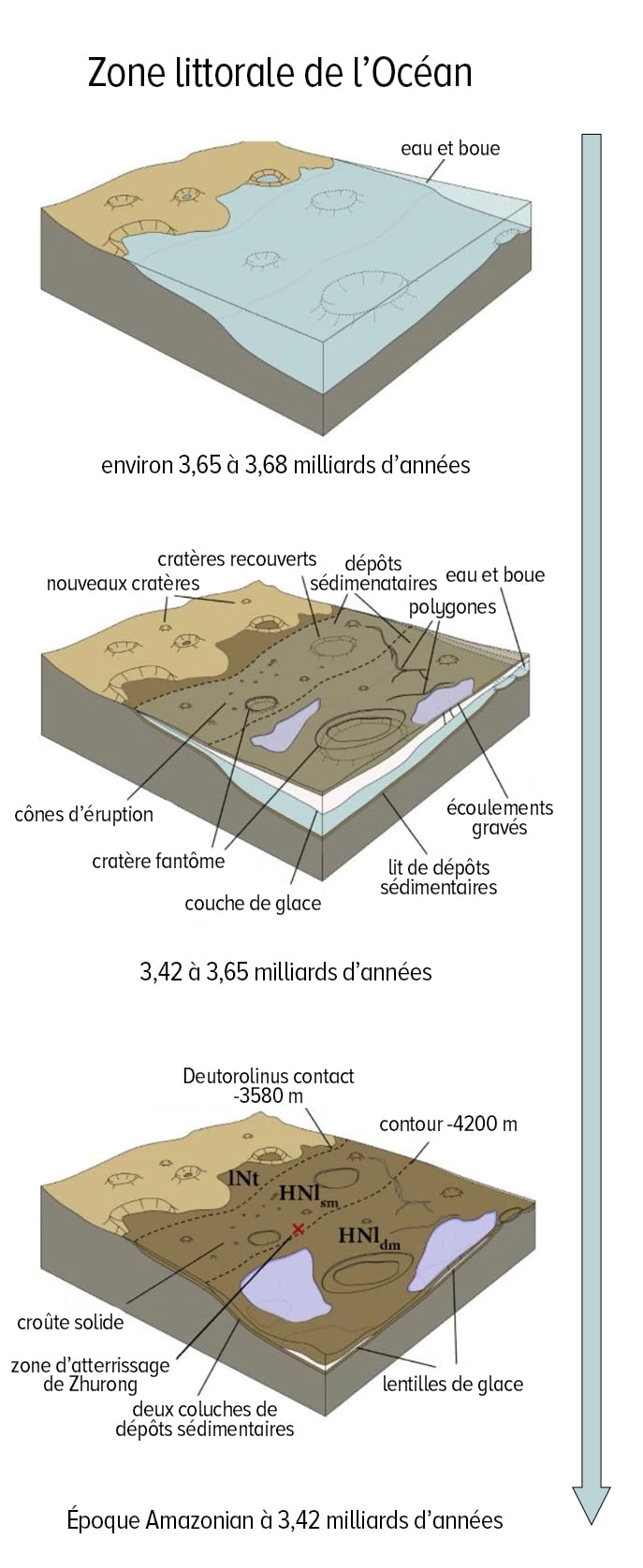
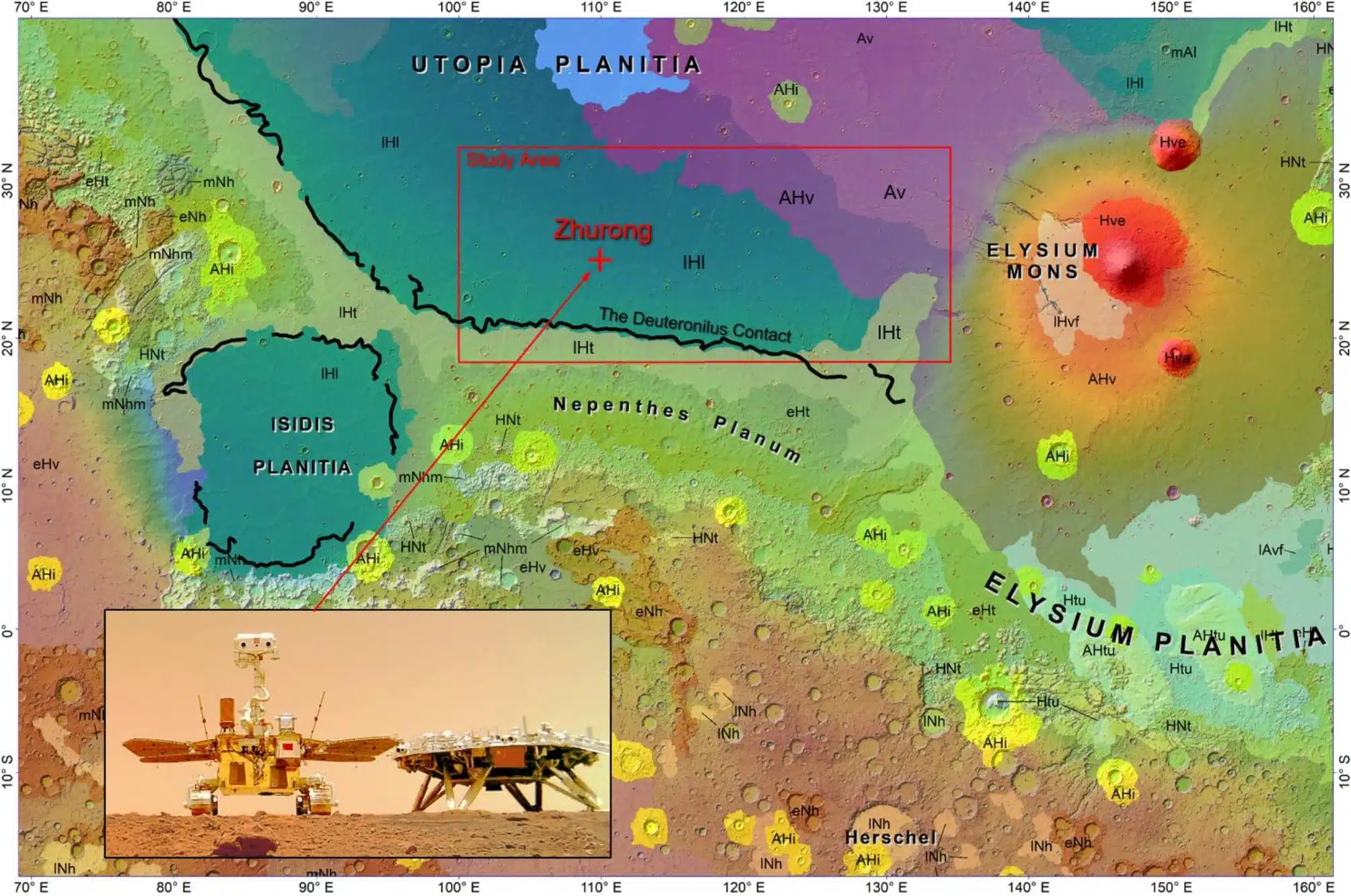
Months after its last wheel movement, Chinese scientists continue to delve into the multitude of data collected by the rover. The research team, led by Bo Wu of the Hong Kong Polytechnic University, has identified a series of geological formations characteristic of a coastal environment, including cones, depressions, but also sedimentary channels and mud volcano formations. These structures, distributed along an ancient potential shoreline called “Deuteronilus contact,” indicate that there was water in this location. In an article published in Nature, the team performs dating. According to them, the ocean may have existed about 3.68 billion years ago. Its depth could have exceeded 3500 m in places. The analysis of Martian rocks by the Zhurong rover revealed the presence of minerals that generally form in the presence of water. While the discovery of sedimentary rock on the surface and at depth by the rover’s radar also reinforces the hypothesis of an ancient ocean. However, only further analysis will provide certainty that a vast ocean did cover Mars at that time. The disappearance of water on the surface of Mars is a phenomenon that is presented during the animation “Labo Mars” at the Cité de l’espace through amazing and fun experiments.

Zhurong landed in the Utopia Planitia region. It headed south towards the ancient potential shoreline called “Deuteronilus contact”.

© CNSA

An Evolution in Three Stages

Based on the evidence, scientists propose a three-stage model to explain the evolution of this coastal zone:

  • Initially, floods would have filled the lowlands of northern Mars, creating a vast body of water in Utopia Planitia.
  • Then, the ocean would have frozen, forming a layer of ice covered with deposits. During this period, the sublimation of ice and eruptions of mud volcanoes would have contributed to the formation of the observed geological features.
  • Finally, liquid water would have gradually disappeared, leaving behind vestiges of underground ice and geological formations that bear witness to an aquatic past.

Related articles