




• Mars

Has Perseverance found a new clue to past life on Mars?

Published on 25 June 2026

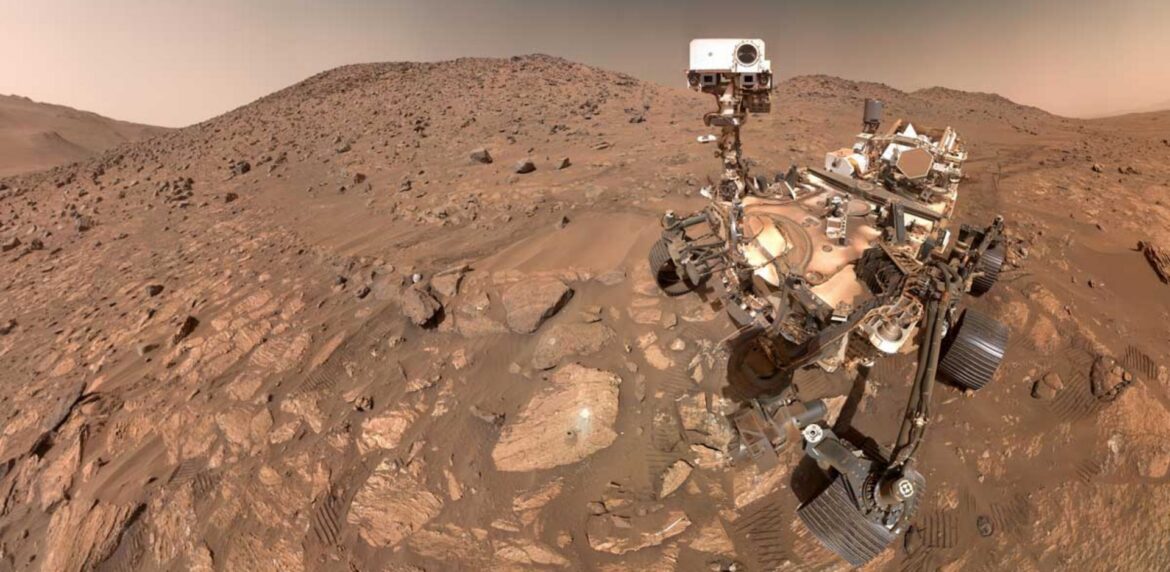
The Perseverance rover has identified hundreds of traces of complex organic carbon on and beneath the surface of Cheyava Falls. This record-breaking discovery suggests that the building blocks of life were present throughout Mars billions of years ago, although the biological origin of these traces still needs to be confirmed on Earth.

Has Perseverance found a new clue to past life on Mars?

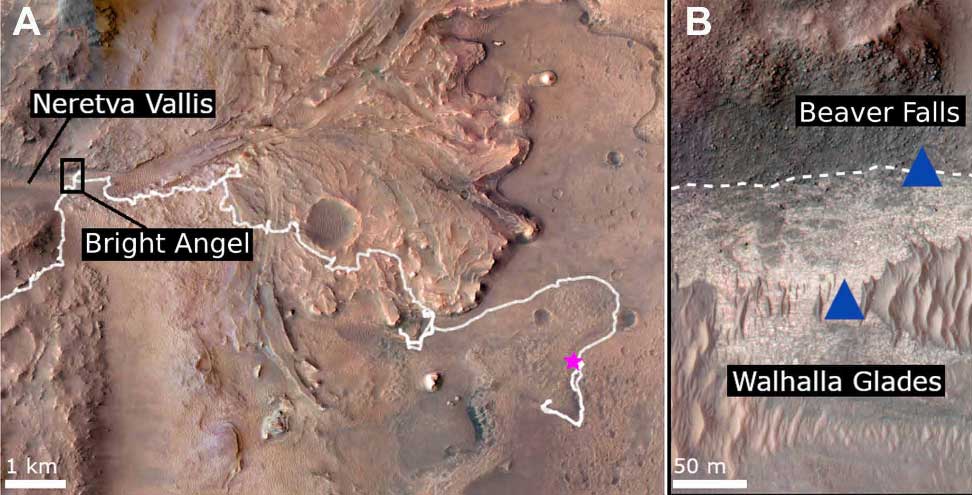
This is yet another piece of evidence supporting the hypothesis that life once developed on Mars . Another clue, but not yet proof. A year after the intriguing discovery of the “Cheyava Falls” rock and its famous “leopard spots ,” the Perseverance rover has reached a new milestone. A study published on June 24, 2026, in the journal Science Advances confirms the presence of hundreds of traces of complex organic carbon within the ancient river valley of Neretva Vallis. These results reinforce the idea that the components necessary for the emergence of life were once widespread on the Red Planet, though they do not constitute definitive biological proof.

These new clues were found on the surface of the Chevaya Falls rock, but also below the surface, as well as on other nearby rocks, which helps to ensure that this is not an isolated phenomenon.

© NASA/JPL-Caltech/ASU/MSSS

Chemical analyses that complement visual clues

A record number of organic detections in Jezero Crater

In July 2025, attention was drawn to Cheyava Falls due to unique visual characteristics suggestive of terrestrial microbial processes . Indeed, on Earth , the presence of minerals like vivianite and greigite, identified in this rock, is often associated with life. New data published in June 2026 provides further evidence to support this hypothesis. Measurements taken on two types of thin sedimentary rocks revealed hundreds of organic detections. According to the authors of the scientific article, this is the most robust detection of organic carbon made to date in Jezero Crater.

The closest detection to the surface ever achieved

One of the most striking aspects of this announcement is the detection of complex carbon directly on the natural surface of the rock , simply cleaned of dust. This is the first time such molecules have been found so close to the surface, where solar radiation would normally destroy them. Specifically, this is macromolecular carbon, or MMC. It is a solid and complex network of carbon, primarily reduced, which is insoluble and highly resistant to chemical or thermal decomposition.

How were the researchers able to make this discovery?

How the SHERLOC instrument works

To obtain these results, the scientists used SHERLOC . This spectrometer, mounted at the end of Perseverance ‘s robotic arm , functions like a chemical scanner. It projects an ultraviolet laser onto the rock to identify its composition. By precisely scanning different areas, the laser created a detailed map showing exactly how organic matter is distributed within the stone.

Three key areas for understanding the history of the rock

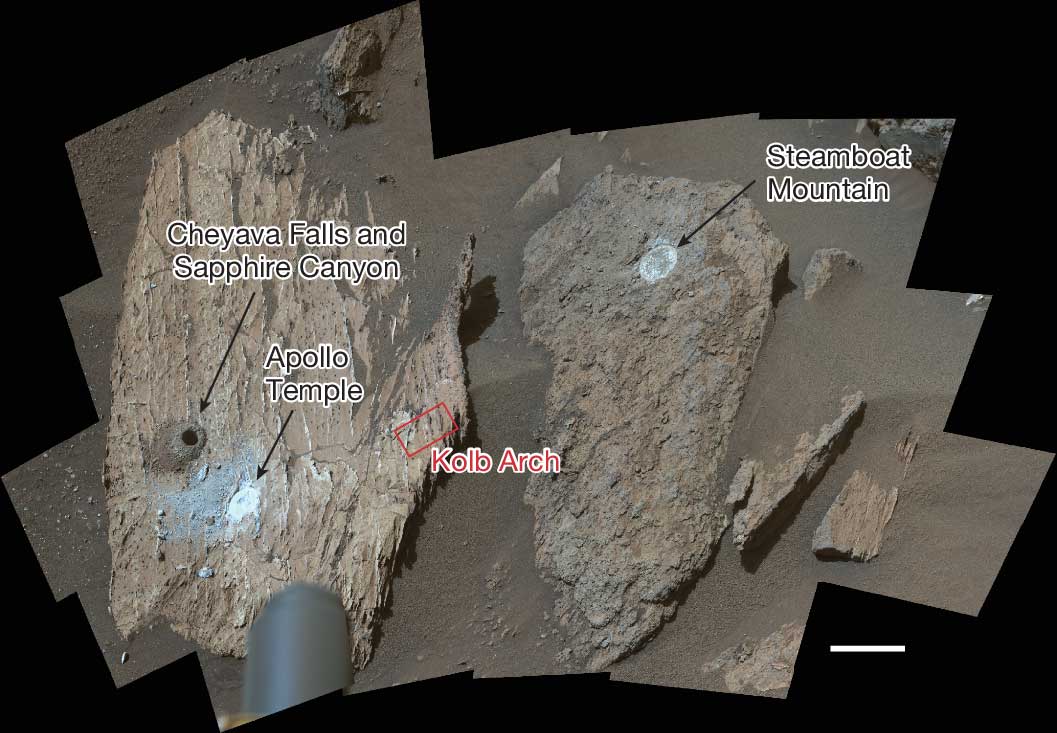
To properly interpret these results, the researchers focused on three specific locations:

  • Cheyava Falls (Surface): Analysis of the outer surface, cleaned by a gas jet, revealed carbon despite exposure to radiation.
  • Apollo Temple (The Interior): This area is located on the same Chevaya Falls rock that the rover sanded down to a depth of 7.8 millimeters to see what was “beneath the surface.” It is here that organic traces are associated with carbonates and sulfates (salts).
  • Walhalla Glades (The Comparison Point): An abraded area on another rock located 111 meters away. Organic traces are associated with silicates, proving that these molecules are not isolated in a single location.

The Walhalla Clades rock is located 111 m from Chevaya Falls. It was used to compare the results. MMC carbons were also found there.

© NASA/JPL-C altech/ASU/MSSS.

In 2030, Rosalind Franklin, the European rover of the ExoMars mission, will explore the Oxia Planum region and will be able to drill to a depth of 2 meters. This region is rich in clays and could provide additional resources.

© ESA/Thales Alenia Space

A fresh look at the hypothesis of life

Clues that are reminiscent of terrestrial biology

Carbon is the fundamental building block of life as we know it . In this study, Perseverance detected evidence resembling biochemical interactions observed on Earth . But, once again, we must remain very cautious before concluding that this constitutes proof of life. Current instruments cannot rule out an “abiotic” origin—that is, one unrelated to living organisms—such as meteorite impacts or deep geological processes. To know for sure, we will have to wait for these samples to return to Earth for analysis with more powerful instruments. However, NASA’s cancellation of the Mars Sample Return mission postpones this deadline, and these samples may never be brought back. In the meantime, this discovery, on clay rocks like Chevaya Falls , opens up exciting avenues of research for the future European ExoMars mission and the Rosalind Franklin rover . It will explore the Oxia Planum site. However, we learned a few days ago that analyses of this region by orbiters around Mars revealed a high presence of clay . Scheduled for launch in 2028, this rover will be able to drill to a depth of two meters, where any potential traces of life are even better protected from radiation than those found today by Perseverance .

Related articles
