
• Satellite

First images of an artificial eclipse in orbit thanks to the Proba-3 mission

Published on 17 June 2025

ESA's Proba-3 mission has created the first artificial solar eclipse in orbit, providing unprecedented images of the Sun's corona. This feat opens new perspectives for predicting space weather and protecting our technology on Earth.

First images of an artificial eclipse in orbit thanks to the Proba-3 mission

Observing the solar corona, the outer region of the Sun ‘s atmosphere , represents a scientific and technical challenge. For the first time, a European space mission has succeeded in recreating an artificial eclipse in orbit, opening a new avenue for the detailed study of the Sun. Called Proba-3 , this mission is based on the formation flight of two satellites and allows for unprecedented observational precision.

The feat includes being able to fly in formation at a distance of 150 m with a precision of the thickness of a fingernail.
© ESA

An eclipse recreated in space

Two satellites in formation to block sunlight

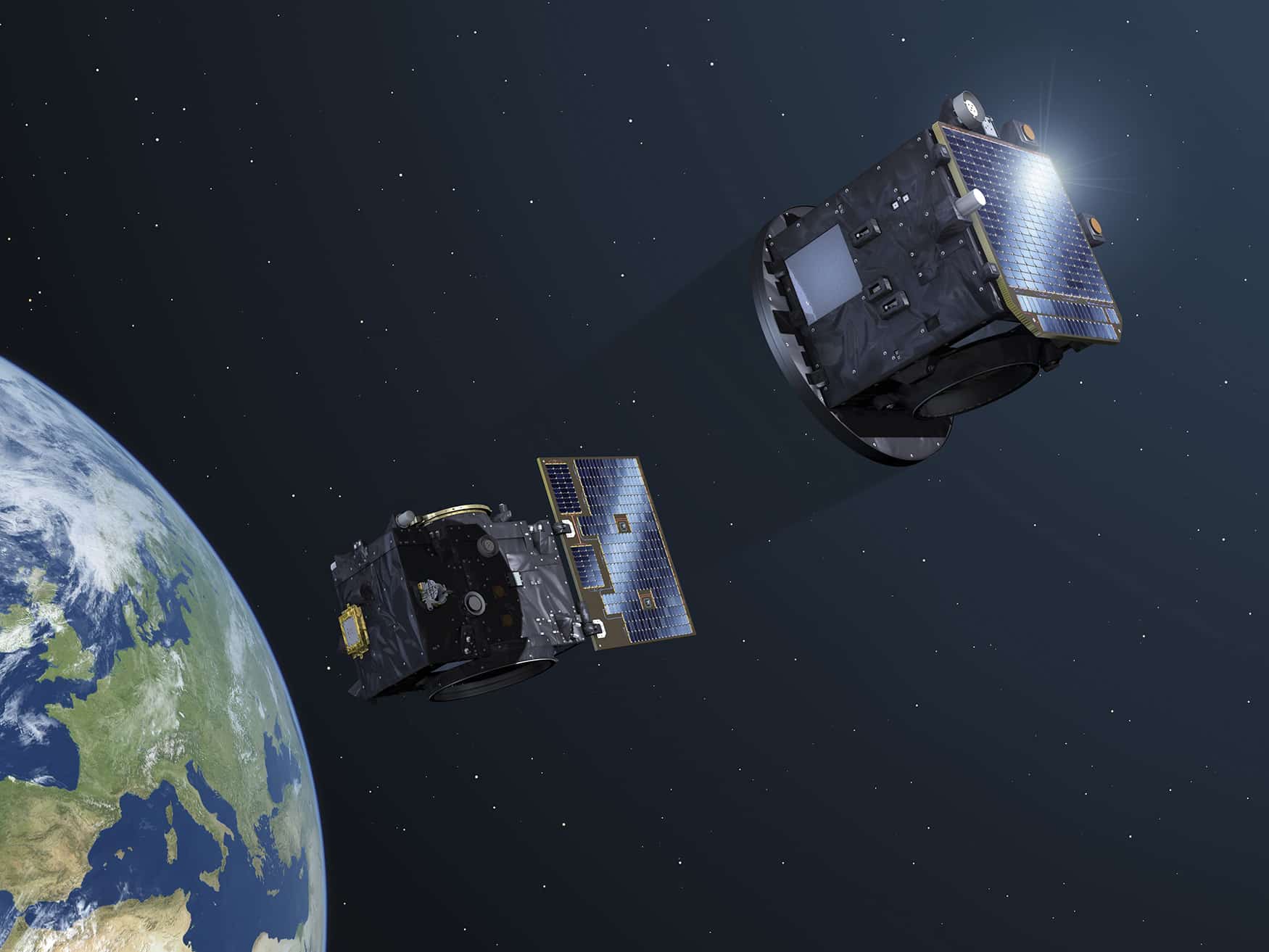
Launched on 5 December 2024 from India, Proba-3 is a mission developed by ESA to study the solar corona using a novel method: simulating an eclipse in orbit . Two small satellites, named Coronagraph Spacecraft (CSC) and Occulter Spacecraft (OSC) , are orbiting about 150 metres apart. The OSC carries a 1.4-metre diameter occulting disk, which blocks direct sunlight, casting a very thin shadow on a telescope on board the CSC , named ASPIICS. This system makes the corona observable under much more controlled conditions than during natural eclipses, and this, at each orbit.

Formation flight without intervention from the ground: a feat of precision and autonomy


The success of this artificial eclipse relies on  coordination between the two satellites . The alignment must be maintained with millimeter-level precision for several hours. This is a true technological feat that ESA teams have hailed. “  The fact that two spacecraft form a giant coronagraph in space allowed us to capture the inner corona with very low levels of stray light in our observations, exactly as planned,  ” explains Damien Galano, the project manager for  Proba-3  in the ESA press release. “  We have already achieved formation flights of unparalleled precision. This is what allowed us to capture the first images of the mission, which will undoubtedly be of great value to the scientific community  .”

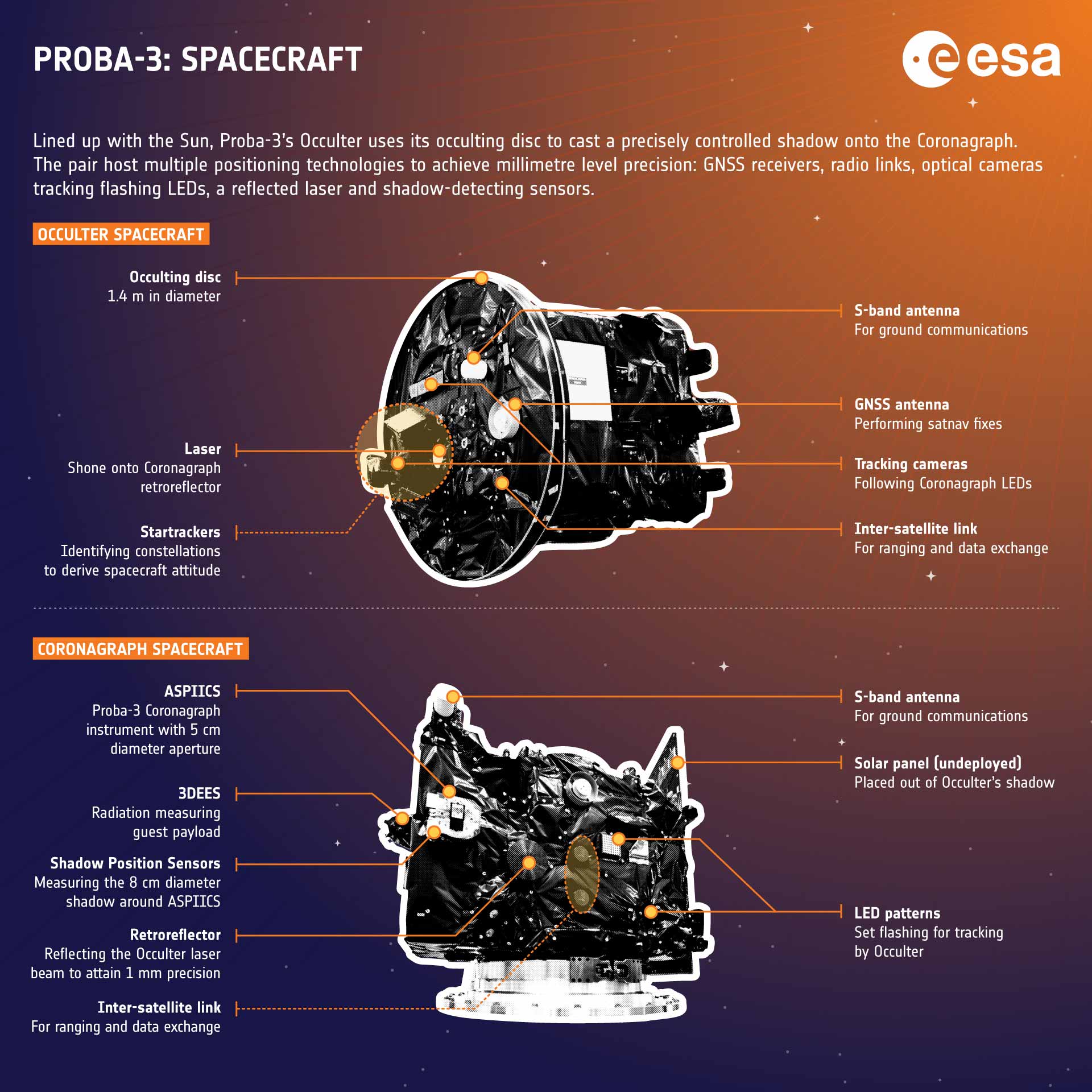
Instruments on board the two satellites of ESA’s Proba-3 mission.

© ESA

Voici une image du Soleil prise lors d'une éclipse solaire artificielle. Sur un fond noir, le corps lumineux du Soleil est recouvert d'un disque noir, d'où partent des filaments violets semblables à des cheveux, dans toutes les directions. Une lumière violette plus vive apparaît derrière le bord du disque noir, s'estompant progressivement vers les bords extérieurs de l'image

This image was obtained using the ASPIICS instrument of the Proba-3 mission on 23 May 2025.

© ESA/Proba-3/ASPIICS

Understanding the mysteries of the solar corona

A high-temperature region still poorly explained

The solar corona has intrigued researchers for decades. While the visible surface of the Sun reaches about 5,500°C, the corona can exceed a million degrees . This still-unexplained difference fascinates solar physics specialists. Natural solar eclipses offer a brief opportunity, lasting only a few minutes, to observe the corona. Moreover, their rarity limits their scientific usefulness. Proba-3 overcomes these constraints. Thanks to its configuration, the mission can recreate an eclipse lasting about six hours during each 19.6-hour orbit . This is a valuable capability, as Jorge Amaya, ESA’s coordinator for space weather modeling, points out. ” Conventional coronagraphs cannot compete with Proba-3. This mission allows us to observe the corona right up to the solar disk. “

First images and new perspectives

“Protrusions” captured from the beginning


” We were lucky enough to detect a beautiful structure from the first observations, which confirms the precision of our instrument, ” says Andrei Zhukov, the scientific director of the ASPIICS instrument at the Royal Observatory of Belgium. Unveiled on June 16, 2025, the first images from ASPIICS identified prominences , the plasma arches often visible during eclipses. A promising first result. Proba-3’s observations are not limited to simple image acquisition. Thanks to an open data policy, the approximately 1,000 hours of observations planned over two years will feed into increasingly detailed numerical models. The idea is to improve space weather forecasting, particularly in the event of a coronal mass ejection (CME), which can disrupt satellites and power grids. Satellite navigation, communications, aviation—all these sectors are vulnerable to solar activity . Thanks to this European mission, the scientific community has a unique tool to better understand, anticipate and protect itself against these hazards.

A prominence in the Sun’s inner corona appears pale yellow in this image of helium atoms taken on March 23, 2025, by the ASPIICS coronagraph.

©ESA/Proba-3/ASPIICS

Related articles