
• Moon

China tests its Mengzhou lunar spacecraft

Published on 17 June 2025

China has successfully simulated an ejection, similar to what would happen in a launch pad emergency, from its Mengzhou spacecraft. The spacecraft is expected to be used for future manned lunar missions.

China tests its Mengzhou lunar spacecraft

A major space power, China is conducting an ambitious human spaceflight program that is currently distinguished by the operation of a space station around the Earth (Tiangong-3 or CSS for China Space Station). At the end of April, this orbital complex received its new crew of 3 astronauts, Shenzhou-20 .
At the same time, this country is setting up a manned lunar exploration program , after having sent several probes and robotic landers there. On June 17, an important milestone was reached with a ground ejection test of the Mengzhou spacecraft.

The “pad abort”, an essential maneuver

Once known as the ” next-generation manned spacecraft ,” Mengzhou is a capsule offering 13 cubic meters of space for its crew, which flies alongside a service module. This rather classic configuration is intended to succeed the current Shenzhou spacecraft , which has been transporting Chinese astronauts since 2003.
Mengzhou underwent its first empty test flight in May 2020 to test its systems around Earth.

On June 17 , at the Jiuquan Space Center in Inner Mongolia, the CMSA (China Manned Space Agency in charge of human spaceflight) conducted a so-called “pad abort” test . This involves simulating the ejection of the capsule if an explosion occurred while the launcher was stationary on its launch pad. This maneuver is considered essential to ensure the safety of the astronauts in such a configuration. As the photos show, the test took place with the capsule on the ground. The ignition of its backup system propelled Mengzhou high enough for the parachutes to deploy, guaranteeing the expected return. The next step is expected to be an ejection test at the top of a launcher during ascent. This too is a decisive test for the safety of the passengers.

The main stages of Mengzhou’s successful pad abort on June 17: capsule ejection using its rescue tower, capsule separation, and parachute deployment. Inflatable balloons were even present to cushion the impact.
© Cité de l’espace, based on CMSA

Illustration from the Chinese space agency showing the Mengzhou spacecraft (left) with the Lanyue lunar module (right). A mission scenario reminiscent of Apollo.
© CNSA

Mengzhou: for the Moon, but not only

China has made no secret of the fact that this capsule is to serve as a vessel for transporting its astronauts to the Moon and back . Based on an architecture reminiscent of Apollo, Mengzhou will travel to our natural satellite with a lunar module called Lanyue . It has also been known since last February that the Chinese lunar spacesuit is called Wangyu . It was presented at the end of September 2024. The CMSA has also communicated on how it will conduct its manned exploration of the Moon. The year 2029 is often put forward as the year of the first mission, as it will mark the 80th anniversary of the People’s Republic of China.

Furthermore, Mengzhou does not appear to be exclusively intended for Earth-Moon and return journeys. While its lunar version has three seats, another version specifically adapted to low Earth orbit has up to six or seven seats, according to several sources . Mengzhou would then provide more flexibility in the management of crews for the Tiangong-3 station compared to the Shenzhou’s three-seater limit. Mengzhou would thus allow short-term missions for passengers taken there in addition to the main crew replacement (transported by the new Mengzhou, they return several days later aboard the one that previously arrived a few months earlier). The new vessel could also pave the way for a station with a main crew of more than three people.


Orion also prepares for the Moon

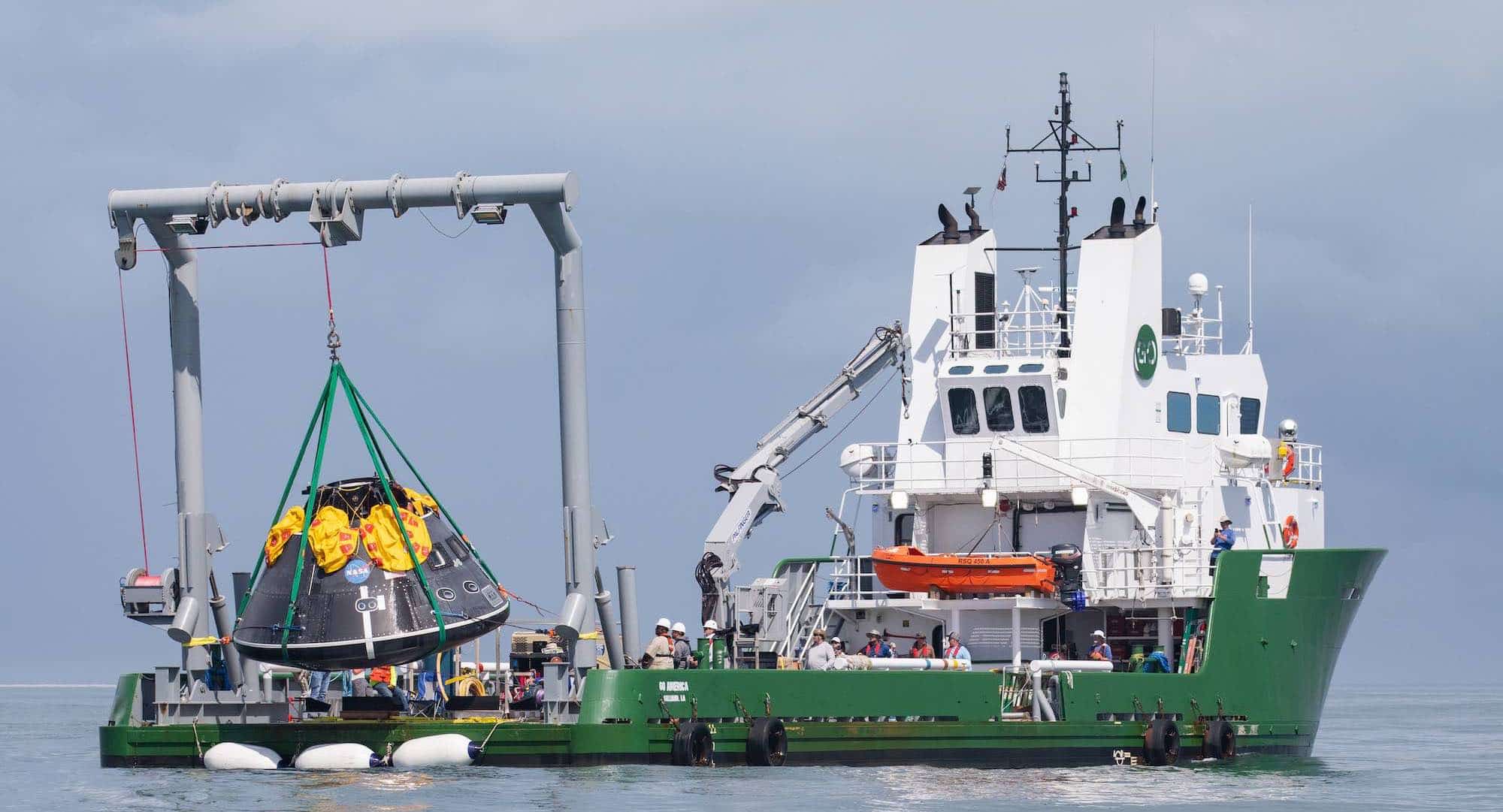
On the American side , preparations for the Artemis II mission , now targeted for February 2026 , continue. The crew trains regularly at NASA’s center in Houston on an Orion capsule simulator (Mengzhou is the Chinese equivalent of Orion). And when it comes to rehearsing emergency procedures , the United States is not far behind. On June 11 and 12, the American agency and the DoD (Department of Defense) practiced the recovery of an Orion capsule that had been ejected from its SLS launcher while it was still on the launch pad. In short, another aspect of a “pad abort.”

A full-size mockup of an Orion capsule is recovered from the sea off the coast of the Kennedy Space Center in Florida by joint teams from the DoD and NASA. In the event of a pad abort, the capsule would parachute to water after ejection.Crédit : NASA/Isaac Watson

Related articles