





• Astronomy

An atmosphere composed of helium around the exoplanet LHS 1140b

Published on 20 July 2026

Astronomers have detected a helium atmosphere on LHS 1140b, a rocky exoplanet in the habitable zone 48 light-years away. This would confirm that these worlds can retain a gaseous envelope despite the radiation from their star, but caution is still advised.

An atmosphere composed of helium around the exoplanet LHS 1140b

An international team of astronomers has detected a helium atmosphere around the exoplanet LHS 1140b , located 48 light-years from Earth. This rocky world, approximately 1.7 times larger than Earth and 5.6 times more massive, orbits within the habitable zone of its star, a red dwarf. This observation, detailed in the journal Science , represents the first direct detection of a gaseous envelope on a temperate terrestrial planet .

Artist’s impression of the exoplanet LHS 1140b in front of its star.

© ESO/spaceengine.org CC by 4.0

A spectral signature captured from Chile

The key role of the WINERED spectrograph

The detection was made using the WINERED spectrograph, installed on the Magellan telescope. By analyzing the starlight filtered through the planet’s gaseous layers during its transit in front of its star in September 2024, researchers identified metastable helium escaping from the atmosphere . This gas is currently escaping from the atmosphere , forming a kind of gaseous tail in its orbit. This tail is one and a half times the size of the planet. ” We interpret these results as indicating an upper atmosphere dominated by helium and depleted in hydrogen, with other volatile species trapped at lower altitudes, which is consistent with atmospheric fragmentation models ,” the study authors explain.

A step towards understanding the telluric worlds

Between hydrogen loss and helium conservation

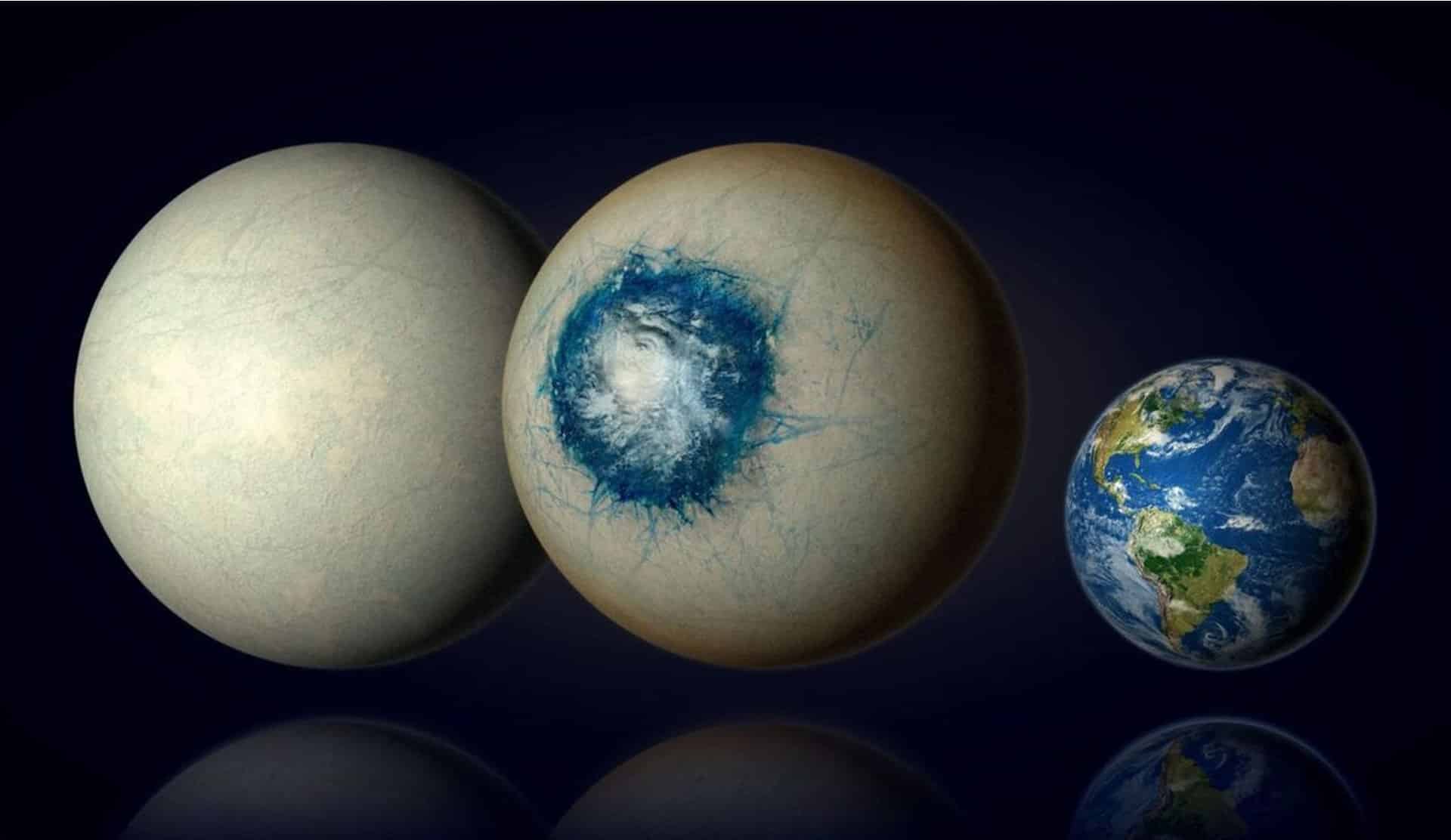
This finding therefore validates theoretical models according to which massive rocky planets can retain an envelope of heavy gases despite their proximity to their star . This discovery is crucial because it demonstrates that an atmosphere can survive for billions of years around a red dwarf. Back in July 2024, a team of researchers from the University of Michigan had already reported finding traces of nitrogen in the atmosphere of LHS 1140b, thanks to the James Webb Space Telescope . ” I’m not claiming that this planet harbors life ,” asserts Colin Chrubin, PhD from Harvard University and lead author of the study, in an interview with Space.com . ” With further investigation, scientists could better understand what else this atmosphere contains and confirm the presence of water .” Especially since, during subsequent observations in 2025, helium was not detected.

© Artist’s impression: B. Gougeon/University of Montreal

Why we need to remain very cautious

Despite the enthusiasm generated by this study, proving that an exoplanet is truly habitable, or inhabited, remains an immense challenge . The detection of helium, if confirmed, would only be a first physical indicator and would in no way guarantee the presence of liquid water or oxygen. Furthermore, what is called the “habitable zone” is only a theoretical boundary linked to the distance from its star. It does not take into account the precise chemical composition of the surface or the actual climatic stability. For example, LHS 1140b is subject to gravitational locking . This means that, like the Moon relative to the Earth , it always shows the same face to its star. In addition, the mass of this exoplanet is much greater; consequently, on its surface, a human being would feel crushed as if they weighed three times as much. Moreover, identifying evidence of life would require a level of technological precision that still exceeds our current capabilities . As the study highlights, the absence of a stable signal in 2025 shows that the host star’s activity can mask or distort our observations. The scientific gap between detecting an inert gas like helium and confirming a biological ecosystem remains immense.

Related articles
