




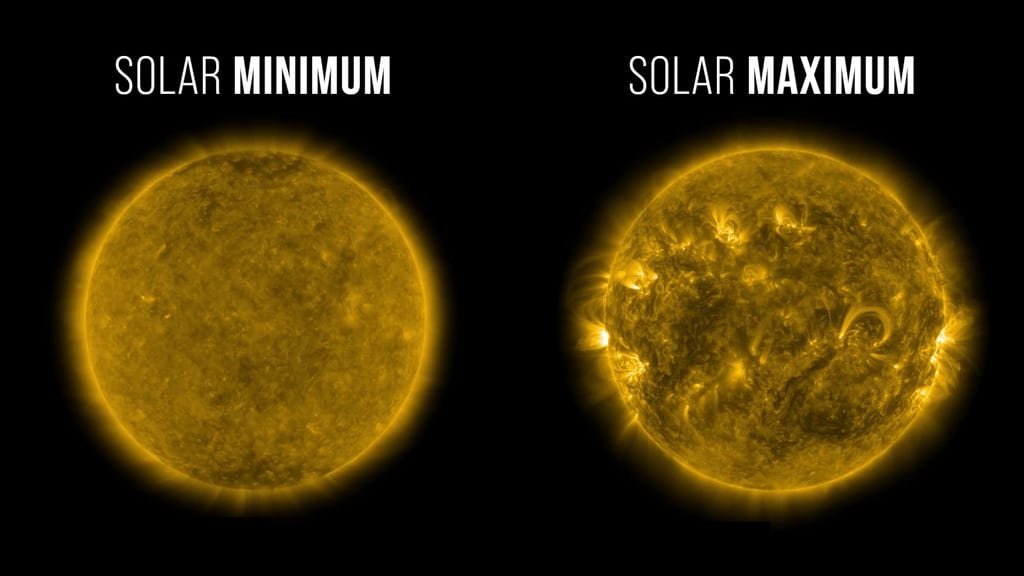



Left, the Sun at its minimum in December 2019 relative to solar maximum, right, in May 2024. Bottom, ultraviolet light images revealing active regions of the Sun that are more common during solar maximum. Top, in visible light, sunspots are more numerous.
© NASA, NOAA
What is a solar cycle?
Every eleven years, the Sun experiences a peak in activity linked to the reversal of its magnetic poles.
The solar cycle is a natural cycle that the Sun goes through as it transitions from low to high magnetic activity. Approximately every 11 years, at the height of the solar cycle, the Sun’s magnetic poles reverse. The Sun then goes from a calm state to an active and eruptive state. “During solar maximum, the number of sunspots, and therefore the amount of solar activity, increases,” explains Jamie Favors, director of the space weather program at NASA Headquarters in Washington. “This increase in activity offers an exciting opportunity to learn more about our nearest star, but it also has real effects on Earth and throughout our solar system.”
A danger not to be overlooked
Solar activity strongly influences conditions in space, which is called space weather. Eruptions of matter can cause magnetic storms. This can affect satellites and astronauts in space, as well as communication systems – such as radio and GPS – and power grids on Earth.



