• Astronomy

The sky of May 2025

Published on 07 May 2025

In May, the Moon has a rendezvous with several planets as well as the star Spica. Also try the Eta Aquarid meteor shower and observe Mars passing through the Beehive Cluster.

The sky of May 2025

The logic that began with the equinox continues: the nights are getting shorter and shorter . On May 10, for example, we have to wait until 11 p.m. for the true darkness to set in (the Sun is 18° below the horizon) before disappearing shortly after 4:30 a.m. But the sky still has some beautiful events in store for us this month of May 2025.

Unless otherwise stated, all times in this article are in metropolitan France legal time (the time on your watch).

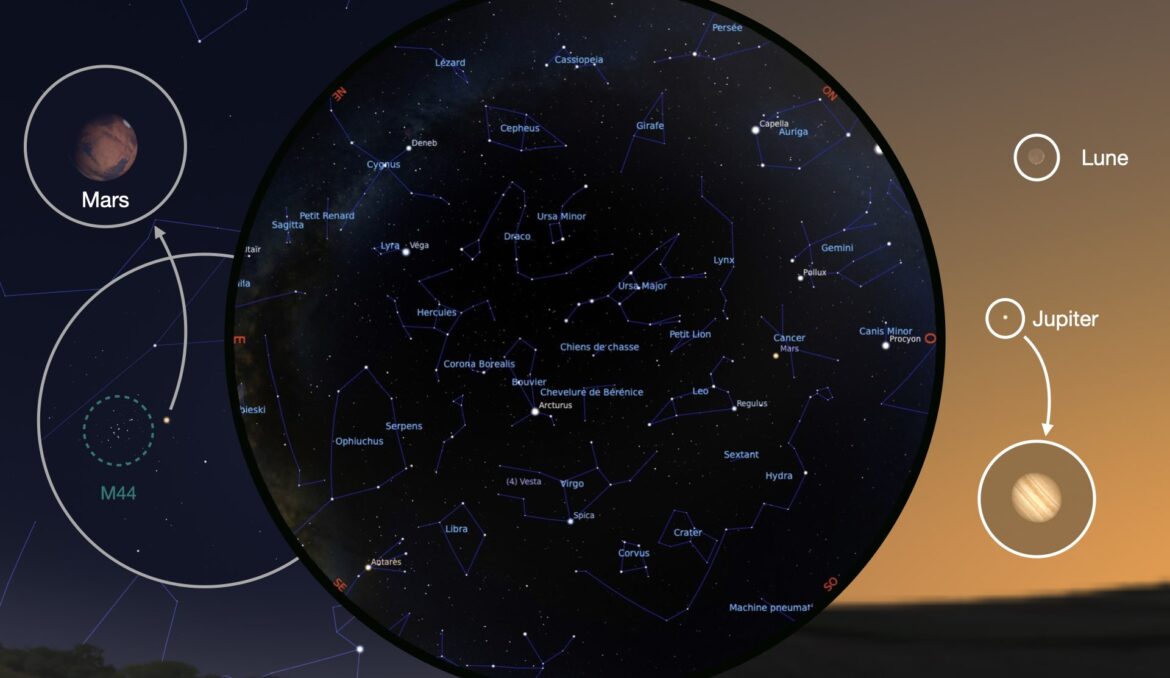
This map shows the sky for Toulouse on May 15 at 11:30 p.m. (legal time, i.e., the time on your watch).
It is valid for most of May across metropolitan France, except for the position of the Moon (which on this map at that time has not risen).
© Cité de l’espace/Stellarium

Mars and the Beehive Cluster

A classic target for amateur astronomers, the Beehive Cluster is also listed as M44 (Messier catalog) or NGC 2632. It is an open cluster of stars located a little over 600 light-years away from us. Recognizable to the naked eye as a fuzzy patch under a good sky, it is even better revealed with binoculars by showing its stars. A telescope or a telescope, even a modest one, amplifies the spectacle.
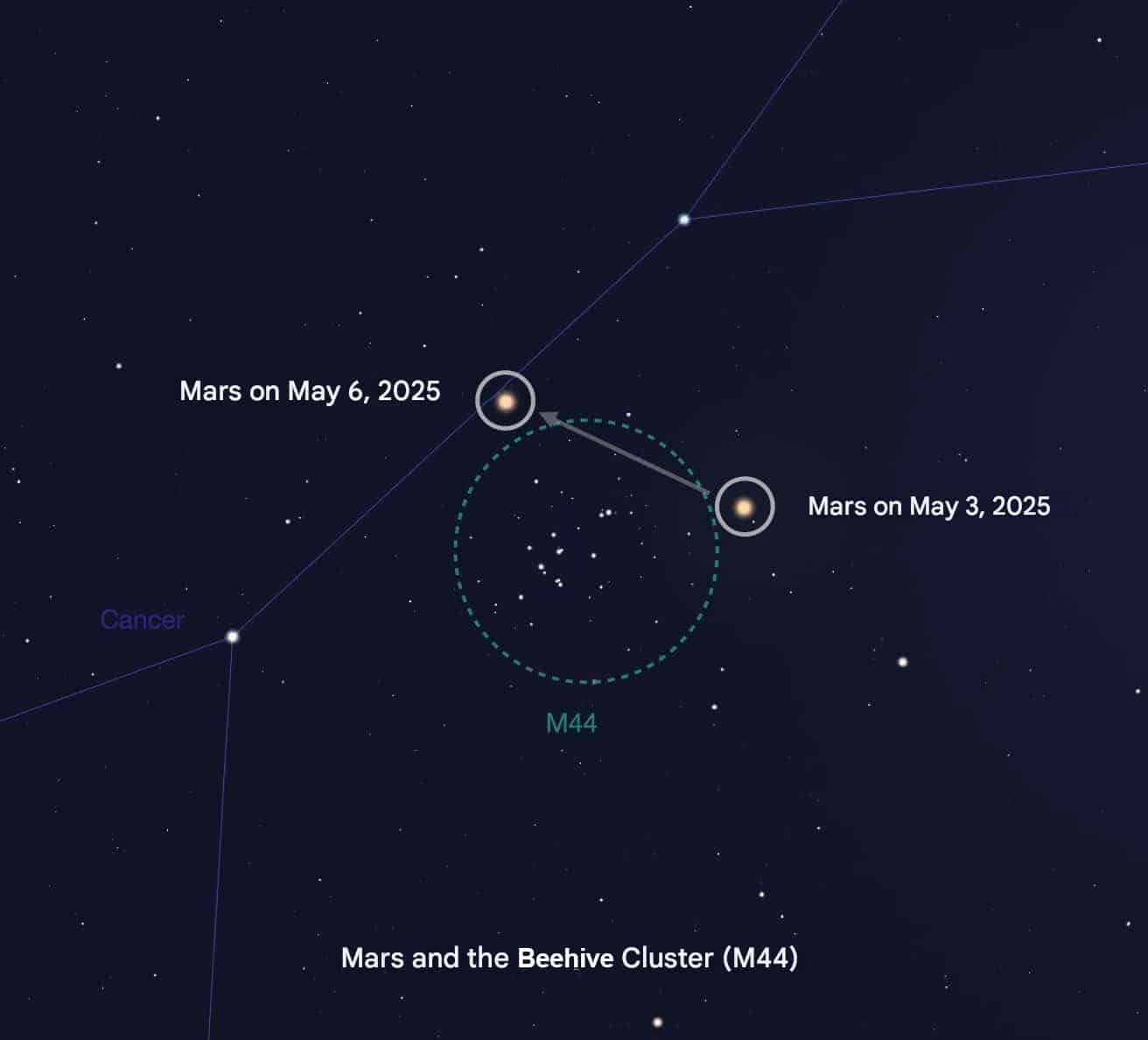
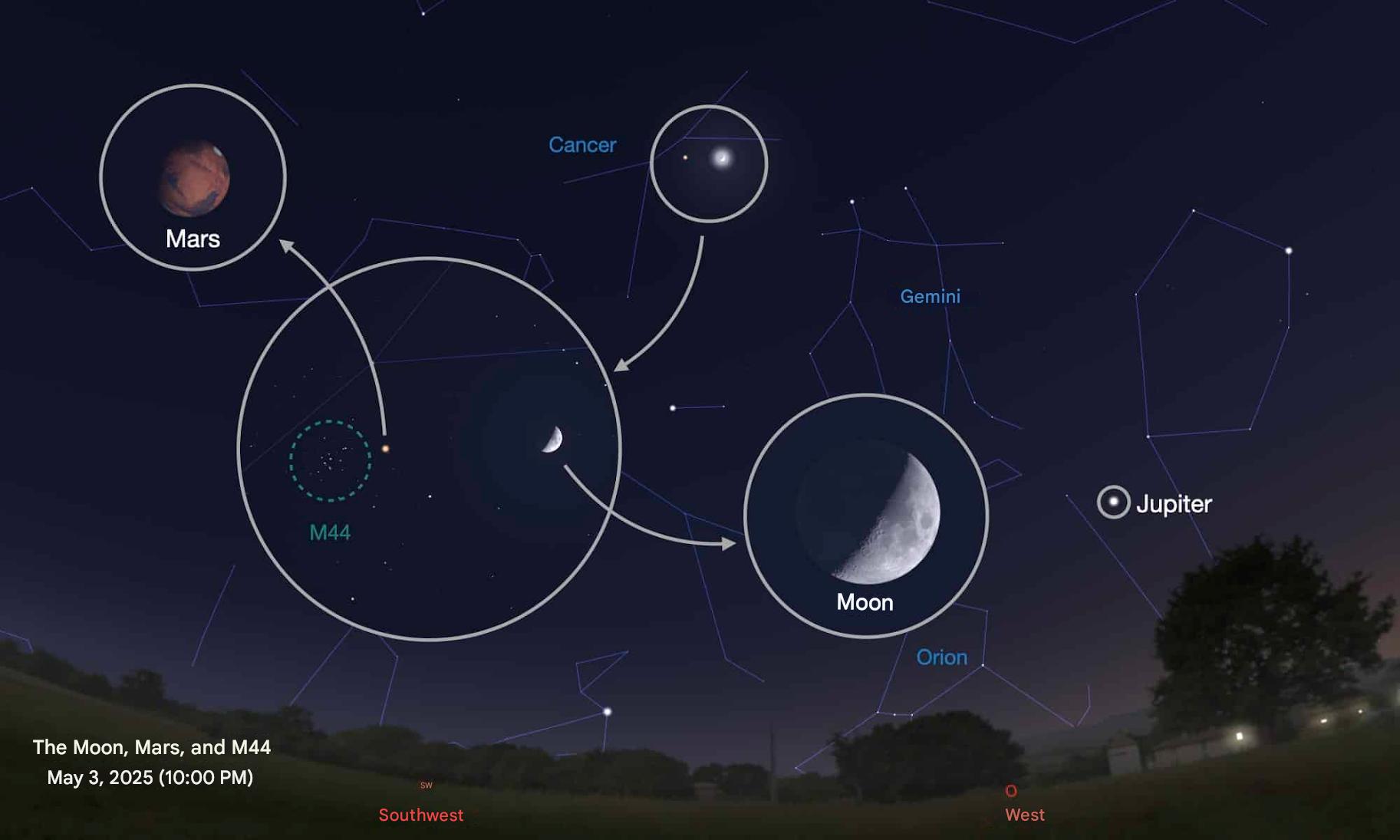
From May 3 to 6, Mars crosses the Beehive Cluster . This proximity is only illusory, because the red planet will be only 216 million km or 12 light-minutes away. The stars of the Beehive Cluster are therefore 26 million times further away… On May 3, the Moon appears not far from the M44/Mars rapprochement and makes it easier to spot.

From May 3 to 6, Mars passes through the Beehive Cluster.

© Cité de l’espace/Stellarium

On May 3rd, in the southwest, a quarter Moon guides you to find Mars and the Manger Cluster (M44) in the sky, just over 50° above the horizon. The red planet crosses the horizon from May 3rd to 6th. Note Jupiter and its strong brightness to the west.
© Cité de l’espace/Stellarium

The Eta Aquarids meteor shower

Let us remember again that “shooting stars” are actually dust particles (usually from comets or asteroids) that vaporize upon re-entering the atmosphere , creating a fleeting luminous line. While they can be seen every evening, “showers” identify periods of more sustained activity, with the Earth passing through a specific swarm of dust. The name given to these events is taken from the constellation where the radiant is located, the point from which the “shooting stars” seem to come. The Eta Aquarids owe their name to the constellation of Aquarius (Aquarius) and Eta is explained by the proximity of the radiant to the star Eta Aquarii. The famous Halley’s Comet is the source of the dust cloud, which offers a modest spectacle, however, with a ZHR of 50. The ZHR (Zenital Hourly Rate) is an estimate of the number of meteors that a person could see for a radiant at the zenith (which is not the case, by the way) under a perfect black sky (maximum visible magnitude of 6.5, the limit for the naked eye). By comparison, the ZHR of the famous Perseids in August is commonly 100. Observers in the northern hemisphere are not in the best position and it is estimated that under a sky clear of any light pollution, 10 to 15 meteors per hour at most are seen for the Eta Aquarids.

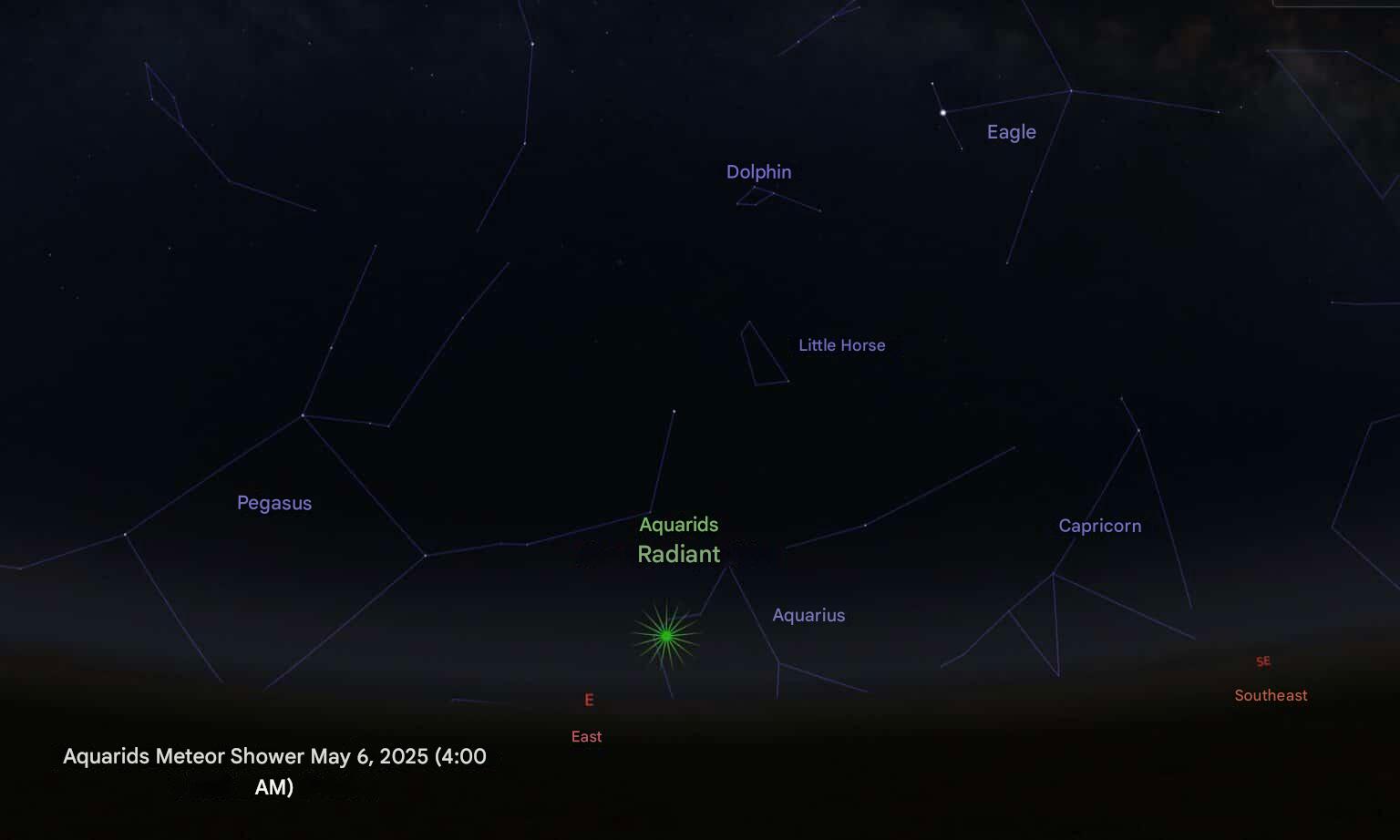
For 2025, the maximum is expected during the night of May 5 to 6. The Moon, which will be very disturbing (illuminated at 69%), sets on the 6th around 4 a.m. while the radiant rises on the eastern horizon.

However, there’s no need to focus on the radiant; the best thing to do is to take in as much of the celestial vault as possible (a deck chair is ideal) away from light pollution. Don’t expect a spectacular meteor shower during these Eta Aquarids.

The radiant of the Eta Aquarids is located in the constellation Aquarius. This meteor shower is active from April 19 to May 28, with a peak expected in 2025 on the night of May 5 to 6.
© Cité de l’espace/Stellarium

The Moon and Spica

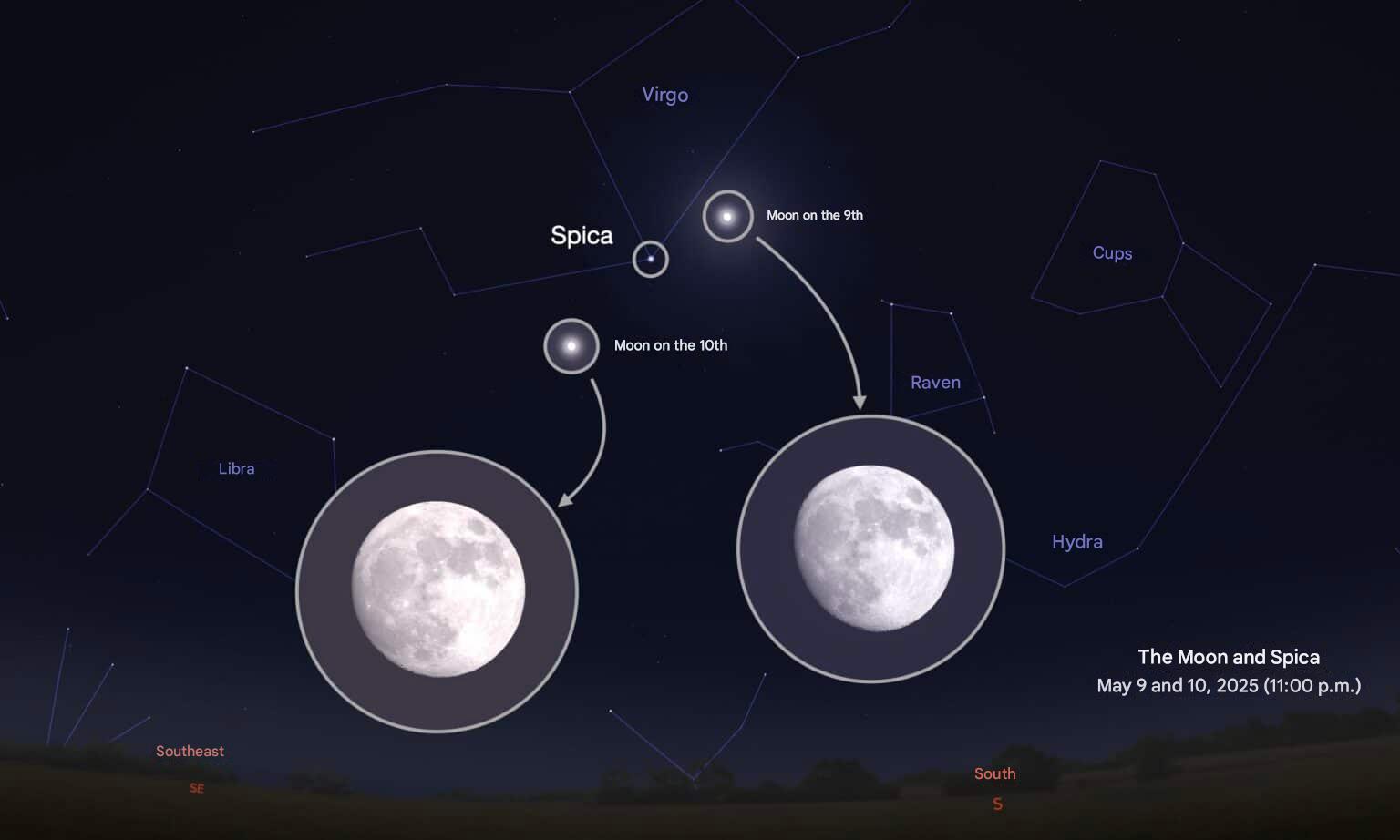
On May 9 and 10, the Moon sails across the sky not far from Spica . This star is the brightest in the constellation Virgo and its name in Latin meaning ear (of wheat), Spica is also known as the Ear of Virgo . In reality, 250 light years away from us, Spica is a double star and more precisely a spectroscopic binary  : the two stars are so close that only the analysis of their light spectrum can identify their dual nature.

On May 9 and 10, let the Moon show you the way to Spica, the brightest star in Virgo.

© Cité de l’espace/Stellarium

The Moon with Venus and Saturn

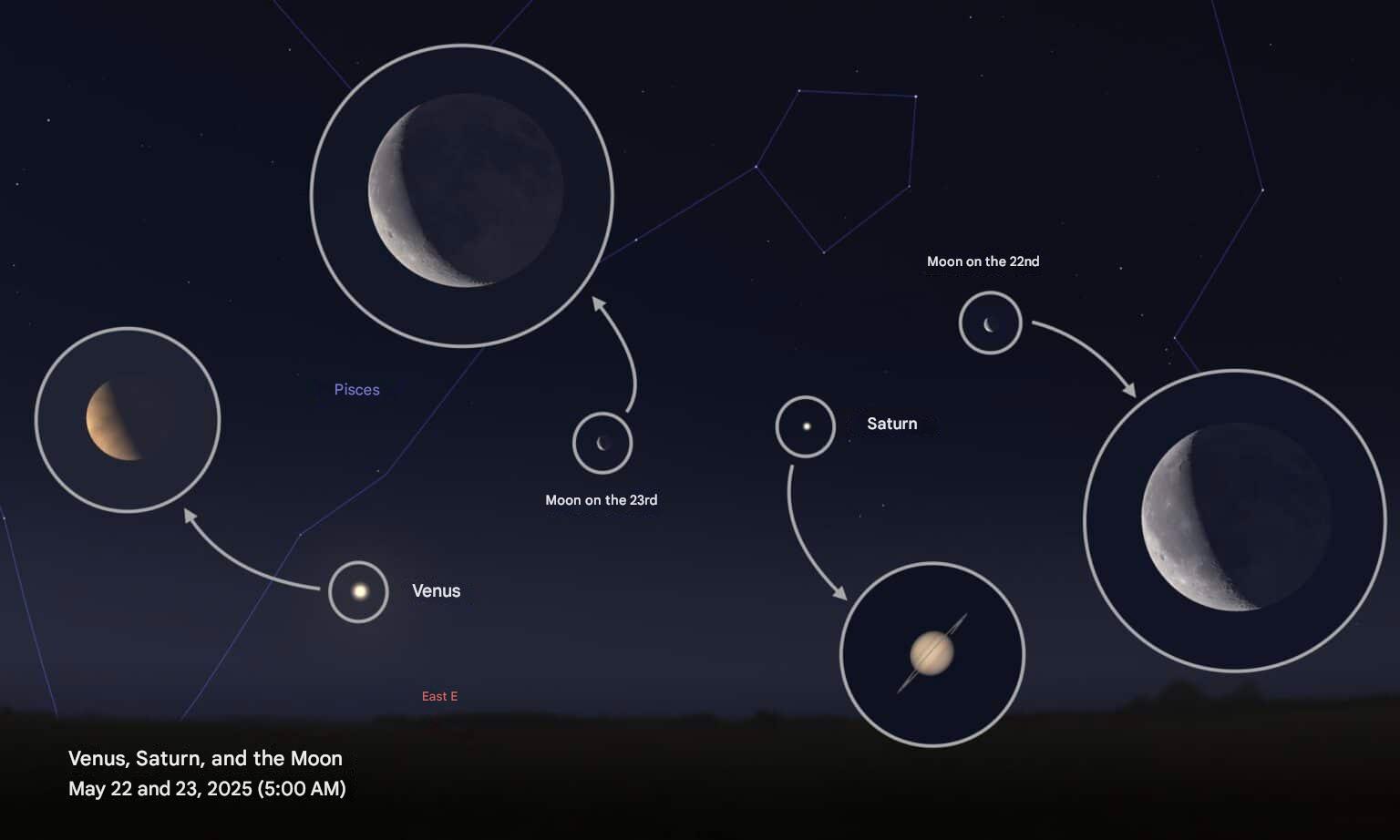
As in April, you will have to orient yourself at the level of the eastern horizon to capture the Moon accompanied by planets, in this case Venus and Saturn . This observation will not be easy, because Venus will be very close to the horizon, barely more than 4°, at 5:00 in the morning on May 22. Of course, the longer you wait, the more Venus (as well as the Moon and Saturn) will “rise” in the sky. But the light of the rising sun will also become more and more evident. Since you will be looking to the East, be careful of sunrise at 6:23 for Toulouse on the 22nd (6:22 on the 23rd) to preserve your eyesight. We remind you that you should not look at the Sun without adequate protection at the risk of losing your eyesight. In addition, the time of sunrise differs depending on where you are.

In the East on May 22 and 23, a crescent Moon accompanies Venus and Saturn close to the horizon.

© Cité de l’espace/Stellarium

A thin crescent and Jupiter

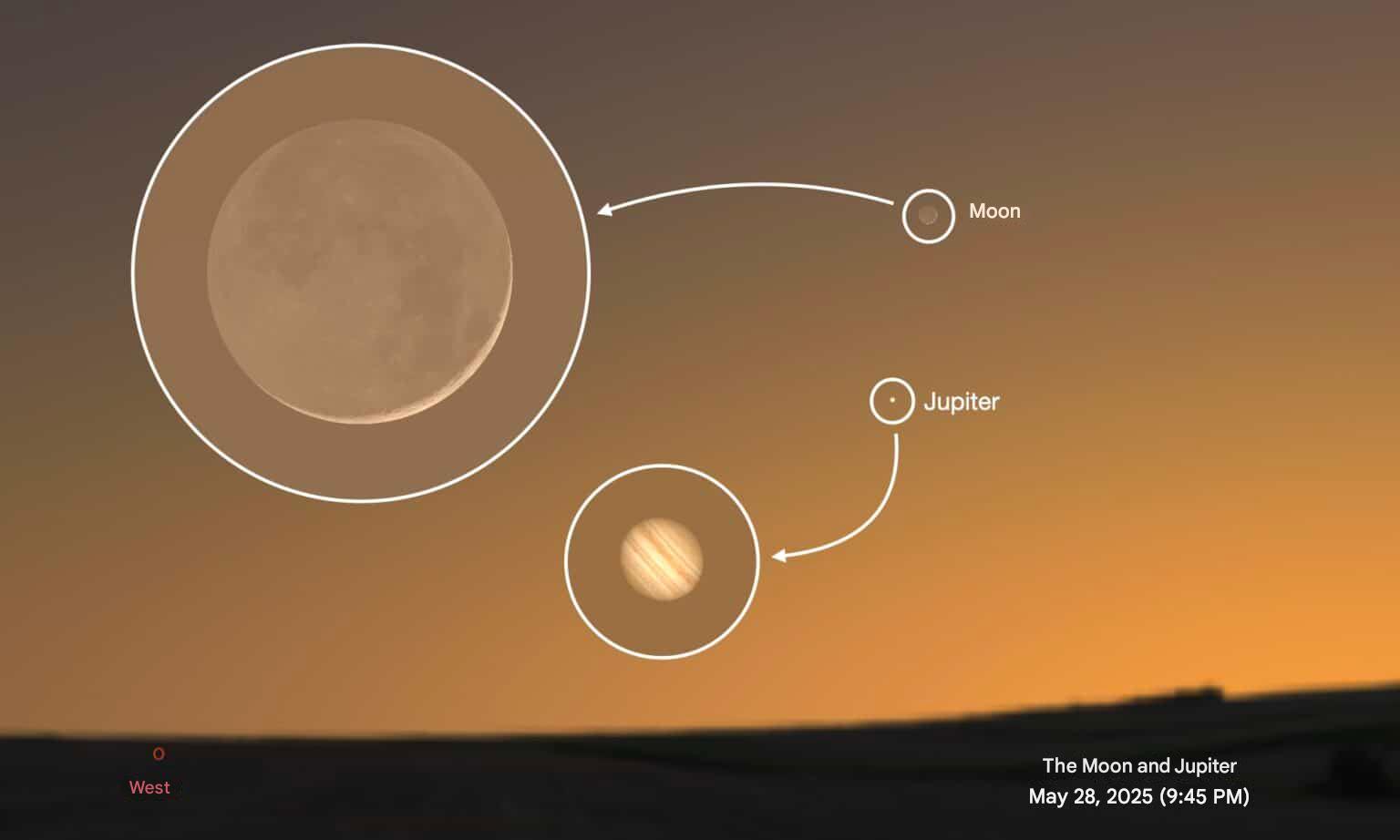
This time, we move from sunrise to sunset. On May 28, a thin crescent Moon will hang over Jupiter just below the western horizon . To safely look for this duo, wait until after sunset, which in Toulouse will occur at 9:26 p.m. We remind you not to look at the Sun without adequate protection, as this could cause vision loss. In addition, the time of sunset varies depending on where you are.

A clear west is imperative since Jupiter will only be 10° high and will move closer to the horizon (same for the Moon) as the minutes pass.

On May 28th, after sunset, try to spot a thin crescent Moon and Jupiter on the western horizon.
© Cité de l’espace/Stellarium

Related articles