
• Astronomy

The sky of August 2026

Published on 31 July 2026

This year the sky will be generous in August with a solar eclipse, the Perseid meteor shower, a lunar eclipse and rendezvous with the planets and our natural satellite.

The sky of August 2026

Since the solstice on June 21st, the nights have indeed gained a few minutes, but the true “dark sky,” when the Sun is more than 18° below the horizon, doesn’t appear until 11:15 PM at the beginning of August. By the end of the month, we will have gained almost an hour, with astronomical twilight concluding as early as 10:16 PM. And as if to celebrate this gain in nighttime hours, August 2026 promises some truly beautiful astronomical phenomena .

Reminder: unless otherwise stated, times are those of metropolitan France . Maps are calculated for Toulouse, but in most cases remain applicable to the entire metropolitan territory.

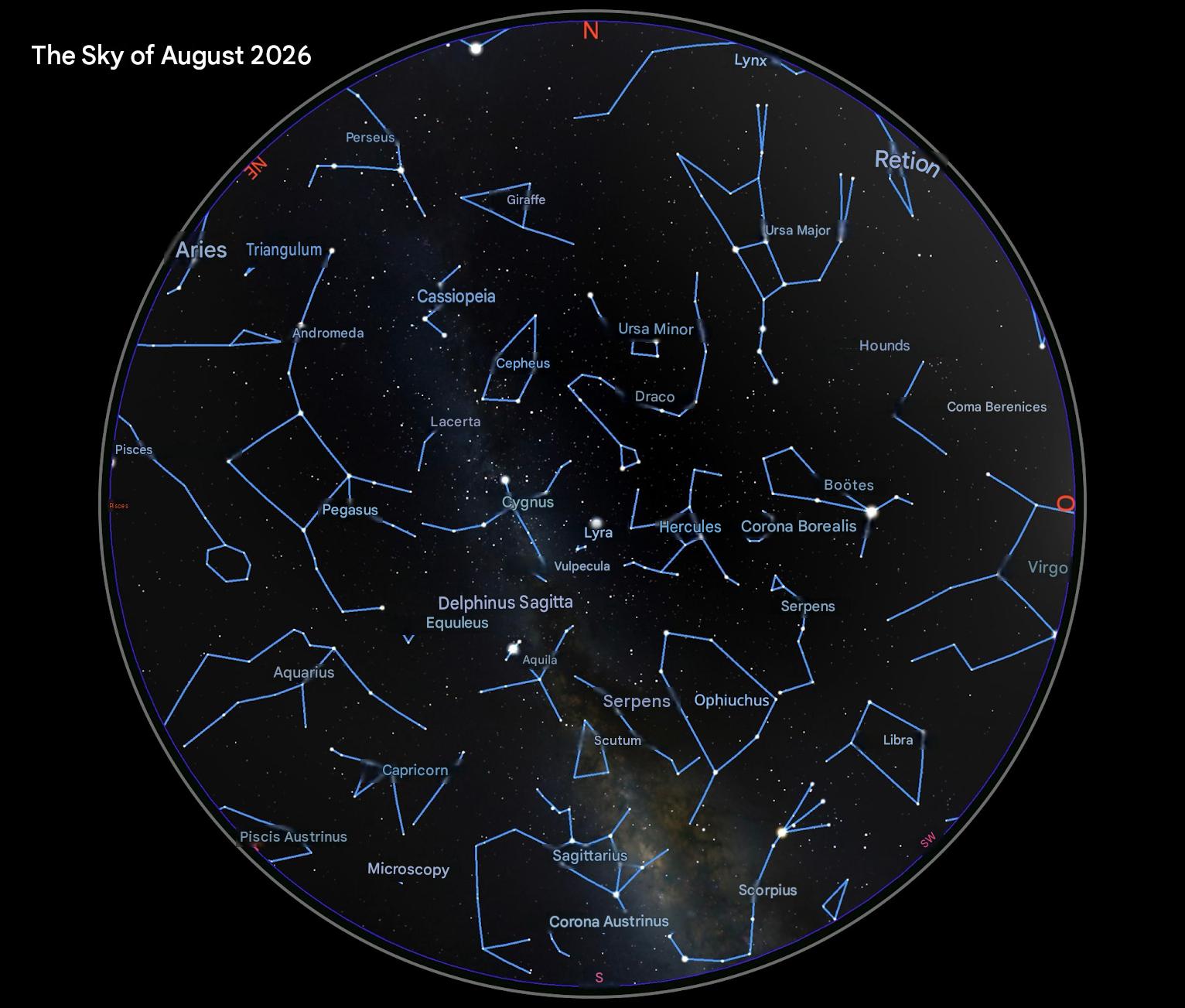
This map shows the sky for Toulouse on August 15th at 11:00 PM (local time, i.e., your watch time).
It is largely valid for the month of August across mainland France, except for the position of the Moon (which has not yet risen at that time).
© Cité de l’espace/Stellarium

SATURN AND THE MOON

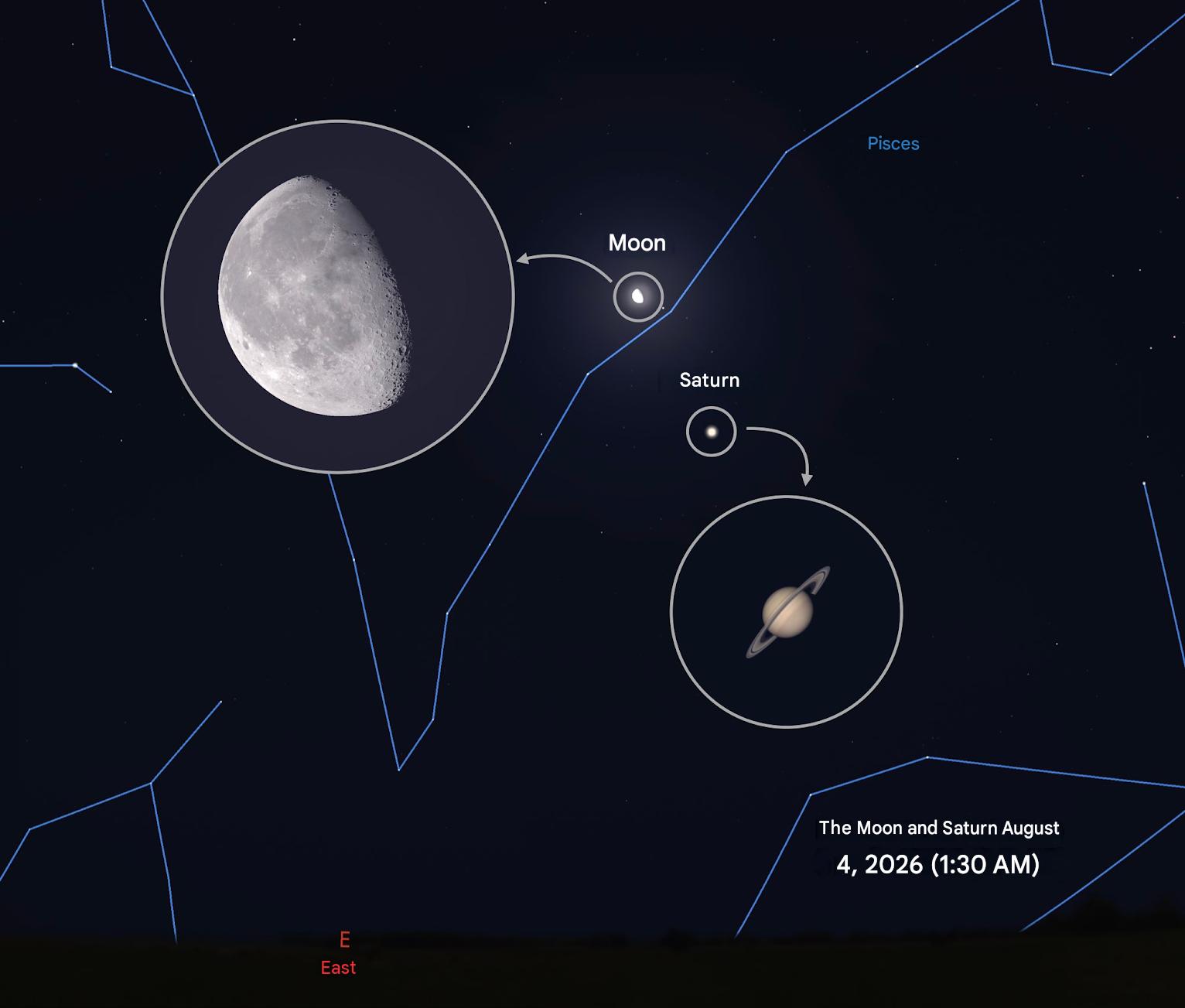
On the night of August 3rd to 4th, the Moon will accompany Saturn , making it easier to spot the ringed giant. The Moon rises at 11:16 PM on August 3rd in Toulouse, followed by Saturn 30 minutes later. To enjoy this beautiful pairing, we suggest waiting until both celestial bodies are high in the sky. For example, at 1:30 AM on August 4th, Saturn will be 18° above the horizon, slightly to the right of the East. The Moon will be at 23°.
The
longer you wait, the higher the pair will rise.

A Saturn-Moon conjunction awaits you on the night of August 3-4.
© Cité de l’espace/ Stellarium

MARS AND THE MOON

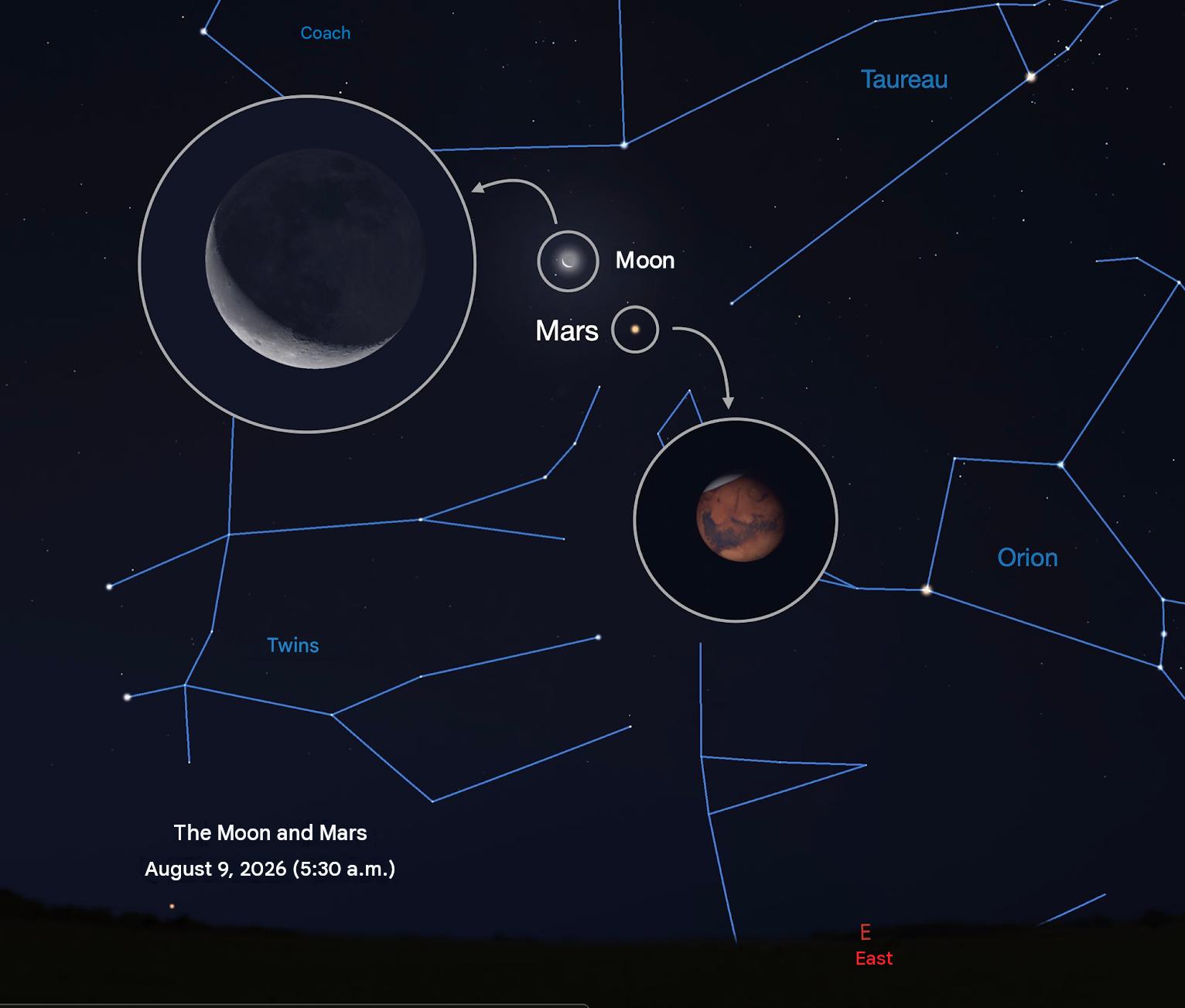
On the morning of August 9th , enjoy another conjunction between our natural satellite and a planet. This time, above the eastern horizon, a crescent Moon will accompany the orange glow of Mars . The two celestial bodies will have risen at 2:23 a.m. and 2:55 a.m. respectively. By 5:30 a.m., the pair will be much higher in the sky, with Mars at 25°.
Keep an eye out for the Sun, which will rise in the eastern sky at 6:52 a.m.

A beautiful pair of Moon and Mars on the morning of August 9th in the East.
© Cité de l’espace/ Stellarium

MERCURY AND THE MOON

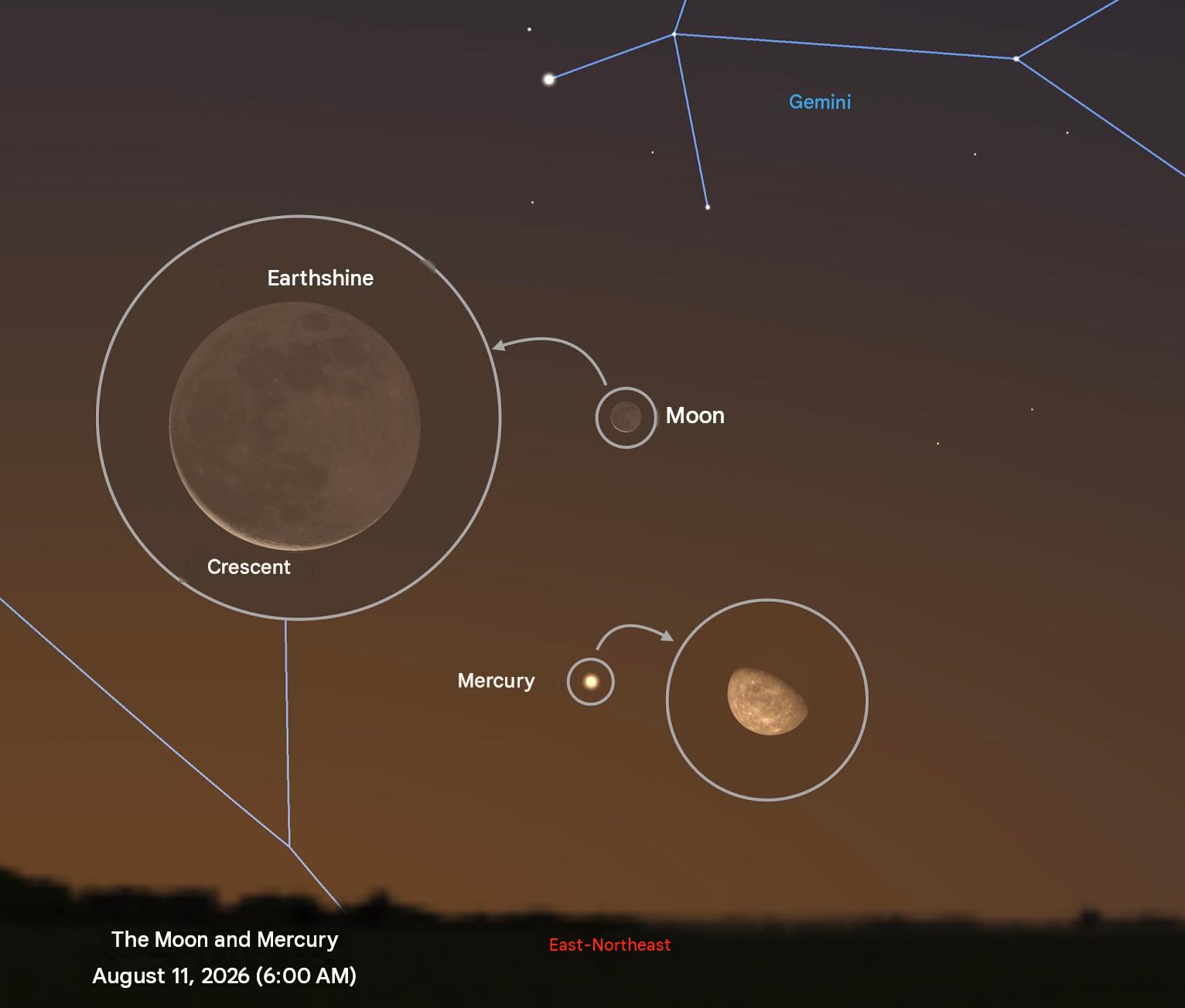
The Moon again, but this time in tandem with Mercury! On the morning of August 11th , try a challenging observation by looking low on the horizon, slightly to the left of the East, for a thin crescent Moon and the planet Mercury . Mercury will be only 4° above the horizon at 6:00 AM. A perfectly clear horizon is essential . You can wait a while for the two celestial bodies to rise in the sky, but the rising sun will make them increasingly difficult to spot. Above all, remember that the Sun will rise for Toulouse at 6:54 AM in the same area of ​​the sky. Protect your eyes by stopping observation beforehand and allowing a safety margin.

Mercury and a thin crescent moon on August 11. A challenging observation. Be careful of the sun, which rises at 6:54 a.m.
© Cité de l’espace/ Stellarium

A planetary PARADE?

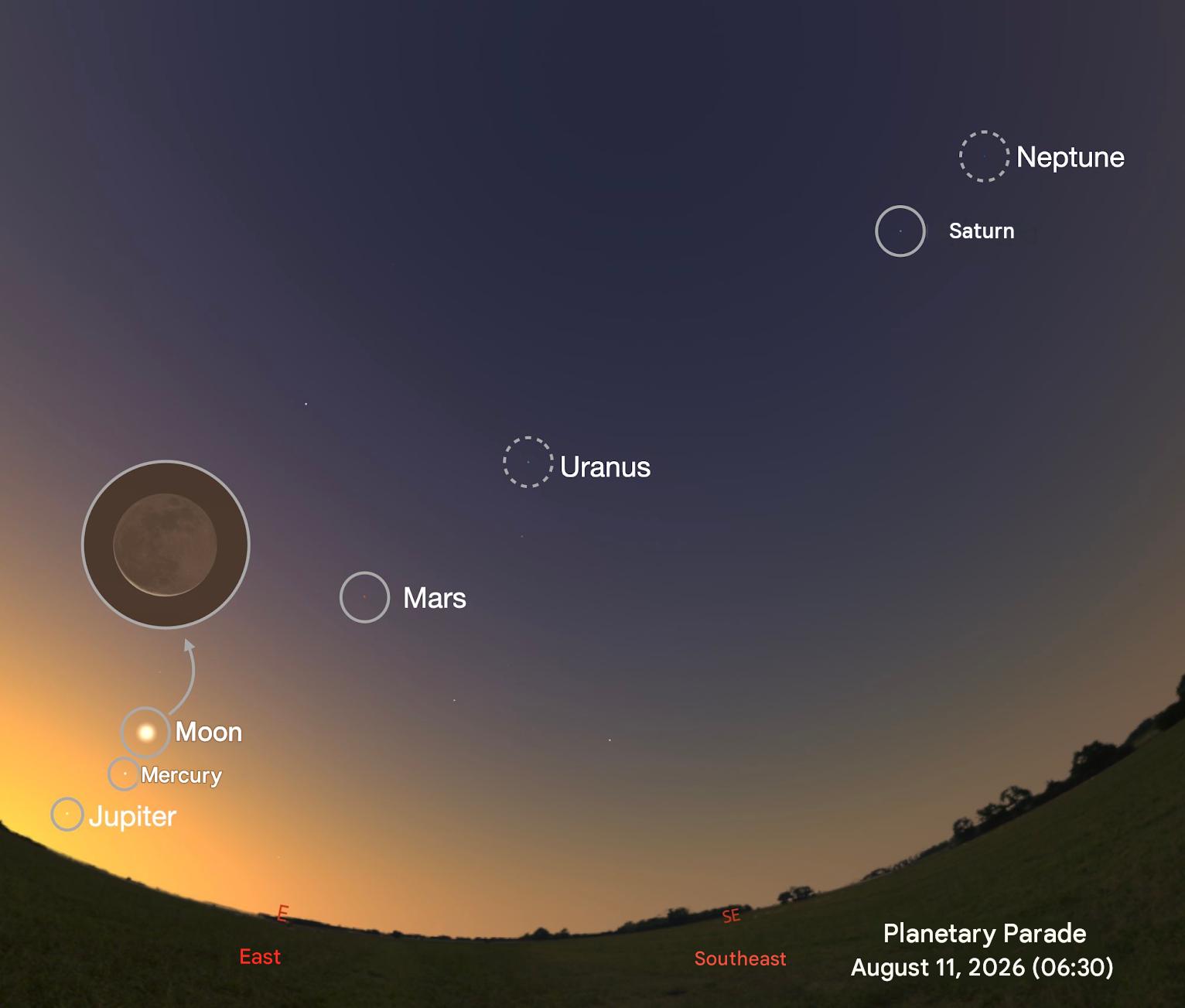
August is likely to see a flurry of somewhat sensationalist announcements about the possibility of observing six planets together in the morning . Such configurations are not truly exceptional. Around August 12th, Jupiter, Mercury, Mars, Uranus, Saturn, and Neptune will all be visible in the morning sky .
First, it’s important to remember that Uranus and Neptune are not visible to the naked eye. As for the others, Jupiter and Mercury will be very low on the horizon and “lost” in the twilight. With the sky no longer dark, Mars and Saturn will be even less obvious to spot.
Most importantly, note that you have to wait until 6:30 AM for Jupiter to barely emerge from the horizon to the left of the east, reaching an altitude of almost 4° (which is very low and requires an unobstructed horizon). However, the Sun rises about twenty minutes later and observing it without adequate protection represents a danger (possibility of losing sight).

A planetary parade that’s not easy to see…
© Cité de l’espace/ Stellarium

THE SOLAR ECLIPSE OF AUGUST 12

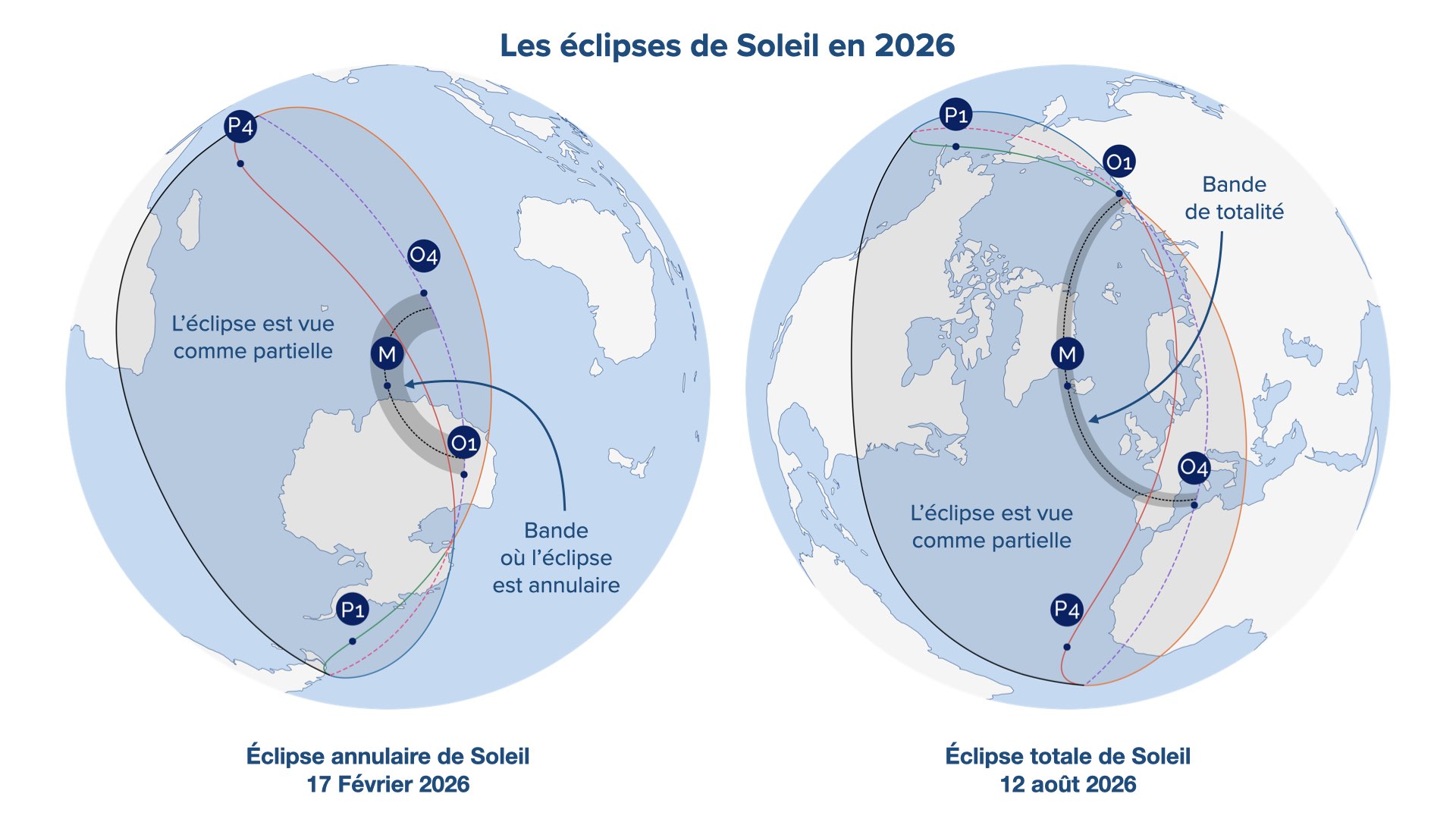
The year 2026 saw two eclipses . The first, an annular eclipse, occurred on February 17th. It affected Antarctica. At that time, the Moon was too far from Earth in its orbit, and its angular size was insufficient to completely cover our star.

The most anticipated solar eclipse is obviously the second one on August 12, 2026. The path of totality (the path of the Moon’s shadow on our planet) will begin in Russia, continue through Greenland, partially touch Iceland and arrive on the European continent through northern Spain before ending at the island of Majorca (a very small part of Portugal will be touched by the edge of the path of totality).

Maps of solar eclipses in 2026 from the Paris Observatory. On each map, point M identifies the location where the maximum of the eclipse lasts the longest (for the August 12th eclipse, this is just off the coast of Iceland). The gray band identifies the locations where the eclipse will be visible as an annular eclipse (February 17th) or a total eclipse (August 12th). The other, much larger gray area delineates the regions where the eclipse will only be partial.

Maps on the Paris Observatory website

© Cité de l’espace based on Paris Observatory

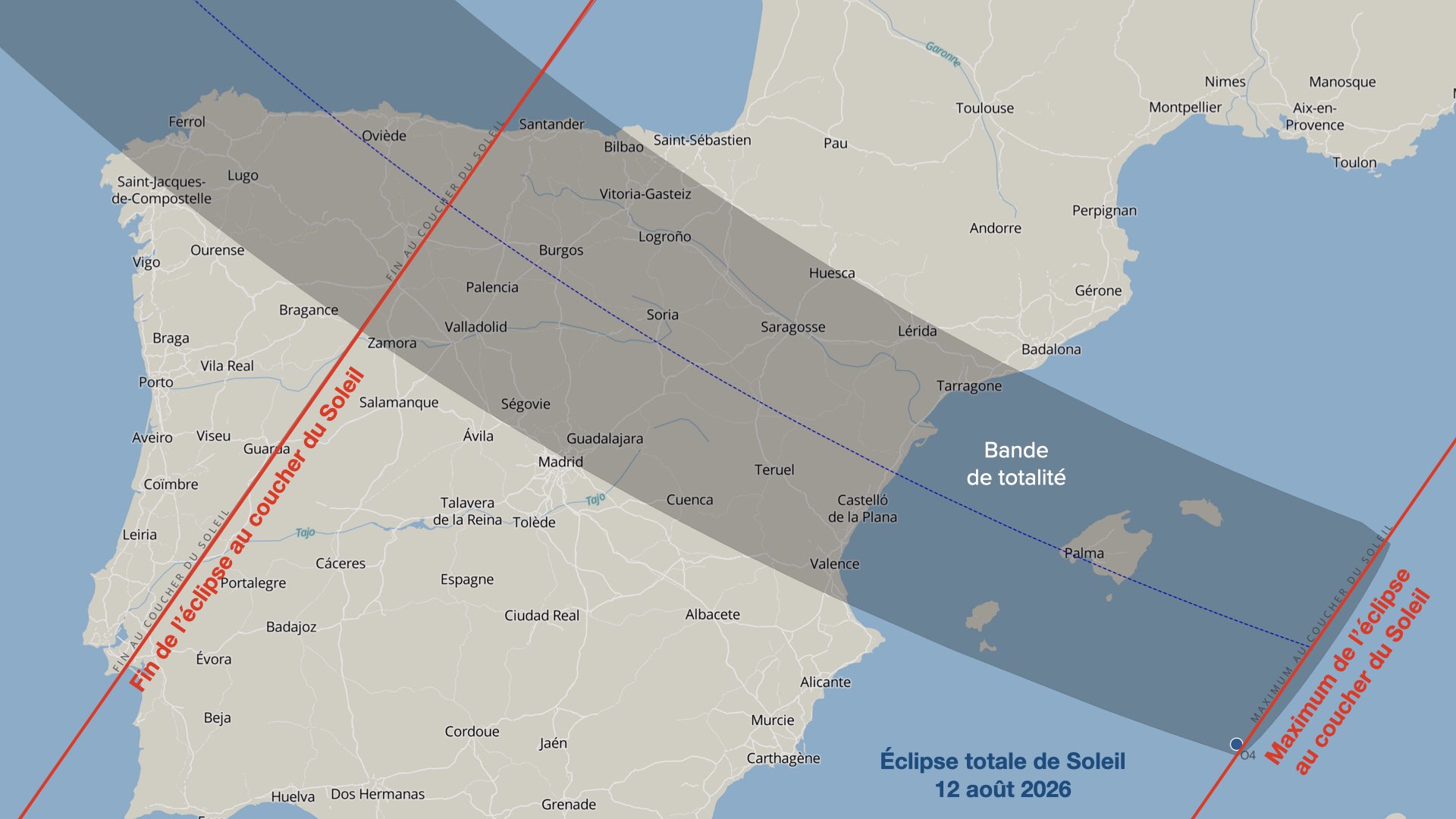
Map of the path of totality that will cross Spain on August 12, 2026. The dotted line in the center of the path of totality identifies where the maximum of the eclipse (totality) will last the longest (but it will still be less than two minutes).

The Paris Observatory offers an interactive map allowing you to look more precisely at the observation conditions for a given location.

© Cité de l’espace based on Paris Observatory

It should be noted that in continental Europe, the totality of August 12, 2026, will last less than two minutes at the center of the path of totality and will occur at sunset, low on the horizon. In mainland France, the solar disk will be largely occulted, for example, 97.9% in Toulouse or 92.2% in Paris . A completely clear western horizon will be essential, as the maximum occultation will occur shortly before sunset.

Warning: Even a largely obscured Sun low on the horizon remains dangerous to observe without proper protection (such as certified eclipse glasses with a filter). The risk is vision loss , especially since retinal burns do not cause pain. Protection can only be removed during totality, and this particular phase of the eclipse will not occur in mainland France.

THE TOTALITY path IN SPAIN

Northern Spain will be crossed by the path of totality of the eclipse of August 12, 2026. However, the Sun will be low on the horizon at the time of maximum, which occurs shortly before sunset.

A VERY PRONOUNCED PARTIAL ECLIPSE IN METROPOLITAN FRANCE

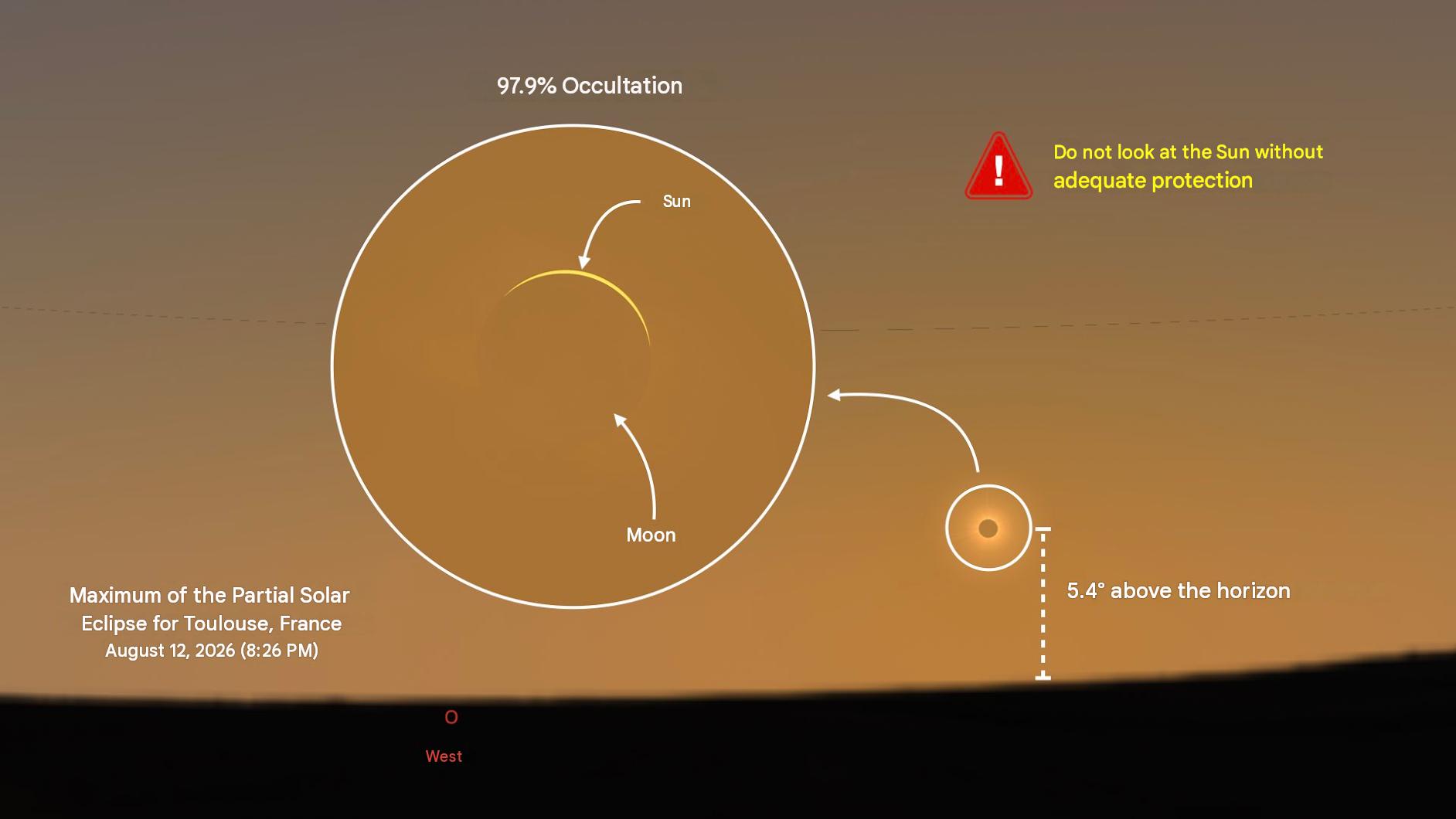
The path of totality will not reach mainland France. Consequently, the eclipse will be partial , but very pronounced, reaching 97.9% in Toulouse at 8:26 PM (local time) and 92.2% in Paris at 8:17 PM. As mentioned above, the Sun will be only a few degrees above the western horizon at the time of maximum occultation . For Toulouse, this will be barely more than 5°, meaning that even the slightest hill or building will obstruct the view. For comparison, Paris will only be 7.5° above the horizon. Due to its more westerly position, Brest will reach a maximum altitude of 11.5° at 8:19 PM, with 96.5% occultation.

We emphasize that even a thin crescent of the Sun can damage your eyesight if you look at it without proper protection .
Finally, even a very pronounced partial eclipse does not offer the same spectacle as a total eclipse, which completely obscures the Sun and allows you to see the solar corona.

On August 12, the Cité de l’espace in Toulouse has planned a program of specific activities.


Simulation using Stellarium software of the maximum of the eclipse from Toulouse, which will therefore be partial. The eclipse will have started at 7:31 PM (the Moon begins to pass in front of the Sun) and will end at 9:17 PM, but the Sun will have set a little over ten minutes earlier.

© Cité de l’espace/ Stellarium

THE PERSEID METEOR SHOWER

The faithful Perseids return for their August rendezvous, which in 2026 is expected to occur under favorable conditions.

What are incorrectly called shooting stars are actually dust particles left behind by Comet Swift-Tuttle that burn up upon entering Earth’s atmosphere. Their name comes from the radiant located in the constellation Perseus. The radiant is the area of ​​the sky from which a meteor shower appears to originate due to perspective.
To observe the Perseids, choose a spot far from city lights and position yourself so you can take in the entire celestial vault (no need to focus on the radiant). Then, the only “equipment” you need is… patience! Sometimes the sky is streaked with only a few tens of seconds (or less) between two “shooting stars,” and sometimes several minutes pass. So, patience is key!

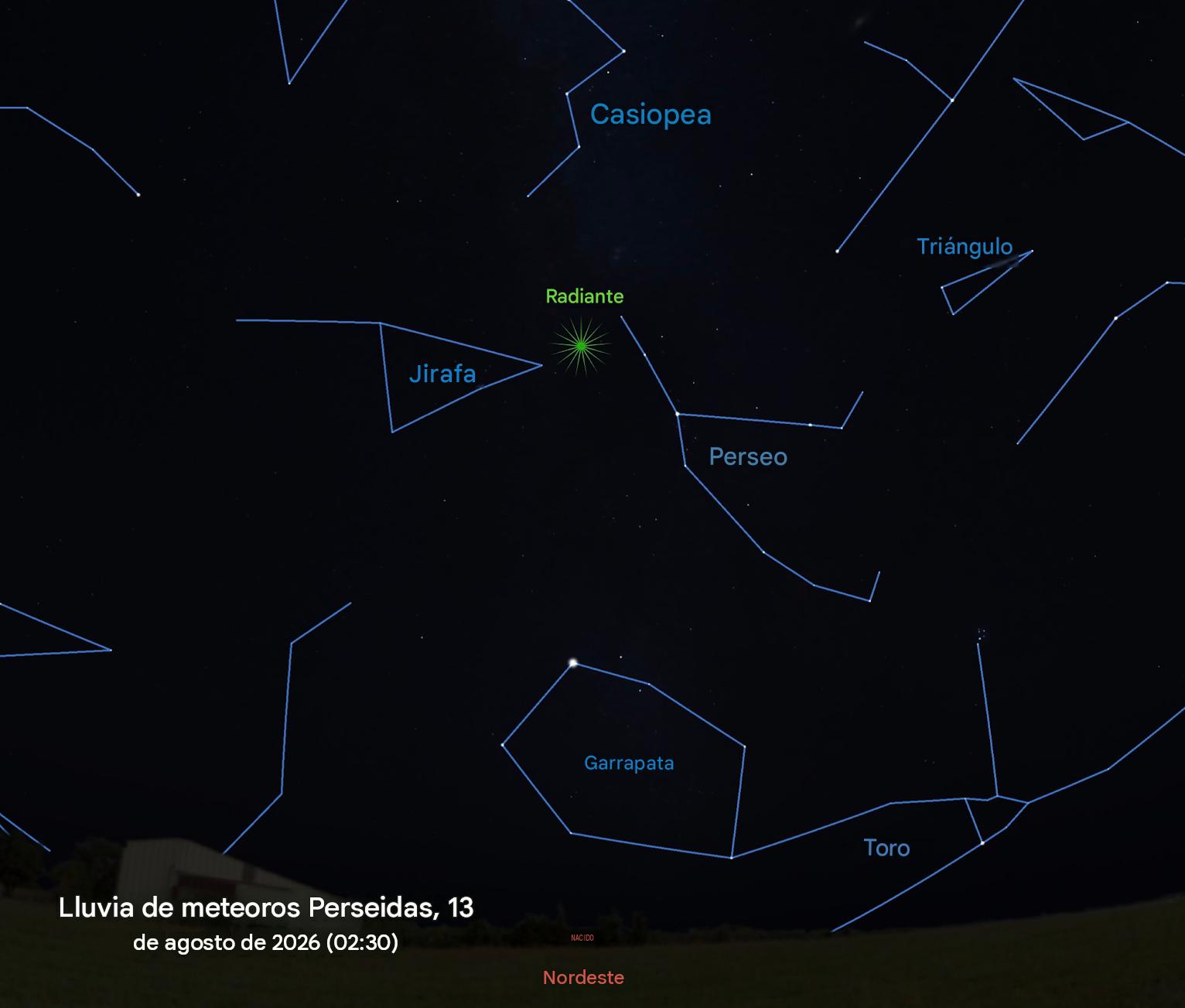
The peak of the 2026 Perseid meteor shower is predicted for August 13th between 4:00 and 6:00 AM . Keep in mind that this is an estimate and the peak may begin earlier or later. While the nights around the peak can also offer some beautiful shooting stars, the night of August 12th to 13th is the best time to observe them. We have created a map for 2:30 AM, a little before the peak .
Due to the solar eclipse on August 12th, the moon will be new and therefore will not interfere with the 2026 Perseids. To observe them, choose a location far from city lights and find a spot where you can take in the entire celestial vault. Also, be careful not to create light pollution yourself! If you are outside on a patio or balcony, for example, turn off all outdoor lights, as well as any indoor lights that might be bothersome if the shutters aren’t closed. Avoid using your smartphone, as the screen’s light will dazzle you and cause your pupils to constrict. Remember that it takes about 15 minutes for your vision to adapt to nighttime conditions (maximum pupil dilation).

The radiant of the Perseid meteor shower is located in the constellation Perseus. On August 13, 2026, at 2:30 a.m., it will already be 41° above the northeastern horizon. 
© Cité de l’espace/Stellarium

JUPITER AND MERCURY

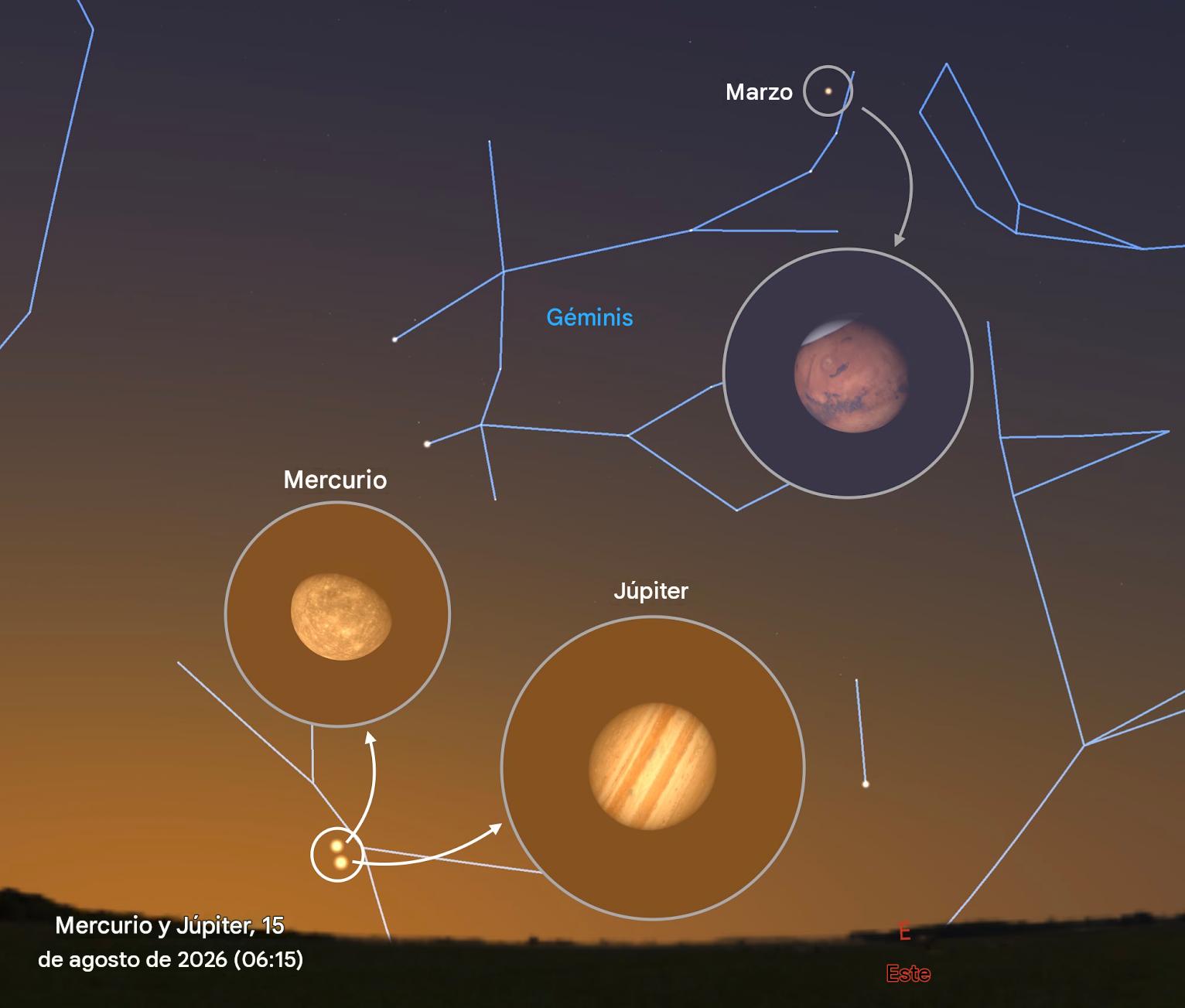
On the morning of August 15th, Jupiter and Mercury will be very close together , separated by only slightly more than the full moon. However, this observation will not be easy . At 6:15 AM (Toulouse time), Jupiter will be just 3° above the eastern horizon, with Mercury slightly higher. The longer you wait, the higher the pair will climb, but the rising sun will make the sky increasingly bright, gradually obscuring the two planets. Also, keep in mind that the sun rises at 6:59 AM (Toulouse time), so you should stop observing this area of ​​the sky to protect your eyes . At 34° altitude, Mars will be a consolation prize.

Jupiter and Mercury will be low on the horizon on the morning of August 15. Be careful of the sun, which rises about forty minutes after 6:15 a.m. 
©
Cité de l’espace/Stellarium

A PARTIAL LUNAR ECLIPSE

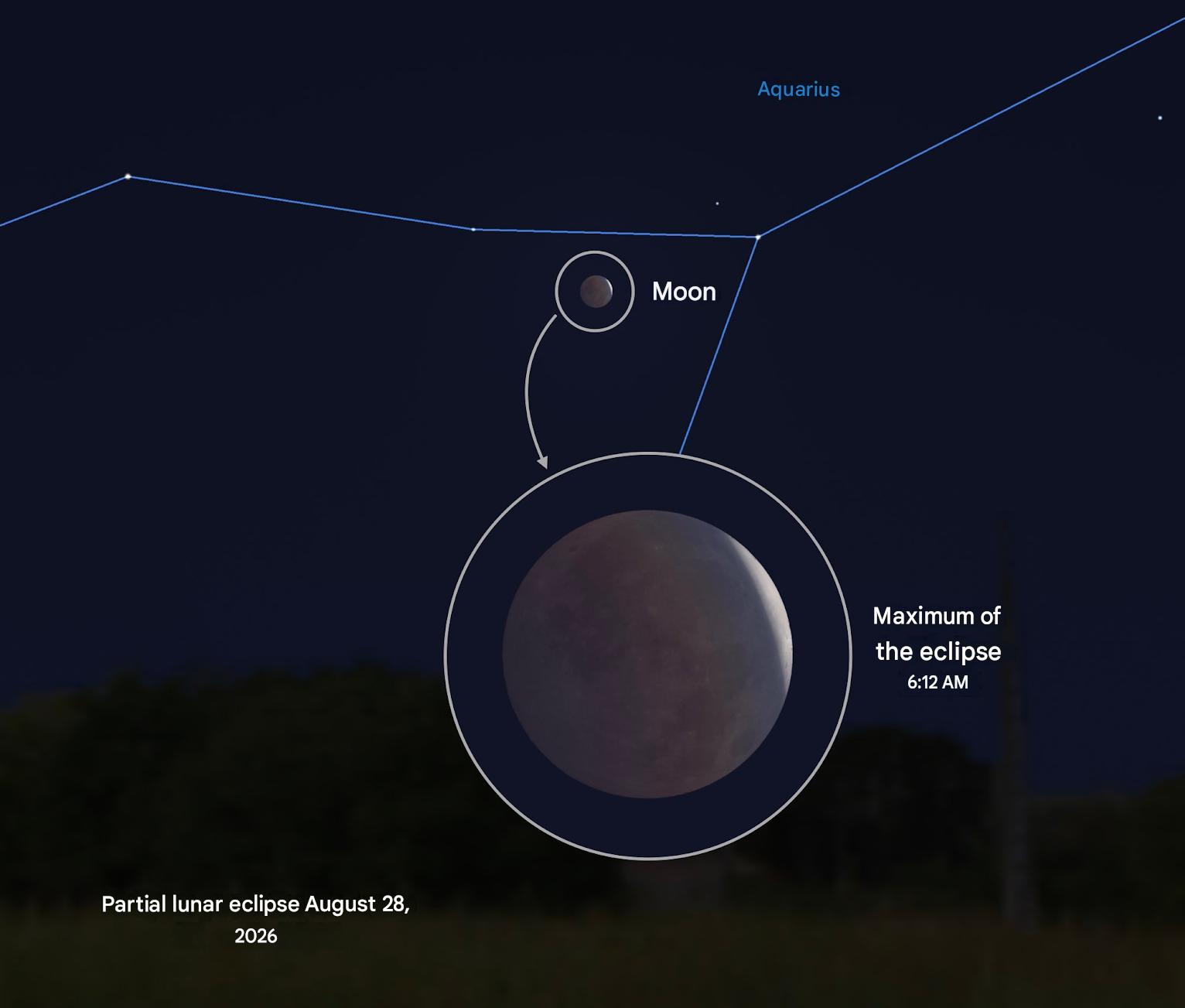
On August 28th, our natural satellite will enter a large portion of Earth’s shadow , offering us a beautiful partial lunar eclipse . At its maximum, our planet’s shadow will cover 92% of the lunar disk. A partial eclipse, certainly, but a significant one. In mainland France, it won’t be possible to observe the entire phenomenon. Fortunately, the beginning, when the Moon enters the penumbra and then the umbra, will be visible. At the maximum at 6:12 AM, the Moon will be 10° above the horizon in Toulouse. With a clear horizon (and favorable weather), we will also be able to observe this moment, and then the beginning of Earth’s shadow’s withdrawal.

Entry into twilight: 03:23
The phenomenon is generally not noticeable to the naked eye.

Entry into Earth’s shadow: 4:33 AM.
Very quickly, a curved shadow becomes noticeable, gradually encroaching upon the Moon .
The phenomenon is easily observed with the naked eye, and unlike solar eclipses, no protective eyewear is necessary .
Binoculars, telescopes, or spotting scopes allow you to zoom in on the event. This is an opportunity to better see certain nuances, for example, the fact that the side of the Moon closest to the center of the shadow is darker. There are other subtle differences to observe at the boundary between the eclipsed Moon and the side outside the shadow. However, since the degree of darkening depends on the composition of Earth’s atmosphere at that moment, it is difficult to predict whether these nuances will be more or less visible.

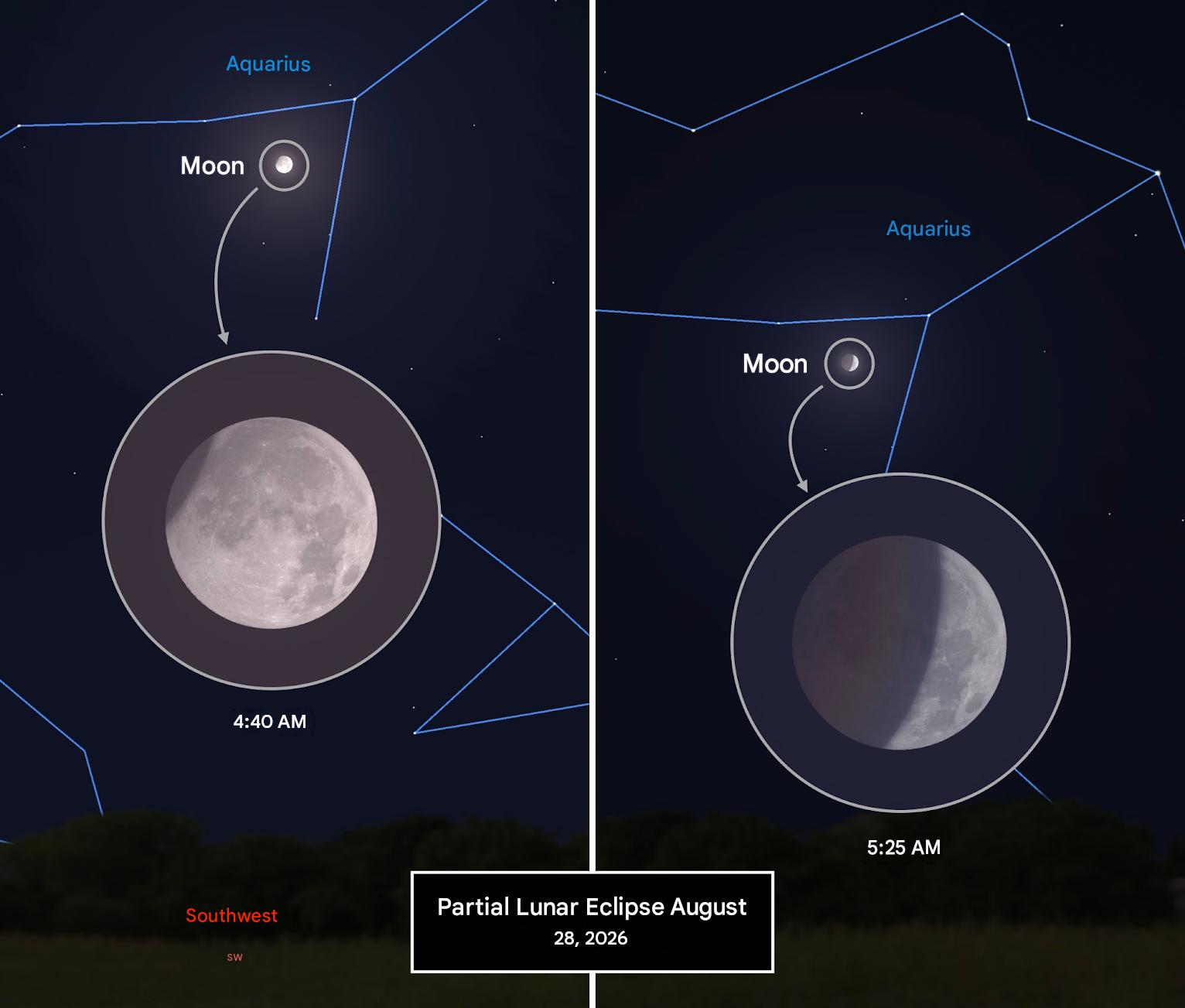
The lunar eclipse begins at 4:33 a.m. when our natural satellite is 24° (for Toulouse) above the southwest horizon. Seven minutes later, at 4:40 a.m., the Earth’s shadow is already clearly visible. When the shadow covers more than half of the Moon, it is 5:25 a.m. and our natural satellite is only 17° above the horizon.
© Cité de l’espace/Stellarium

Maximum of the eclipse: 6:12 AM.
The Earth’s shadow then covers 92% of the lunar disk . As you can see from the schedule, a lunar eclipse is a phenomenon that takes its time! From 6:12 AM onwards, the Earth’s shadow “recedes” and the Moon is less and less eclipsed.

Exit from the shadow: 7:52 AM.
At its maximum at 6:12 AM, the Moon will already be low on the western horizon, only 10° above the horizon in Toulouse. Also in Toulouse, our natural satellite sets at 7:21 AM, almost 30 minutes before it has completely emerged from the Earth’s shadow. At the time of setting, the Moon will still be about 44% within Earth’s shadow.

The Moon at the maximum of the eclipse at 6:12 a.m. and 10° above the horizon.
© Cité de l’espace/Stellarium

While the phenomenon won’t be fully visible from mainland France, we’ll witness the beginning, the peak, and part of the retreat of Earth’s shadow. This spectacle requires only a clear horizon between the southwest and west. Even light pollution from urban centers won’t significantly hinder observation.

A solar eclipse, the Perseids, a partial lunar eclipse… What an August!

Related articles