• Astronomy

The sky in November 2025

Published on 30 October 2025

The November sky welcomes the second "Super" Moon of 2025, Comet Lemmon at perihelion, and the interesting Leonid meteor shower.

The sky in November 2025

The nights are certainly getting cooler, but they are also longer, a boon for stargazers. The return to winter time on October 26th gives us a truly dark sky (the Sun is at least 18° below the horizon) earlier than our clocks, as early as 7:20 pm in early November.

Our maps and timetables are calculated for Toulouse in standard time for metropolitan France. The vast majority of these times remain valid for the entire metropolitan area.

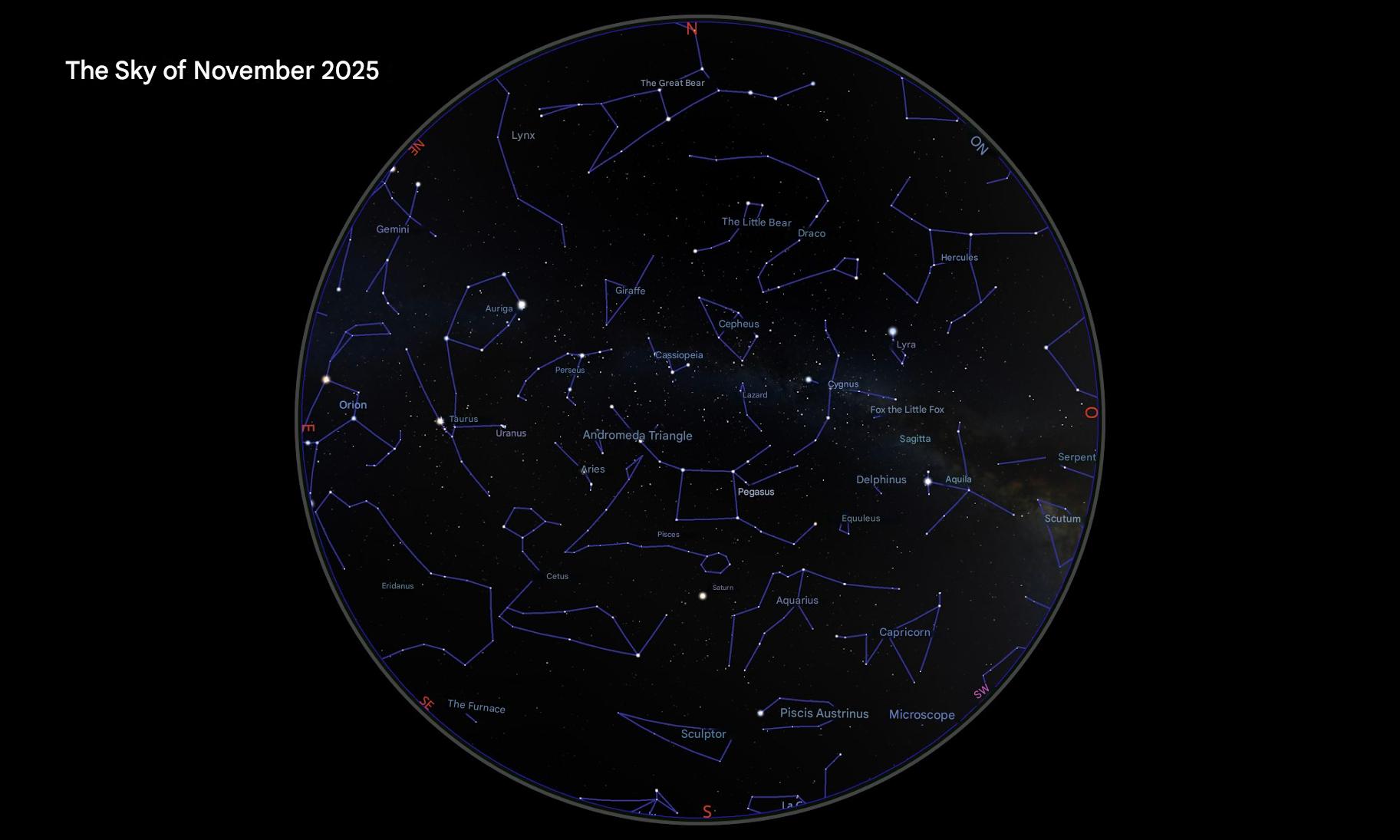
This map shows the sky for Toulouse on November 15th at 9:00 PM (local time, i.e., your watch time).
It is largely valid for the month of November (except for the position of the Moon, which will not have risen for this map) across all of metropolitan France.
© Cité de l’espace/Stellarium

THE SMALL METEOR SHOWERS

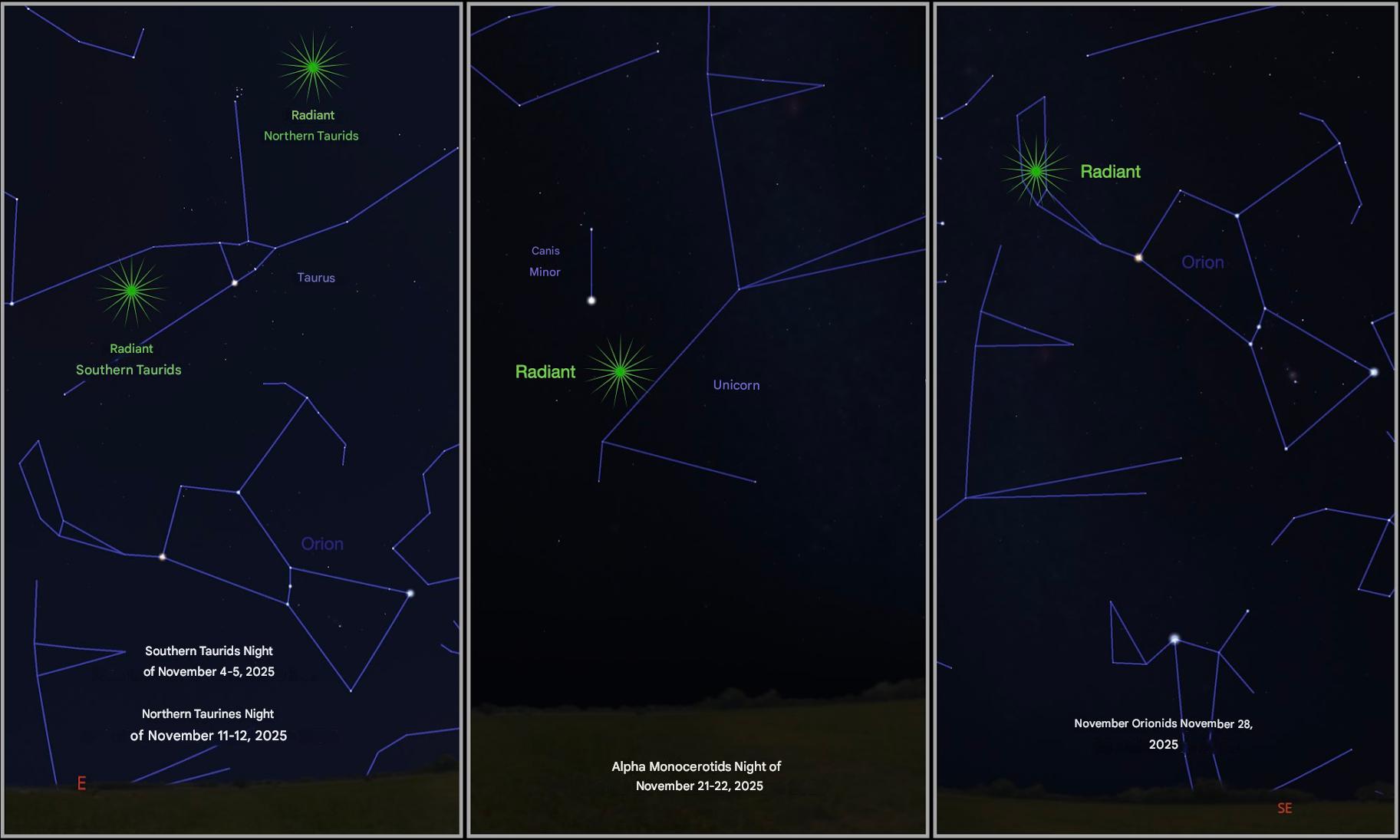
Here we have grouped together four very modest meteor showers from November , the first occurring on the night of the 4th to the 5th. Their zenithal hourly rate (ZHR) ranges from 3 to 5, meaning that under a sky perfectly free of light pollution and if the radiant were at the zenith (two very ideal conditions), we would observe 3 to 5 “shooting stars” per hour.
It’s worth remembering that these “shooting stars” are actually dust particles that leave a fleeting, bright trail as they burn up during their entry into our atmosphere. These dust particles are most often released by a comet.

SOUTHERN TAURIDS METEOR SHOWER

The peak of this meteor shower is expected on the night of November 4th to 5th, with a ZHR of 5. In practice, you will see much less, especially since the Full Moon is on the 5th, meaning our natural satellite will illuminate the sky and obscure most of the few shooting stars that night.
The comet responsible for the dust cloud is 2P/Encke, both for the South and North Taurids (see below).

NORTHERN TAURIDS METEOR SHOWER

The second meteor shower from comet 2P/Encke, the Northern Taurids, is equally modest with a ZHR of 5. Peak predicted for the night of the 11th to the 12th . The last quarter moon will interfere, as it will rise at 23:34 (for Toulouse).

ALPHA MONOCEROTID METEOR SHOWER

The Alpha Monocerotids dust cloud originates from a long-period comet that has not yet been formally identified. The ZHR remains modest, and the peak is expected during the night of November 21-22 . The Moon will not interfere (it is a very thin crescent that sets shortly after the Sun).

NOVEMBER ORIONID METEOR SHOWER 

This meteor shower should not be confused with the Orionids (plain and simple), which peaked last month. The November Orionids have a ZHR of 3, lower than the previous modest showers mentioned above, and their peak is expected on November 28th . The first quarter moon is not improving viewing conditions.

For meteor showers, November is primarily the month of the Leonids.

Location of the radiants of the modest November meteor showers. Reminder: the radiant is the point in the sky from which “shooting stars” appear to originate due to perspective.
© Cité de l’espace/ Stellarium

THE (SUPER) MOON OF NOVEMBER 5TH

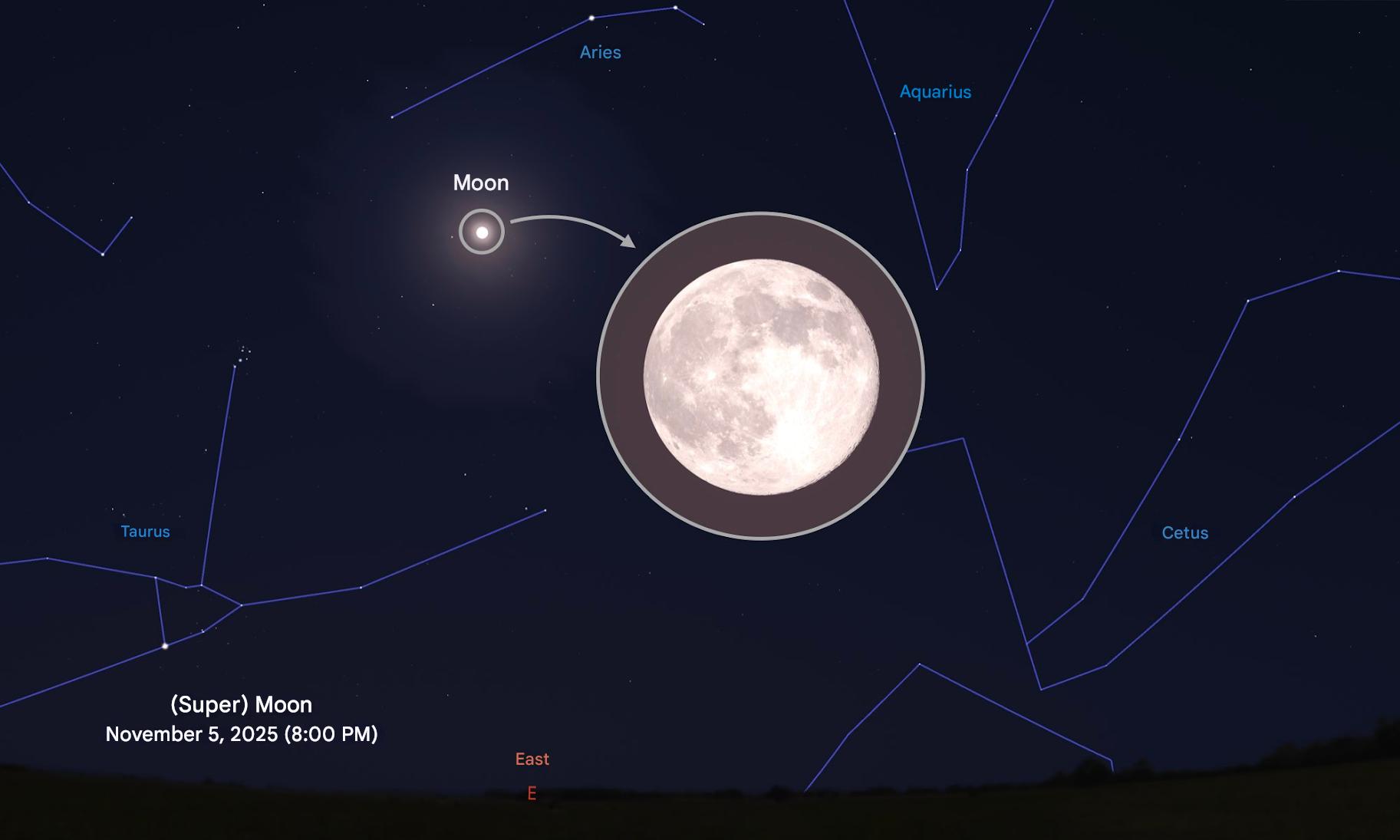
The highly publicized Supermoon made its return for 2025 last month. And we’re having three in a row to end the year. It’s worth remembering that a Supermoon isn’t actually anything extraordinary or exceptional . It’s simply a Full Moon, described as “Super,” when it occurs while our natural satellite is at its closest point to Earth in its orbit. The late American scientist Fred Espenak established a scale based on the Earth-Moon distance, ranging from 0 to 1 (0 being the farthest point and 1 the closest). A Full Moon is classified as Super from 0.9 to 1. The one on November 5th occurs at exactly 2:19 PM with an “Espenak scale” of 0.997 (slightly better than in October and the best score of 2025). The Moon will be 356,980 km from Earth. 

Next “Super” Moon on December 4th.

On November 5th at 8 p.m., the Full Moon will be slightly more than 25° above the eastern horizon.
© Cité de l’espace/Stellarium

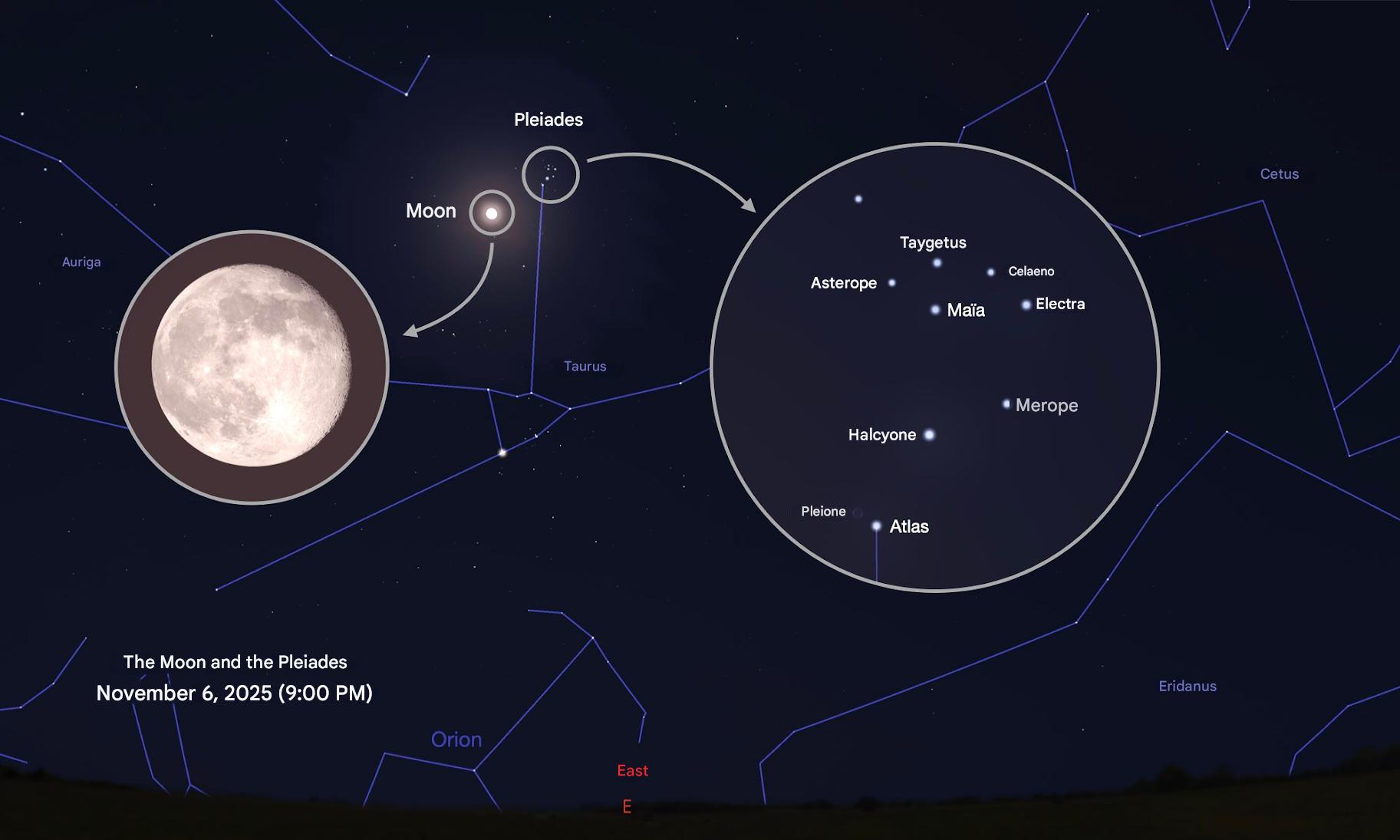
THE MOON NEAR THE PLEIADES

The day after the “Super” Moon, on November 6th, we find a classic celestial event with our natural satellite near the Pleiades , the seven sisters of antiquity immortalized as stars resembling a miniature Big Dipper. Alcyone, Asterope, Maia, Taygete, Celaeno, Merope, and Electra are watched over by their “parent” thanks to two stars named Atlas and Pleione.

This is an open cluster of 3,000 young stars (only about ten are visible to the naked eye under good conditions) located approximately 440 light-years from Earth. The delicate nebulae surrounding them were once thought to be remnants of their formation process, but it is now believed that we are observing an interstellar cloud through which they are dispersing.

The Pleiades already offer a beautiful object to scrutinize with the naked eye . Under a good night sky, 5 are easily visible. Capturing the 7 or 9 main ones requires skies free from all light pollution and/or the use of binoculars.

On November 6, the Moon will pass close to the Pleiades star cluster. Until 9 p.m., the Moon and the Pleiades will be at an altitude of just over 25°, and therefore well clear of the eastern horizon.
© Cité de l’espace/Stellarium

COMET LEMMON AT PERIHELION

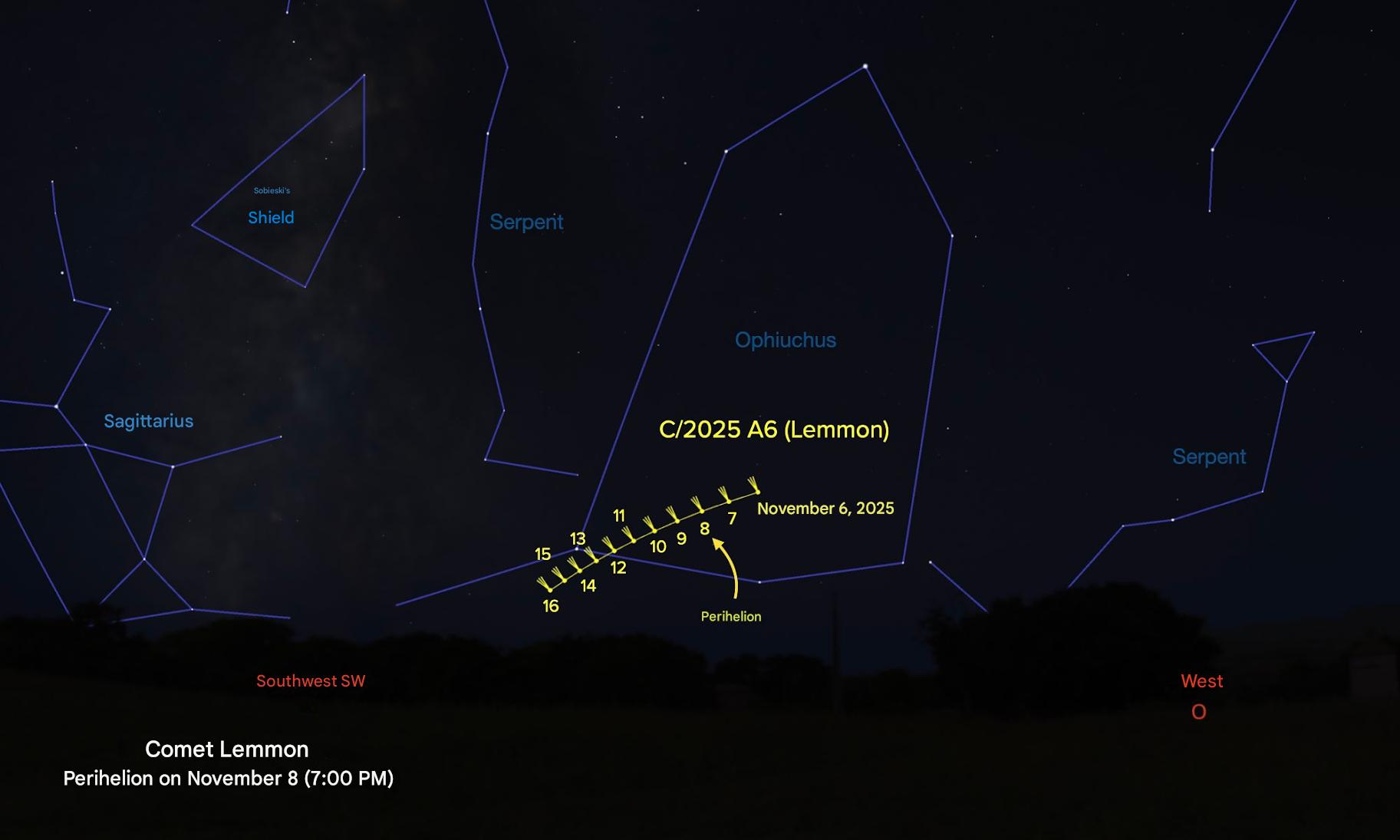
Comet C/2025 A6 (Lemmon) made headlines last month when it crossed the threshold of naked-eye visibility (under a good sky, and even then, observation wasn’t easy). On November 8, Comet Lemmon will make its closest approach to the Sun (perihelion) at a distance of 79 million kilometers. Often, this proximity triggers significant cometary activity.

C/2025 A6 (Lemmon) could then be brighter , but there is no guarantee of this. It will be observed very low on the horizon (only 10° altitude on the 8th at 7:00 PM) between the Southwest and the West.

Comet Lemmon will be very low on the horizon.
© Cité de l’espace/Stellarium

THE MOON AND JUPITER IN THE MORNING

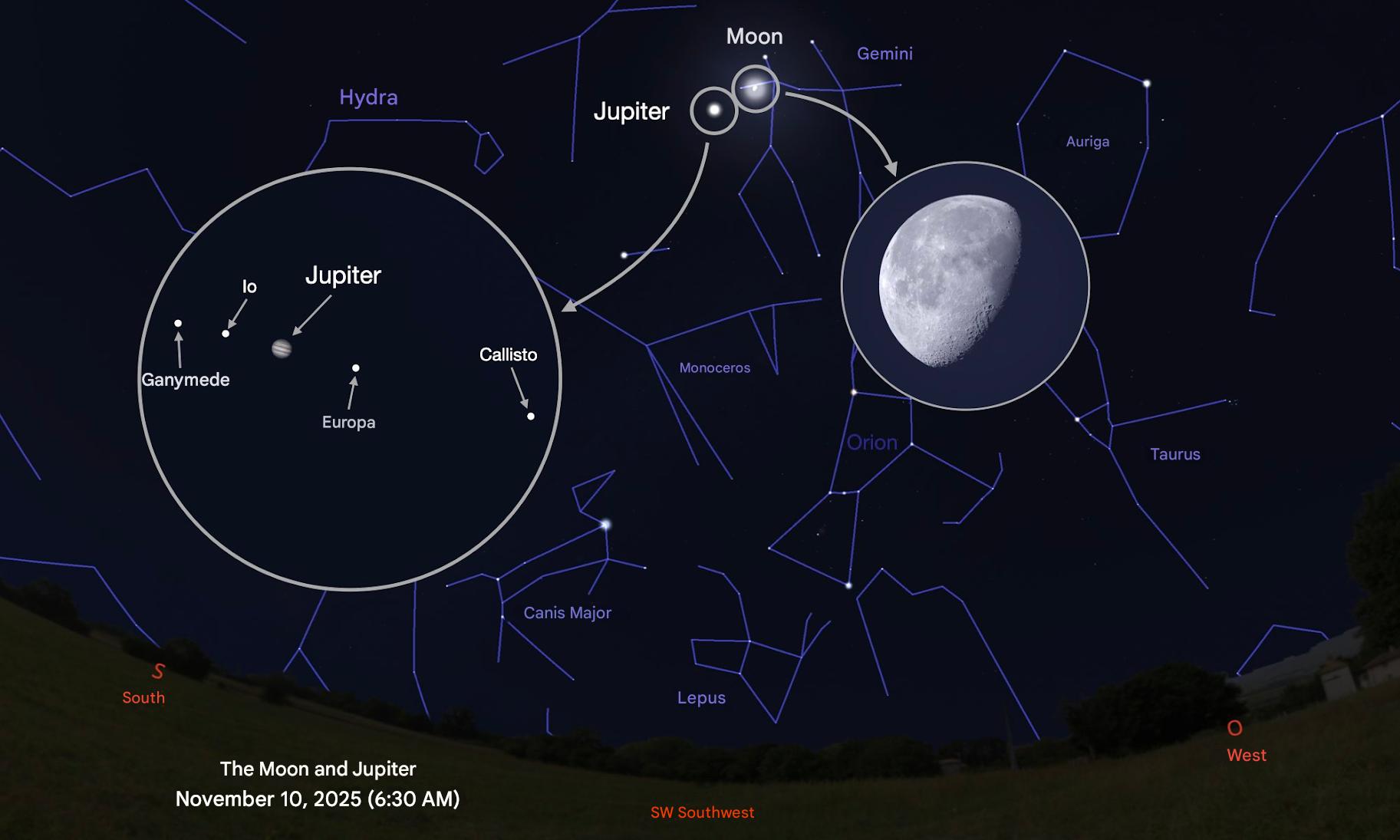
On November 10th, before sunrise, it will be easy to spot the Moon and Jupiter high in the southwest sky. The pair will be at just over 60° at 6:30 AM, about an hour and a quarter before sunrise.

If you have a good pair of binoculars, observe Jupiter and you should see its four Galilean moons (because they were discovered by the Italian astronomer Galileo in 1610).

On the morning of November 10, the Moon and the brightness of Jupiter will dominate the southwestern sky.
© Cité de l’espace/Stellarium

THE LEONID METEOR SHOWER

Undoubtedly, the star meteor shower of November , despite a rather average ZHR of 15 , is the Leonids. They fascinate us because in the past they produced spectacular showers, notably the one in 1833 estimated at several thousand “shooting stars” per hour. This is no longer the case, as it is estimated that Earth will not pass through a dense cloud of dust again until 2099. The Leonids (whose radiant is in the constellation Leo) originate from the dust scattered by comet 55P/Tempel-Tuttle . The Leonids are also monitored even when their activity is more modest, because while they leave fleeting, short streaks in the sky, their brightness often reaches magnitude 0 , well above the limit of naked-eye visibility (6 under a perfect sky).
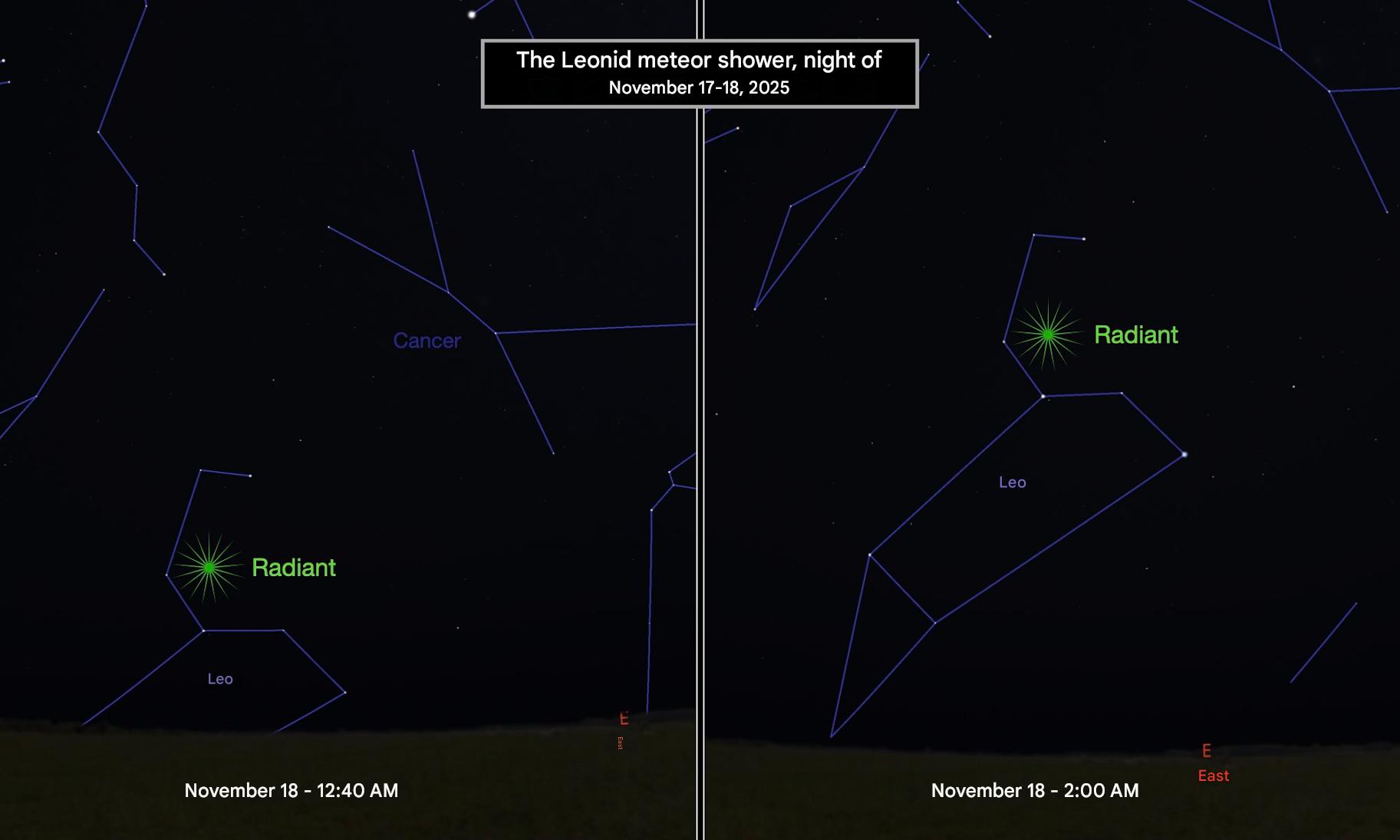
Multiple peak predictions are expected for 2025. There might be a chance of seeing a meteor shower on November 9th around 11 PM and on the 15th around 4 AM . However, the main event remains the night of November 17th to 18th, with a predicted peak  around 8 PM and another at 11:40 PM .
A 6% illuminated Moon that sets before the Sun won’t interfere. The radiant in the constellation Leo will not have risen during either peak (which is why our map shows two later times on the night of November 17th to 18th). But remember, you don’t need to look at the radiant to enjoy a meteor shower.
As with other showers, gaze at the night sky far from any light pollution (which includes the glare from your smartphone screen) and be patient. Dress warmly, too; November nights are generally cold.

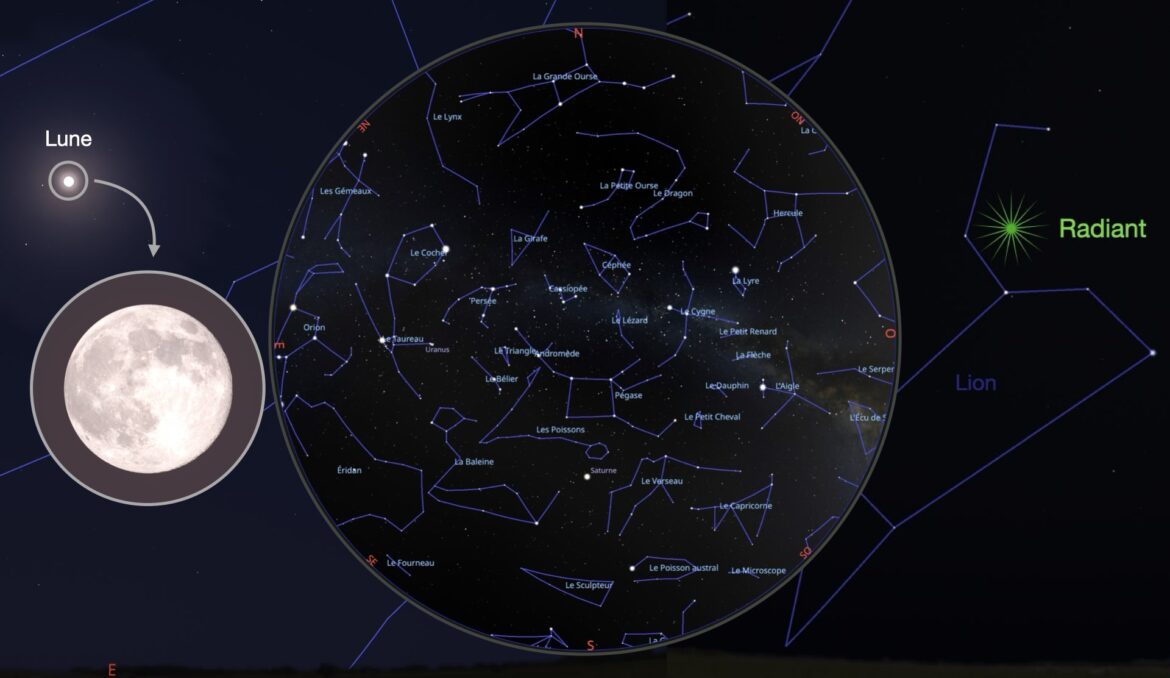
The radiant of the Leonids, located in the constellation of Leo, will rise after the two predicted peaks on November 17th around 8pm and 11:40pm.

© Cité de l’espace/Stellarium

Related articles