• Astronomy

The sky in May 2026

Published on 30 April 2026

The program for May 2026 includes some beautiful encounters between the Moon and several planets, as well as a modest meteor shower.

The sky in May 2026

Since the equinox, the nights have been getting shorter and shorter . It’s not until 11 p.m. that true darkness sets in. Fortunately, conjunctions between the Moon and the planets will bring some beautiful celestial displays this May 2026 .

Unless otherwise stated, all times in this article are in Metropolitan France time (your watch time). Maps are calculated for Toulouse, but are generally similar for mainland France.

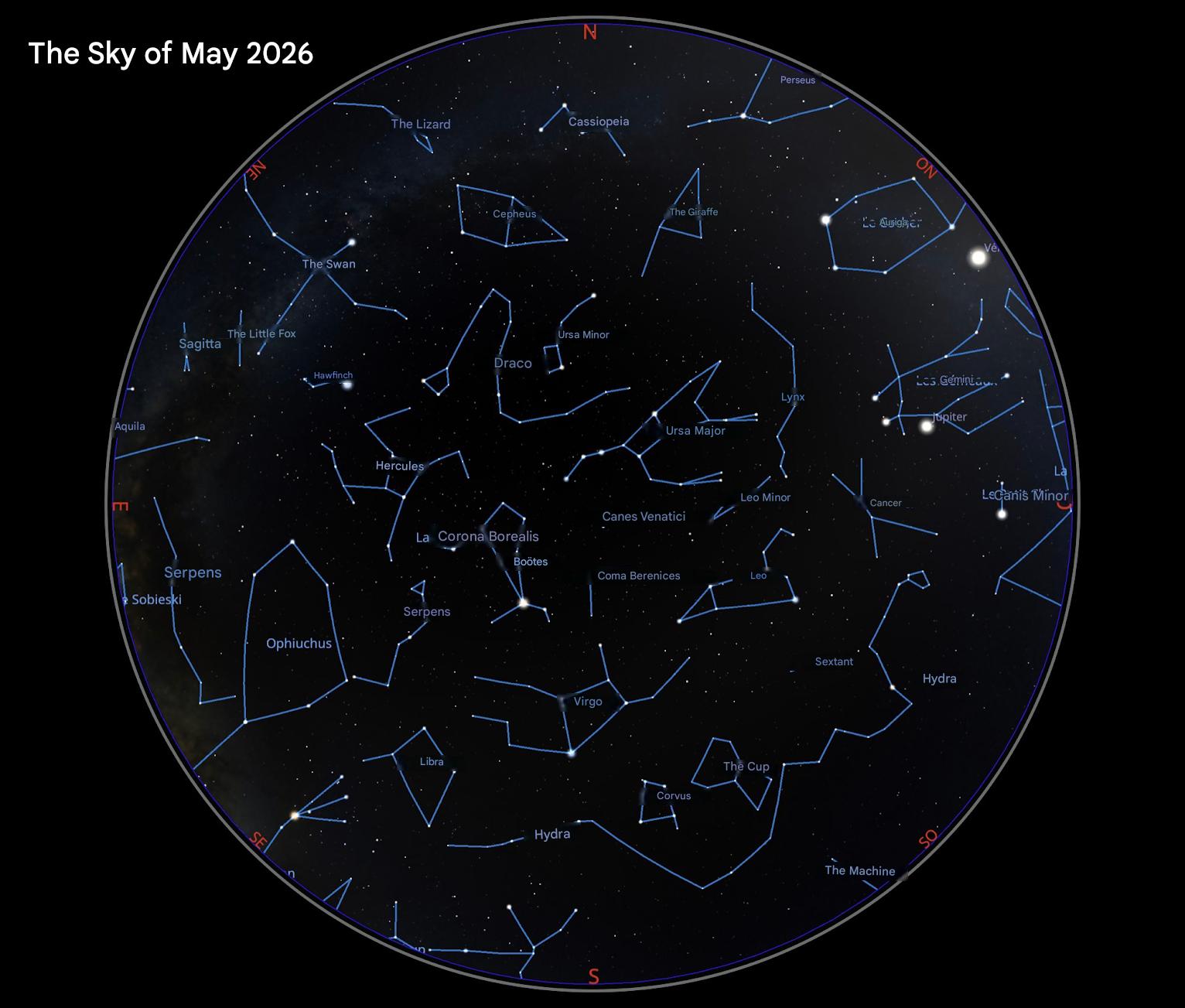
This map shows the sky for Toulouse on May 15th at 11:30 PM (local time, i.e., your watch time).
It is largely valid for the month of May across all of metropolitan France, except for the position of the Moon (which, on this map, had not yet risen at that time).
© Cité de l’espace/Stellarium

ANTARES AND THE MOON

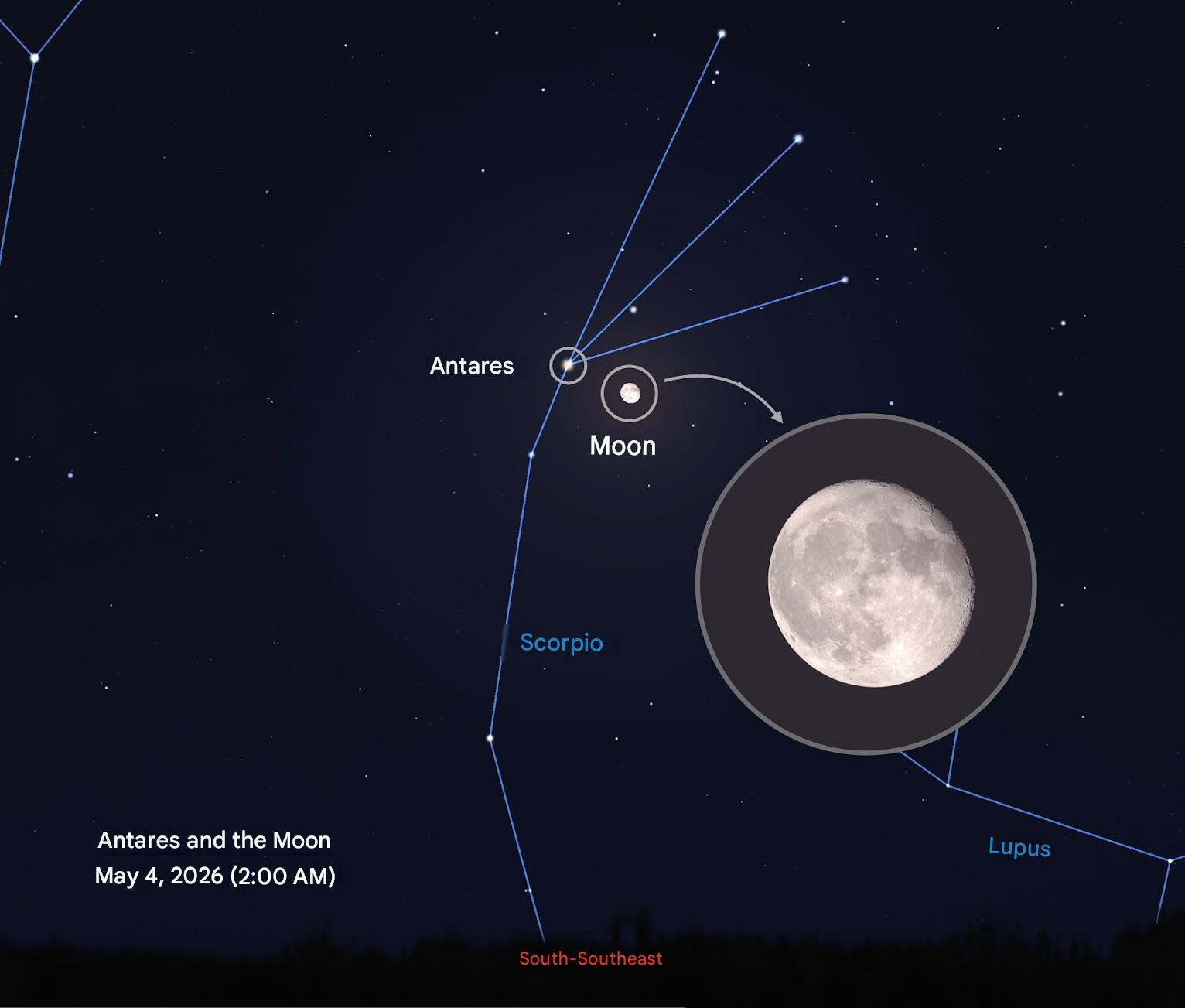
To begin the month, we have a classic conjunction between Antares and the Moon on the night of May 3rd to 4th . This star and our natural satellite rise in the east shortly before midnight, but our chart is set for 2:00 AM on May 4th so that both celestial bodies are high enough above the horizon , about 15 degrees.
The Moon will then be a beautiful gibbous, 95% illuminated. Antares is a red supergiant located 550 light-years away. If this star were in the position of our Sun, it would encompass much of the orbit of Mars.

In the South-Southeast at 2 a.m. on May 4, locate the pair formed by Antares and the Moon about fifteen degrees above the horizon.

© Cité de l’espace/Stellarium

THE ETA AQUARIDS METEOR SHOWER

Popularized as “shooting stars,” meteors are dust particles (usually from comets or asteroids) that vaporize upon entering the atmosphere , creating a fleeting streak of light. While meteor showers can be seen every night, they are identified as periods of more sustained activity, when the Earth passes through a specific stream of dust. The name given to these events comes from the constellation where the radiant is located, the point from which the “shooting stars” appear to originate. The Eta Aquarids, therefore, owe their name to the constellation Aquarius, and “Eta” refers to the proximity of the radiant to the star Eta Aquarii . The famous Halley’s Comet is responsible for the dust cloud, which offers a relatively modest spectacle with a maximum ZHR of 50. The Zenith Hourly Rate (ZHR) is an estimate of the number of meteors a person could see from a radiant at the zenith (which, incidentally, is not the case) under a perfectly dark sky (maximum visible magnitude of 6.5, the limit for the naked eye). By comparison, the ZHR of the famous Perseids in August is typically 100. Observers in the Northern Hemisphere are not ideally positioned for the Eta Aquarids , and it is estimated that, under skies free from light pollution, this modest meteor shower offers a maximum of 10 to 15 meteors per hour.

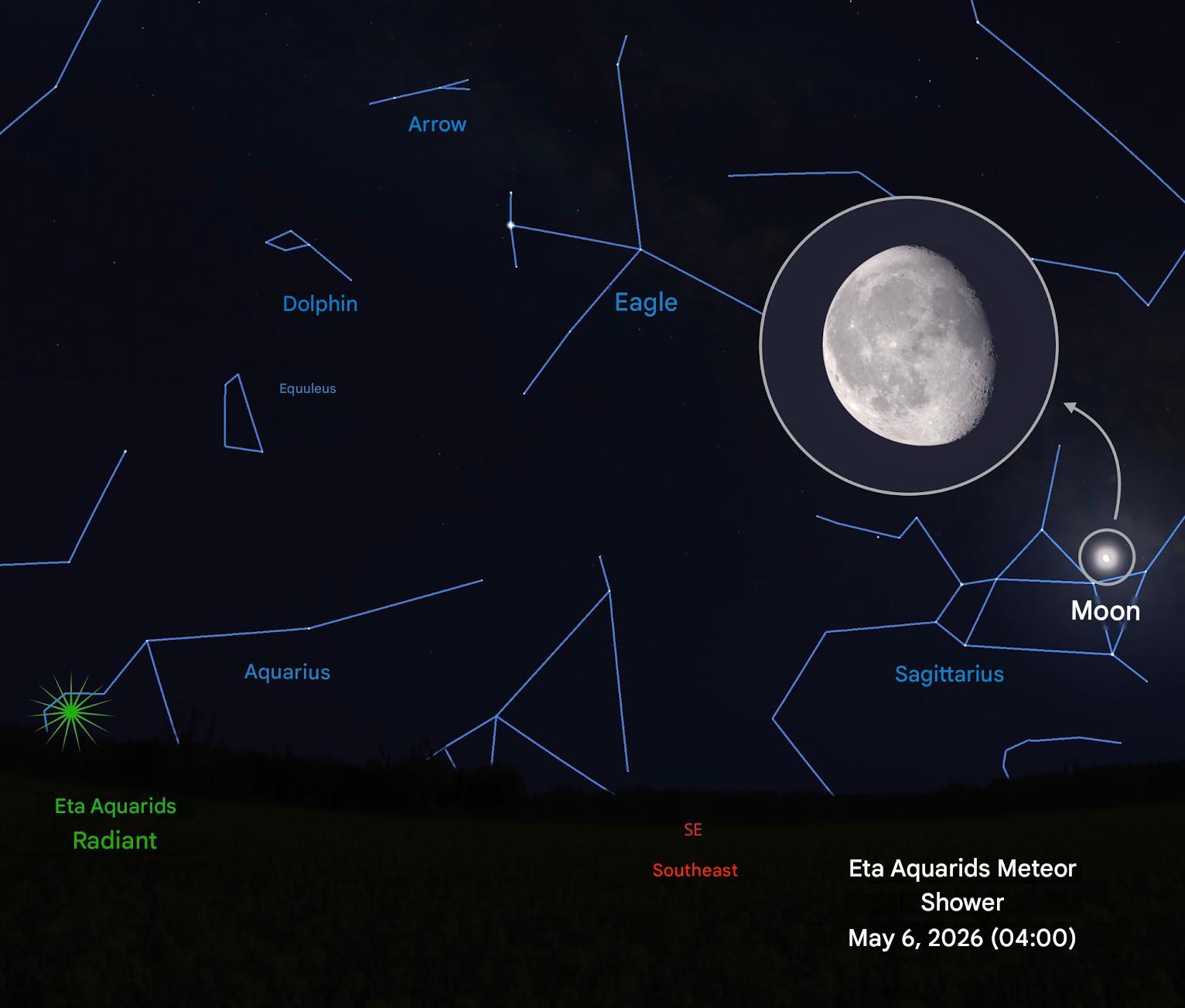
For 2026, the maximum is expected during the night of May 5-6 and, unfortunately, a Moon illuminated at 83% will greatly interfere, reducing the number of visible meteors . 

There’s no need to focus on the radiant, which rises late at our latitudes; the best thing to do is to take in as much of the night sky as possible (a deckchair is ideal) away from light pollution. Don’t expect a spectacular meteor shower during these Eta Aquarids.

The radiant of the Eta Aquarids barely above the horizon on May 6 at 4 a.m. The Moon, 83% illuminated, will obscure most of the meteors.
© Cité de l’espace/Stellarium

THE MOON AND SATURN

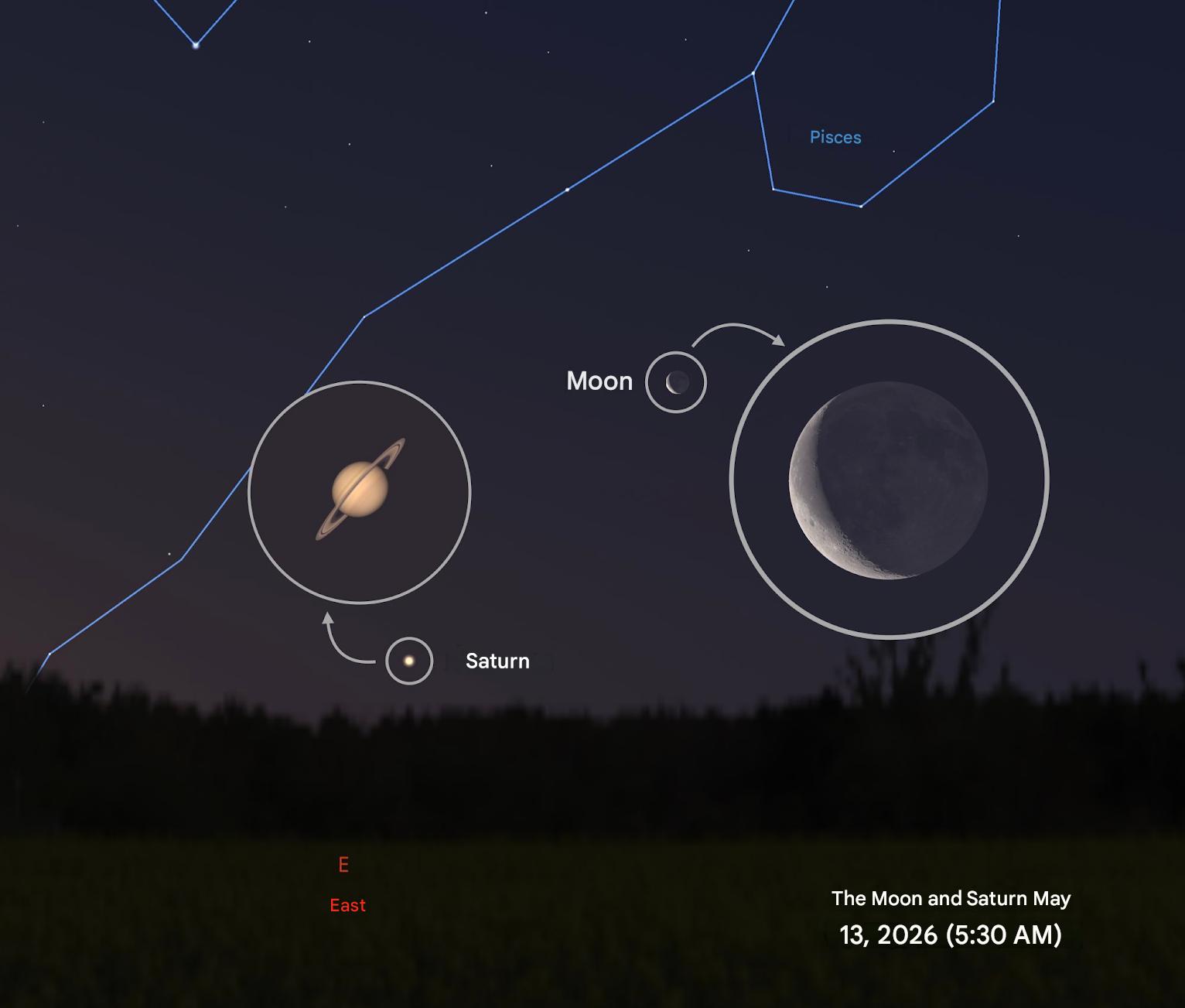
The ringed giant returns to the morning sky. On May 13, an hour before sunrise, a crescent Moon will accompany Saturn close to the horizon . This observation requires a completely clear eastern sky, as Saturn will be only 4° above the horizon . The Moon will be at 11°.
It is possible to wait until both celestial bodies rise even higher, but the morning sky will gradually brighten, erasing the characteristic yellowish glow of Saturn first. Finally, protect your eyes by being careful of the Sun, which will rise not far to the east at 6:30 a.m. for Toulouse.

A challenging observation, as Saturn will be very low on the eastern horizon on May 13.
© Cité de l’espace/Stellarium

VENUS AND EARTHSHINE

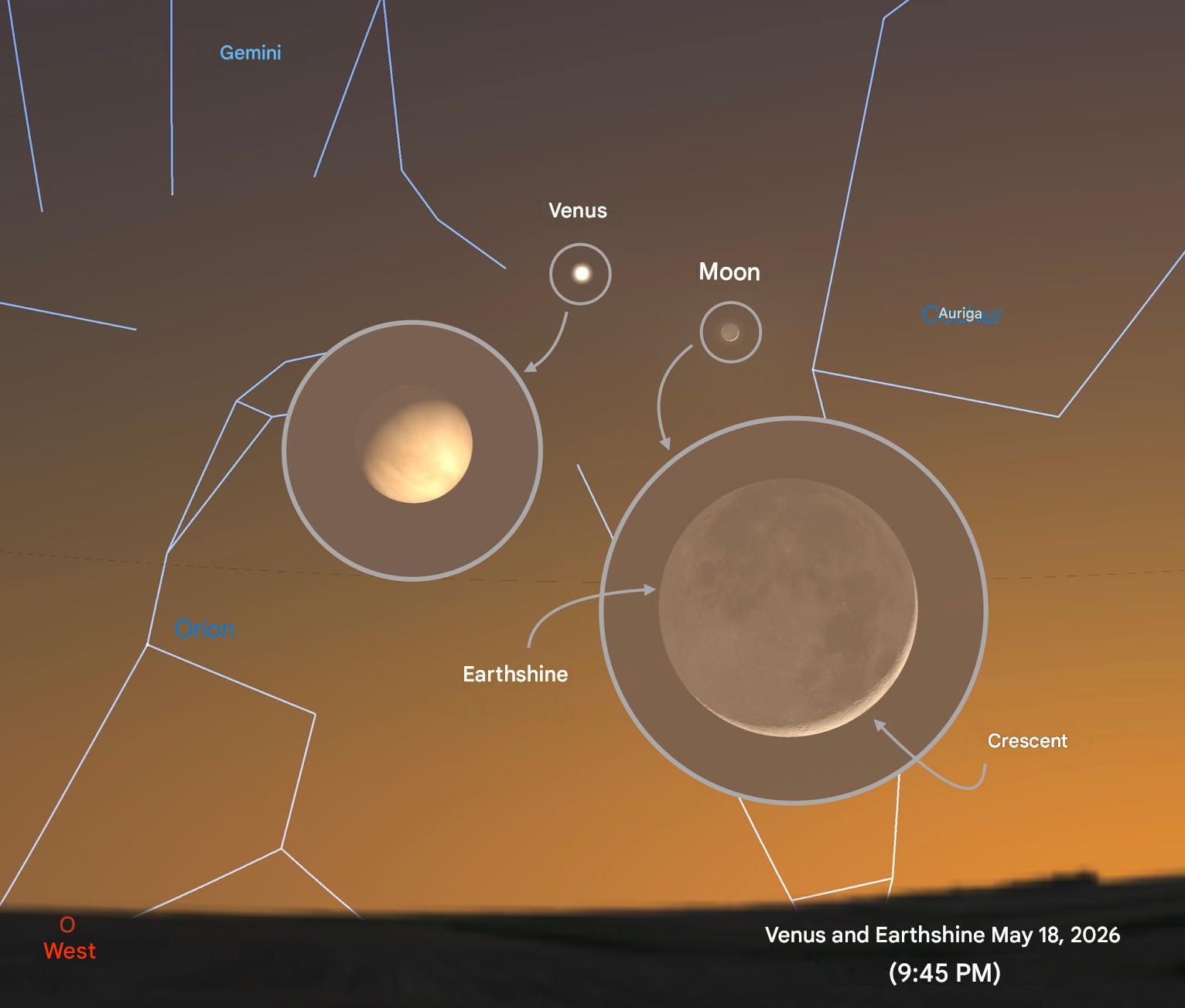
Five days later, let’s move from East to West and from morning to evening. On May 18, 30 minutes after sunset, look slightly to the left in the West for the very bright Venus (magnitude -4) accompanied by a thin crescent moon displaying a superb earthshine. The crescent is directly illuminated by our star, while earthshine is the portion of our natural satellite lit by the reflection of the Sun on Earth. The Moon will be about 20 degrees above the horizon at 9:45 PM. Therefore, a relatively unobstructed sky is necessary in the West.

To protect your eyes, wait 30 minutes after sunset, then admire a beautiful earthshine similar to the glow of Venus.
© Cité de l’espace/Stellarium

JUPITER, THE MOON AND VENUS

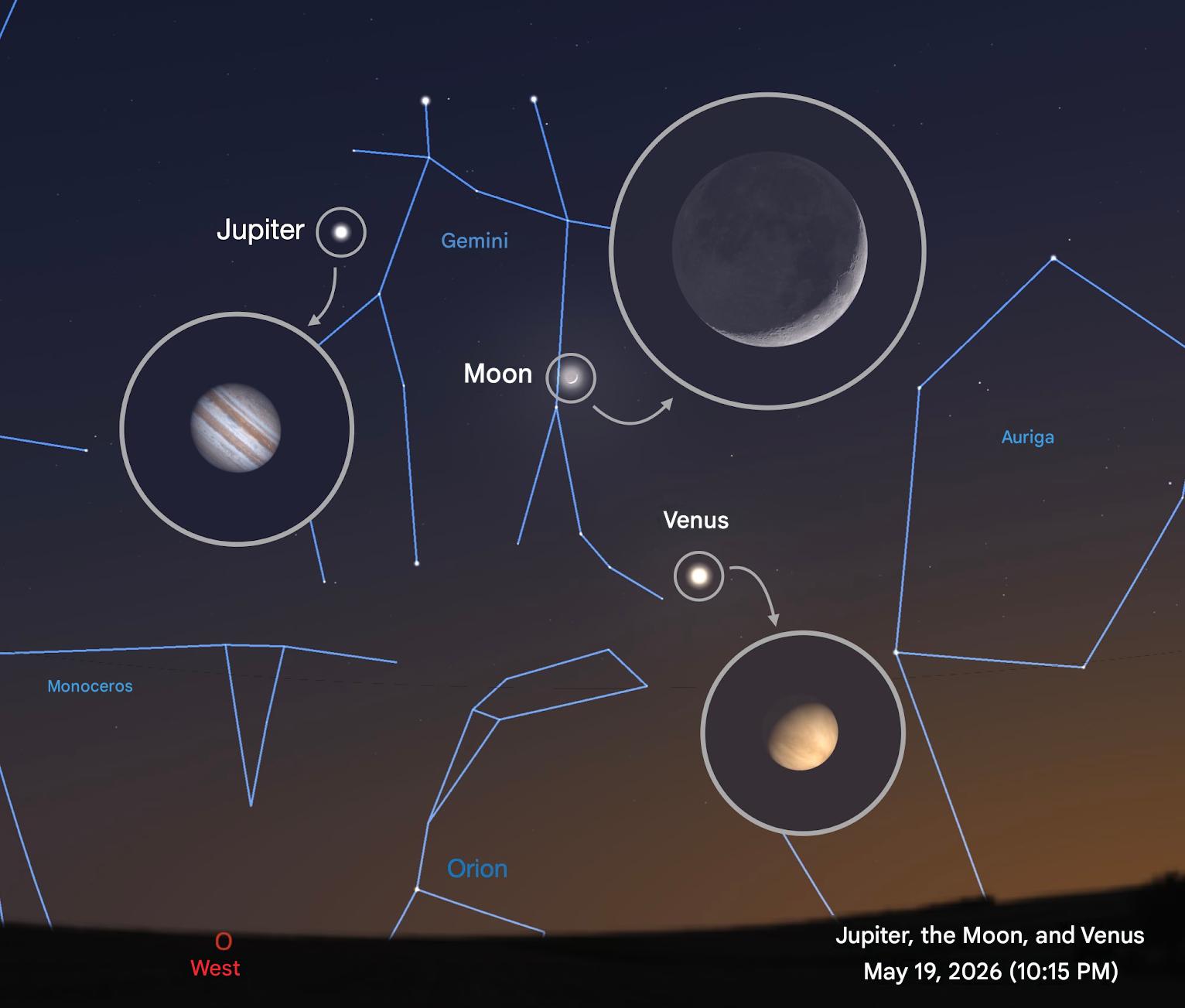
On May 19th, the Moon will be almost between Venus and Jupiter . Around 10:15 PM, the sky will begin to darken enough to enhance the spectacle. Venus , easily recognizable by its bright light, will then be about fifteen degrees above the horizon, not far from the west. Draw a line towards brilliant Jupiter and you’ll cross a beautiful crescent Moon along the way . A superb trio!

Jupiter, the Moon, and Venus form a trio that will be prominent on the western horizon approximately one hour after sunset.
© Cité de l’espace/Stellarium

THE MOON AND JUPITER

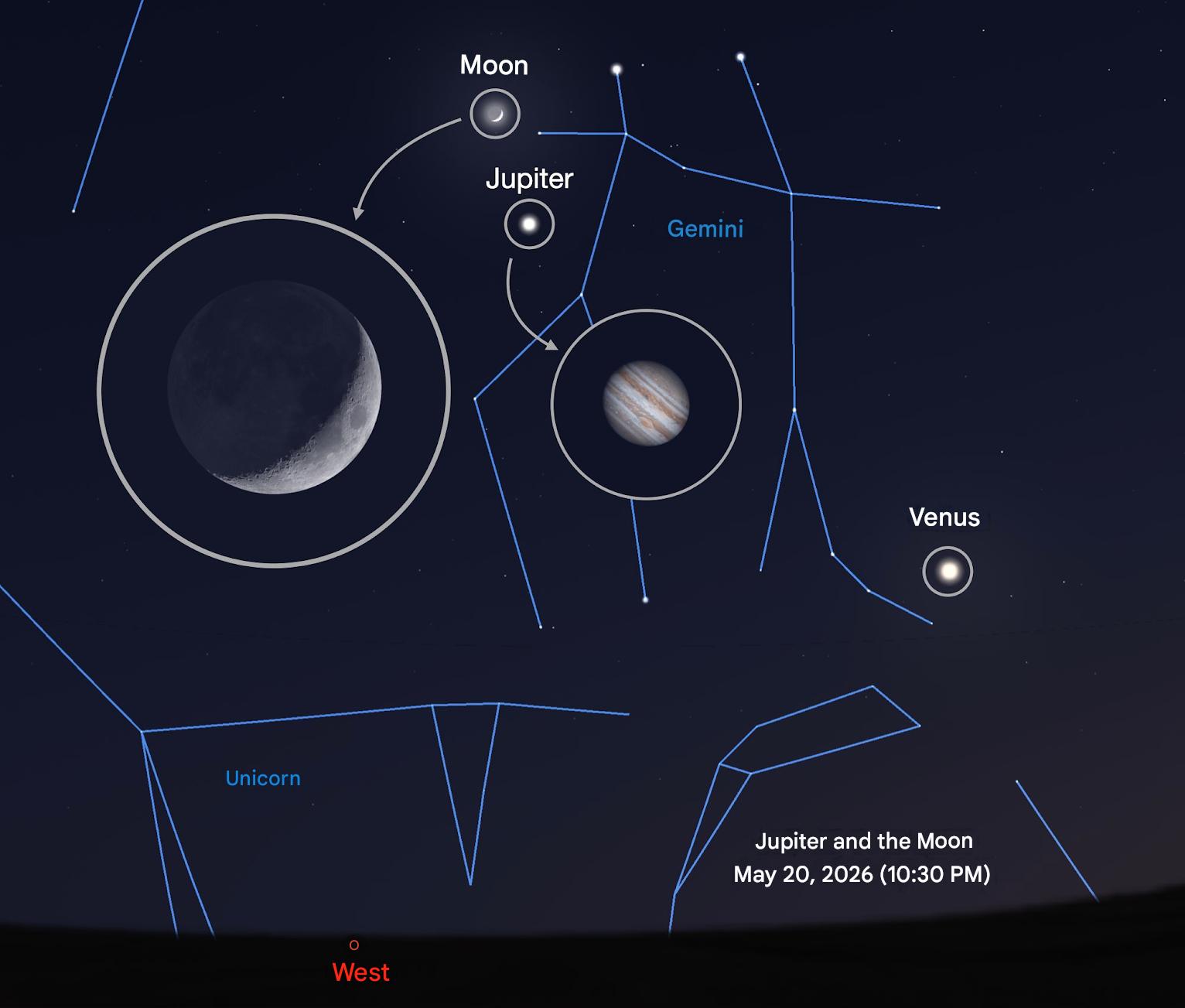
On May 20, the Moon and Jupiter will be even closer together than the day before. The gas giant and our natural satellite will dominate the sky, about twenty degrees above the West.

The Moon and Jupiter in the constellation of Gemini on May 20th.

© Cité de l’espace/Stellarium

Related articles