• Astronomy

The sky in June 2026

Published on 28 May 2026

With the solstice on the 21st, the nights of June are short, but the West will offer us Mercury, Venus and Jupiter visited by the Moon which will then go to meet the stars Regulus, Spica and Antares.

The sky in June 2026

As every year after the spring equinox, the increasingly long days gradually encroach upon the night sky until the summer solstice (in the Northern Hemisphere, it is the winter solstice in the Southern Hemisphere). Predicted to occur on June 21st in 2026 (some years it falls on the 20th, for example in 2028), the passage of this solstice will mark the moment when, in the Northern Hemisphere, night begins to slowly encroach upon the daylight once again.
Though very short in duration, the celestial vaults of June will nonetheless offer some beautiful observations, particularly thanks to the presence of the planets Mercury, Venus, and Jupiter in the west at sunset.

It should be noted that the peak of the very small Bootid meteor shower on June 27 (1 or 2 “shooting stars” per hour) will be almost erased by an almost full Moon.

Unless otherwise stated, all times in this article are in Metropolitan France time (your watch time). Maps are calculated for Toulouse, but are generally similar for mainland France.

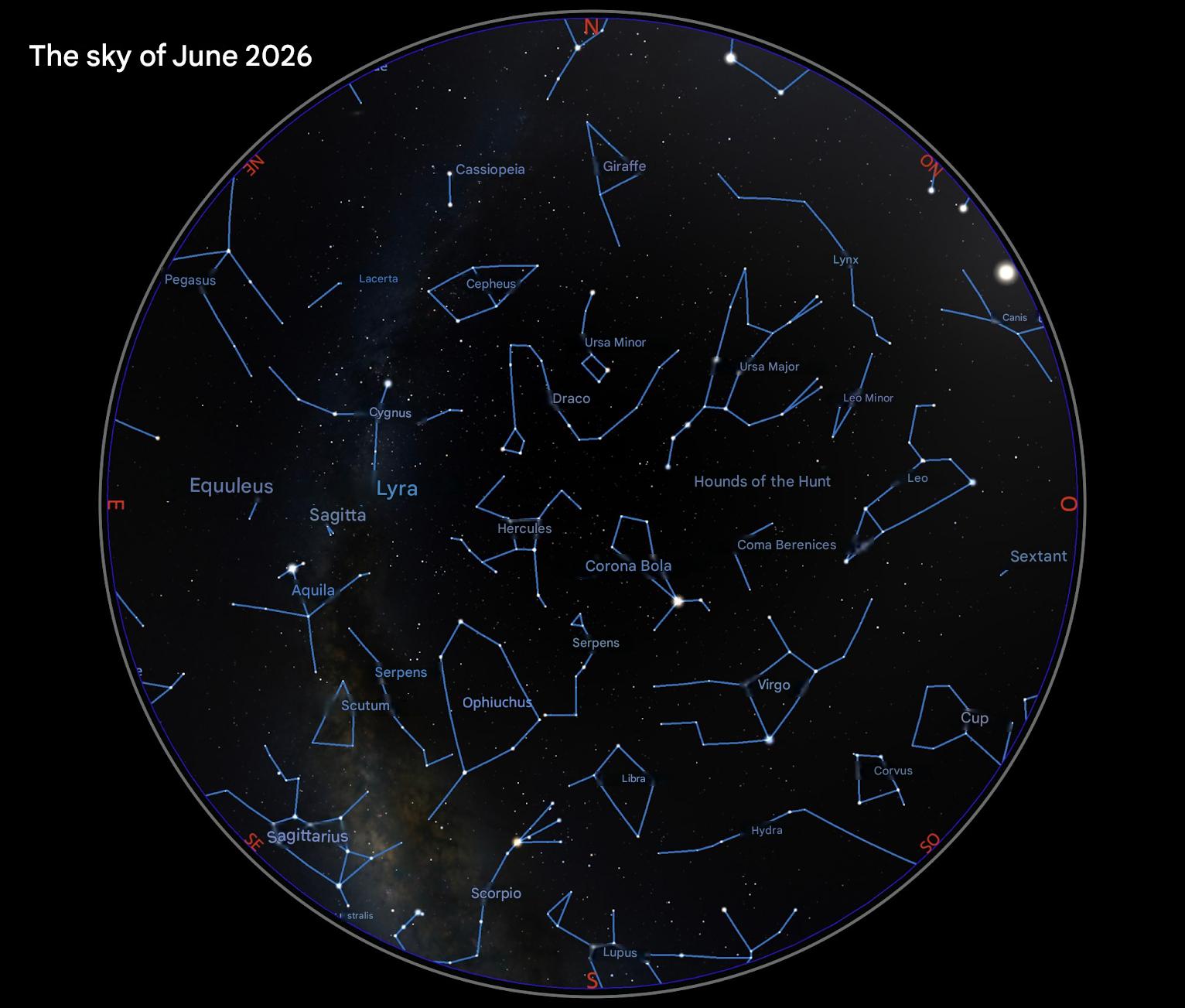
This map shows the sky for Toulouse on June 15th at midnight (local time, i.e., the time on your watch).
It is largely valid for the month of June across mainland France, except for the position of the Moon (which, on this map, had not yet risen at that time).
© Cité de l’espace/Stellarium

VENUS AND JUPITER WITH MERCURY

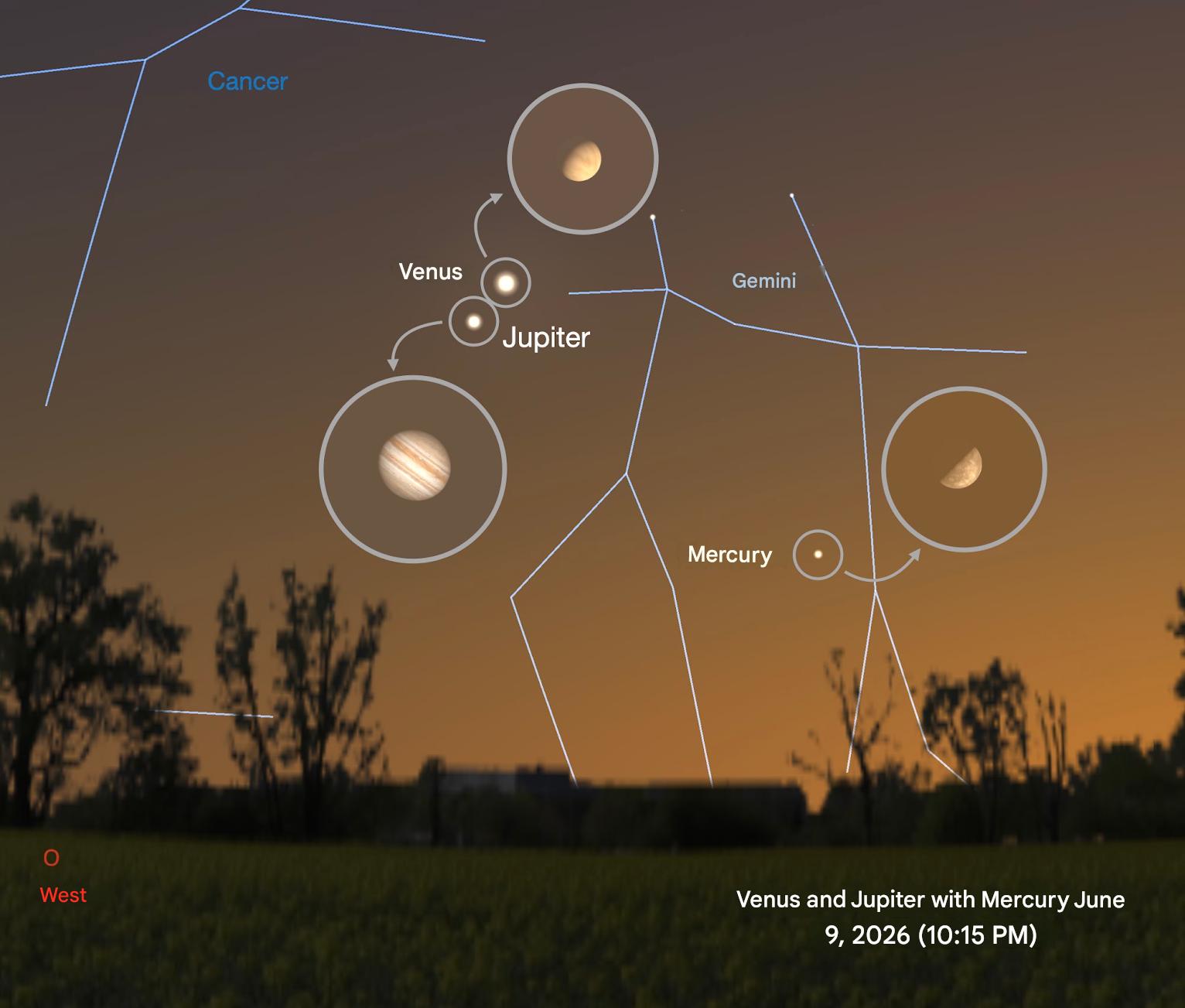
On June 9th, Venus and Jupiter will offer a dazzling duo in the twilight. To avoid any risk to your eyes and to allow the sky to darken sufficiently, wait 40 minutes after sunset and look towards the west-northwest . At 18° above the horizon, the bright light of Venus (magnitude -3.5) will dominate the sky, barely rivaled by nearby Jupiter at magnitude -1.4.

As a reminder, magnitude is an “inverted” scale of brightness, meaning that the higher the number, the less bright the celestial body. The limit of human perception in a night sky free of light pollution is around magnitude 6. With their negative magnitudes, Venus and Jupiter will therefore appear very bright.
Further down to the right, at an altitude of only 10°, you might be able to spot Mercury (magnitude 0.1), but you’ll need an unobstructed horizon.

The Venus-Jupiter duo will be escorted at a distance by Mercury on the evening of June 9.
© Cité de l’espace/Stellarium

THE MOON AND SATURN

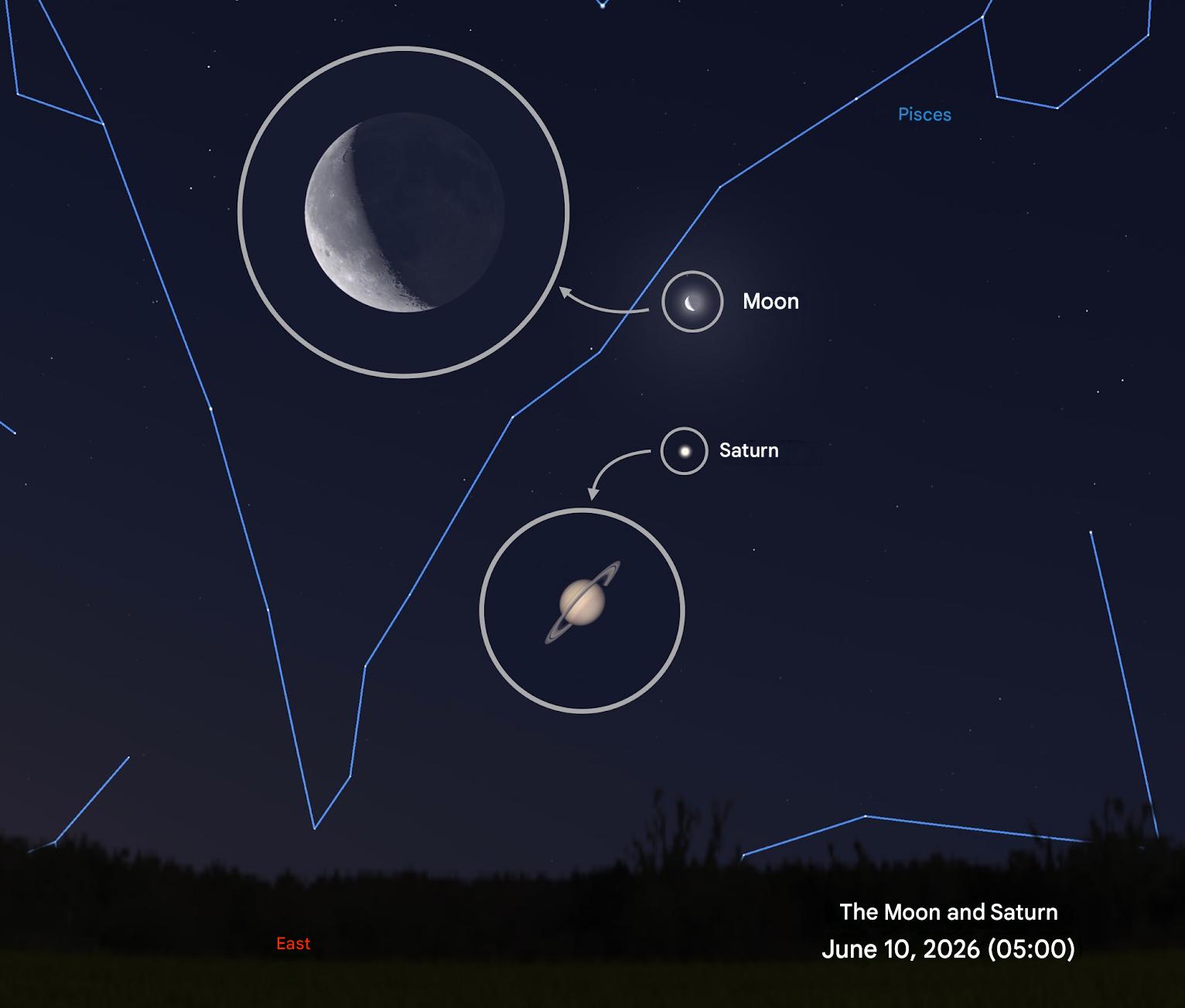
On the morning of June 10th, the Moon will be in conjunction with Saturn. A little over an hour before sunrise, the ringed giant will be visible in the east, 18° above the horizon, topped by a crescent of our natural satellite. As the minutes pass, the pair will climb higher in the sky, but be mindful of the Sun, which rises at 6:13 AM in Toulouse.

Saturn appears in the morning sky with the Moon on June 10.
© Cité de l’espace/Stellarium

MERCURY AND EARTHSHINE

WITH JUPITER AND VENUS AS A BONUS

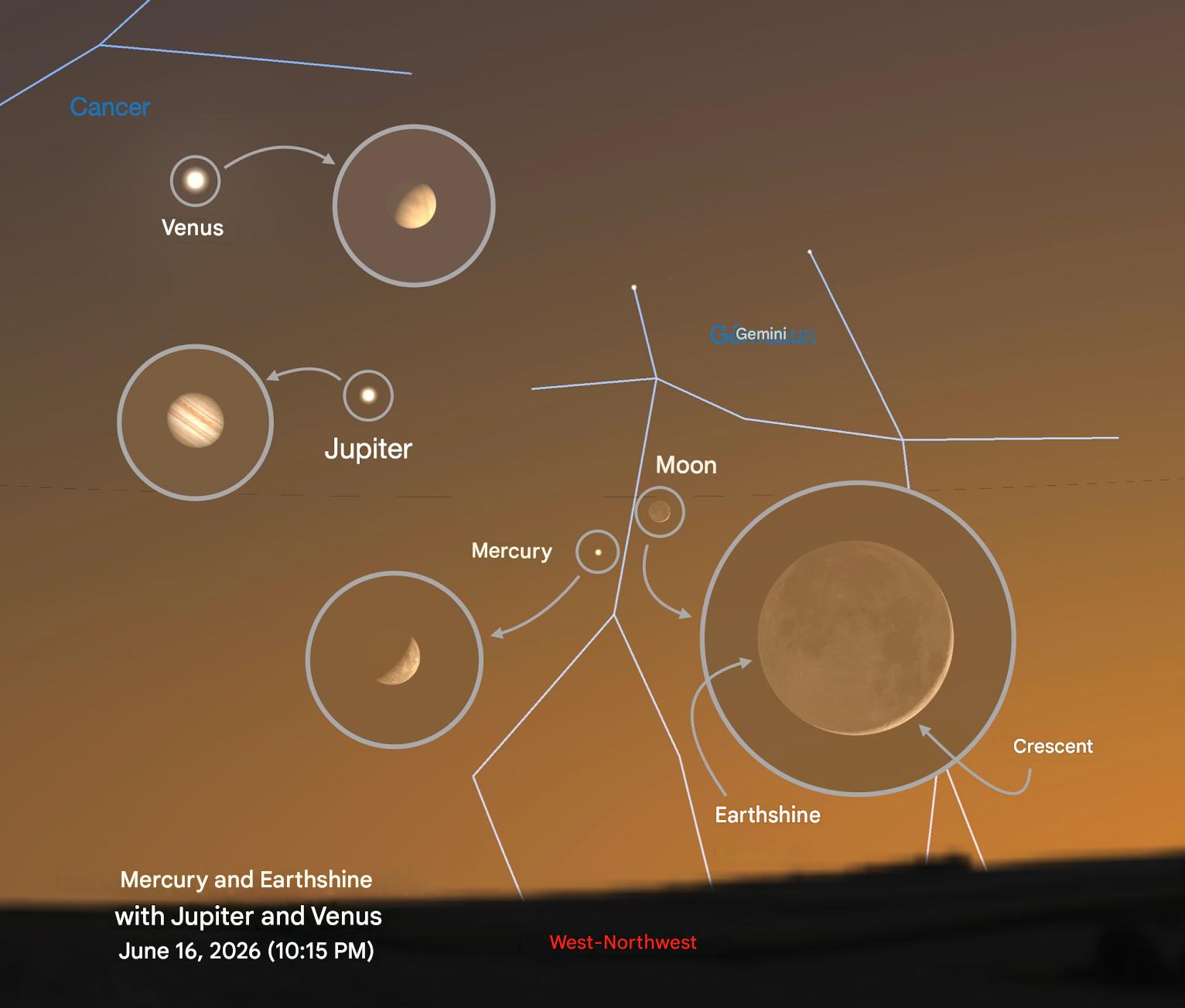
On the evening of June 16th, you have a date with the Moon, Mercury, Jupiter, and Venus. You’ll need a clear west-northwest horizon, as Mercury will be quite low, only 9.5° above the horizon at 10:15 PM, a little less than 40 minutes after sunset (for Toulouse). A little earlier, the first planet of the Solar System would certainly be a bit higher, but the twilight glow could be a problem, and to protect your eyes, it’s wise to wait until the sun is well below the horizon .

Near Mercury, you’ll notice a thin crescent Moon displaying earthshine . This is the portion of our natural satellite illuminated by sunlight reflected from Earth. The crescent itself is directly illuminated by our star. This Mercury-Moon duo will be accompanied by the bright planets Jupiter (13° above the Earth) and Venus (19° above the Moon).

Mercury near Earthshine on the evening of June 16.
© Cité de l’espace/Stellarium

VENUS AND THE MOON

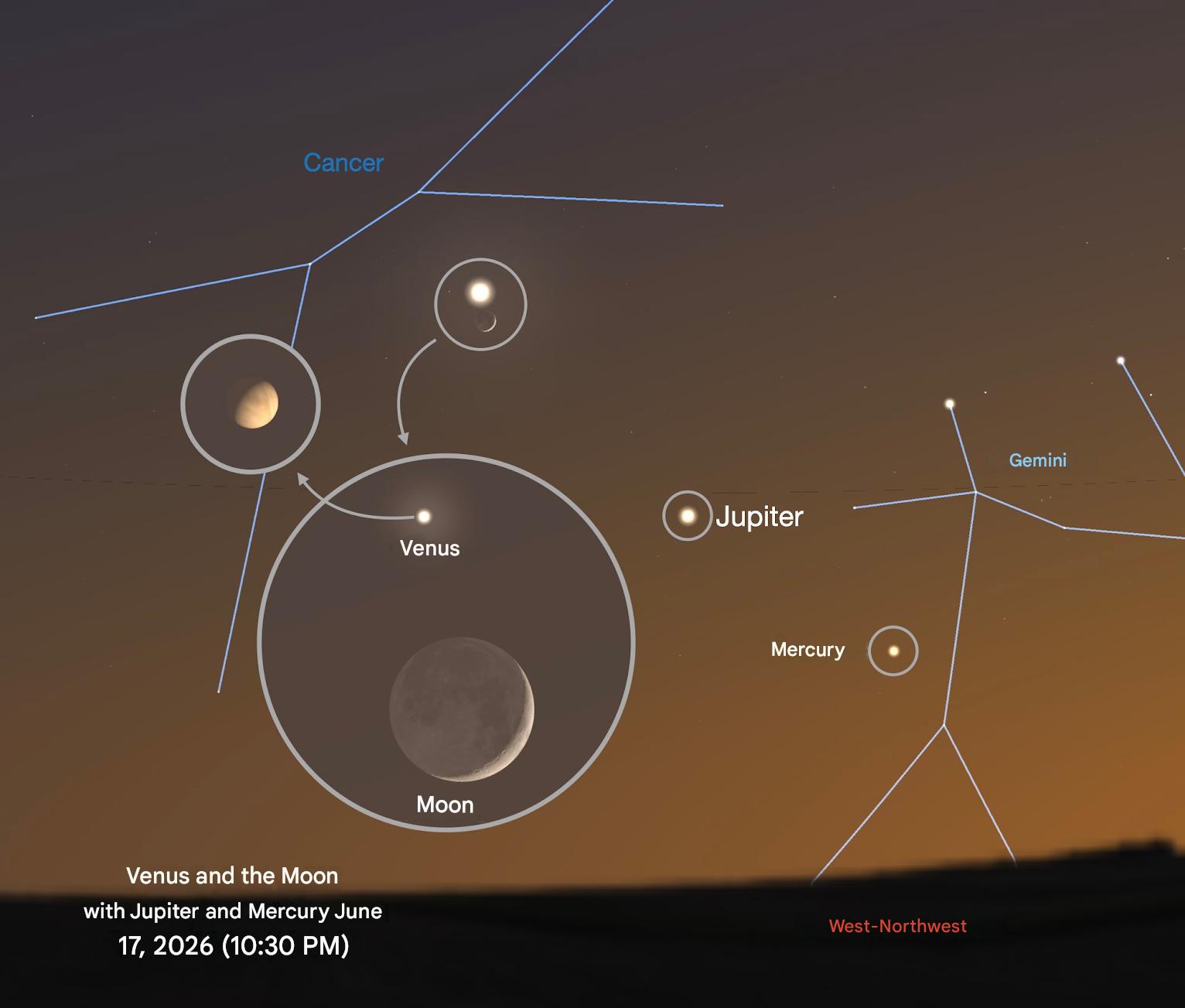
On June 17th, Venus and the Moon will offer a close conjunction in the west. A little less than an hour after sunset (which will be at 9:38 PM in Toulouse), the sky will begin to lose enough of its twilight colors to reveal a remarkably bright Venus (magnitude -3.5) at an altitude of 16°, rising above a crescent Moon illuminated by earthshine . Looking to the right and lower, you can spot Jupiter and Mercury (a clear horizon is essential).
You can attempt this observation earlier, but the sky will be clearer. As a precaution, since you will be looking west, wait until sunset is complete.

Venus, like a sparkling diamond above a crescent moon, on the evening of June 17.
© Cité de l’espace/Stellarium

THE MOON AND REGULUS

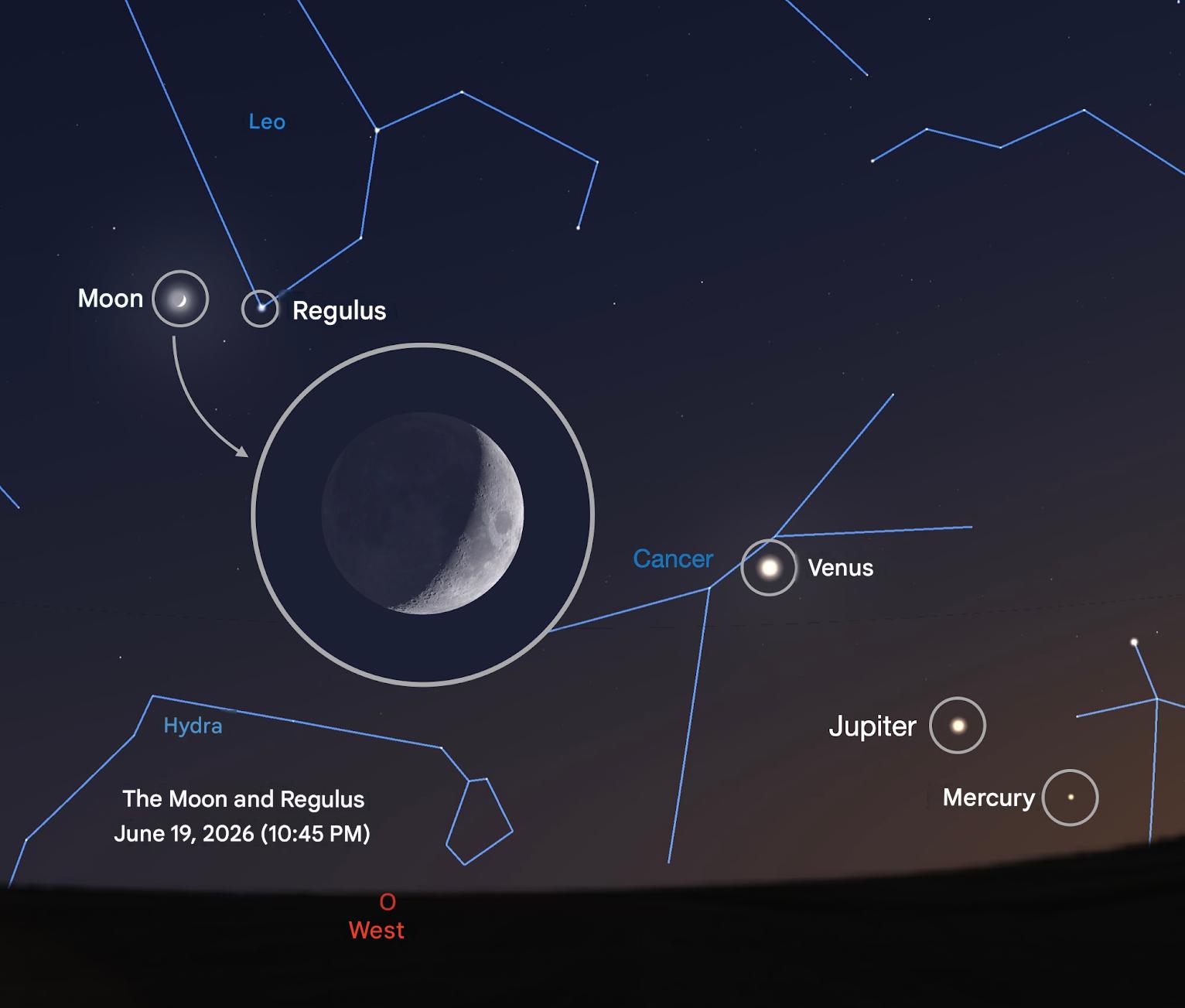
On June 19, a crescent Moon will grace the sky near Regulus. This conjunction will be easily visible about 20 degrees above the western horizon. With a magnitude of 1.4, Regulus is the brightest star in the constellation Leo , hence its other name, Alpha Leonis. The conjunction with the Moon on June 19 provides an opportunity to reflect on the vastness of astronomical distances. Although Regulus is a “neighbor” in the grand scheme of our Milky Way galaxy, it is still 79 light-years away, while the Moon is approximately 1 light-second distant.

The Moon and Regulus, close in the sky on June 19, but yet so far apart in distance.

© Cité de l’espace/Stellarium

THE MOON AND SPICA

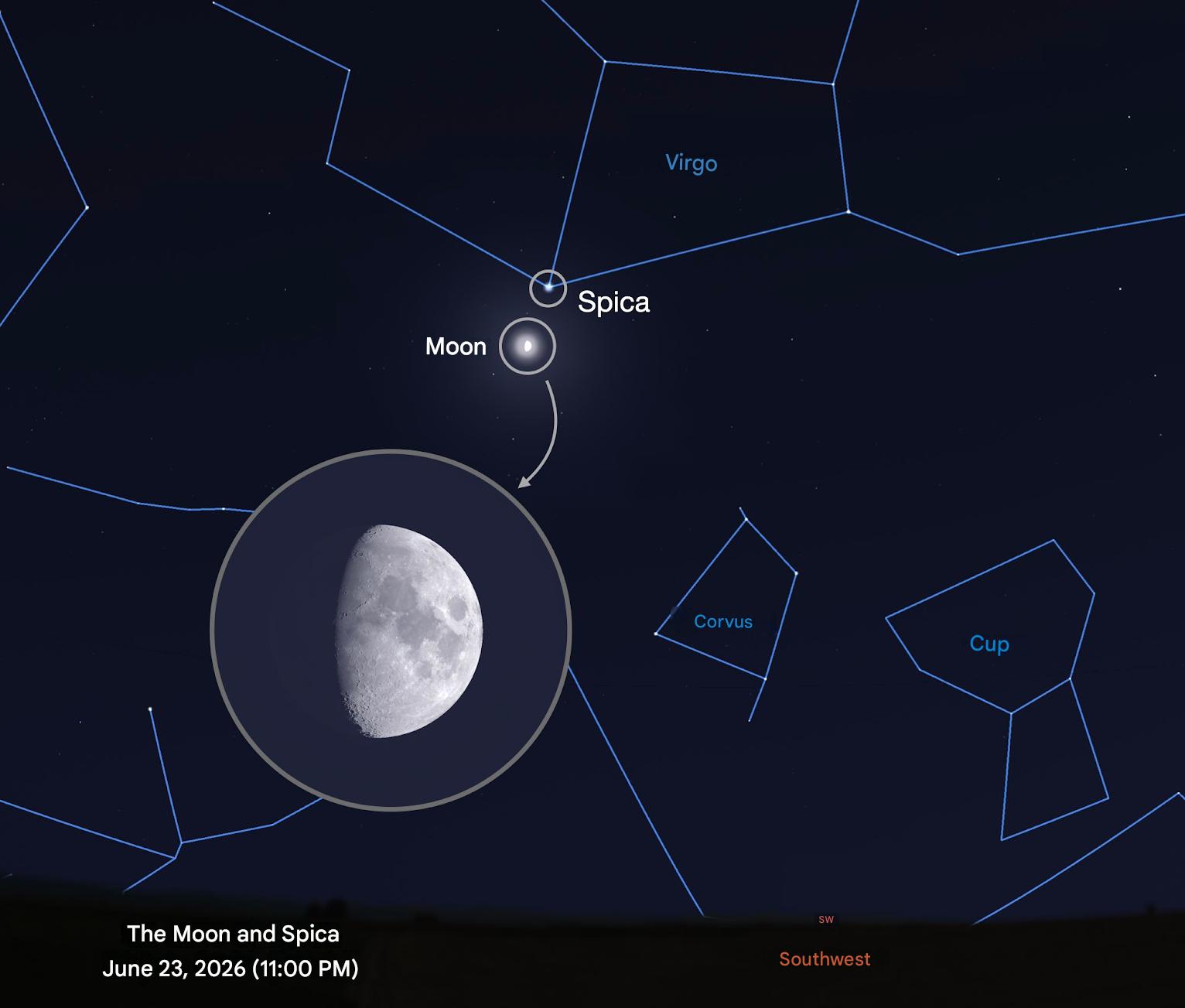
After Regulus, on June 23, the Moon will pass close to another bright star, Spica in Virgo . The pair will be about 30 degrees above the southwest horizon around 11 p.m. With a magnitude of 1, Spica is the brightest star in its constellation and is nicknamed the “Stalk of Virgo .” It is also the fifteenth brightest star in the night sky. Spica is 250 light-years away from us.

Spica above the Moon on June 23rd.

© Cité de l’espace/Stellarium

THE MOON AND ANTARES

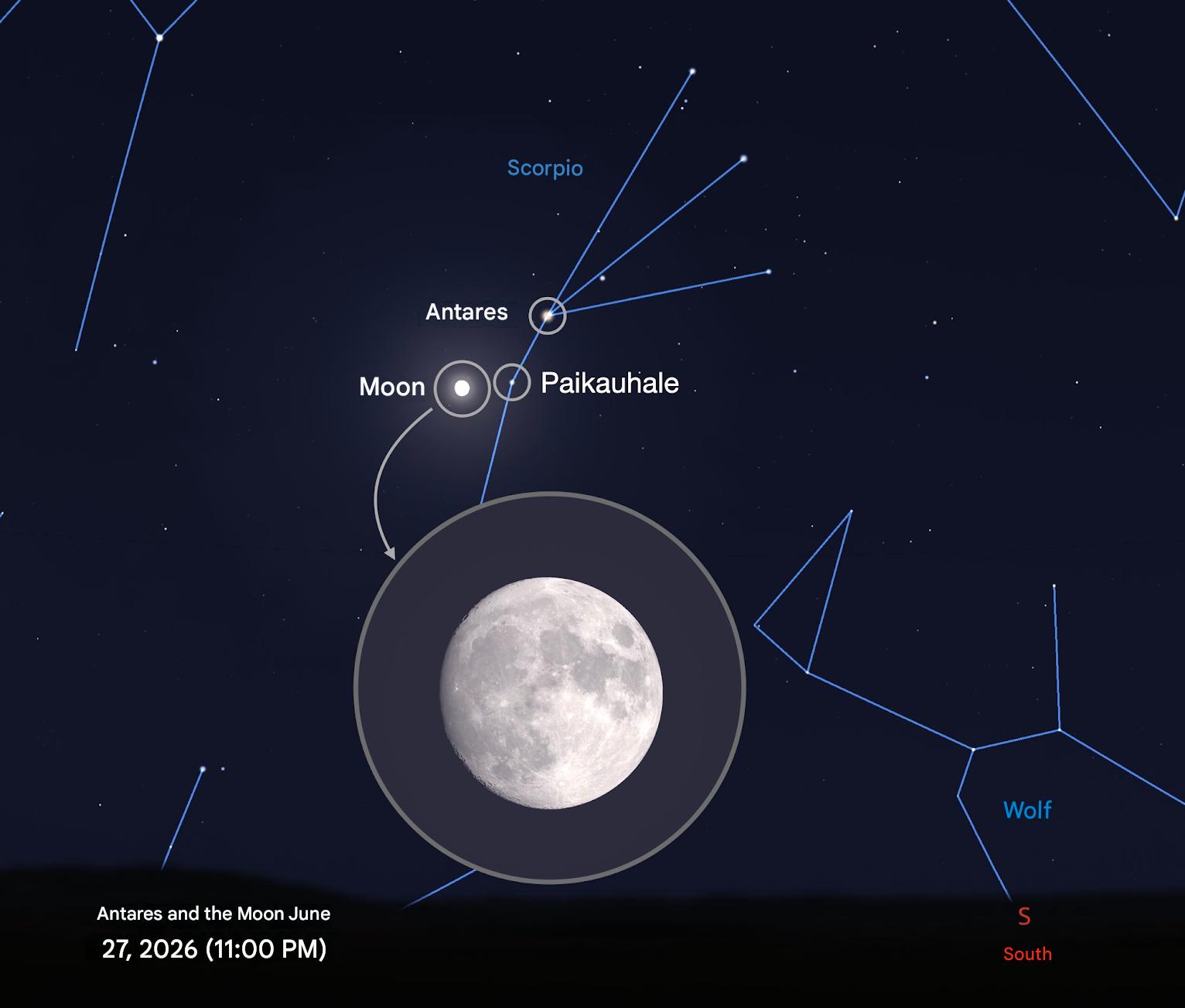
Four days later, on June 27, it was Antares’ turn to be “visited” by the Moon. In about ten days, the June sky will have offered us three classic pairings between our natural satellite and “alpha” stars of their constellation. Antares (or Alpha Scorpii) is the brightest star (magnitude 1) in Scorpius . While our natural satellite will be barely more than a light-second away, the light from Antares will have taken 550 years to reach us. This star is a red supergiant that would largely encompass the orbit of Mars if it were in the place of our Sun. It should be noted that the Moon will be particularly close to Paikauhale, a much more modest star of magnitude 3. The brightness of the Moon, illuminated at 96%, could even “overshadow” this star.

The Moon and Antares will be a little over fifteen degrees above the   South-Southeast horizon on June 27 at 23:00.

© Cité de l’espace/Stellarium

Related articles