• Astronomy

The sky in January 2026

Published on 19 December 2025

For the first month of the year, the Moon will be in "Super" mode on January 3rd, but it will mainly help us spot Jupiter and Saturn. The interesting Quadrantid meteor shower will be disrupted by the Full Moon.

The sky in January 2026

On January 3rd, Earth will be at its closest point to the Sun in its orbit, at 147 million kilometers, while it will be at its farthest point on July 6th (152 million kilometers). As every year, this event confirms that it is indeed the tilt of Earth’s axis of rotation that creates the seasons , and not our distance from the Sun.

All times shown on this page are those of legal time in metropolitan France (the time shown on your watch). The maps are calculated for Toulouse, but remain essentially applicable to metropolitan France.

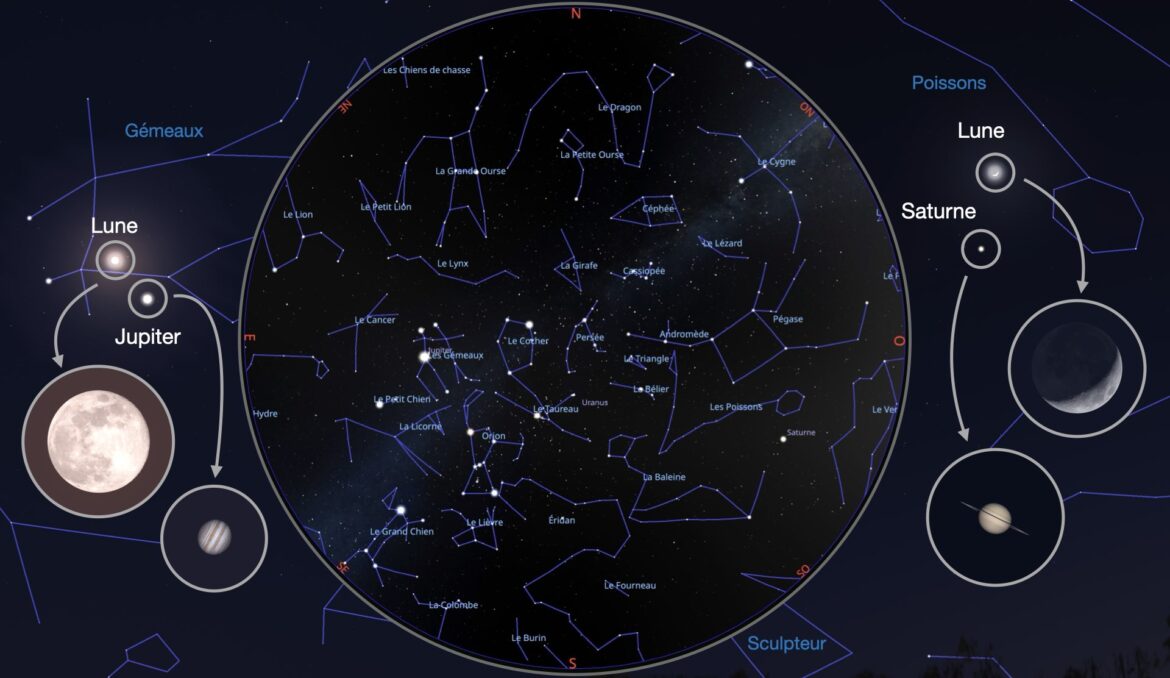
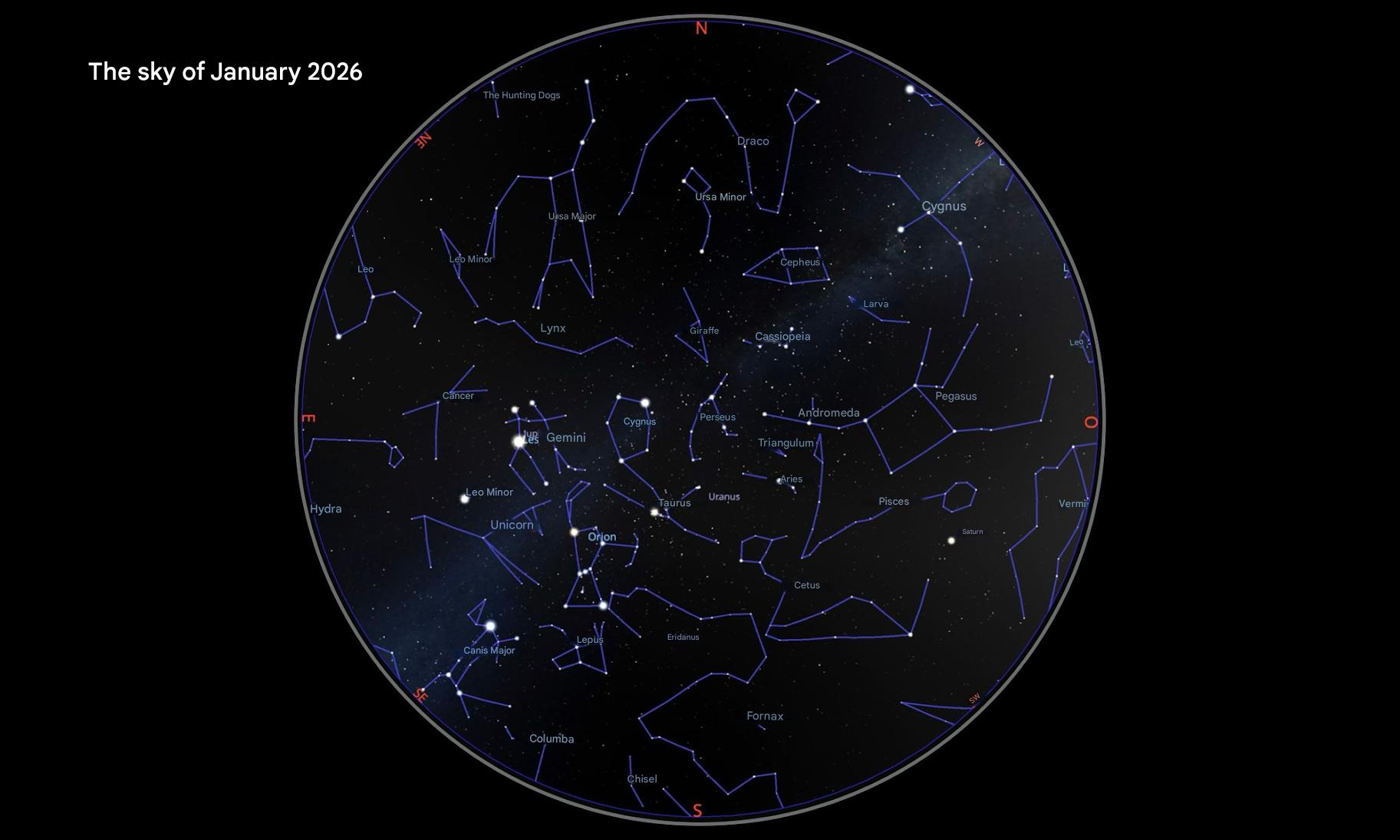
This map shows the sky for Toulouse on January 15th at 9:00 PM (local time, i.e., your watch time).
It is largely valid for the month of January across mainland France, except for the position of the Moon, which is not shown as having risen on this map.
© Cité de l’espace/Stellarium

THE “SUPER” MOON AND JUPITER

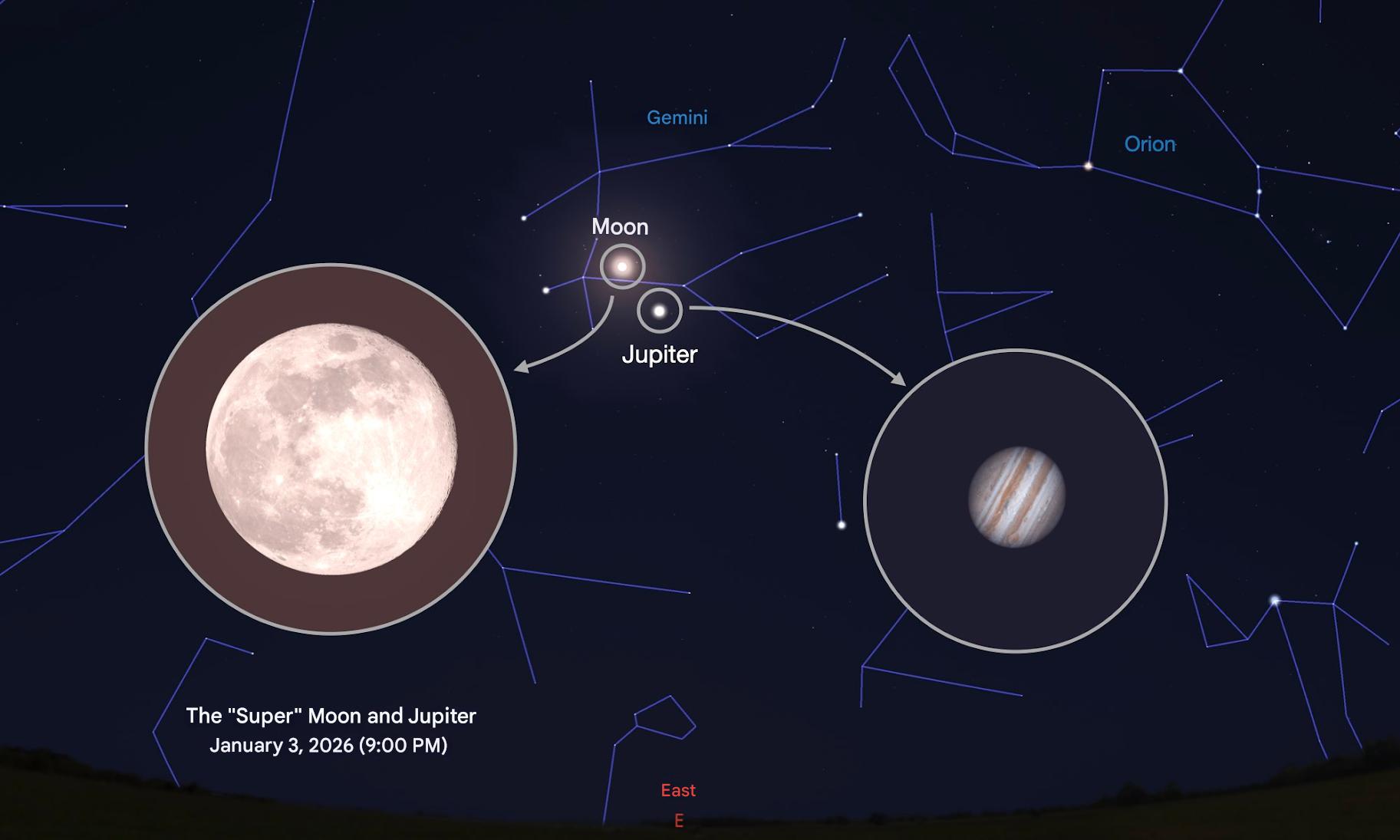
After appearing over the last three months of the year, the highly publicized “Super” Moon arrives in 2026 on January 3rd . It occurs at precisely 11:03 AM and will therefore not be visible in mainland France at that exact time. This full moon actually rises over Toulouse at 5:25 PM.
It’s worth remembering that a Supermoon isn’t actually anything truly “Super” or exceptional. It’s simply a full moon that occurs when our natural satellite is at its closest point to Earth in its orbit. The late American scientist Fred Espenak established a scale based on the Earth-Moon distance, ranging from 0 to 1 (0 being the farthest point and 1 the closest). A full moon is designated “Super” from 0.9 to 1. The one on January 3rd occurs with a relatively modest “Espenak scale” of 0.956. The Moon will be 362,312 km from Earth.
The most interesting thing to do will be to use the Full Moon to locate Jupiter . The largest planet in the Solar System will already be quite bright in the sky, but thanks to our natural satellite, there’s no mistaking it!

The first Full Moon (called a Supermoon) of 2026 will occur on January 3rd. Jupiter will be close to it.
© Cité de l’espace/Stellarium

THE QUADRANTID METEOR SHOWER

What better way to start a new year than with a beautiful shower of shooting stars (sorry, meteors)? Let’s hope this shower isn’t disrupted by the Moon!

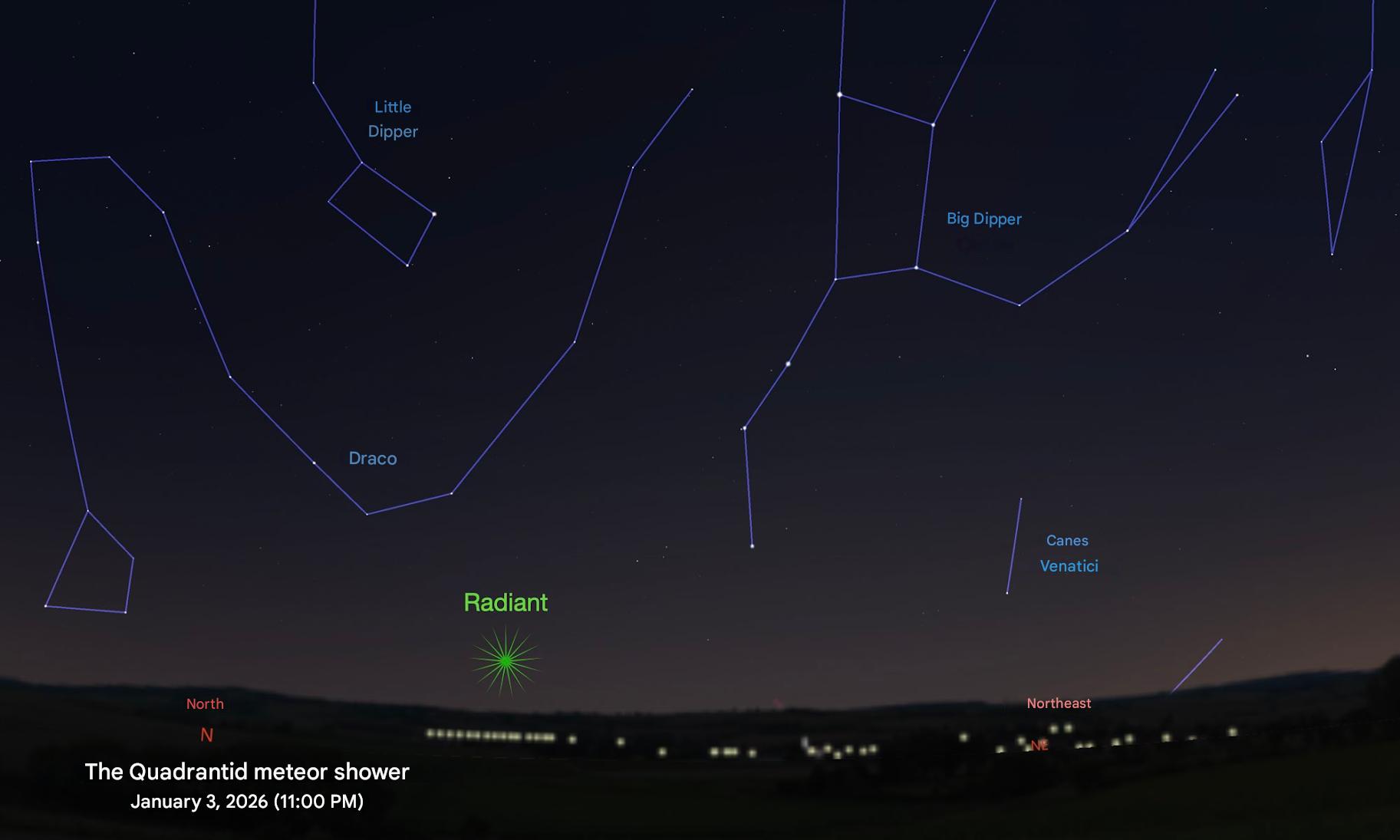
The radiant (the point from which shooting stars appear to originate due to perspective) of the Quadrantids is located in the constellation Boötes. The name, however, still comes from a constellation, Quadrant, but it was removed from catalogs in 1922. The name of the meteor shower remained.
For 2026, the peak of the Quadrantids is predicted for January 3rd around 10 PM . This time is normally favorable, as the sky will already be quite dark. Furthermore, the Quadrantids produce up to a hundred shooting stars per hour under perfect conditions, and about twenty in practice. Unfortunately, this 2026 display will be spoiled by the bright light of the full moon, which will significantly reduce the number of visible meteors.

For your information, the “shooting stars” of the Quadrantids originate from dust scattered by 2003 EH, an object 2 to 4 km wide considered to be an extinct comet.

The radiant of the Quadrantids will be low on the north-northeast horizon on January 3rd at 11 PM. This position isn’t really a problem, because to enjoy a meteor shower, you need to watch the entire sky. However, the brightness of the full moon will obscure most of the meteors.
© Cité de l’espace/Stellarium

JUPITER’S OPPOSITION

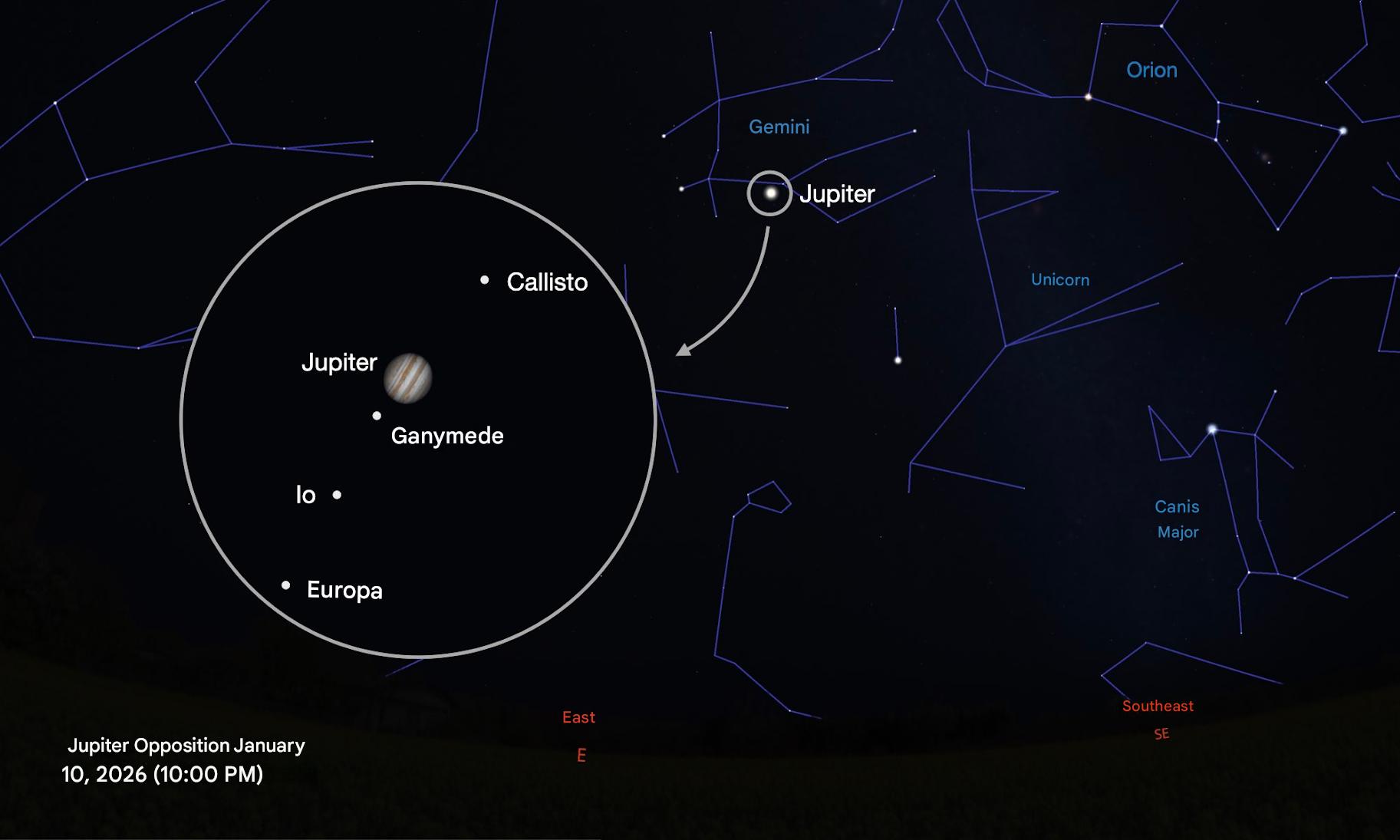
On January 10th, the largest planet in the Solar System is at opposition . This means that our star, the Sun, Earth, and Jupiter are aligned in that order. A subtle detail of celestial mechanics: the closest distance between us and Jupiter (for this opposition) occurred the previous day, January 9th, at 633 million kilometers. Naturally, this is a very favorable time to observe Jupiter with binoculars or a telescope . Amateur astronomers generally wait until the planet is higher in the sky after sunset, because the higher it is above the horizon, the less atmospheric turbulence there is (the planet is viewed through a thinner layer of Earth’s atmosphere). For example, at 10 PM on January 10th, the gas giant will be at an altitude of 47° , providing excellent viewing conditions. With a good pair of binoculars, and even more so a telescope or spotting scope, you can easily see Jupiter’s main moons, which that night will be in this order: Europa, Io, Ganymede and Callisto.

On January 10th, Jupiter is at opposition.

© Cité de l’espace/Stellarium

SATURN AND THE MOON

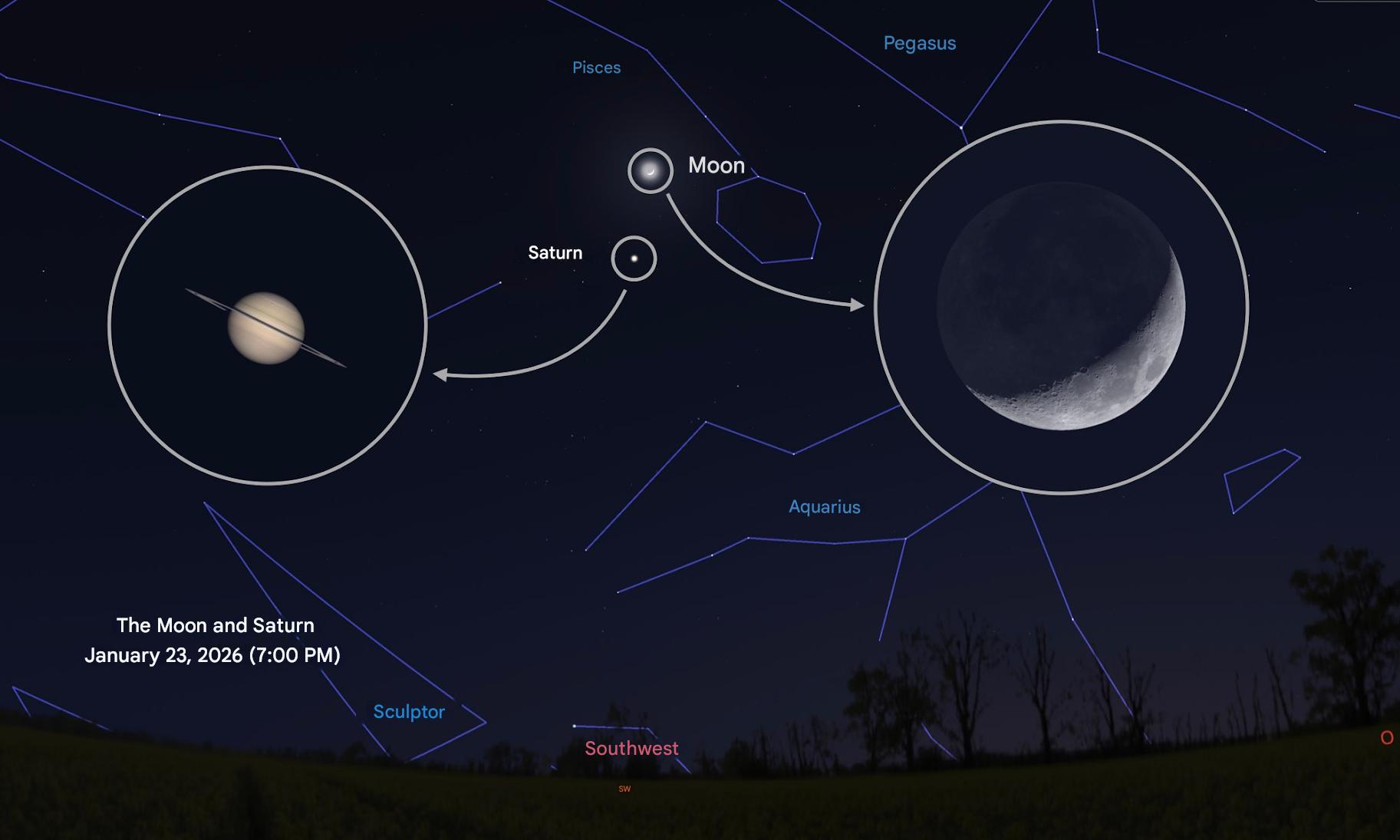
On January 23, the Moon will help you easily spot another gas giant . This time, a nearly 5-day-old crescent will be your guide. You’ll find it easily at 7:00 PM, almost 40° above the southwest horizon. Below it, look for the brightest star in this area of ​​the sky, with a slightly yellowish glow. It’s not a star, but Saturn . With good binoculars, you’ll see that its rings are still somewhat closed. At the end of March 2025, they were “seen” (or rather, “not seen”) edge-on. From now on, the angle will become increasingly favorable, reaching its maximum in 2032.

A crescent moon and Saturn form a beautiful duo at about forty degrees above the Southwest on January 23 at 7:00 PM.

© Cité de l’espace/Stellarium

JUPITER AND THE MOON

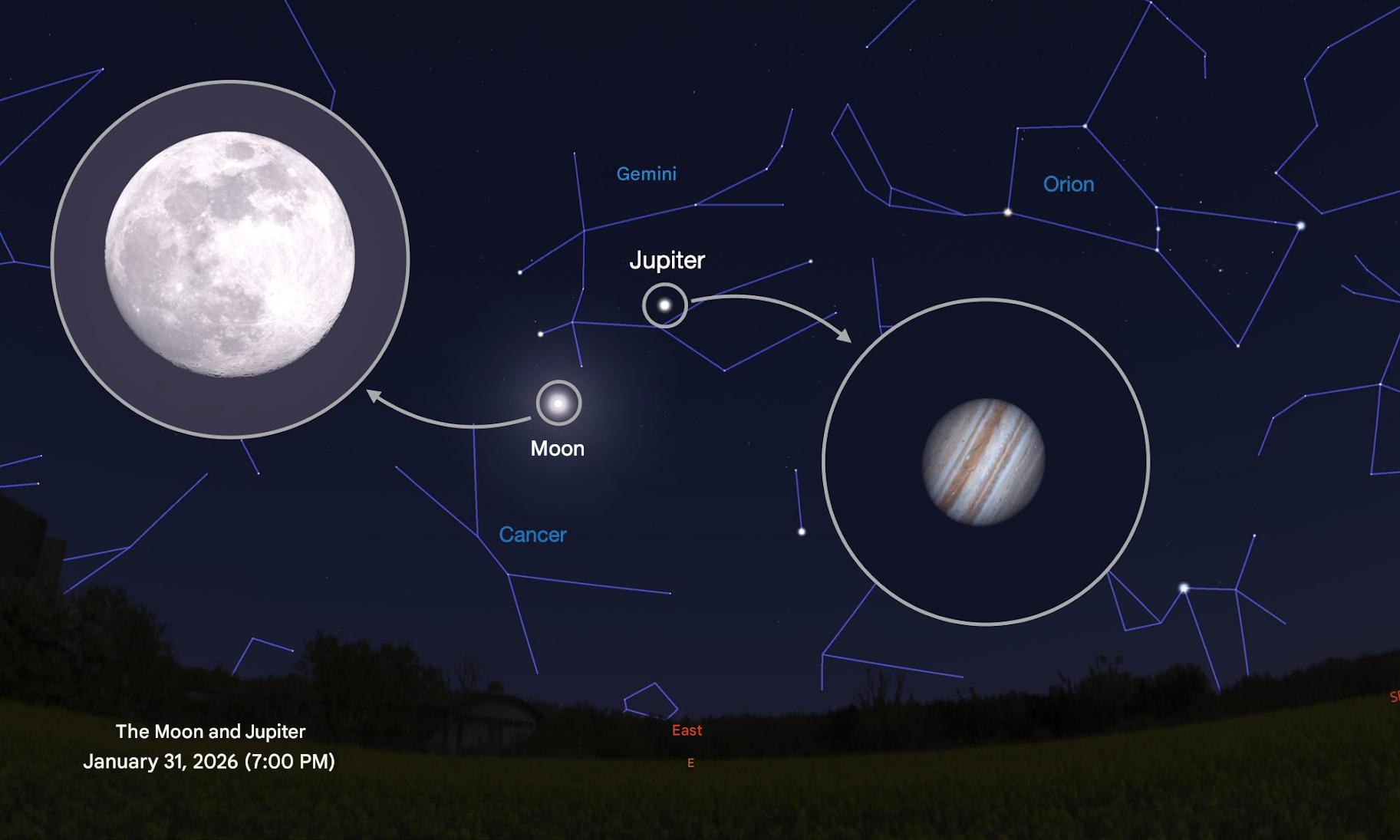
On January 31st, we see the return of the Jupiter-Moon duo , but this time the two celestial bodies are a little further apart than on January 3rd. The spectacle remains beautiful, and as the night progresses, the pair will climb even higher in the sky.

On January 31st at 7pm, Jupiter and the Moon dominate the eastern horizon.

© Cité de l’espace/Stellarium

Related articles