• Crewed Flights

The crew of Soyuz MS-29 has arrived at the International Space Station

Published on 15 July 2026

The Soyuz MS-29 docked with the ISS in three hours. Anil Menon, Pyotr Dubrov, and Anna Kikina are beginning an eight-month mission there, joining Sophie Adenot to prepare for Expedition 75 and continue research in orbit within a framework of strengthened international cooperation until 2030.

The crew of Soyuz MS-29 has arrived at the International Space Station

It took them just three hours to reach the ISS . On July 14, 2026, the crew of Soyuz MS-29 arrived at the orbital complex after a rapid flight . Aboard the Russian spacecraft, astronaut Anil Menon and cosmonauts Pyotr Dubrov and Anna Kikina began an eight-month mission . Their arrival temporarily brought the number of occupants on the station to ten , marking the beginning of a handover phase before the return of Soyuz MS-28 and the transition to Expedition 75.

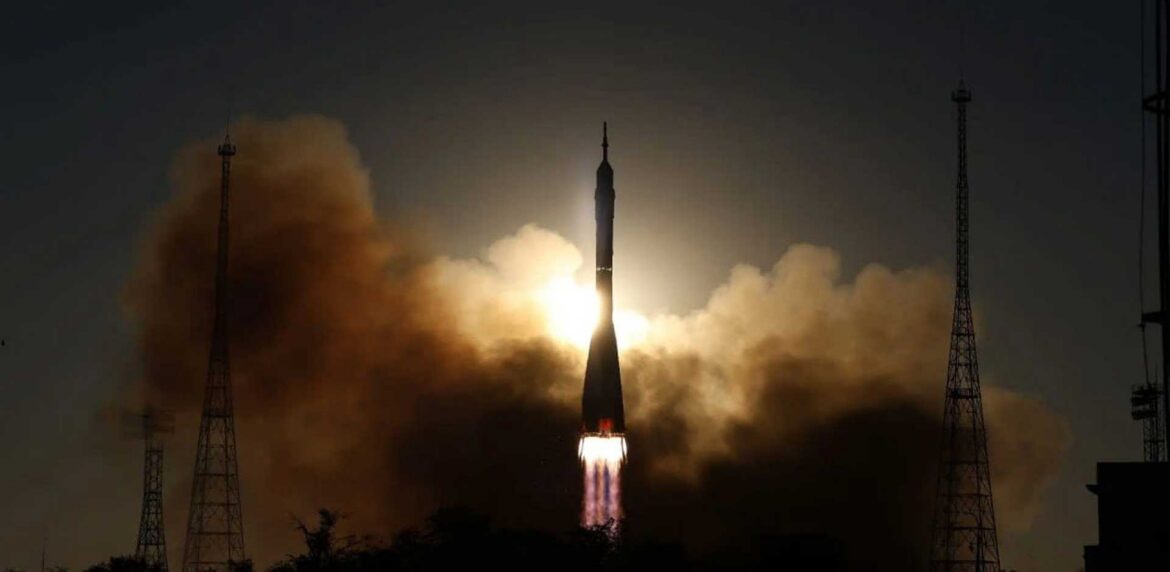
Sophie Adenot and four other astronauts already on the ISS gathered in the Cupola to watch the launch of the MS-29 mission. They managed to capture the plume of the Soyuz 2.1a .

© NASA / ESA

An orbital rendezvous in three hours

From takeoff to automated docking

The Soyuz 2.1aa rocket lifted off from Launch Complex 31 at the Baikonur Cosmodrome on July 14, 2026, at 4:47 p.m. Paris time. Thanks to an optimized two-orbit trajectory, the spacecraft approached the International Space Station in just three hours and four minutes. Docking with the Prichal module occurred automatically at 7:52 p.m., under the supervision of Roscosmos and NASA control centers. Then, after a series of leak checks, the hatch opening was confirmed around 10:30 p.m. The launch was closely followed by the crew already aboard the ISS . On her X account , Crew-12 commander Jessica Meir explained that they were preparing for their arrival. ” We are so excited to welcome our new crewmates.” “We’ve prepared their supplies and will welcome Pyotr, Anna, and Anil with the biggest floating hugs we can offer,” she commented after posting a photo of the American astronaut’s cabin. Along with Sophie Adenot , Jack Hathaway , Chris Williams, and Sergey Kud-Sverchkov , the current ISS commander, they watched the launch from the Cupola. They managed to capture the “feather” of the launch , the jet of very hot gases expelled by the engines at liftoff.

Towards Expedition 75

The crew’s first impressions

The arrival of Soyuz MS-29 marks the beginning of a twelve-day handover period with the crew of Soyuz MS-28 . After their departure on July 26, the team, composed of ESA astronaut Sophie Adenot , along with Jack Hathaway, Andrey Fedyaev, and Jessica Meir, will officially transition from Expedition 74 to Expedition 75. During the welcoming ceremony, Russian astronaut Pyotr Dubrov , on his second mission and with 355 days already spent in space, expressed his emotion. ” I feel like I’m returning to something I know so well , a place where I’ve spent a lot of time. I feel like my business trip was to return to Earth , and now here I am, back home .” His Roscosmos colleague, Anna Kikina, emphasized the warm welcome they received. “ It’s a great tradition when the arriving crew is greeted by the smiling faces of our crewmates. These traditional hugs are incredible; they’re so warm and heartfelt .” Finally, American astronaut Anil Menon, on his first mission, shared his enthusiasm upon arriving at the station. “ The station is a sight to behold and a testament to what we are capable of achieving  .”

A few minutes after their arrival, the three new crew members participated in a welcoming ceremony. The ISS now has ten crew members before the return of MS-28, scheduled for July 26.

© NASA

NASA – Roscosmos: a partnership renewed until 2030

The heads of NASA and Roscosmos met in Baikonur to discuss the future of their cooperation 

On the sidelines of the Soyuz MS-29 docking , officials from the American and Russian space agencies reaffirmed their commitment to continuing their scientific collaboration.  Dmitry Bakanov, Director General of Roscosmos, announced that an agreement in principle had been reached to extend the station’s operation: ” We have agreed in principle on the conditions for extending the ISS’s operations until 2030 , and of course, since the Russian and American segments are part of the ISS , there will be the same cross-flights using both Russian crews and NASA astronauts .” For his part, Jared Isaacman emphasized the importance of this partnership for maintaining a continuous human presence in orbit. ” The ISS serves as a prime example of how cooperation between Russia and the United States works,” the NASA administrator noted . “It is only through such interaction that it is possible to ensure a permanent Russian and American presence in space.” We will continue to do so in the future for as long as possible .” This seat-exchange system between the Soyuz spacecraft and the Crew Dragon spacecraft, established by an agreement in 2022, ensures that at least one representative from each country is always present on board to maintain their respective segment in case of unforeseen circumstances.

nasa_roscomos

Dimitry Bakanov, the director general of the Russian agency Roscomos, and Jared Isaacman, the NASA administrator, met in Baikonur.

© Roscomos

Related articles