
• Launch
  • Moon

How will the Artemis II mission around the Moon unfold?

Published on 18 March 2026

From Earth orbit to a flyby of the Moon at over 400,000 km, discover how the Artemis II mission will unfold. This ten-day flight will test the systems of the Orion spacecraft to prepare for humanity's return to the lunar surface.

How will the Artemis II mission around the Moon unfold?

The Artemis II mission will be the first crewed flight to the Moon in over fifty years . Scheduled to last approximately ten days , this expedition will take four astronauts around our satellite aboard the Orion spacecraft . The objective is to verify the capsule ‘s ability to sustain a crew in deep space and to validate flight procedures for future missions. This test flight will mark a key step before the extended return of humans to the lunar surface . It will be followed in 2027 by Artemis III, which will consist of a rendezvous in Earth orbit between the Orion capsule and the lunar lander(s) SpaceX’s Starship and/or Blue Origin’s Blue Moon . Finally, in 2028, the Artemis IV mission plans to land on the Moon and see the first woman walk on its surface.

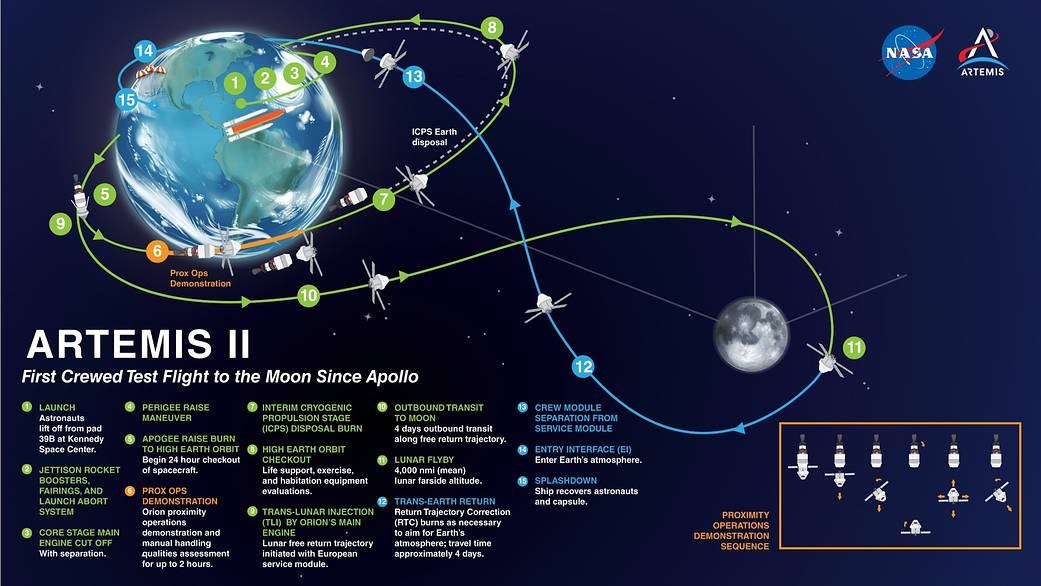
The flight plan for the Artemis II mission.

© NASA

The departure

Day 1: Launch and local demonstration

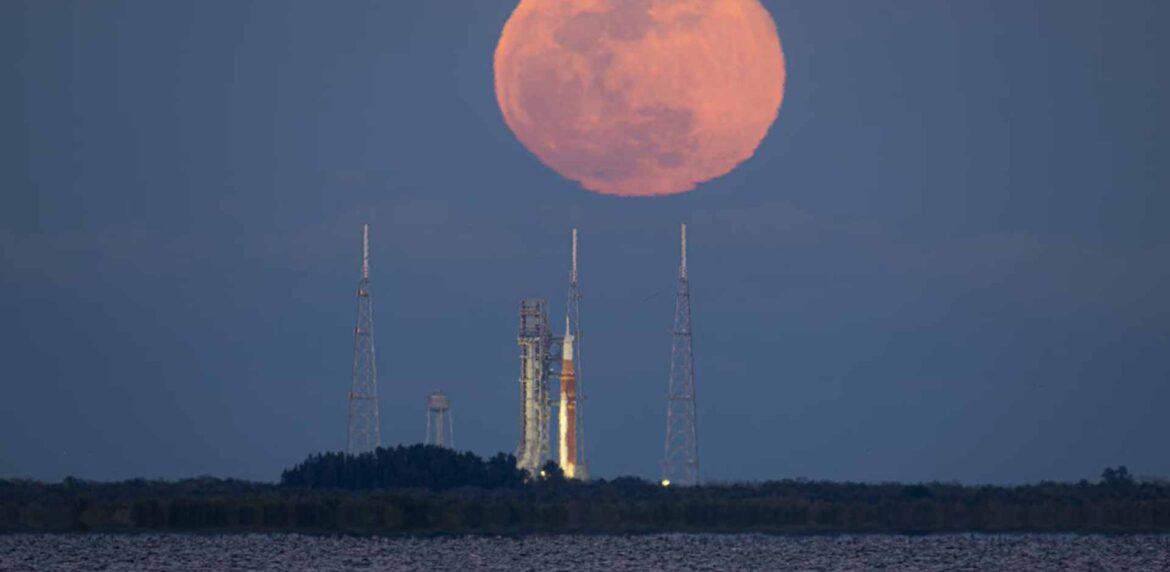
On the first day, the 98-meter-tall SLS rocket will lift off from the Kennedy Space Center. To escape gravity, the 2,721.5-ton rocket will generate approximately 3,991 tons of thrust . Eight minutes after liftoff, the Orion spacecraft and its crew  will be in orbit. The crew consists of Commander Reid Wiseman, Pilot Victor Glover, Mission Specialist Christina Koch, and Canadian Mission Specialist Jeremy Hansen. Once orbit is reached, the ICPS upper stage will perform maneuvers. About 49 minutes after liftoff, it will raise the orbit to an altitude of 160 km, and then to a high orbit about an hour later. Approximately three hours after launch, the astronauts will conduct a proximity operations demonstration . They will manually pilot Orion to approach and move away from the ICPS stage to test the spacecraft’s maneuverability. Then, after eight and a half hours of flight, the crew will take a short rest period before performing an engine start-up to prepare for the rest of the journey.

The Road to the Moon

Day 2: Translunar injection and physical exercise

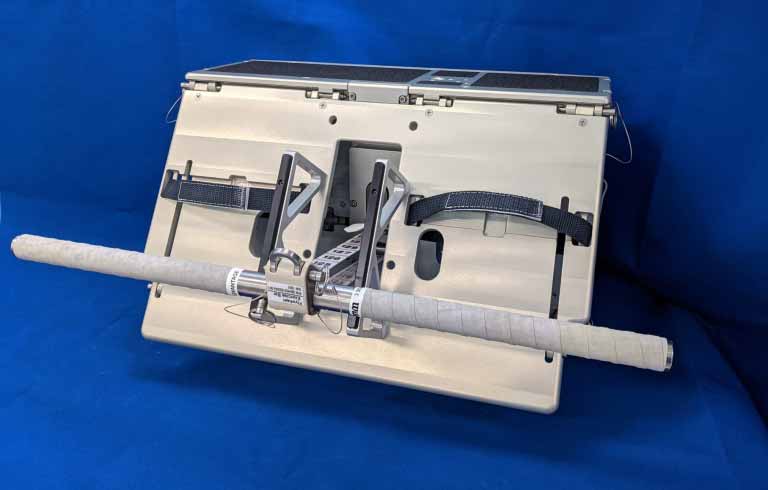
On the second day, the main engine of the European service module will deliver 2.7 tonnes of thrust during the translunar injection (TLI) . This maneuver, prepared by Kristina Koch, will propel Orion out of Earth orbit. The capsule will then be launched around the Moon on a free-return trajectory before returning to Earth . The crew will also test the exercise device , a type of rowing machine designed to allow them to exercise for approximately 30 minutes per day. This device, significantly smaller than the instruments aboard the ISS, could be used during long-duration missions.

Days 3 and 4: Trajectory corrections and medical tests

On the third day, the crew will make their first trajectory correction shortly after their lunch break. Next, they will conduct a simulation of a medical emergency aboard the capsule . Victor Glover, Christina Koch, and Jeremy Hansen will perform a demonstration of cardiopulmonary resuscitation (CPR) in microgravity, while Reid Wiseman and Victor Glover will check the onboard medical equipment . On the fourth day, a second correction will refine the route to the Moon. Then, the astronauts will spend an hour studying the targets they will photograph on the Moon two days later. They will try to orient themselves to minimize the time lost during their closest approach. Finally, they will have 20 minutes dedicated to taking photographs through the lunar window.

The flywheel, a kind of space rower, will be tested by the crew in groups of two.

© NASA

NHQ202512200048~medium

The astronauts will train to quickly put on the orange, intravehicular suits, which are used for the takeoff and splashdown phases and in case of accidental depressurizations.

© NASA

The arrival in the lunar influence

Day 5: Entry into the lunar zone and testing of the spacesuits

On the fifth day, Orion will enter the Moon’s sphere of influence , where lunar gravity becomes dominant. The morning will be dedicated to testing the orange “Orion Crew Survival System” suits. The astronauts will practice donning them quickly and eating or drinking through a port on their helmets in case of accidental depressurization. In the afternoon, a final trajectory correction will be performed before the flyby.

The passage behind the hidden face

Day 6: Lunar flyby and distance record

The sixth day will mark the mission’s high point. Orion will pass between 6,400 and 9,600 km from the lunar surface . The astronauts will become the first humans to observe the far side of the Moon since 1972. The mission will likely set a new distance record from Earth, exceeding 400,171 km. This distance was unintentionally set by the crew of Apollo 13 on April 15, 1970. Following the explosion of an oxygen tank, the capsule had taken a trajectory to bypass the Moon, which sent them slightly farther than usual lunar missions. During the pass behind the Moon, a 30- to 50-minute interruption in communications will occur between Earth and the Orion capsule.

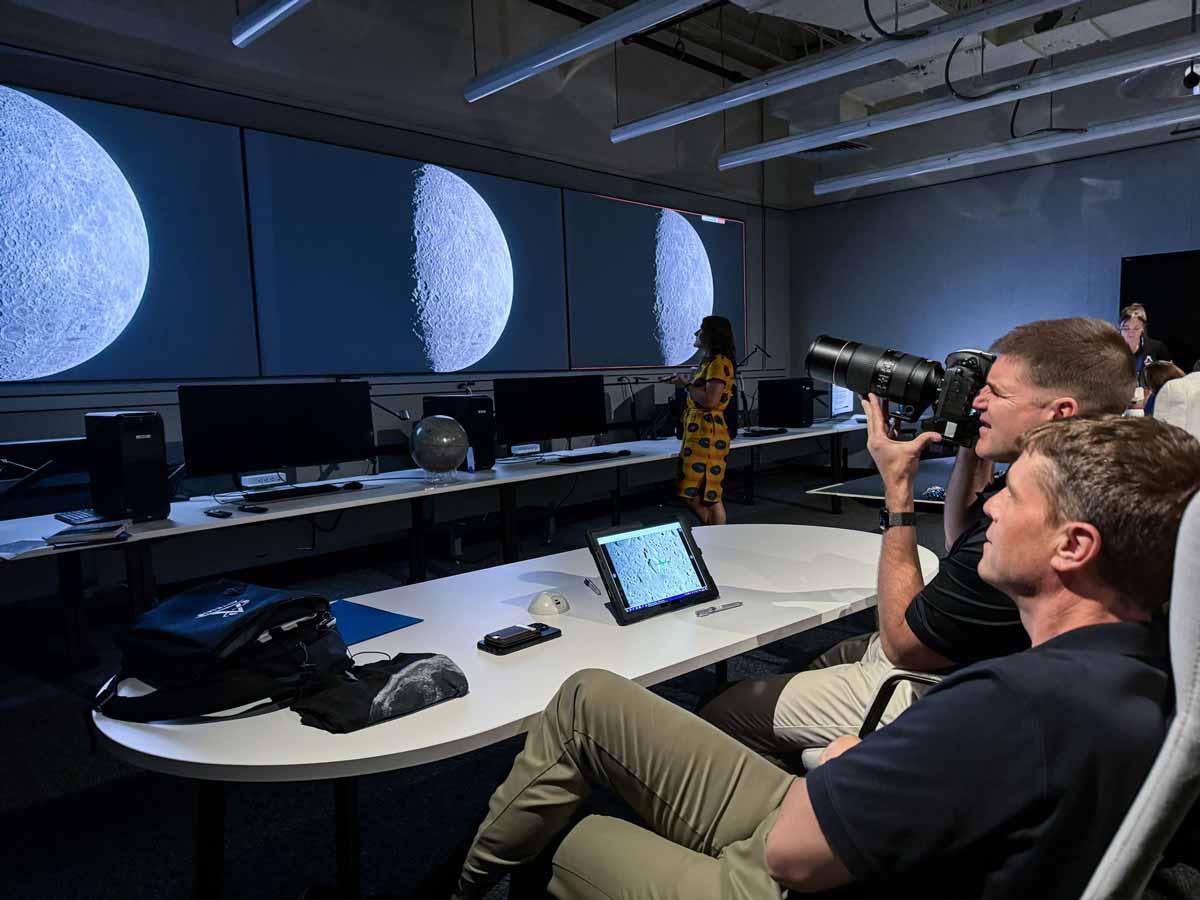
During their training, the crew practiced taking pictures of the Moon.

© NASA

orion-artemis1-images.004

The Orion capsule during the Artemis I mission in November 2022.

© NASA

The return to Earth

Days 7 to 9: Radiations and manual piloting

On the seventh day, the crew will debrief their observations with scientists before leaving the lunar zone of influence. On the eighth day, the astronauts will test their ability to construct a radiation shelter using onboard equipment and practice manually piloting Orion. The ninth day will be devoted to reentry preparations and testing compression garments to help the body cope with the return of gravity.

Atmospheric reentry and recovery

Day 10: Splashdown in the Pacific

On the final day, the command module will separate from the service module before entering the atmosphere at 40,233 km/h . The heat shield will protect the crew from temperatures reaching 2,760°C. A sequence of 11 parachutes will slow the capsule . The main parachutes will deploy at an altitude of 2,743 meters to stabilize the descent. Orion will splash down in the Pacific Ocean at less than 27 km/h, approximately 92 km off the coast of California, where a U.S. Navy team will recover them.

header orion

The Orion capsule, during its recovery on December 11, 2022.

© NASA

Related articles