
• Moon

Artemis II: Proposed launch dates

Published on 12 January 2026

NASA has specified the launch dates for the Artemis II crewed mission around the Moon. Between February 6 and April 30, there are sixteen launch opportunities.

Artemis II: Proposed launch dates

After several postponements, NASA announced in December 2024 that it was planning Artemis II for April 2026. This deadline, covering a full month, was later clarified as ” at the latest ,” with the possibility of a launch as early as the beginning of February . While preparations for the first crewed mission around the Moon in over 50 years were progressing (the launch vehicle is now ready with its Orion capsule and European service module), the launch slots were still not made public. This changed on Friday, January 9, when NASA published a complete schedule of possible dates.

A 10-DAY MISSION

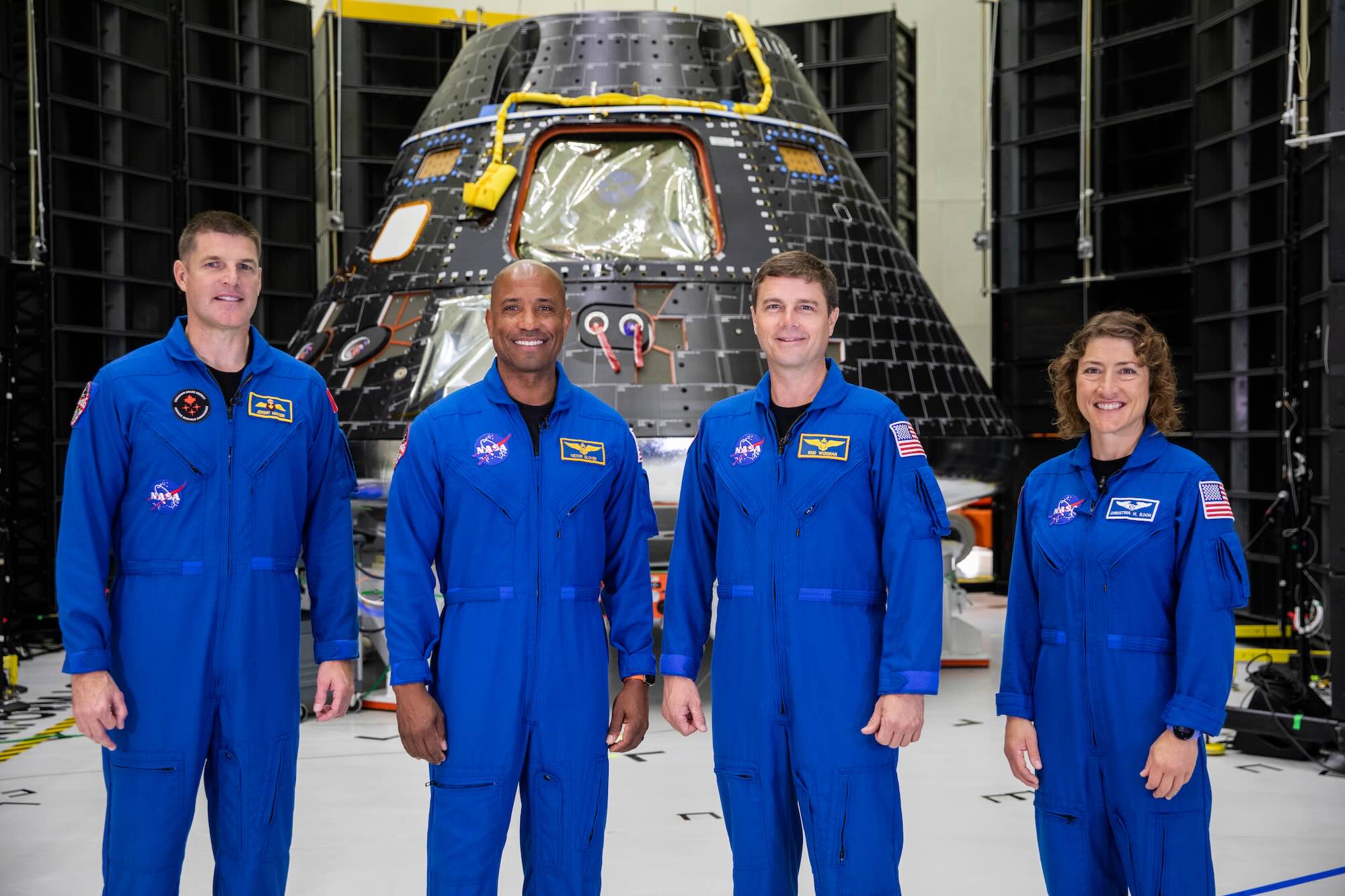
American astronaut Reid Wideman, his compatriots Victor Glover and Christina Koch, and Canadian astronaut Jeremy Hansen will soon become the first people of the 21st century to orbit our natural satellite . This mission, lasting approximately ten days from launch to return to Earth after a lunar orbit, is subject to several constraints, particularly those related to the relative positions of our planet and its natural satellite. The Orion capsule, attached to its European Space Module (ESM) provided by the European Space Agency (ESA), must also avoid being in an eclipse (in the shadow of the Earth or the Moon) for more than 90 minutes. Furthermore, the launch date must be compatible with the desired reentry profile into Earth’s atmosphere at least ten days later.

The crew of Artemis II (from left to right): Jeremy Hansen of the CSA (Canadian Space Agency), followed by his NASA colleagues Victor Glover (pilot), Reid Wiseman (commander), and Christina Koch. Hansen and Koch are mission specialists.
© NASA

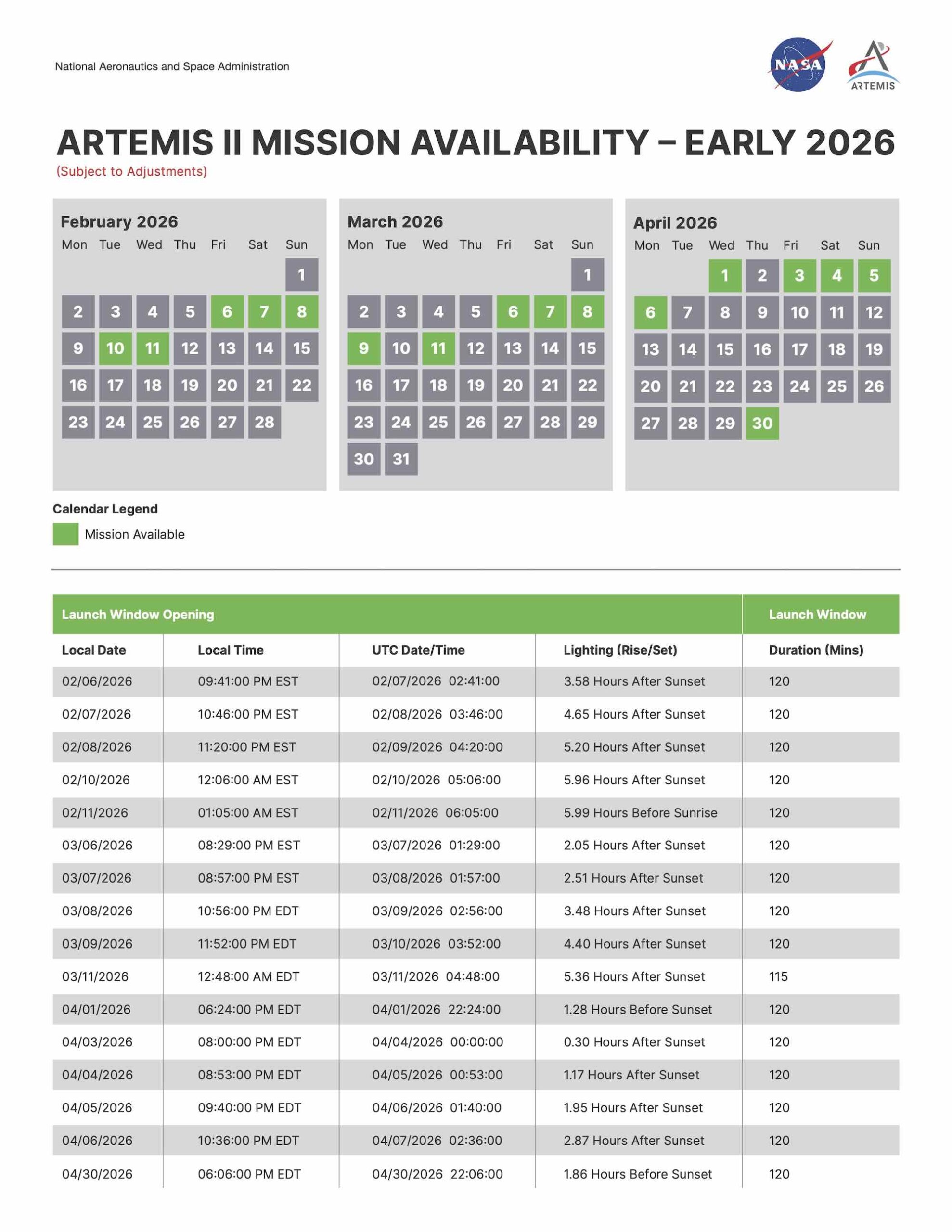
For Artemis II, NASA has selected sixteen dates from February 6 to April 30, 2026. This table of dates and times is in Florida local time, followed by Universal Time (UTC), the time before or after sunrise or sunset, and then the duration of the viewing window in minutes.
© NASA

16 DAYS FOR THE MOON

FROM FEBRUARY 6TH TO APRIL 30TH

Taking all these constraints into account, five possible launch days are identified each month from February to April, with a sixth possibility for April (Florida local time). For each date, the launch window lasts 120 minutes (except for March 11, which is 115 minutes), meaning the 98-meter-tall SLS (Space Launch System) rocket has approximately two hours from the designated time to launch while respecting the various travel constraints. This provides some leeway to resolve any potential technical issues that may arise during the countdown. The launch will take place from Launch Complex 39B at NASA’s Kennedy Space Center in Florida, the same launch pad used for Artemis 1.

REMINDER: YOUR NAME ON BOARD ARTEMIS II

Don’t forget that you have until January 21st to send your name around the Moon with Artemis II.

DATES AND TIMES FOR METROPOLITAN FRANCE

FEBRUARY

Saturday, February 7 at 3:41 AM (February 6 in Florida)
Sunday, February 8 at 4:46 AM (February 7 in Florida)
Monday, February 9 at 5:20 AM (February 8 in Florida)
Tuesday, February 10 at 6:06 AM (same day in Florida, as it is just after midnight)
Wednesday, February 11 at 7:05 AM (same day in Florida)

MARCH

Saturday, March 7 at 2:29 AM (March 6 in Florida)
Sunday, March 8 at 2:57 AM (March 7 in Florida)
Monday, March 9 at 3:56 AM* (March 8 in Florida)
Tuesday, March 10 at 4:52 AM (March 9 in Florida)
Wednesday, March 11 at 5:48 AM (same day in Florida, as it is 48 minutes past midnight)

APRIL

Thursday, April 2nd at 00:24 (April 1st in Florida)
Saturday, April 4th at 02:00 (April 3rd in Florida)
Sunday, April 5th at 02:53 (April 4th in Florida)
Monday, April 6th at 03:40 (April 5th in Florida)
Tuesday, April 7th at 04:36 (April 6th in Florida)
Friday, May 1st at 00:06 (April 30th in Florida)

(*) The United States switches to daylight saving time on March 8, so from that date onward, there is only a 5-hour time difference between Florida and Metropolitan France.
France switches to daylight saving time on March 29, so in April, the time difference with Florida is again 6 hours.

THE NEXT STEPS

A COMPLEX COUNTDOWN

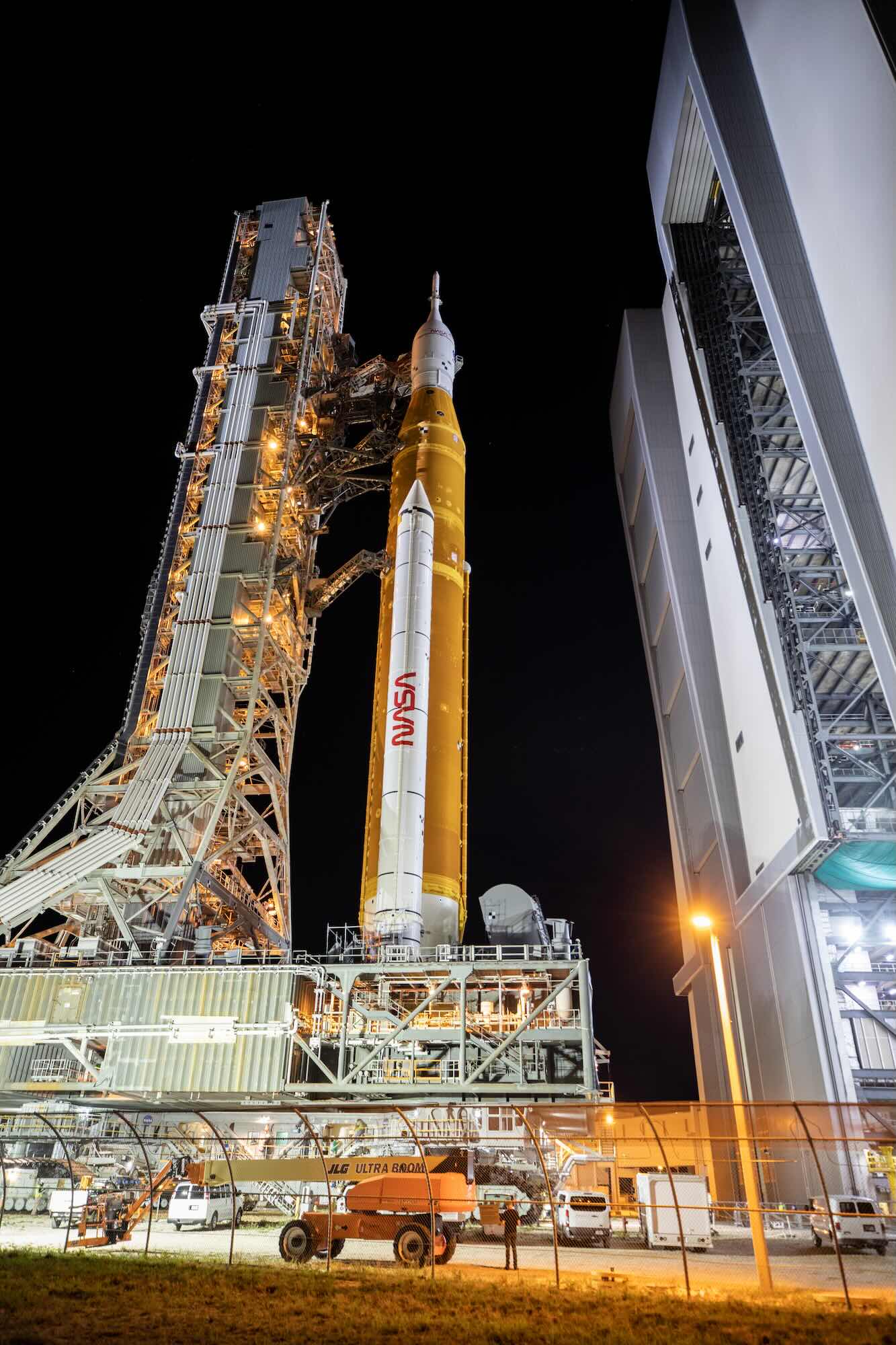
NASA plans to move the SLS out of the massive Vehicle Assembly Building (VAB) no earlier than January 17. The journey of just over 6 km to launch pad LC-39B (a legacy of the Apollo program, like the VAB) is expected to take approximately 12 hours.
At the end of January, teams at the Kennedy Space Center will conduct a full countdown, including fueling the SLS’s tanks .

This complex 48-hour countdown will be conducted as if the SLS launch vehicle were about to lift off with its crew on board, but it will be interrupted before the engines ignite. The procedure is called a wet dress rehearsal (or WDR), because ” wet ” refers to the filling of the tanks for a dress rehearsal . This
test under real-world conditions will allow for fine-tuning the procedures and identifying any potential problems. If all goes perfectly, the launch could target the first launch opportunities in February . However, NASA warns in its press release that “additional rehearsals may be necessary to ensure the launch vehicle is fully checked and flight-ready .” The possibility of having to return the SLS to the Vehicle Assembly Building (VAB) before launch for adjustments (not all of which can be performed on the launch pad) is even mentioned, which would lead to additional delays.

The SLS rocket will be rolled out of the Vehicle Assembly Building (VAB) for the Artemis I mission in 2022 (an operation NASA calls a rollout ). The procedure for Artemis II will be identical. Placed on a massive vehicle called a Crawler-Transporter, the SLS and its launch platform (which includes the tower visible on the left) will travel just over 6 km to reach launch pad LC-39B.
© NASA/Ben Smegelsky

Related articles