• Moon

China shows off its lunar capabilities

Published on 18 August 2025

This summer, China conducted ground tests of its future manned lunar lander, including the Lanyue landing module and the first stage of the CZ-10 launch vehicle.

China shows off its lunar capabilities

After successful robotic lunar missions, China has increasingly asserted its ambition to see its astronauts walk on our natural satellite . Over the years, cautious communication has turned into clear announcements (for example, the presentation of the future lunar spacesuit) punctuated by ground tests that demonstrate the impressive means implemented . Recently, we have seen a successful ejection simulation of the Mengzhou spacecraft capsule , a landing test of the Lanyue lunar module and a firing of the first stage of the CZ-10 launcher .
Many observers predict two Chinese on the Moon in 2029 to mark the 80th anniversary of the People’s Republic.

Lanyue lands on Earth before the Moon

The installation, in the form of a gigantic gantry, is impressive and reminiscent of a similar device for the Apollo program.

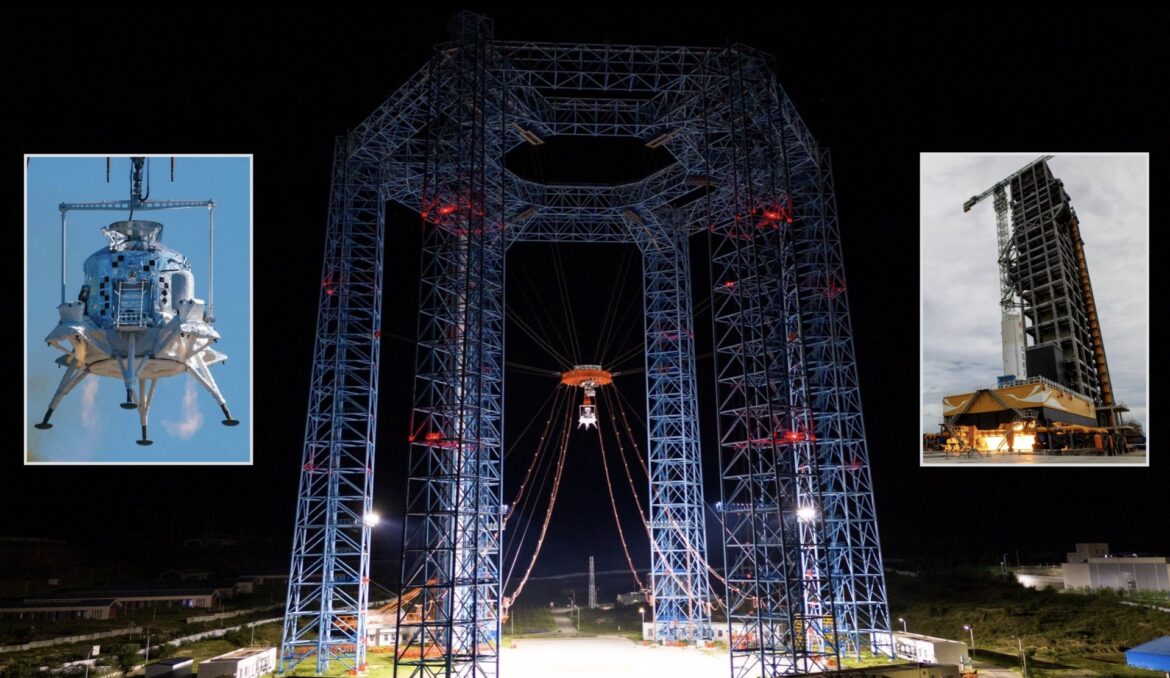
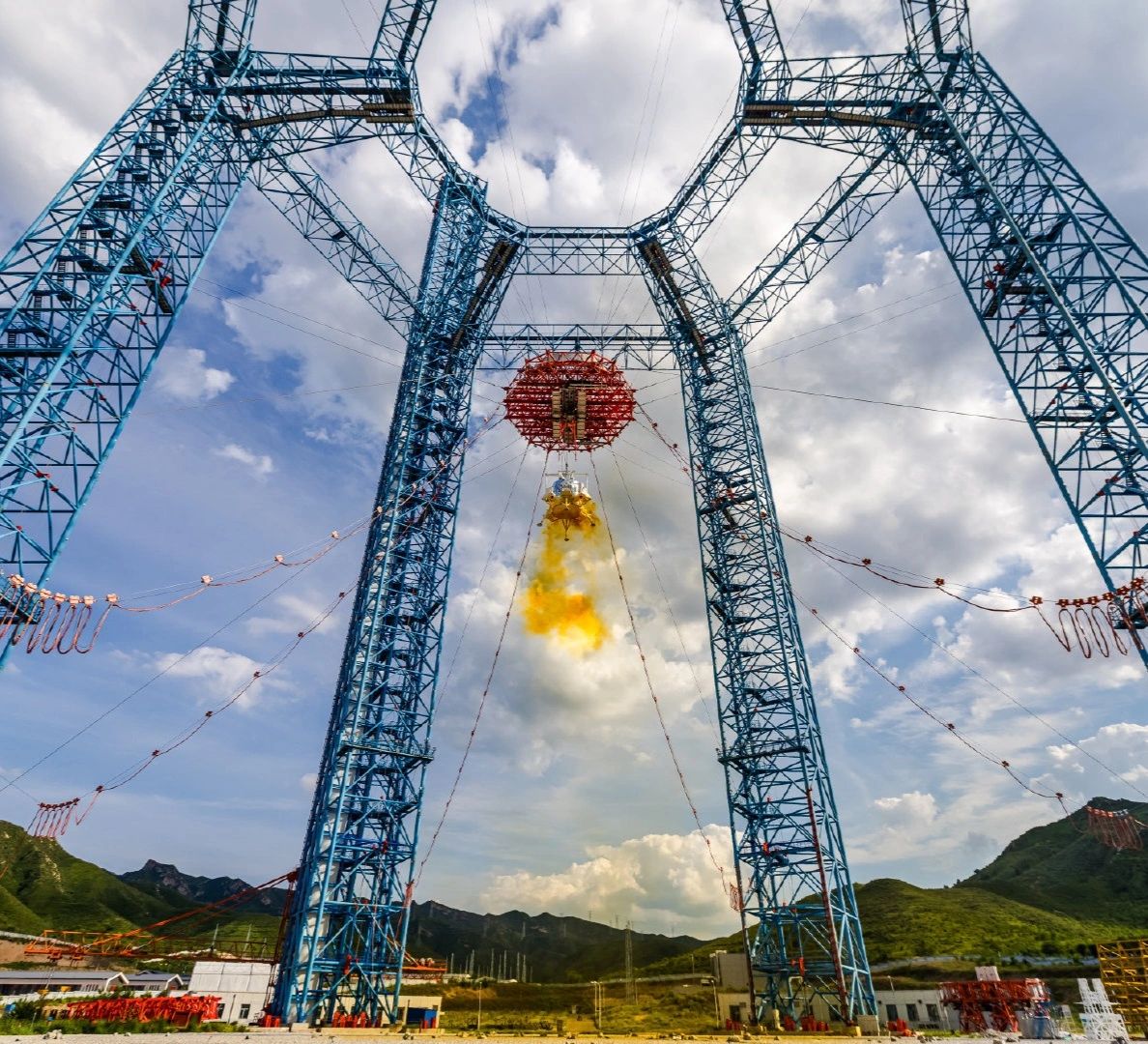
In Hebei province, 70 km from Beijing, a structure reaches 150 m in height to hold by cables a real-size double of the Chinese lunar module Lanyue (described as a prototype). This system aims to compensate for Earth’s gravity, 6 times stronger than that of our natural satellite, in order to test the lunar landing procedure as close as possible to real conditions (minus the vacuum of space). The latter can be carried out automatically, similar to what is done with the Chang’e landers. The tests lasted several months and concluded on August 6.

The impressive gantry that partially supports the prototype Lanyue lunar module in order to simulate a lunar gravity 6 times less than that of Earth.
© CNSA

Le prototype de Lanyue destiné aux tests qui se sont déroulés cet été.
© CNSA

Designed by CAST (China Academy of Space Technology), Lanyue is a machine whose mass is estimated at 26 tonnes (around 10 tonnes more than the Apollo Lunar Module reconstructed full size at the Cité de l’espace ).

Be careful, however, this mass includes an additional propulsion stage and if we talk about the lander alone (the one we see in the simulation photos), we come back to a little more than ten tons, much closer to its American alter ego of half a century ago.
Lanyue, capable of transporting two astronauts to the lunar surface with a small pilotable rover, would be sent unmanned to the Moon with a CZ-10 launcher (see below). The crew (up to four) would leave Earth aboard the Mengzhou spacecraft to join it, again using a CZ-10.

The CZ-10’s first stage roars

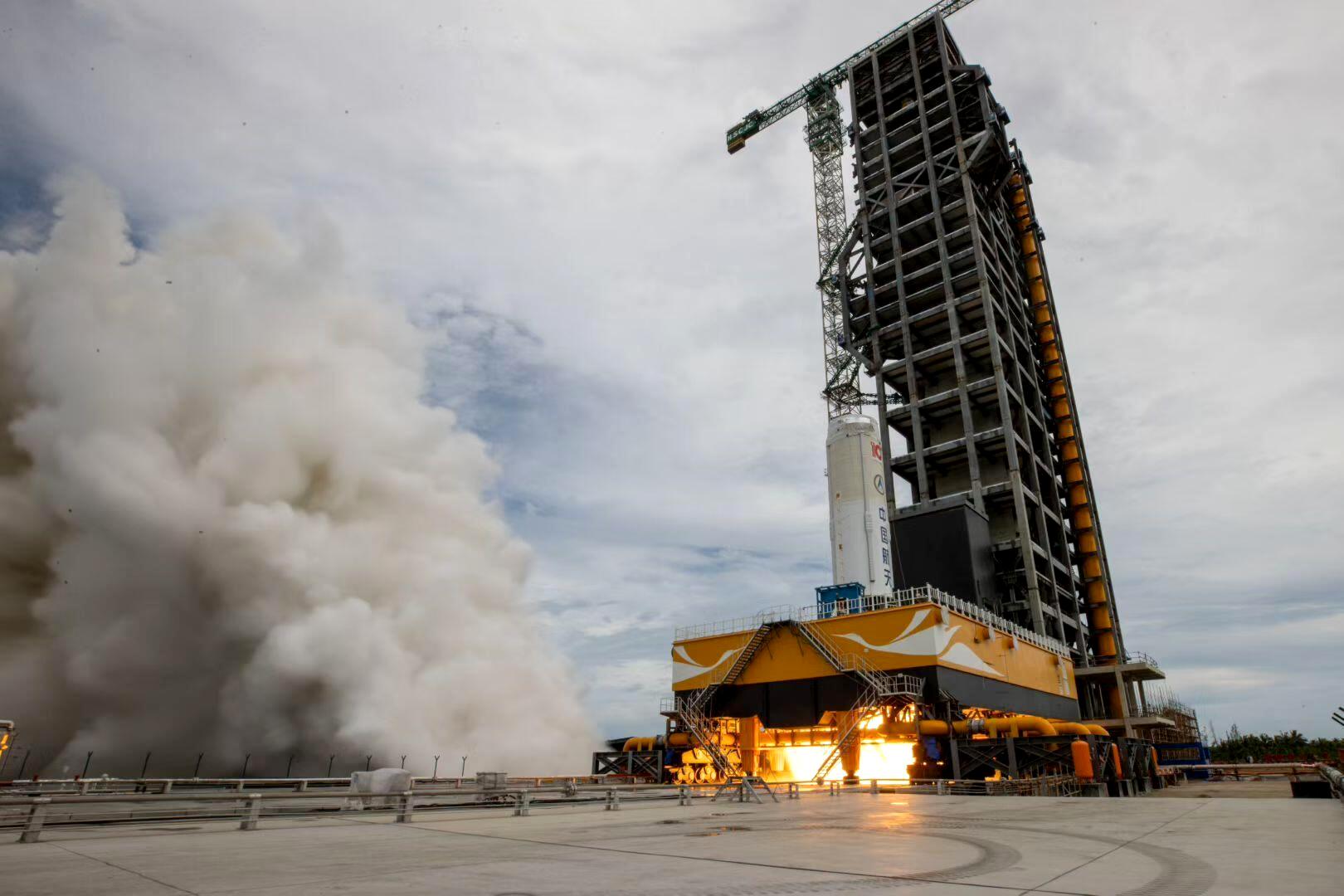
Another crucial test for the Chinese manned lunar program is that of the CZ-10 launcher , or more precisely its first stage . This time, we leave the continent for the island of Hainan, which hosts the Wenchang space center. There, the LC-301 launch pad, which is being built specifically for the CZ-10, also served as a static test bench. On August 15, a test example of the first stage successfully fired its seven YK-100K boosters . These engines consume kerosene and liquid oxygen. The development of the launcher could then consist of a low-altitude flight (with recovery of one stage!), followed by another, this time orbital.

The first stage of the CZ-10 launch vehicle was fired on August 15. CZ stands for Chang Zheng, or Long March, in reference to a historical episode in the country.
© CNSA

The next steps in China’s manned lunar program remain unclear, however. Will unmanned flights of these elements be carried out around the Earth and/or the Moon, as was the case with Apollo? In the meantime, looking at what has been officially shown, namely the Wangyu spacesuit , the Lanyue lunar module, the Mengzhou spacecraft and the CZ-10 launcher, it appears that China has all the pieces of the “puzzle” necessary for its astronauts to soon walk on our celestial neighbor .

Related articles