• Astronomy

Lemmon and Swan, two comets in the October sky

Published on 15 October 2025

Discovered in January and September 2025 respectively, comets C/2025 A6 (Lemmon) and C/2025 R2 (SWAN) will grace the October night sky.

Lemmon and Swan, two comets in the October sky

The two comets C/2025 A6 (Lemmon) and C/2025 R2 (SWAN) , or more simply Lemmon and SWAN, are to be found towards the South-West and the West in the evening sky of October . The term “visible to the naked eye” remains delicate for such objects which are by nature diffuse and whose observation can be hampered by light pollution.

After the presentation of the two comets, we offer you a map to locate them in the sky .

LEMMON AND SWAN

TWO COMETS DISCOVERED IN 2025

The nomenclature of comet names indicates that both objects were discovered in 2025. The letter C before the year indicates that in both cases they are so-called non-periodic or long-period comets (orbit of more than 200 years). For a periodic comet it would be P and for an interstellar object it would be I. The
letter and number after the year are a code that identifies the period of the year by fortnight and the order of discovery. Lemmon is thus the sixth comet cataloged (number 6) in the first fortnight of 2025 (letter A). The second fortnight of the year is B, then C and so on.
Incidentally, the name given is linked to the person or instrument that made it possible to locate the star. For Lemmon and SWAN, it is the second case.

C/2025 A6 (LEMMON)

C/2025 A6 (Lemmon) was discovered thanks to images taken on January 3, 2025, at the Mount Lemmon Survey in Arizona. This observatory is part of the Catalina Sky Survey’s network of three automated telescopes designed to detect asteroids and comets. Such installations are part of a planetary protection approach that involves detecting an object that could threaten Earth with a collision with it well in advance. These observatories very regularly capture asteroids and comets that pose no danger. The orbital period of C/2025 A6 (Lemmon) is estimated at 1,350 years, and its close passage of the Sun, which will take place on November 8 , could reduce this duration to 1,150 years. Keep in mind that the trajectories of comets around the Sun are very elliptical.

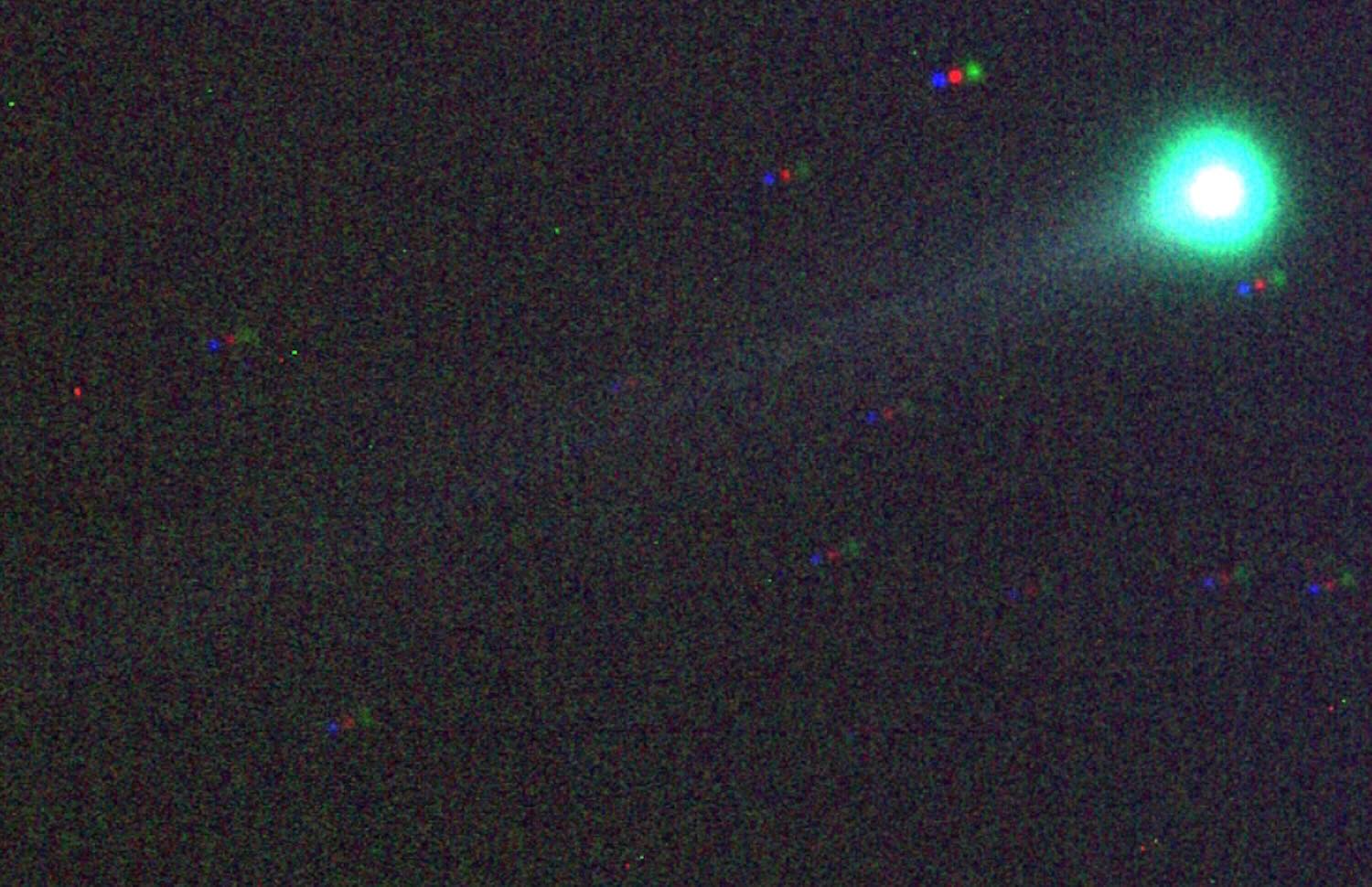
Comet C/2025 A6 (Lemmon) photographed by Dimitrios Katevainis in September.

© CC BY-SA 4.0

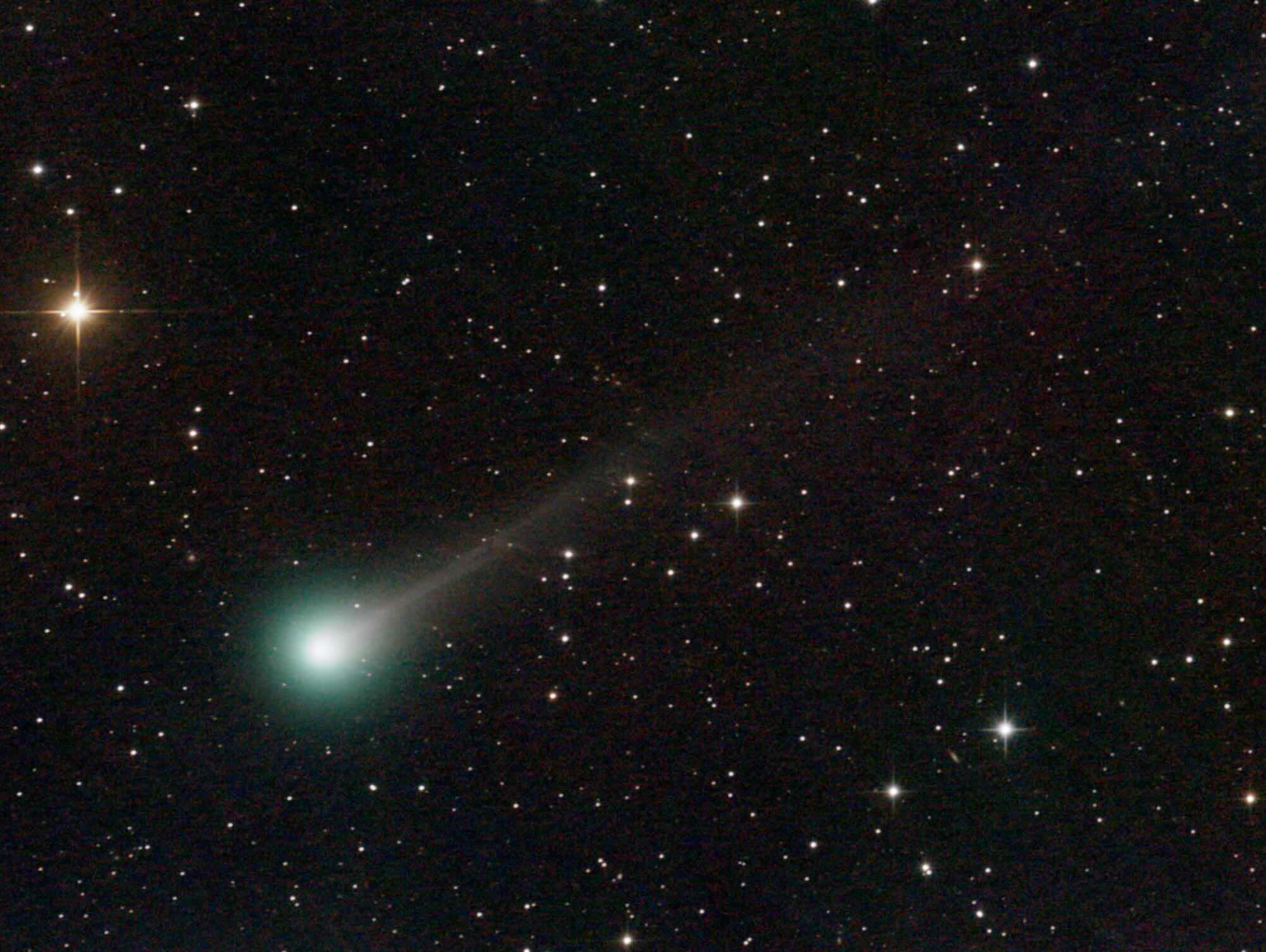
Comet C/2025 R2 (SWAN) photographed by Filipp Romanov in September.

© CC BY-SA 4.0

C/2025 R2 (SWAN)

C/2025 R2 (SWAN) was spotted on September 11, 2025, by analyzing images from the SWAN (Solar Wind ANisotropies) instrument, a telescope aboard the SOHO (Solar and Heliospheric Observatory) satellite that monitors the Sun. Built in Europe and launched in 1995, SOHO is a joint effort between NASA and the European Space Agency (ESA). The SWAN instrument has discovered about 20 comets.
The orbital period of C/2025 R2 (SWAN) is approximately 654 years, and it has already passed its closest approach to the Sun on September 12 .

OBSERVE LEMMON AND SWAN

When they approach the Sun, comets experience activity in their nuclei, as the ice it contains sublimates as it approaches our star. This creates what is called a coma or diffuse coma, as well as a tail. These are the two elements that we observe.
C/2025 A6 (Lemmon) reached a magnitude of 5 a few days ago . This earned it the title of “visible to the naked eye.” But it is worth making a few clarifications. Visual magnitude in astronomy is a kind of inverted scale. The higher the value, the less luminous the object. Classically, the limiting magnitude for human vision is 6, so any magnitude higher cannot be seen. Be careful, this numerical benchmark is only valid for a sky completely free of light pollution (i.e., outside of urban centers). In addition, since comets are diffuse objects, the concept of magnitude is more delicate. So don’t be surprised if you have trouble seeing, or don’t see, a comet that is announced as visible to the naked eye .

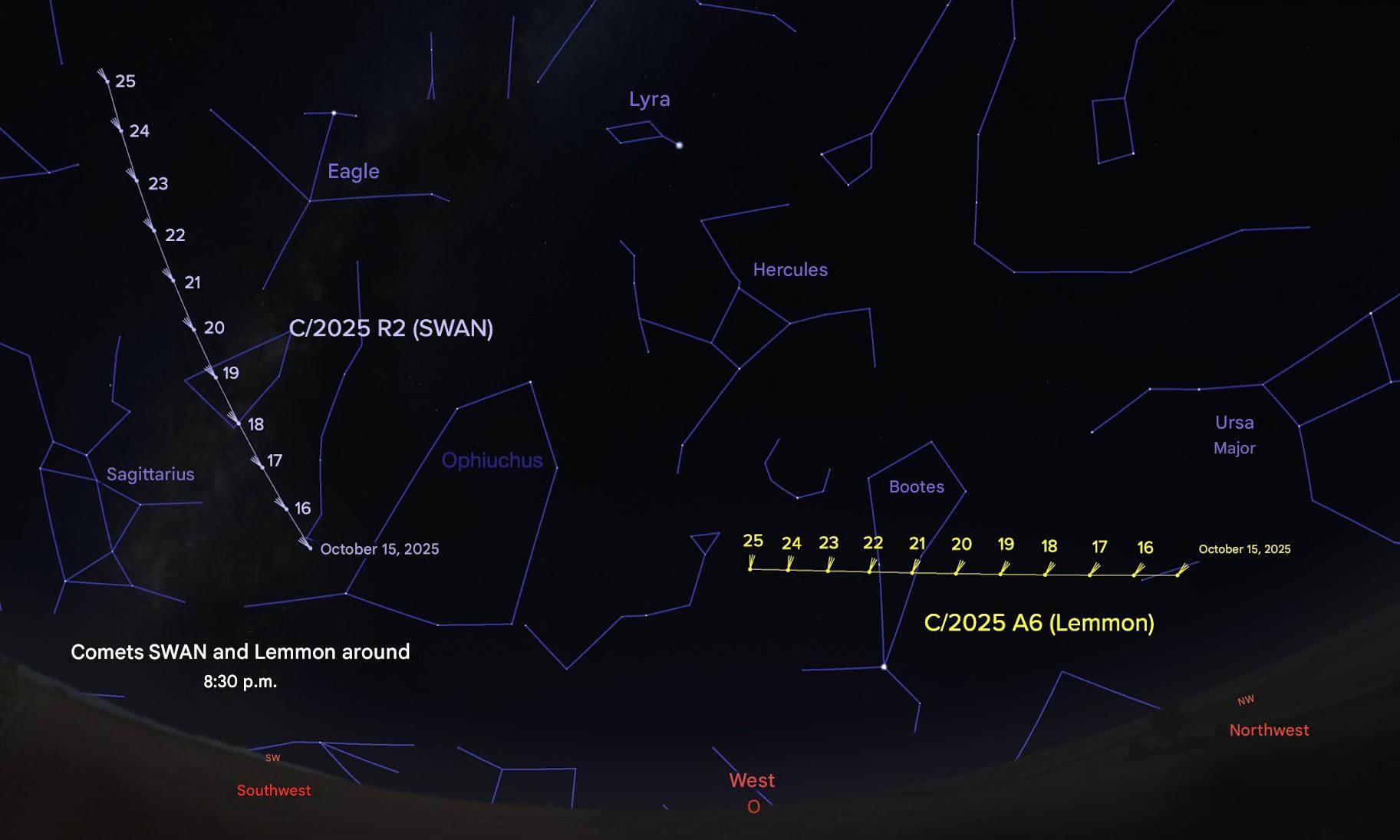
C/2025 R2 (SWAN) is currently close to magnitude 6, which is on the edge of perfect skies. For both comets, a pair of binoculars will be a valuable aid. Both stars should be looked for in the evening in the southwest and west.

This map shows the respective positions of C/2025 R2 (SWAN) and C/2025 A6 (Lemmon) from October 15 to 25 at around 8:30 p.m. , legal time in metropolitan France. Map calculated for Toulouse, but similar for the entire metropolitan territory.

© Cité de l’espace/Stellarium

LEMON FROM MORNING TO NIGHT

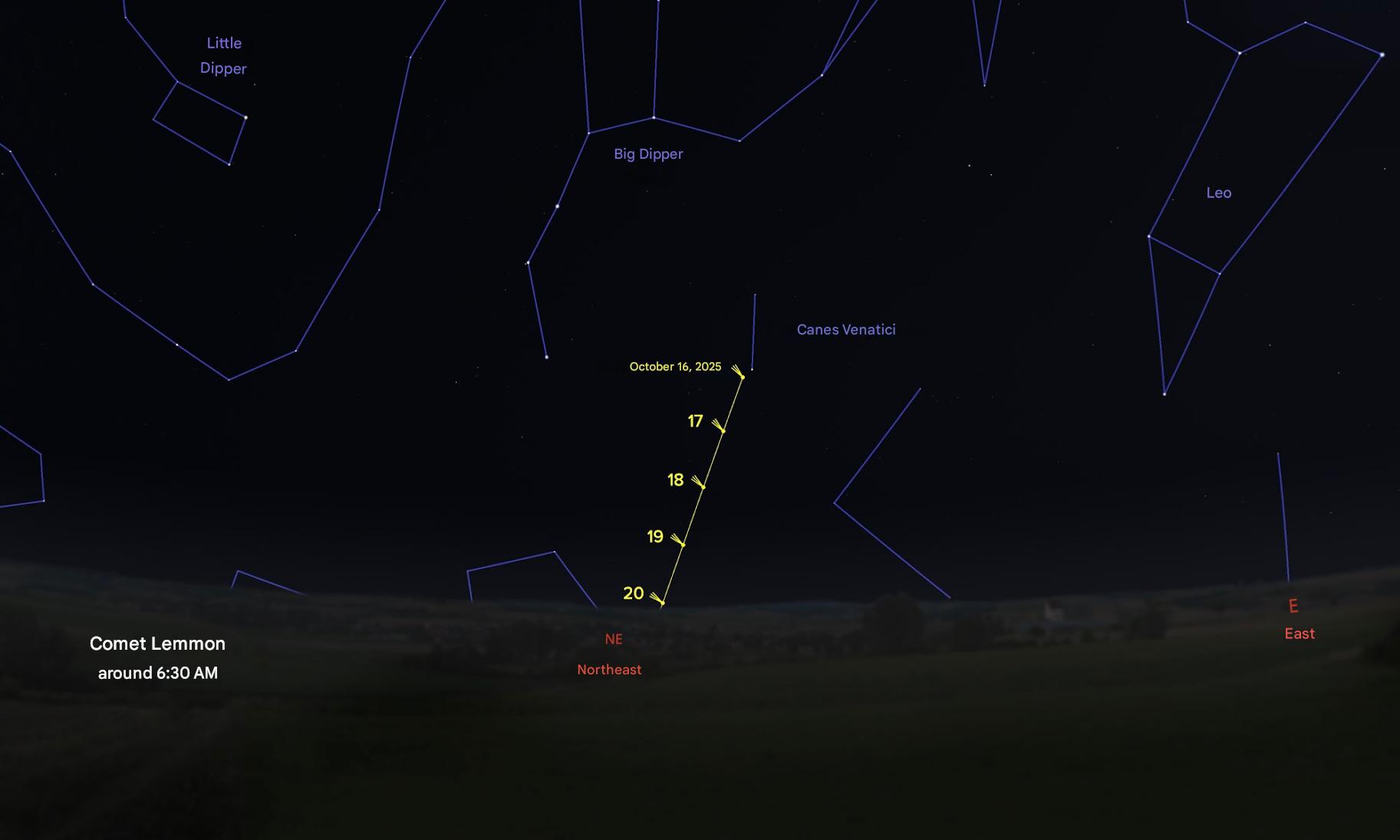
C/2025 A6 (Lemmon) is both a morning and evening comet. The previous map above shows its position in the evening. But it can also be seen in the morning in the Northeast (map opposite). However, we notice that it is low and is moving quickly towards the horizon . On the morning of October 16, it is not even 19° above the horizon. Of course, as we wait, the comet rises a little, but the Sun arrives (rise over Toulouse at 8:10 a.m. on the 16th) and before its rise makes the sky increasingly clear, unsuitable for spotting the comet.
C/2025 A6 (Lemmon) will therefore be progressively easier to find in the evening sky . It will pass closest to Earth on October 21 at 90 million kilometers. This could be the ideal time to observe it . On October 21 at 8:30 p.m., it will be 17.5° above the west-northwest horizon. Lemmon will then pass closest to the Sun on November 8 at a distance of 79 million kilometers.

Comet Lemmon can still be seen for a few days in the morning, but low on the horizon.
© Cité de l’espace/Stellarium

A SURPRISE FROM SWAN?

C/2025 R2 (SWAN) already completed its closest approach to the Sun on September 12. It will be at its closest approach to Earth on October 20 at 39 million kilometers . Above all, we note that the comet’s trajectory makes it rise higher and higher in the sky, which facilitates observations . Here too, use a pair of binoculars, then gently scan the area of ​​the sky shown by the map. A comet appears as a diffuse ball, sometimes greenish in color. The visibility of the tail depends on the quality of the sky.

On October 20, SWAN will be 30° above the south-southwest horizon . If its magnitude remains constant or changes in the right direction (brighter), this hairy star could well become easier to spot.

However, the activity of a comet remains difficult to predict, as both pleasant surprises and disappointments are possible.

Related articles