• Astronomy

The sky of April 2025

Published on 02 April 2025

With the equinox passed and daylight saving time in effect, night arrives late but remains fertile with celestial spectacles. In April 2025, the Moon has a rendezvous with several planets as well as the seven sisters of the Pleiades.

The sky of April 2025

In the night of March 29 to 30, daylight saving time moved our clocks forward by about two hours compared to astronomical reality. Thus, it is necessary to wait beyond 10 PM for the astronomical twilight to pass, giving way to a truly dark night sky (the Sun is more than 18° below the horizon). And at the end of the month, 45 minutes will be added. The nights, which have been shortening since the equinox, do not, however, prevent us from enjoying a few encounters with the celestial vault.

All times are legal time in metropolitan France.

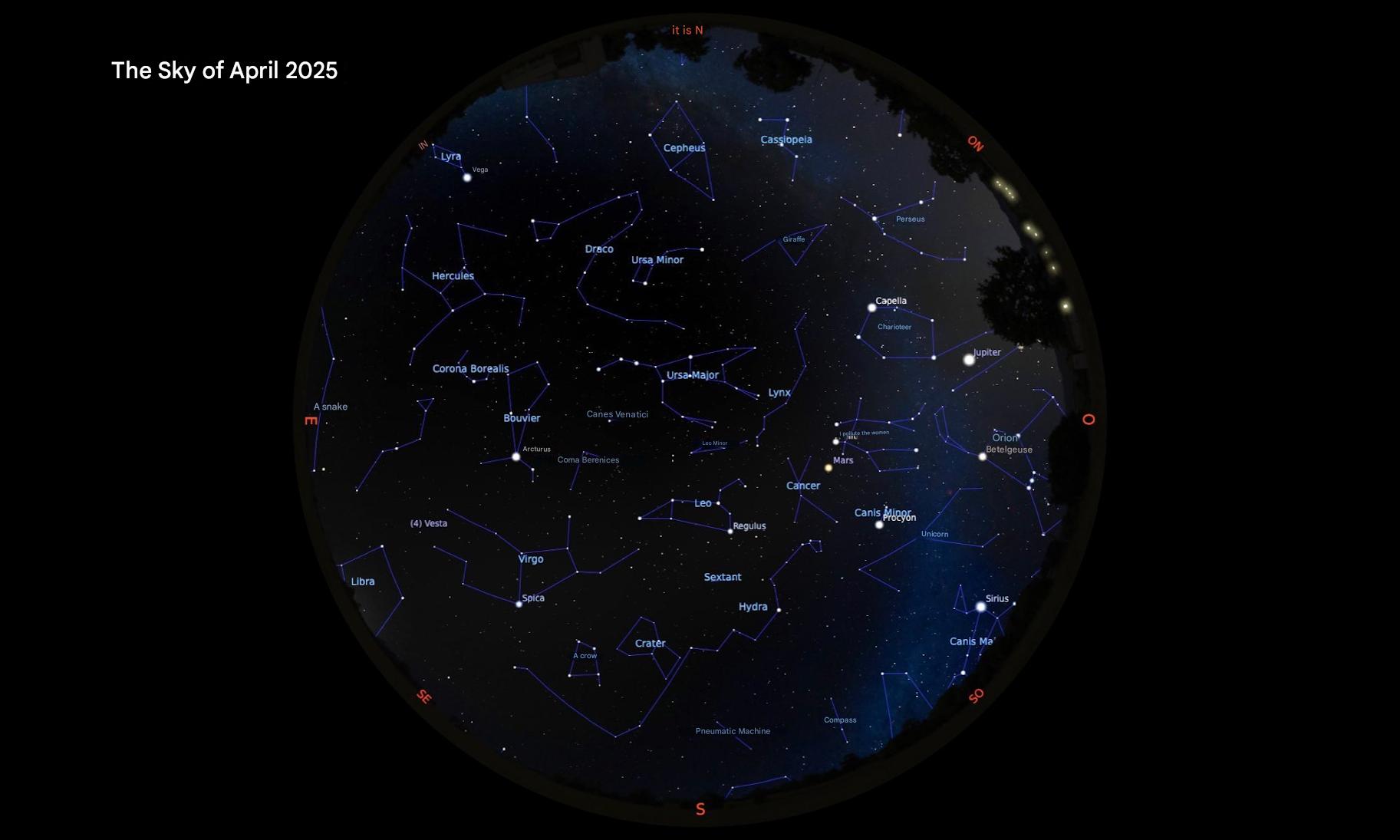
The Moon and three planets This map shows the sky for Toulouse on April 15 at 11:00 PM (metropolitan France legal time). It is largely valid for the month of April throughout metropolitan France, except concerning the position of the Moon (which, on this map at this time, has not risen).
© Cité de l’espace/Stellarium

The Moon and the seven sisters

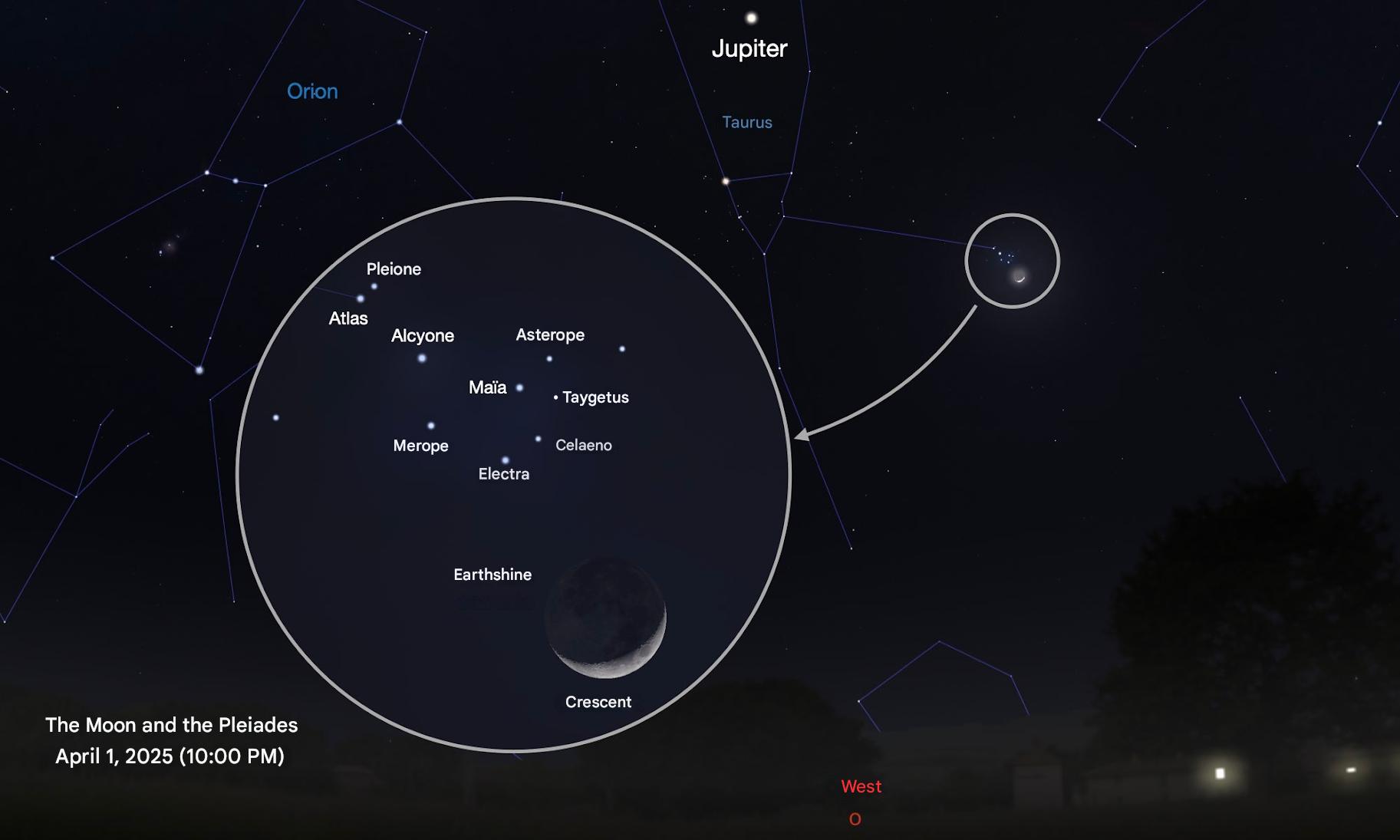
On April 1st witness the meeting between our natural satellite and the famous seven sisters of Greek mythology immortalized by the Pleiades. This group of stars in the constellation Taurus has been documented for millennia by different cultures and civilizations. During ancient Greece, they were linked to 7 sisters: Alcyone, Asterope, Maia, Taygete, Celaeno, Merope, and Electra. Their father and mother seem to watch over them nearby thanks to two stars named Atlas and Pleione. Today, we know that it is an open cluster of 3000 young stars (only about ten are visible to the naked eye under good conditions) located approximately 440 light-years away from us. The delicate nebulae that surround them were considered remnants of their formation mechanism, but it is now thought that we are observing an interstellar cloud that they are passing through while dispersing.

pleiades-palomar

Classic photograph of the Pleiades with the 1.2 m Schmidt telescope of Mount Palomar in California, which allows seeing the nebula that drapes the “7 sisters”. This cluster is now cataloged M45 (Messier catalog) or NGC 1432/35.
©NASA, ESA, AURA/Caltech, Palomar Observatory

The Pleiades already offer a beautiful object to scrutinize with the naked eye, especially since it resembles a Big or Little Dipper in miniature (the size in the sky is equivalent to 2 times the full Moon). Under a good night sky, five are easily seen. Capturing the 7 or 9 main ones (identified in the diagram below) requires skies clear of any light pollution and/or the use of binoculars. This April 1st, a crescent moon with its earthshine will play the role of a marker. As the night progresses, our celestial neighbor will pass in front of the seven sisters while this Moon-Pleiades duo will inexorably approach the horizon (the Moon sets at 00:50).
Finally, let’s recall that earthshine is explained by the light of our star reflected towards the Moon by the Earth.

On April 1st, once night has fallen (around 10 PM), look west for a beautiful crescent moon about 26° above the horizon. The Moon has a rendezvous that night with the seven sisters of the Pleiades. A little perspective: our celestial neighbor will be at 361,000 km, or 1.2 light-seconds, while the Pleiades cluster is much further away at 440 light-years!

The Moon and Jupiter

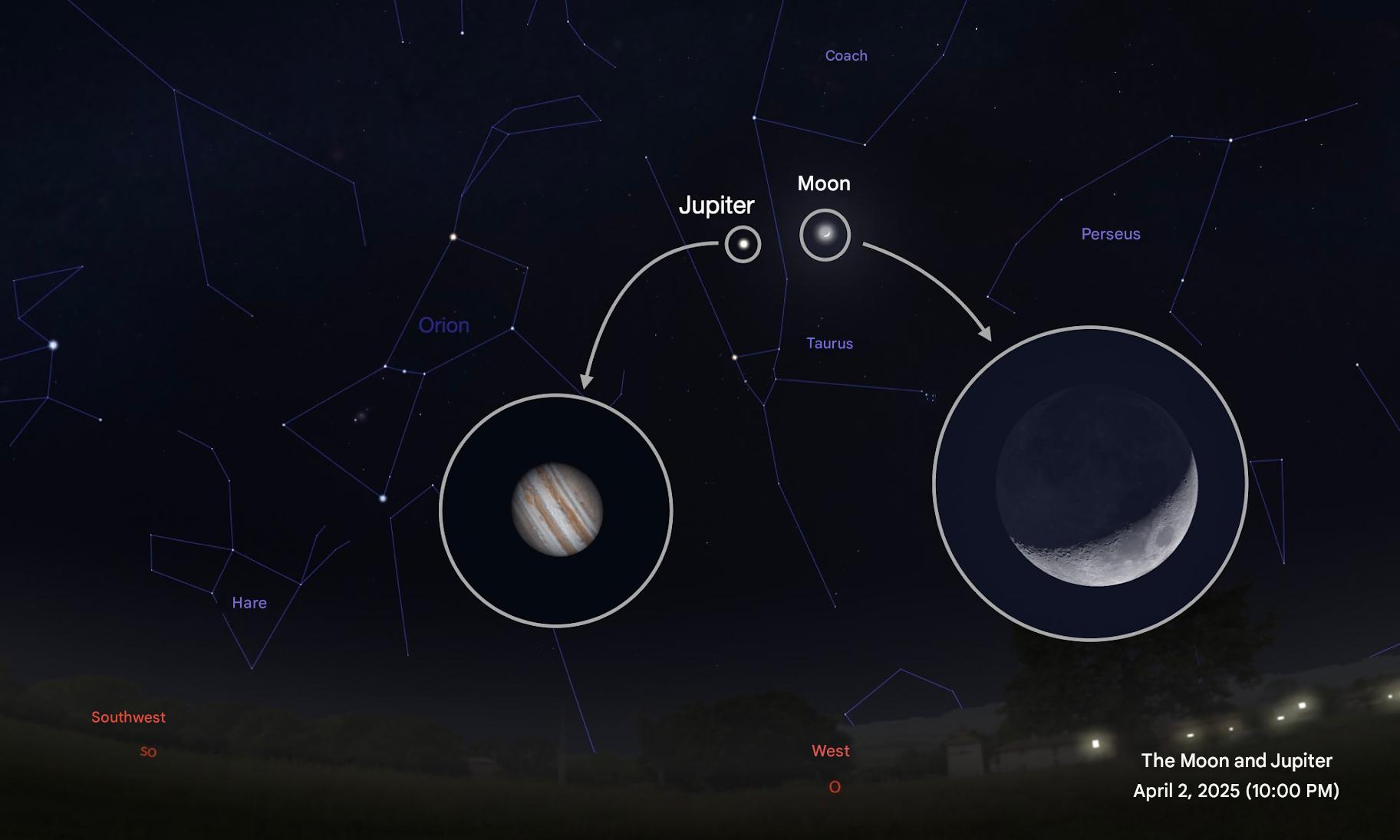
Due to its brightness, the largest planet in the Solar System is not really difficult to spot. But this April 2nd, thanks to our natural satellite, it will be impossible to miss the gas giant. To the West and in the constellation Taurus, the Jupiter-Moon duo will indeed easily dominate this region of the sky. At 765 million kilometers from us, Jupiter will be a little more than 2000 times farther than the Moon on April 2nd.

On April 2nd in the West at 38° above the horizon, Jupiter will be accompanied by a crescent moon. The pair should be quite aesthetic in the sky.
© Cité de l’espace/Stellarium

Moon-Mars duo in Gemini

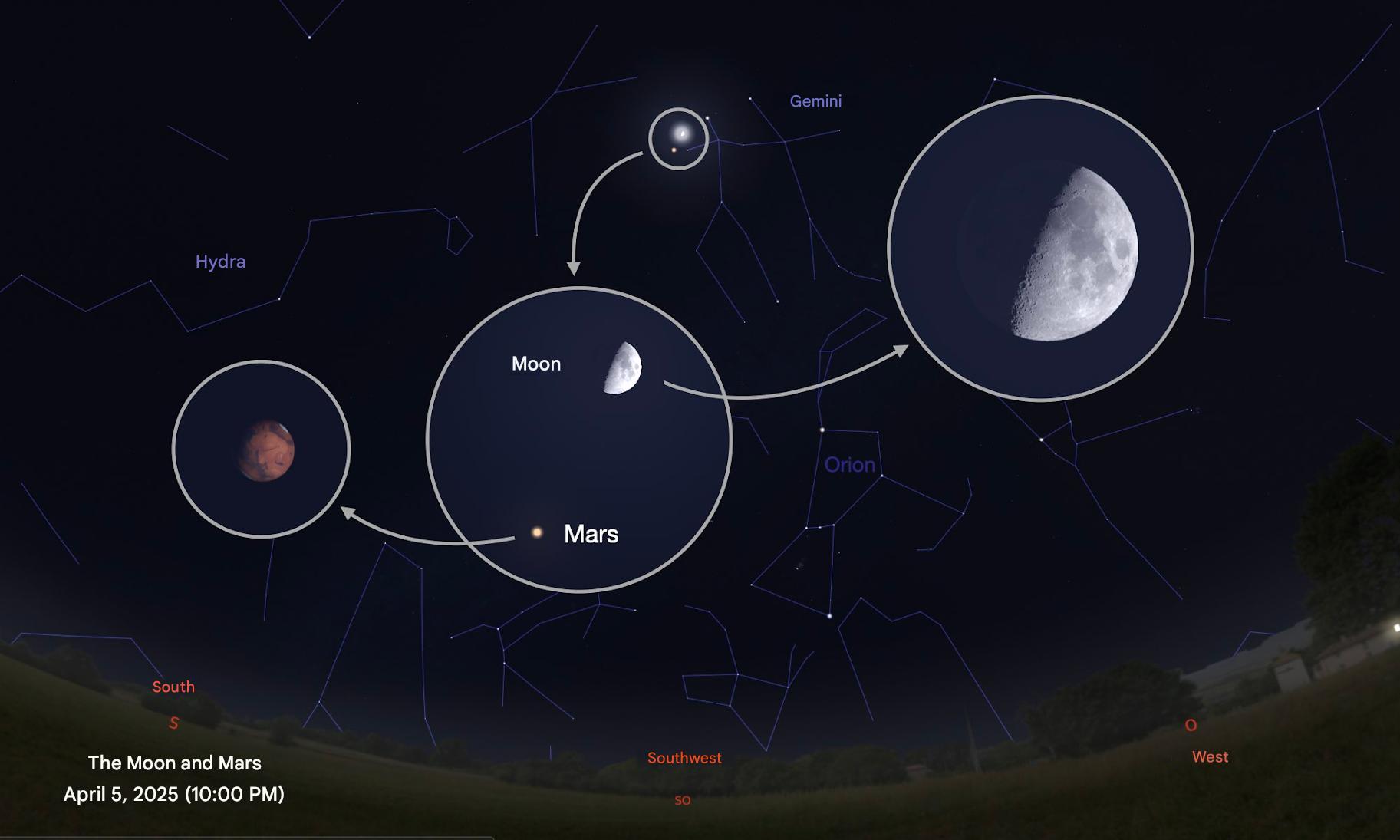
Three days later, on April 5th, the Moon serves as a marker again, but this time for a planet much less bright than Jupiter. Mars and our celestial neighbor offer us a lovely pas de deux in the constellation Gemini. The so-called red planet will be distinguished by its rather orange glow. The proximity of this pair in the sky is obviously only an illusion. Distant from Earth by 249 million kilometers, Mars will be 657 times farther than the Moon.

A beautiful first quarter Moon will accompany Mars in the night sky of April 5th.

© Cité de l’espace/Stellarium

The Lyrid meteor shower

A little reminder first: as poetic as the expression “shooting stars” may be, it is nonetheless totally inaccurate. These are dust particles (usually from comets or asteroids) that vaporize upon entering the atmosphere, creating a fleeting luminous line. While it is possible to see some every night, the “showers” identify periods of more sustained activity, with the Earth passing through an identified swarm of dust. The name given to these events is taken from the constellation where the radiant is located, the point from which the “shooting stars” seem to come.

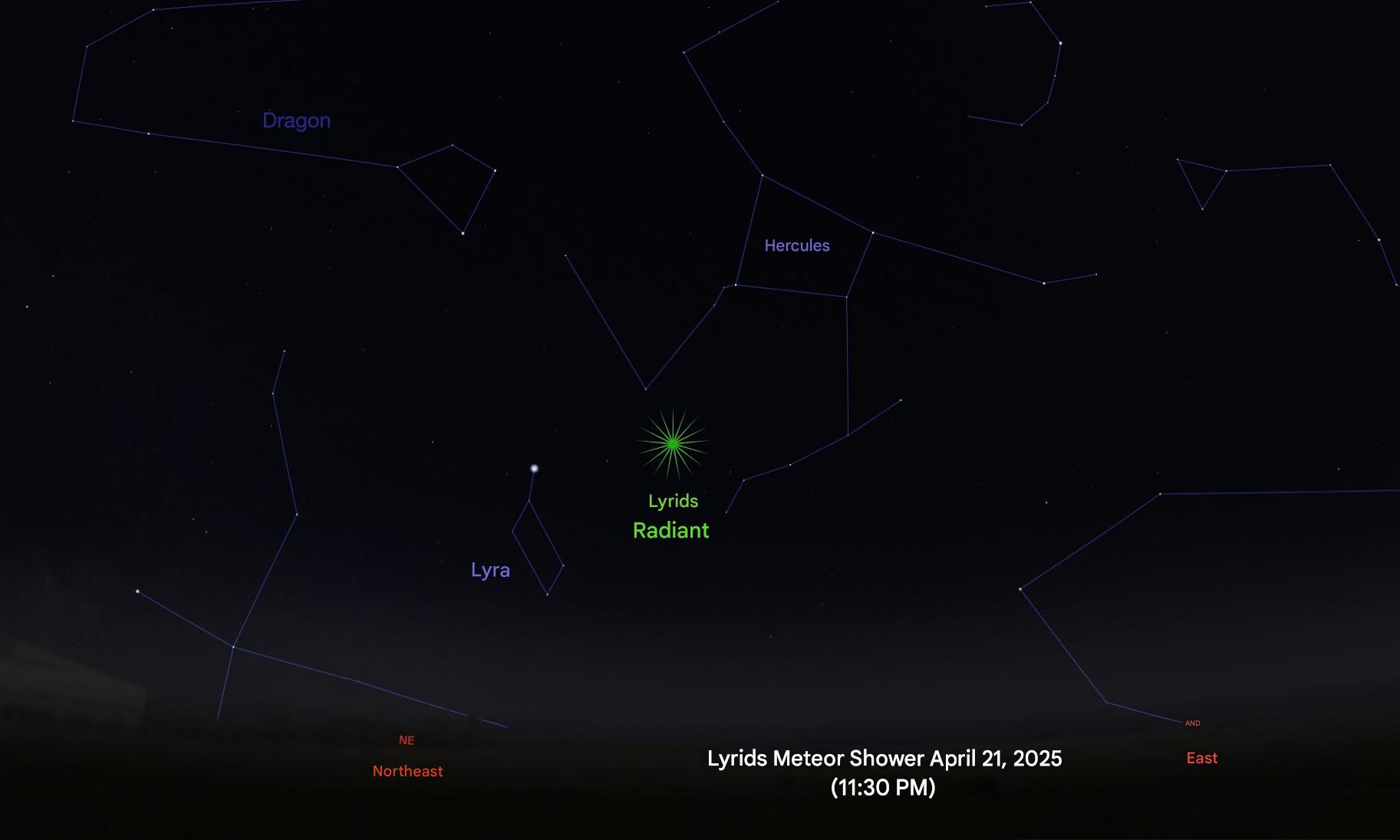
The Lyrids are therefore explained by a radiant in the constellation Lyra. Observed for more than 2500 years, the Lyrids originate from dust sown by the comet C/1981 G1 (Thatcher). Considered active from April 16th to 26th, this shower peaks around April 22nd. For 2025, the International Meteor Organization estimates a maximum for April 22nd at 13h Universal Time (3 PM in metropolitan France), which directs us towards the night of April 21st to 22nd or that of April 22nd to 23rd. In both cases, the radiant is to be sought on the North-East side. However, there is no need to focus on this region; the best way is to encompass the entire celestial vault with your gaze (a deckchair is ideal) away from light pollution. Do not expect a spectacular meteor shower, the Lyrids being rather modest with a ZHR of 18. The ZHR (Zenithal Hourly Rate) is an evaluation of the number of meteors a person could see for a radiant at the zenith (which is not the case in passing) under a perfect dark sky (maximum visible magnitude of 6.5, the limit for the naked eye). For comparison, the ZHR of the famous Perseids in August is usually 100.

The radiant of the Lyrids is located in the constellation Lyra, a classic of the summer sky that shows its nose in April and will later be much higher in the sky.
© Cité de l’espace/Stellarium

The Moon and three planets

Low on the Eastern horizon

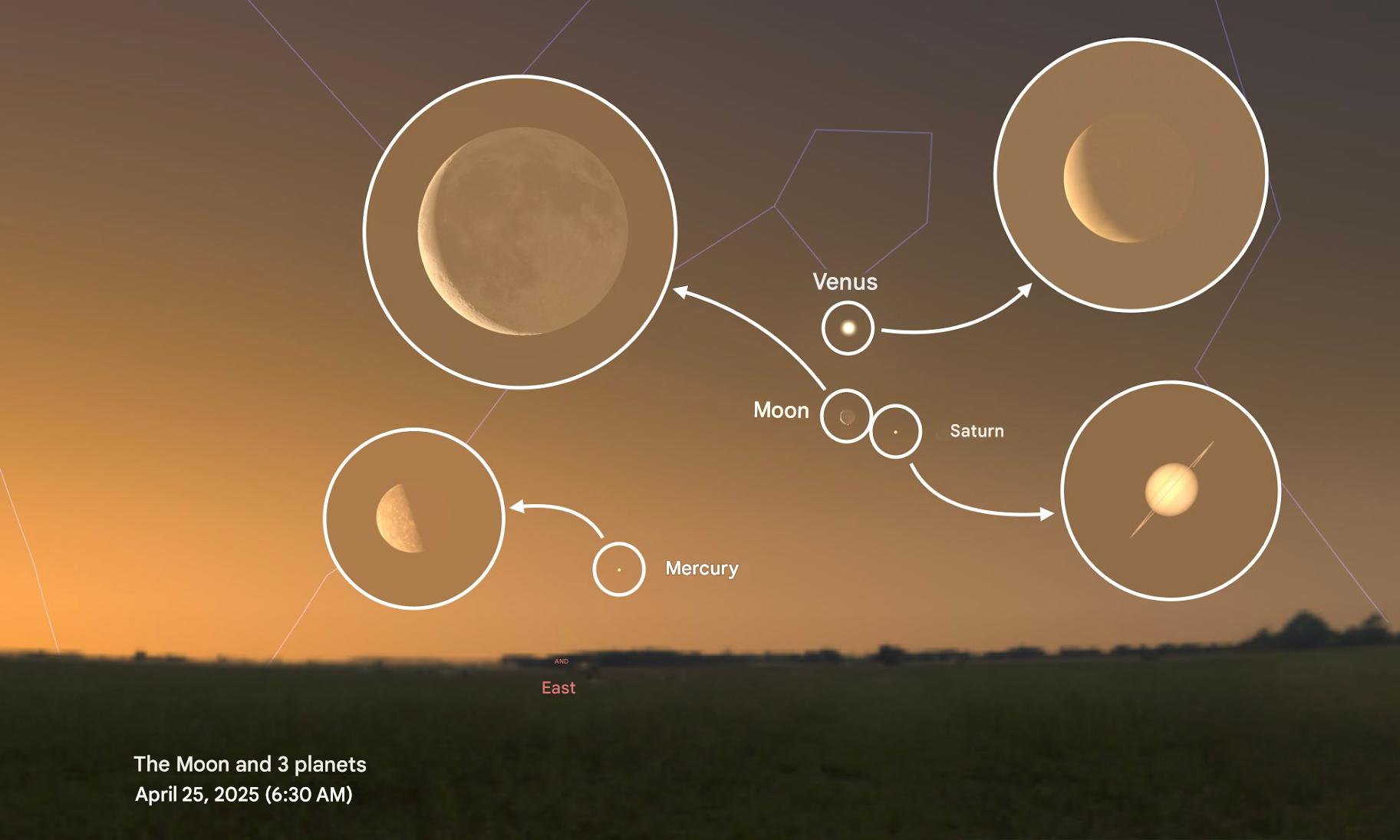
The previous months have been fertile in terms of “planetary alignment,” so we cannot resist the idea of proposing an observation challenge. On April 25th in the morning, before sunrise, a crescent Moon will float near the East at just over 8° in height (for Toulouse). This is practically at the horizon. In this area of the sky, above our natural satellite, you will identify Venus thanks to its brightness. To the right of the Moon, Saturn will be barely lower than our celestial neighbor (much less bright than Venus, its visibility is not certain). On the left, Mercury barely exceeds 3° in height. In short, an elevated observation position with a clear horizon is essential. But this is not the only difficulty. The map below is calculated for Toulouse at 6:30 AM, or 25 minutes before sunrise. Before 6:30 AM, the sky will certainly be less illuminated by the approaching day, making it easier to spot the planets (Venus will be the easiest target), but all these objects will be even closer to the horizon. After 6:30 AM, they rise higher and higher, but the sky brightens and opposes their spotting, especially Mercury and Saturn. Finally, a warning: do not forget that the Sun will rise a little to the left of East, and you will need to be careful to protect your eyesight. As soon as it enters your field of vision, do not force yourself to look in that direction. Even more so if you try to spot the planets with binoculars or another optical instrument. Remember that observing the Sun without a certified protective filter can lead to loss of sight

In the East on April 25th, low on the horizon, a crescent Moon will be accompanied by Venus, Saturn, and Mercury. A very difficult observation in practice.
© Cité de l’espace/Stellarium

Related articles