• Astronomy

The sky in July 2026

Published on 30 June 2026

The nights of July will be an opportunity to spot the Summer Triangle and the Milky Way, while not forgetting the Moon's encounters with Saturn, Mars, the Pleiades and Venus.

The sky in July 2026

With the summer solstice (in the Northern Hemisphere) having passed on June 21st, the night sky is slowly gaining a few minutes . However, the “dark nights,” that is, when the Sun is at least 18° below the horizon, remain short. For example, on July 15th in Toulouse, the dark night will only begin at 11:45 PM and will end at 4:16 AM the following day, July 16th. Fortunately, some phenomena can be observed slightly outside these few hours.

However, to fully appreciate the Milky Way, our galaxy seen edge-on, you will have to wait until the sun is 18° below the horizon.

In 2026, the very modest meteor showers of the Alpha Capricornids and Southern Delta Aquarids (peaking on July 31) will be overshadowed by the presence of a nearly full moon (the full moon occurred two days prior). This is why they are not detailed.

Finally, on July 6, Earth will reach aphelion, its farthest point from the Sun , at approximately 152 million kilometers. On January 3, it will reach perihelion, its closest point to our star at just over 147 million kilometers. This demonstrates that the seasons depend on the tilt of Earth’s axis of rotation and not on its distance from the Sun.

Reminder: unless otherwise stated, times are those of metropolitan France . Maps are calculated for Toulouse, but in most cases remain applicable to the entire metropolitan territory.

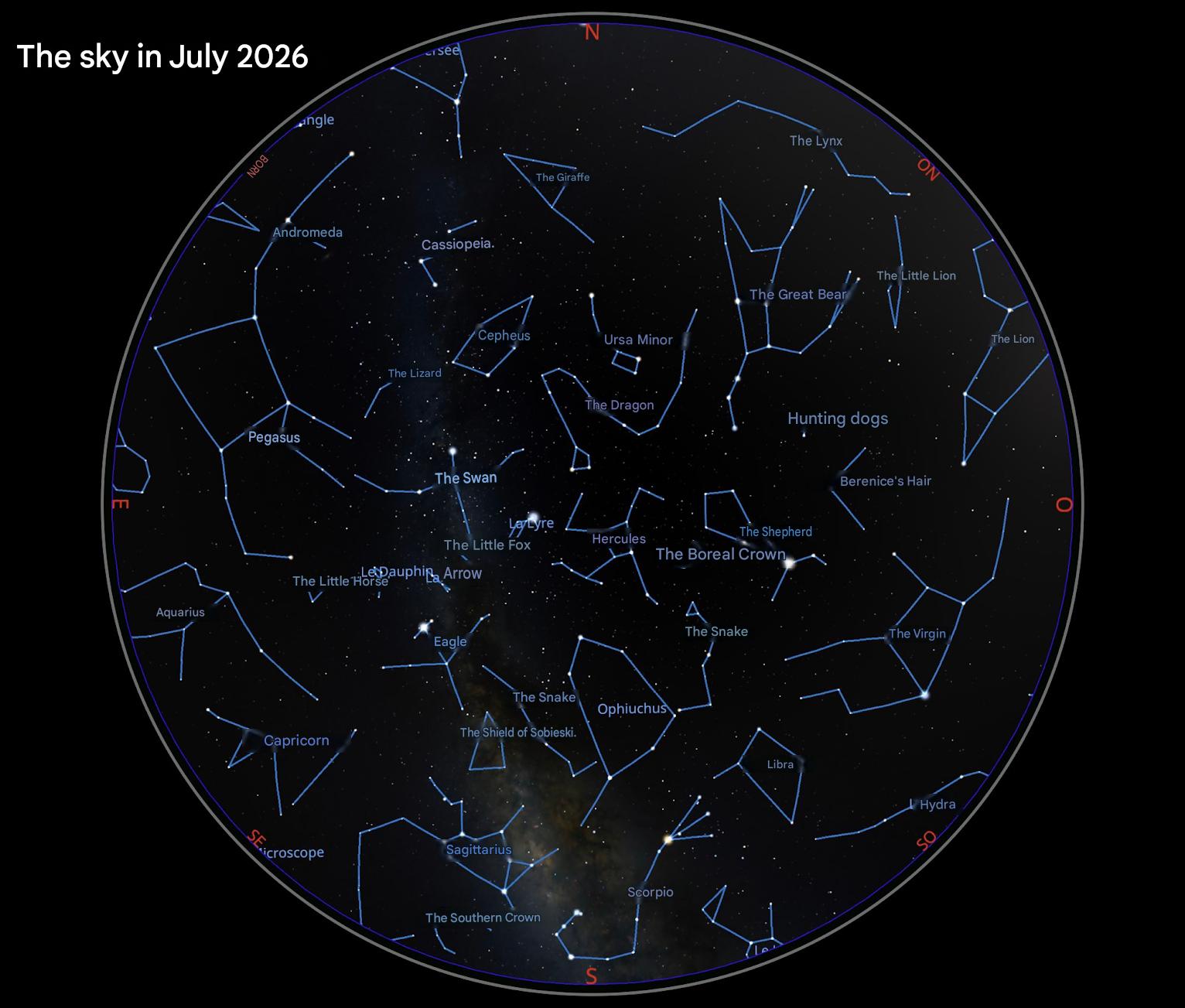
Cette carte montre le ciel pour Toulouse le 15 juillet à 23h45 (heure légale, donc celle de votre montre).
Elle est valable en grande partie pour le mois de juillet sur toute la France métropolitaine, sauf en ce qui concerne la position de la Lune (qui n’est pas encore levée à ce moment-là).
© Cité de l’espace/Stellarium

THE MOON AND SATURN

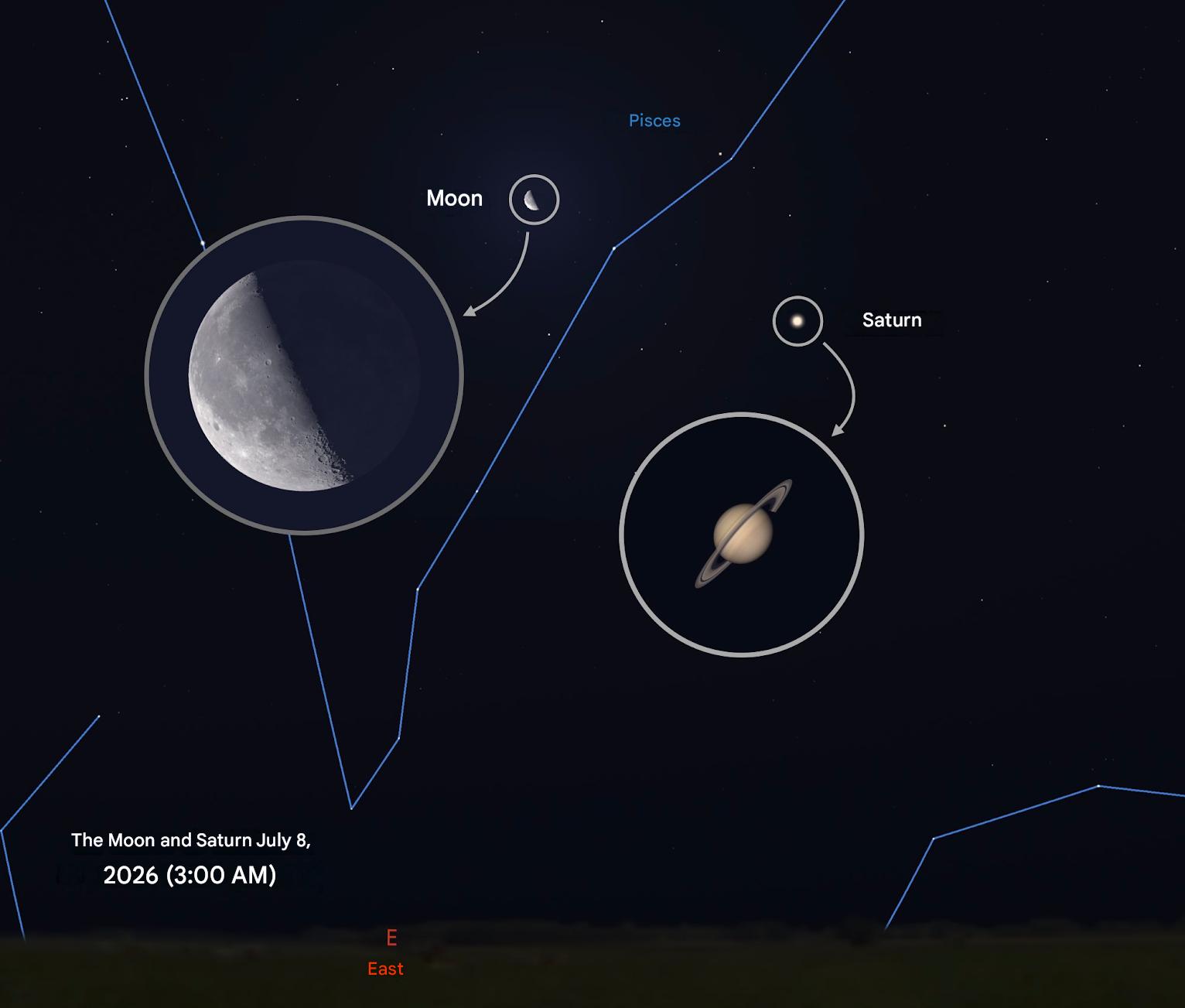
On the night of July 7th to 8th, the Moon will be close to Saturn. However, our natural satellite rises above the horizon at 1:14 AM on July 8th, and Saturn at 1:34 AM. It is therefore best to wait until both celestial bodies are a little higher in the sky.

On July 8th at 3 a.m., the Moon will be 18° above the East, with Saturn slightly lower and to the right at 15°. The longer you wait, the higher the pair will rise, but be careful of the Sun, which rises at 6:21 a.m. to the left of the East and will have brightened the sky beforehand.

A not so close conjunction between the Moon and Saturn early on July 8th could be quite aesthetically pleasing. The ringed giant will stand out with its characteristic yellowish glow.

© Cité de l’espace/Stellarium

MARS, THE MOON AND THE PLEIADES

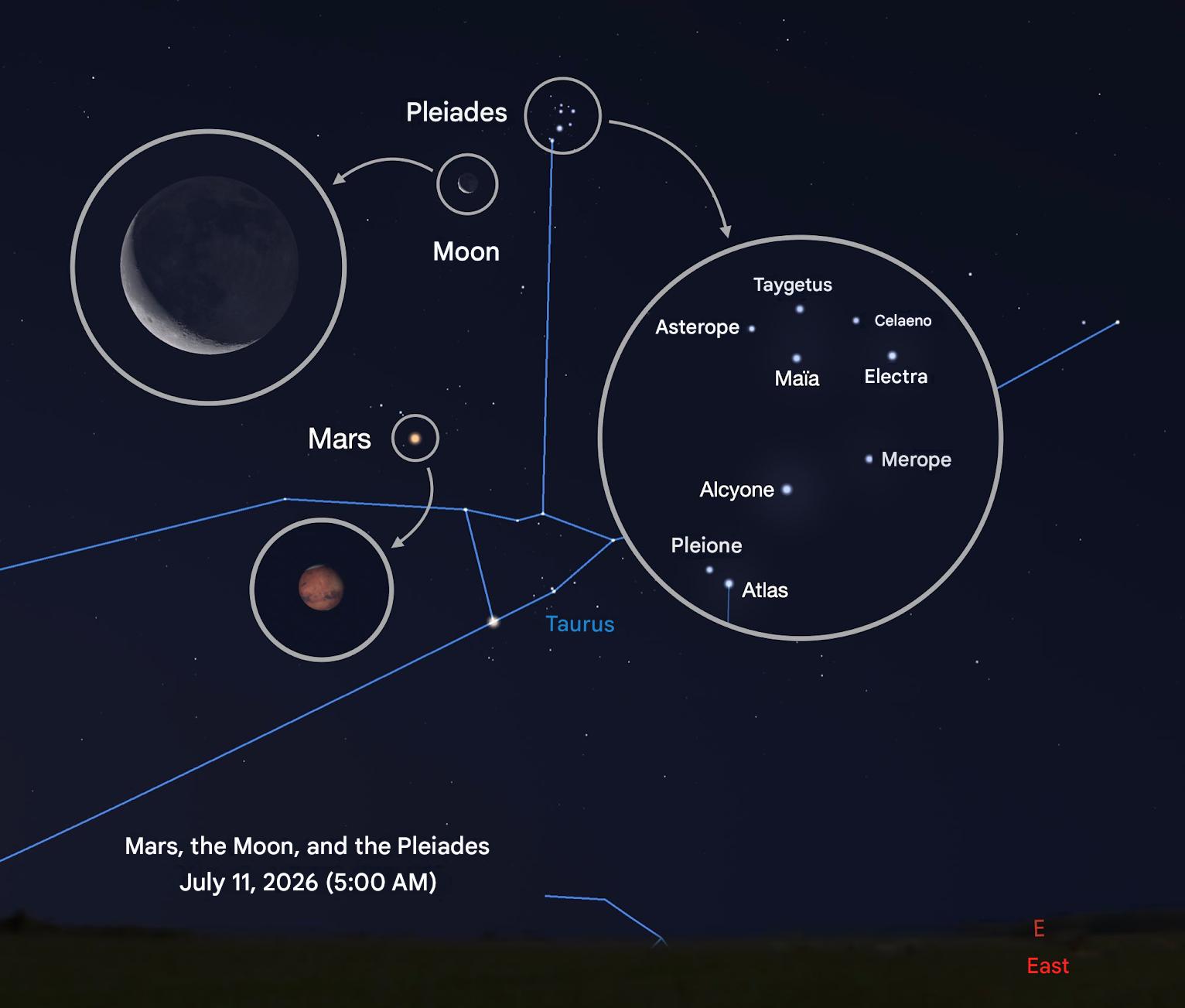
Early in the morning of July 11, the constellation Taurus will host Mars, the Moon, and the Pleiades. The red planet will rise above the horizon between the Northeast and East at 3:43 a.m. However, it’s best to wait until the celestial bodies are higher in the sky.
At 5:00 a.m. on July 11, Mars will be 13° above the horizon . 20° above it, you’ll easily spot a crescent Moon . You might even be able to observe earthshine . This part of the Moon is illuminated by sunlight reflected off the Earth. The crescent itself is directly illuminated by the Sun.
Slightly above and to the right of the Moon, you’ll notice the Pleiades, which resemble a much smaller version of the Big Dipper. The Pleiades immortalize in star form the seven ancient sisters Alcyone, Asterope, Maia, Taygete, Celaeno, Merope, and Electra. They are watched over by their parents, Atlas and Pleione. The Pleiades are an open cluster of 3,000 young stars (only about ten are visible to the naked eye under good conditions) located approximately 440 light-years from Earth. The delicate nebulae surrounding them were once thought to be remnants of their formation, but it is now believed that they are actually an interstellar cloud through which they disperse.

Enjoy the show before the arrival of the Sun (rise at 6:23 am) which will have already begun to dispel the dark night by 5 am.

More than an hour before sunrise, observe Mars, the Moon, and the Pleiades to the left of the east.
© Cité de l’espace/Stellarium

THE MILKY WAY AND THE SUMMER TRIANGLE

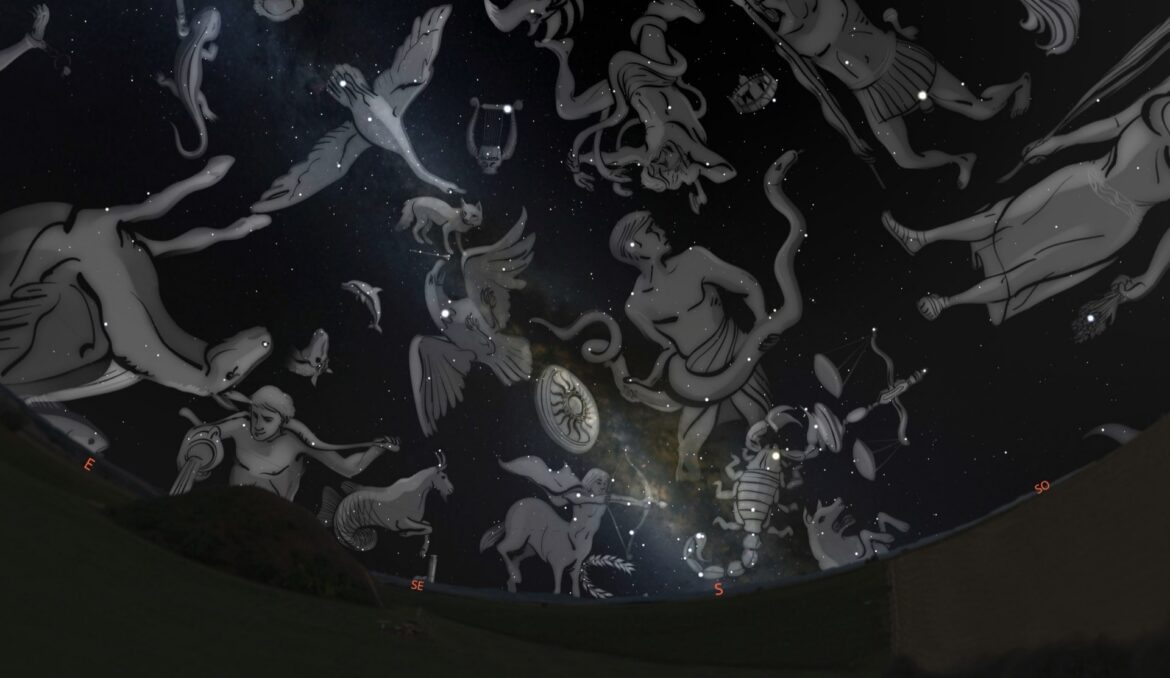
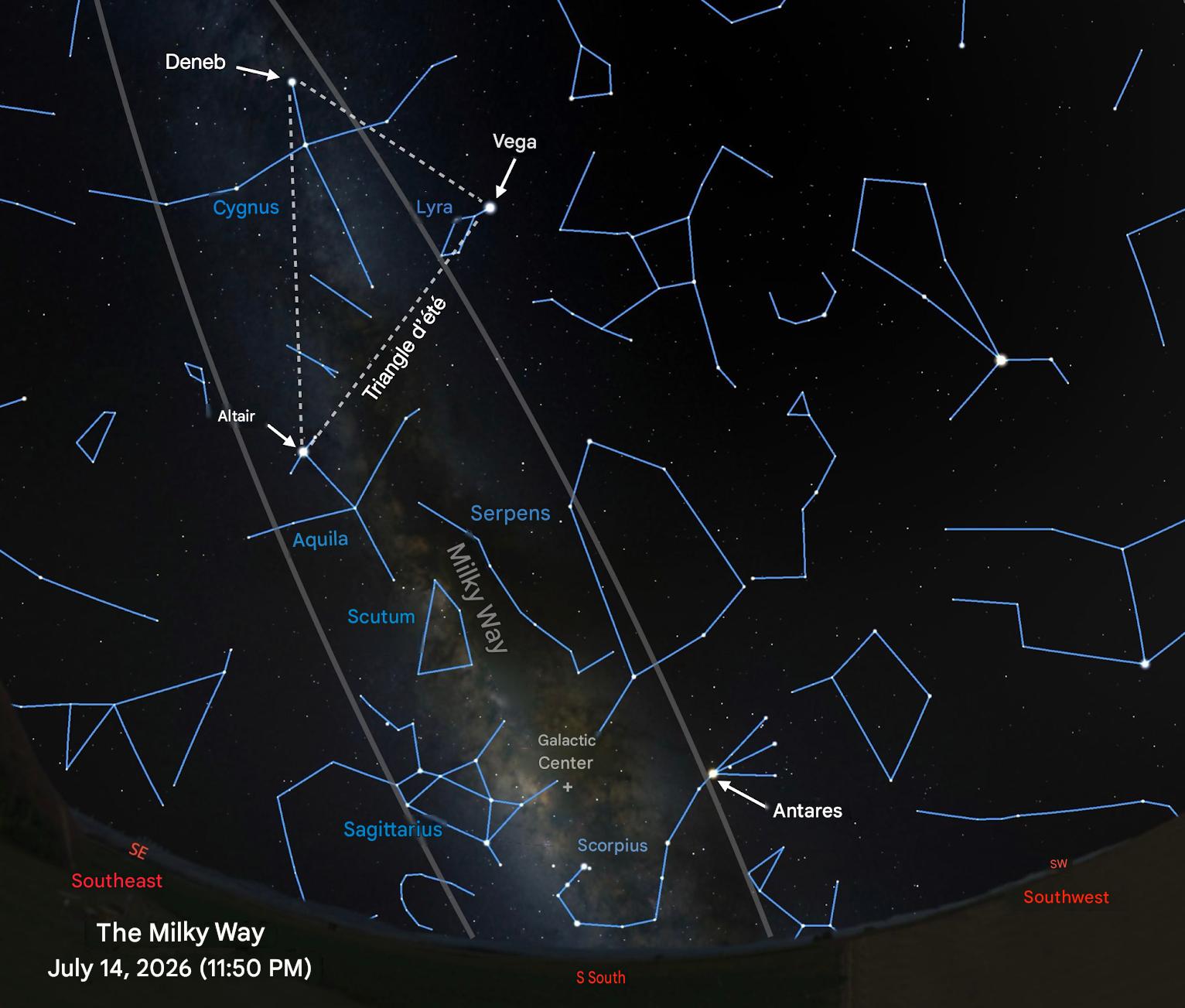
As explained at the beginning of this article, in July, true darkness (the Sun is lower than 18° below the horizon) begins late. This is no reason to miss out on the Milky Way, our galaxy seen edge-on, which is well positioned in the summer sky . This marvel of the night sky is virtually impossible to see in cities due to light pollution . The Moon, with its brightness, can also be a hindrance.

That’s why we’ll take advantage of the New Moon on July 14th . A few days before and after, our natural satellite will spare us its glare, and the nights will be ideal for observing the Milky Way with the naked eye .
It’s essential, of course, to get away from urban centers to avoid light pollution and ensure a clear horizon . If you’re on a terrace, remember to turn off the outdoor lights. Also, avoid using your smartphone, as its bright screen prevents your eyes from adapting to the night sky (allow about 10 to 15 minutes). You’ll then notice a grayish band to the south (wider near the horizon) rising into the heavens: you’re looking at the Milky Way , our own galaxy seen edge-on and from within. Binoculars will reveal that this milky band is actually teeming with stars—those of our galaxy. There are between 200 and 400 billion of them, of which we only perceive a tiny fraction… Our Milky Way is a modest barred spiral galaxy. Its diameter is estimated at 120,000 light-years. This brings to mind a famous Voyager 1 photograph and the caption ” a pale blue dot .” And if you look toward the galactic center, you’re in the vicinity of the recent and spectacular image from the Euclid space telescope .

It is also an opportunity to spot the Summer Triangle, made up of three bright stars of summer nights: Vega, Deneb and Altair . They are respectively the brightest stars in the constellations of Lyra, Cygnus and Aquila.

Above the southern horizon, the constellation Scorpius, with its bright star Antares, will be your starting point. The Milky Way will be that grayish band that continues through Sagittarius (which some find resembling a teapot), Scutum, Aquila (with the bright star Altair), and then Cygnus (home to Deneb). A little further out, note the bright star Vega. Together with Altair and Deneb, it forms what is known as the Summer Triangle.
© Cité de l’espace/Stellarium

THE MOON AND VENUS

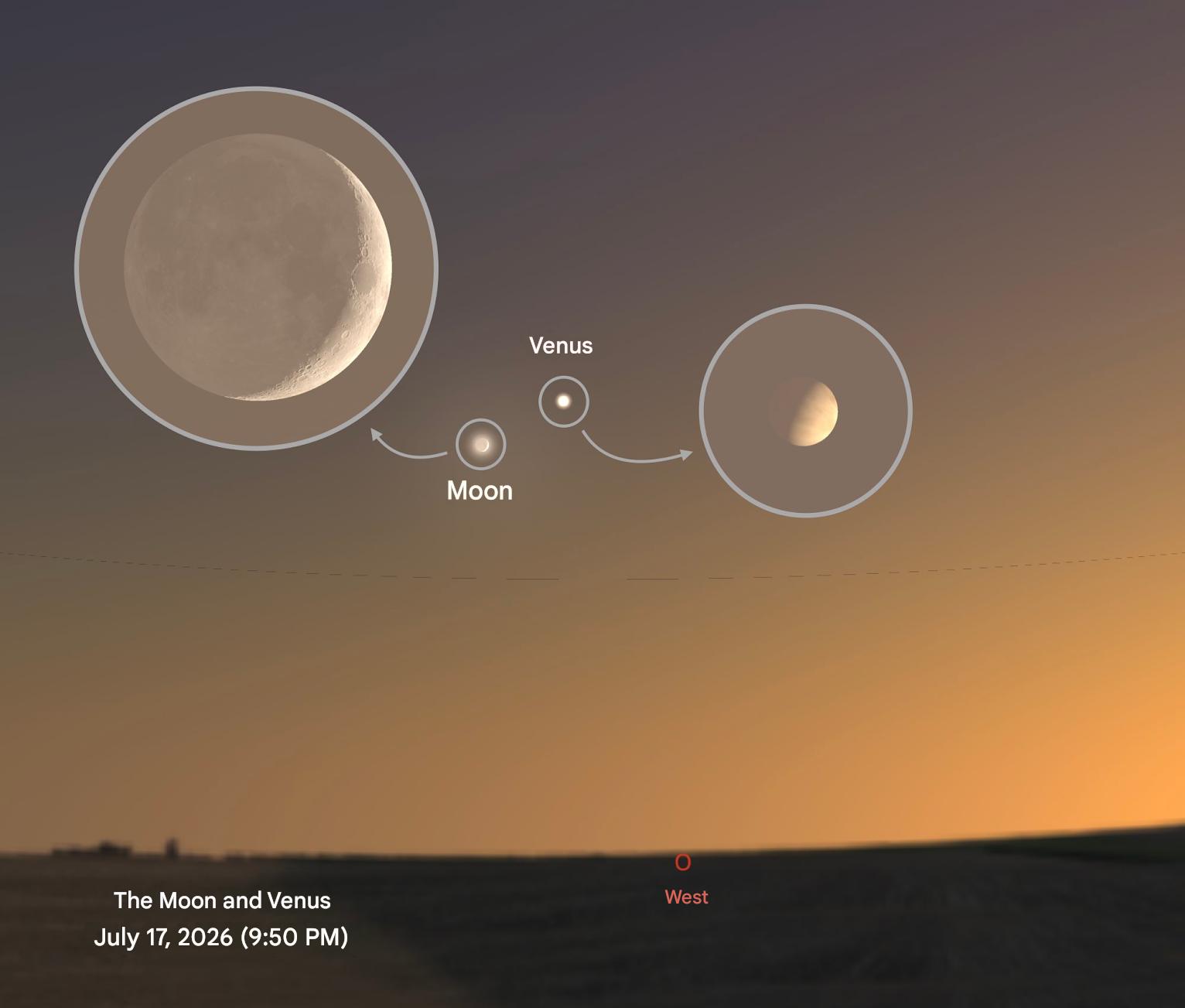
On July 17th, the Moon and Venus will meet in the twilight glow in the west . To be on the safe side, and to protect your eyes, wait until after sunset (9:32 PM in Toulouse). However, the brightness of the sunset might be a hindrance. From 9:50 PM onwards, you can try to spot a crescent Moon and its earthshine 16° above the western horizon . A little higher (18°) and to the right, the bright light of Venus should eventually become more prominent .
The longer you wait, the more evident the pair will be in a less clear sky, but they will also get closer to the horizon. Thus, at 11 PM, the Moon will be only 4° above the horizon.

About twenty minutes after sunset, look out in the West for a pair of Moon and Venus.

© Cité de l’espace/Stellarium

Related articles